Field notes
Types of Crabs to Eat in the US: A Complete Guide
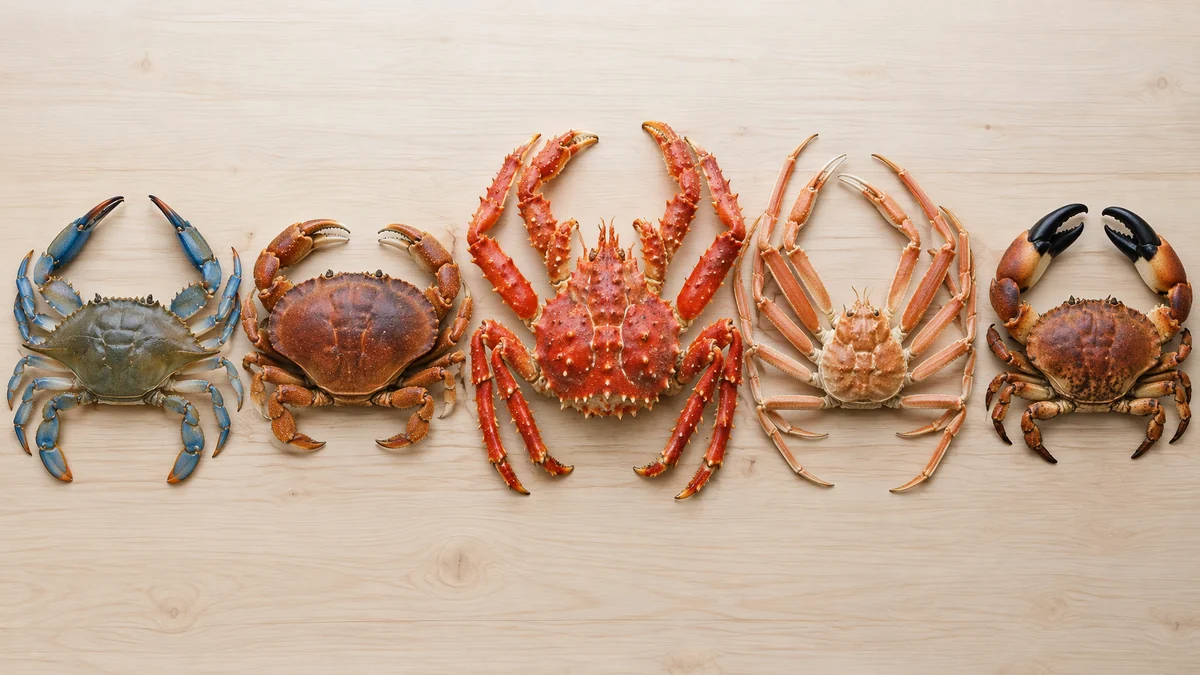
The types of crabs eaten in the US run from a Chesapeake blue crab the size of your palm to an Alaska king crab with a five-foot leg span, and they are caught in very different ways. This guide covers nine crabs taken in US waters, one European species included only for comparison, and the horseshoe crab, which is not a true crab. For each one you get the scientific name, where it lives, which parts are eaten, when it can be caught, how big it gets and the gear used. Where a source gives no figure, the field is marked as not documented rather than filled from general knowledge.
For the how-to side of crabbing, see crab trap basics and the crabbing and shrimping regulations overview.
Blue Crab (Callinectes sapidus)
The blue crab's accepted name is Callinectes sapidus Rathbun, 1896 . It lives along the Atlantic coast of the Americas from Nova Scotia to Argentina, including the Gulf of Mexico, and Chesapeake Bay is its most valuable fishery; the blue crab is Maryland's state crustacean .
Meat comes from the claws, legs and body . A whole crab weighs about one-third of a pound, and the edible share is far below that; the largest Chesapeake record is 1.1 lb with a shell 10.72 inches across . Seasons differ by state: Maryland's recreational season runs April 1 to December 15, some Virginia gears are open year-round on a limited schedule, the Potomac River runs April 1 to November 30, and commercial seasons are set by each state . Shells can reach about 9 inches tip to tip, though most crabs are taken before they get there . Gear includes crab pots, trotlines, handlines, dip nets and scrapes .
Species profile and tactics: blue crab, how to catch blue crabs.
Dungeness Crab (Metacarcinus magister)
Metacarcinus magister (Dana, 1852) is the accepted name, and the older combination Cancer magister still appears in print . The range runs from the Aleutian Islands to Magdalena Bay in Mexico, with Alaska's commercial grounds off Kodiak Island and in Southeast Alaska; the crab lives in bays, estuaries and nearshore water .
Edible parts are the claws, legs and body, and a legal-size Alaska male weighs about 2 lb . The Washington coastal season runs December 1 to September 15, though the actual length is adjusted for meat quality and domoic acid; Alaska seasons are set by area and the specific months are not documented in the sources . Alaska's legal minimum is 6.5 inches notch to notch, measured across the shell shoulder, and large males can exceed 10 inches . Gear is the crab pot and the ring net, and the Washington coastal commercial fishery allows pots only, at 13 cubic feet or less per pot .
More: Dungeness crab, how to catch Dungeness crab.
Stone Crab (Menippe mercenaria)
Menippe mercenaria (Say, 1818) is the stone crab . It is fished mainly in nearshore Florida water on both the Gulf and Atlantic sides, with gear usually set in 65 feet or less; outside that area very little stone crab is taken . About 99 percent of US stone crab claws come from Florida .
Only the claws are eaten . It is a claw-only fishery: the claws are removed and the live crab goes back in the water, and a claw takes about two years to grow back to legal size . Commercial and recreational seasons both run October 15 to May 15 . A minimum size is not documented in the sources . Gear is the baited trap or pot, often set in double rows 100 to 300 feet apart .
Red King Crab (Paralithodes camtschaticus)
Paralithodes camtschaticus (Tilesius, 1815) is the red king crab . In North America it is found in the Bering Sea, the Aleutian Islands and along the Gulf of Alaska south to British Columbia; the US manages four stocks — Bristol Bay, the Pribilof Islands, Norton Sound and the Western Aleutian Islands .
Edible parts are the legs, claws and body meat, with leg and claw meat dominating the market . Crabs can be taken year-round but are mostly caught from October to January, inside a fishing year that runs July 1 to June 30 . The crab can reach 24 lb with a 5-foot leg span; a carapace width in inches is not documented in the sources . Gear is the crab pot, a mesh-covered frame of 7 to 8 square feet .
Species profile and tactics: red king crab, how to catch red king crab.
Snow Crab (Chionoecetes opilio)
Chionoecetes opilio (Fabricius, 1788) is the snow crab . It lives in the Bering, Beaufort and Chukchi seas off Alaska, on sandy and muddy bottom usually shallower than 650 feet .
The legs, claws and body are eaten, mostly as leg meat . The eastern Bering Sea fishery usually runs January to April and crab is available year-round; the fishing year runs July 1 to June 30, and the 2022 and 2023 seasons were closed because of low stock . Males reach about 6 inches across the carapace and females rarely exceed 3 inches . Gear is the crab pot, baited with chopped herring, mackerel or squid .
More: snow crab, how to catch snow crab.
Tanner Crab (Chionoecetes bairdi)
Chionoecetes bairdi Rathbun, 1924 is the Tanner crab . Its range runs from Southeast Alaska north to the Bering Sea and it supports an important local fishery; it is in the same genus as the snow crab and the two hybridize naturally .
Legs, claws and body are eaten . Seasons are set by year and area and the specific months are not documented in the sources; the fishery sits under the Bering Sea and Aleutian Islands king and Tanner crab management plan . Carapace width in inches is not documented in the sources, but the state lists commercial-size males at 2 to 4 lb, against 1 to 2 lb for Chionoecetes opilio . Gear is the crab pot used across the Alaska king and Tanner crab fisheries; gear details specific to bairdi are not documented in the sources .
Jonah Crab (Cancer borealis)
Cancer borealis Stimpson, 1859 is the Jonah crab . It ranges through the northwest Atlantic from Canada to Florida; the US commercial fishery runs from Maine to Virginia, and most of the landings come from the outer continental shelf south of Massachusetts and Rhode Island .
The claws, legs and body are eaten . The crab can be taken year-round, but area closures apply to gear from February 1 to March 31 and April 30 to May 31 . Females reach 6 inches and males 9 inches, and the legal minimum is 4.75 inches measured straight across . Gear is the trap, built to the same specification and fished in the same areas as American lobster traps .
Rock Crab (Cancer irroratus)
Cancer irroratus Say, 1817 is the Atlantic rock crab . It is a northwest Atlantic species whose records come mainly from the US and Canada, and the Alaska department lists it as a commercially fished close relative of the Dungeness crab .
The claws, legs and body follow the general crab pattern, though the sources do not list edible parts for this species individually . Season, size and gear are not documented in the sources. West Coast anglers also use "rock crab" for a different animal sold under that name, so Atlantic and Pacific rock crabs should not be treated as the same species.
Golden King Crab (Lithodes aequispinus)
Lithodes aequispinus Benedict, 1895 is the golden king crab . It ranges from British Columbia to the Aleutians and Japan, with Alaskan concentrations in the Aleutians, the Pribilof and Shumagin islands, Shelikof Strait, Prince William Sound and, in the southeast, Chatham Strait; it lives at depths often beyond 300 fathoms, about 1,800 feet .
Legs, claws and body are eaten, and of the three Alaska king crabs it has the lowest meat fill and the mildest flavor . Specific season months are not documented in the sources; Alaska runs an annual commercial season under the king and Tanner crab plan . Carapace width in inches is not documented, but average weight is 5 to 8 lb, less than the red and blue king crabs . Gear is not documented for this species in the sources, though the Alaska king crab fisheries use pots .
Brown Crab (Cancer pagurus) — Not a US Species
Cancer pagurus Linnaeus, 1758 is included here only as a comparison species, because it is not part of the US fishery . It is a northeast Atlantic species, with records concentrated in the UK, the Netherlands, Germany, Denmark, Ireland and France; it has no natural distribution in US waters and is not part of the US fishery .
Edible parts are the claws, legs and body, with claw meat leading in the UK market, though the sources do not describe edible parts for this species separately . Season, size and gear are not documented in the sources.
Horseshoe Crab (Limulus polyphemus) — Not a True Crab
Despite the name, the horseshoe crab is not a true crab. It belongs to the arthropod subphylum Chelicerata, which makes it a closer relative of spiders, ticks and scorpions, and its lineage goes back roughly 445 million years. That distinction matters in any list of crab species.
Limulus polyphemus (Linnaeus, 1758) is the species . It ranges along the Atlantic coast from northern Maine to the Yucatan Peninsula and the Gulf of Mexico, and Delaware Bay holds the world's largest spawning population .
It is not eaten; its commercial uses are bait for the American eel and whelk fisheries and medicine, where blood is drawn to make the LAL reagent used to test vaccines and drugs for sterility . A harvest season is not documented in the sources, though spawning runs in May and June on the new and full moon high tides . Size and gear are not documented in the sources.
FAQ
Is a king crab the same as a snow crab? No. The red king crab is Paralithodes camtschaticus, a much larger animal that can reach 24 lb with a 5-foot leg span, while the snow crab is Chionoecetes opilio, with males reaching about 6 inches across the carapace.
Why is stone crab sold only as claws? Because it is a claw-only fishery: the claws are taken and the live crab is released, and a claw needs about two years to regrow to legal size .
Can you eat a horseshoe crab? No. The horseshoe crab is not eaten; it is harvested for bait and for the medical reagent made from its blood .
What is the difference between Dungeness and Jonah crab? The Dungeness lives from the Aleutians to Mexico and has a 6.5-inch Alaska minimum notch to notch, while the Jonah crab is an Atlantic species with a 4.75-inch minimum measured straight across.
About the author and how this was tested
About the author
FishermanGuy
Bank, boat and kayak angler · fishing, crabbing and shrimping since 2021
I buy the gear, fish it for a season and write down what failed. No sponsored verdicts, no free-sample flattery. Every rig on this page has landed fish in water I can point at on a map.
How this was tested
- Every rig gets at least six trips on the same water before it is published.
- Gear is bought at retail. Free samples are labelled in the first paragraph.
- Dates show first publication and the last time the page was updated.