Field notes
Dungeness Crab: Identification, Habitat & Diet
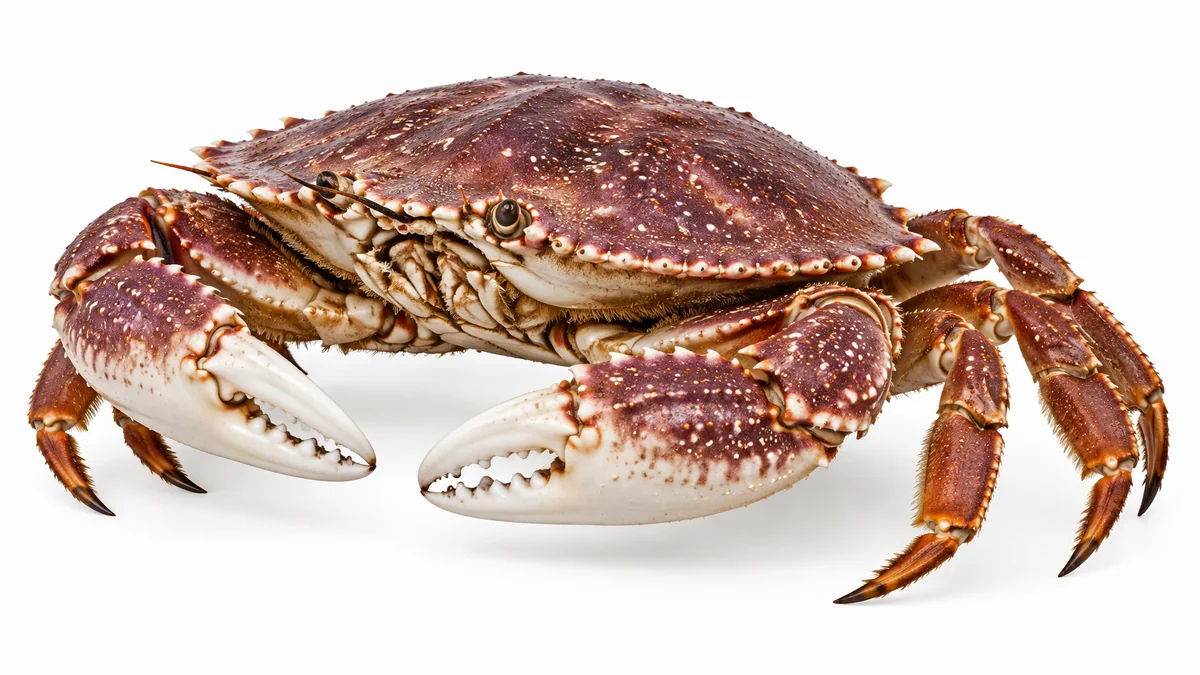
Dungeness Crab: Identification, Habitat & Diet
The Dungeness crab (Metacarcinus magister, long listed as Cancer magister) is the great eating crab of the North American Pacific coast, from Alaska down to central California. Sweet, delicate flesh, a broad purple-brown shell, and white-tipped claws make it easy to recognise, while a strict male-only, hard-shell, minimum-size system makes it one of the best-managed crab fisheries anywhere. This profile covers Dungeness crab identification, habitat, diet, size, the carapace-width rules, and how to catch and cook one.
Quick ID Card
| Field | Details |
|---|---|
| Scientific name | Metacarcinus magister (formerly Cancer magister) |
| Common names | Dungeness crab, Pacific crab, market crab |
| Family | Cancridae (rock crabs) |
| Typical size | 6–10 inches (15–25 cm) carapace width |
| Maximum size | To about 9 inches (23 cm) and 4 lb (1.8 kg) or more |
| Water type | Coastal salt water, sandy and muddy bottom, estuaries |
| Depth range | Intertidal to about 750 ft (230 m); usually 10–300 ft |
| Active water temperature | Roughly 45–60°F (7–15°C) |
| Difficulty | Easy to catch with pots; rules are strict |
| Best season | Late autumn through spring, varying by state |
How to Identify a Dungeness Crab
Dungeness crab identification is straightforward once you know the three signature marks. First, the carapace is broad and oval, wider than it is long, and coloured brown to purple-brown, sometimes with a reddish tinge. Second, the claws are tipped with white or very pale cream — a clean white tip is the classic field mark. Third, the legs are relatively short and stout compared with a spider or king crab.
The front of the carapace carries a serrated edge with a row of teeth, and there is a pale, almost white underside on the belly. Adults reach sexual maturity at different sizes for each sex, and males grow larger than females. A legal male is measured across the widest part of the carapace, from the tip of one side spine to the other, using a crab gauge; the measurement is not the length of the shell.
One easy check on the water: females have a broad, rounded abdomen flap, while mature males have a narrow, pointed flap tucked tight to the body. Dungeness are also hard-shell crabs at legal size, so a legal fish feels solid, not papery — a soft-shell crab is one that has recently moulted and should go back.
Dungeness Crab vs Blue Crab and Other Lookalikes
Anglers moving between coasts often ask about dungeness crab vs blue crab. The blue crab (Callinectes sapidus) is an Atlantic and Gulf species with bright blue claws, a greenish shell, and a pair of long spines on each side of the carapace. A Dungeness has no blue, no long side spines, and white-tipped claws. The two also live on opposite coasts, which settles it.
On the West Coast, the main confusion is with rock crabs. The red rock crab (Cancer productus) is brick-red with black-tipped claws and a more heavily toothed shell; it is legal to keep in most states but is smaller and less meaty. The yellow rock crab and slender crab are also present. Dungeness remains the prize because of its size and the volume of sweet meat in the body and legs.
Is the Dungeness Crab Dangerous?
The Dungeness crab is not venomous, but a big male can deliver a hard, painful pinch with those white-tipped claws. Handle crabs from the back, gripping the rear of the carapace between thumb and fingers, and keep fingers away from the claws. A thick glove helps, and so does chilling crabs before handling.
The real public-health risk is what the crab has eaten. Dungeness crabs can accumulate domoic acid, a toxin produced by certain marine algae, which causes amnesic shellfish poisoning in people. State agencies monitor crab meat and close or delay seasons when domoic acid exceeds safe limits — this is a major reason West Coast crab seasons sometimes open late. Paralytic shellfish poisoning (PSP) is monitored in the same way.
Because of these toxins, always cook crab thoroughly, and never eat the viscera (the "butter" and guts) where toxins concentrate. Follow state health advisories and season openings, which are set with testing in mind. The crab itself does not produce the poison; it accumulates it from the food chain, so a closed season is a safety measure, not a sign of a bad crab.
Where Do Dungeness Crabs Live?
Where do dungeness crabs live? Along the Pacific coast of North America, from the Aleutian Islands and the Gulf of Alaska south through British Columbia, Washington, Oregon, and California to about Point Conception. They favour sandy and muddy bottom, eelgrass beds, and the edges of estuaries, and they range from the intertidal zone out to about 750 feet, though most fishing happens in 10 to 300 feet.
Juveniles use shallow, nearshore water and estuaries as nursery habitat, where they are vulnerable to predators and to warm water. Adults move into deeper water and migrate inshore and offshore with the seasons and with moulting. In many areas, big males move into shallower water in late winter and spring before the moult, which is why late winter and spring can be prime time.
Water temperature keeps the species on the cool end of the spectrum, roughly 45 to 60°F. Dungeness are found where cold, productive coastal water supports the clams, mussels, and small crabs they eat, and their range maps closely to the cold California Current system.
Habits and Diet: What Do Dungeness Crabs Eat?
What do dungeness crabs eat? They are both predators and scavengers. Clams, mussels, oysters, small crabs, shrimp, worms, and small fish are all on the menu, along with carrion. A Dungeness will crush a clam with its claws and pick out the meat, and it will happily clean up a fish carcass on the bottom.
They are most active at night and around the tides, moving across sand and eelgrass to feed. Growth happens by moulting: a crab sheds its old shell and expands into a new, soft one that hardens over weeks. Moulting is when crabs are most vulnerable, and it is why recreational rules require hard-shell crabs — a soft-shell crab has little meat and is recovering from the shed.
Mating happens around the female's moult. The male attaches to the female before she sheds, then fertilises her eggs. Females carry the fertilised eggs under the abdomen for several months before the larvae hatch and drift offshore as plankton. Those larvae return to the coast as juveniles and settle in shallow nursery habitat, completing a life cycle that ties the species to productive, cold coastal water.
Size, Limits and Regulations
How big do dungeness crabs get? Legal adults run about 6 to 10 inches across the carapace, and a big male can reach 9 inches and around 4 pounds. The species grows to 15–25 cm carapace width, typically 0.5–1.5 kg, with large males over 2 kg. Lifespan is roughly 8 to 13 years.
The dungeness crab size limit is the most important rule, and it varies by state. As of 2025, Washington (WDFW) and Oregon (ODFW) use a 6.25-inch (159 mm) minimum carapace width, measured hard-shell, male only. California (CDFW) uses 5.75 inches (146 mm) carapace width for recreational take. Alaska (ADF&G) uses a 6.5-inch (165 mm) minimum for recreational Dungeness. Always measure with a crab gauge across the widest part of the shell, and always release females and soft-shell crabs.
Every West Coast state requires a licence to take Dungeness crab recreationally, and several require a catch record card to log your catch. Gear rules matter too: pots and ring nets must be marked with the owner's buoy and identification, and there are limits on the number of pots per person and soak times. Seasons open and close by area and by state, and they can be delayed for domoic acid testing, whale-entanglement risk, or stock assessments.
As of 2025, check the current rules before you go. Use WDFW for Washington, ODFW for Oregon, CDFW for California, and ADF&G for Alaska. Seasons, size limits, pot rules, and reporting requirements change year to year and by region, so the state website is the final word. Last verified: November 2025.
How to catch dungeness crab: set a crab pot or ring net on sandy or muddy bottom in 20 to 100 feet, bait it with fish carcasses or chicken, and let it soak for a tide or a few hours. Pull the pot, measure every crab across the carapace, keep only legal hard-shell males, and return everything else promptly. Pots work best on a slack tide, and a pot with fresh bait and good scent trails will out-fish a poorly baited one.
FAQ
How big do Dungeness crabs get? Legal adults are 6–10 inches across the carapace. Large males reach about 9 inches and 4 pounds, and very big ones exceed 2 kg.
What is the Dungeness crab size limit? Washington and Oregon use 6.25 inches (159 mm) carapace width; California uses 5.75 inches (146 mm); Alaska uses 6.5 inches (165 mm), as of 2025.
When is Dungeness crab season? It varies by state and area, generally late autumn through spring. Seasons can be delayed for domoic acid testing or whale-entanglement rules — check your state agency.
Where do Dungeness crabs live? Along the Pacific coast from Alaska to central California, on sandy and muddy bottom and in estuaries, from the intertidal zone to about 750 feet.
Dungeness crab vs blue crab: what is the difference? Blue crabs are Atlantic/Gulf crabs with blue claws and long side spines. Dungeness have white-tipped claws, an oval purple-brown shell, and no blue — and they live on the West Coast.
What do Dungeness crabs eat? Clams, mussels, small crabs, shrimp, worms, and small fish, plus carrion. They are predators and scavengers.
How do you catch Dungeness crab? Set a baited pot or ring net on sandy bottom in 20–100 feet, soak it a tide, and keep only legal hard-shell males measured with a gauge.
How to cook Dungeness crab? Boil or steam whole crabs for about 15–20 minutes until the shell turns bright orange-red, then clean and serve. Cook thoroughly and skip the viscera.
Related Articles
- Red King Crab — the giant Alaska crab with its own size and season rules.
- Snow Crab — a cold-water leg crab from the North Pacific and Atlantic.
- Brown Crab — Europe's big edible crab, a cousin in spirit and in the pot.
- Plaice — a flatfish from the same cold coastal water.
- Atlantic Cod — another cold-water species shaped by strict management.
- All species profiles
The Dungeness crab is a Pacific coast treasure: sweet meat, a handsome purple-brown shell, and a fishery built on male-only, hard-shell, minimum-size rules. Learn the white-tipped claws and the oval carapace, measure every crab with a gauge, release the females, and cook it thoroughly. Follow the state season and toxin advisories, and this cold-water crab will reward you with some of the best eating on either coast.
Ready to catch one? Read our step-by-step guide: How to Catch Dungeness Crab.
About the author and how this was tested
About the author
FishermanGuy
Bank, boat and kayak angler · fishing, crabbing and shrimping since 2021
I buy the gear, fish it for a season and write down what failed. No sponsored verdicts, no free-sample flattery. Every rig on this page has landed fish in water I can point at on a map.
How this was tested
- Every rig gets at least six trips on the same water before it is published.
- Gear is bought at retail. Free samples are labelled in the first paragraph.
- Dates show first publication and the last time the page was updated.