Field notes
Brown Crab: Identification, Habitat & Diet
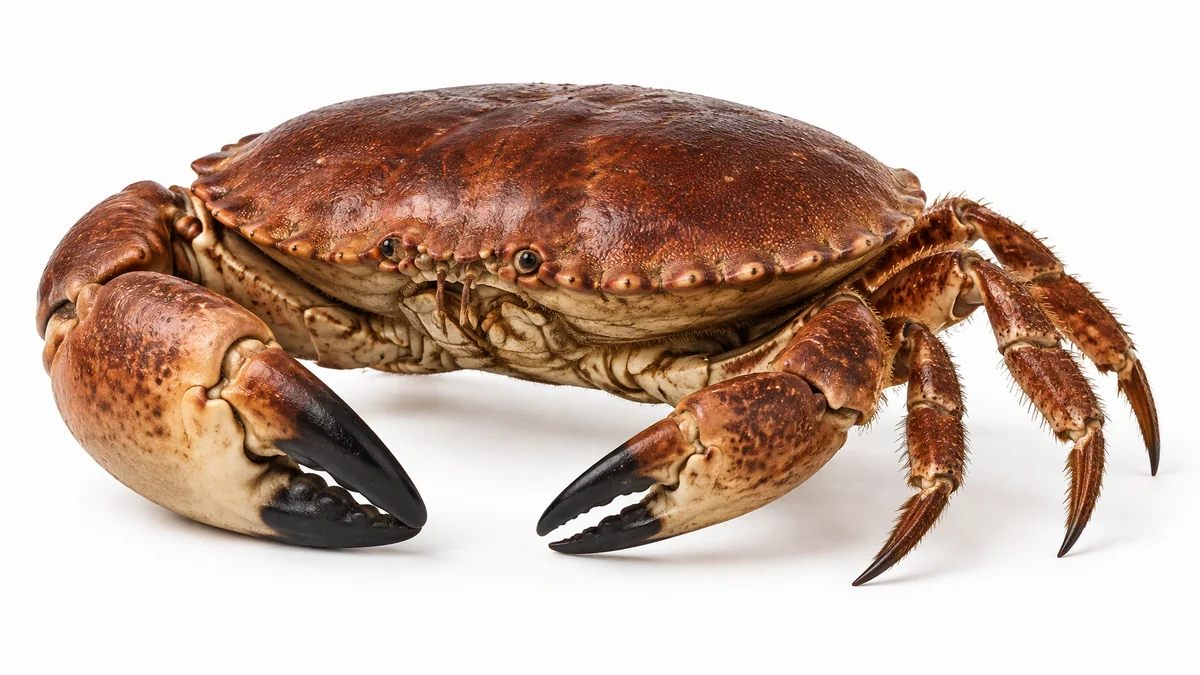
Brown Crab: Identification, Habitat & Diet
The brown crab (Cancer pagurus), also called the edible crab, is the heavyweight of European crab fishing — a thick-shelled, heavy-clawed animal that supplies dressed crab, crab sandwiches, and crab bisque across the UK and the rest of Europe. It is a true crab of the family Cancridae, a close cousin of the American Dungeness, and one of the most valuable inshore species in British waters. This profile covers brown crab identification, habitat, diet, size, the UK carapace-width rules, berried hens, how it differs from spider crab, and how to cook it.
Quick ID Card
| Field | Details |
|---|---|
| Scientific name | Cancer pagurus |
| Common names | Brown crab, edible crab, brown crab (UK), tourteau (France) |
| Family | Cancridae (rock crabs) |
| Typical size | 5–9 inches (13–23 cm) carapace width |
| Maximum size | To about 10 inches (25 cm) and 5 kg (11 lb) or more |
| Water type | Coastal salt water, rocky and sandy bottom, North Sea |
| Depth range | About 15–650 ft (5–200 m) |
| Active water temperature | Roughly 45–63°F (7–17°C) |
| Difficulty | Pot fishery; recreational rules vary by area |
| Best season | Year-round; peak late spring to autumn |
How to Identify a Brown Crab
Brown crab identification is about the shell. The carapace is thick, heavy, and oval — often described as pie-crust shaped — with a smooth, rounded front edge carrying nine rounded lobes between the eyes and the sides. The colour runs from reddish-brown to dark brown, sometimes almost black on older crabs, with a paler underside.
The claws are the second mark. Both claws are heavy and black-tipped, but one is a broad, blunt "crusher" and the other a slimmer "cutter." That asymmetry is normal, and the crusher is powerful enough to break a whelk shell — or a finger. The legs are relatively short and stout compared with a spider crab, and the whole animal feels dense and weighty for its size.
Females have a broad, rounded abdomen flap; mature males have a narrow, pointed one. A berried hen — a female carrying a sponge of eggs under the abdomen — is obvious and, in the UK, must be returned. A soft-shell crab that has just moulted should go back too: the shell is papery and the crab is recovering.
Brown Crab vs Spider Crab and Other Relatives
Brown crab vs spider crab is the comparison every UK rock-pooler and potter needs. The spider crab (Maja squinado) has a pear-shaped, spiny carapace and very long legs, giving it a spidery, leggy look; its body is smaller and carries less meat, and it is prized more for the legs. A brown crab has a heavy oval shell, short stout legs, and large crusher claws, with far more meat in the body and claws. The two are sometimes confused by beginners, but the heavy oval shell and big black-tipped claws settle it.
Among its own family, the brown crab is the European counterpart of the Dungeness crab of the North American Pacific. Both are Cancridae, both are heavy-shelled and pot-caught, and both are managed with male-only, minimum-size rules. The velvet swimming crab (Necora puber) is smaller, blue-tinged, and aggressive, and is not a substitute.
Is the Brown Crab Dangerous?
The brown crab is not venomous, but it is one of the more painful crabs to handle. The crusher claw can deliver a crushing pinch, and the shell edges are hard and sharp. Hold the crab from behind, gripping the rear of the carapace, and keep fingers well clear of the claws; a thick glove and a chilled crab make handling safer.
On the plate, the main health note concerns the brown meat — the soft, dark hepatopancreas inside the shell, as opposed to the white claw and leg meat. Brown meat can accumulate cadmium, a heavy metal, and UK food advice suggests that regular eaters, and especially vulnerable groups, limit how much brown meat they eat. White meat does not carry the same concern. As always, cook crab thoroughly and keep it cold.
Brown crab lives in cold, coastal water and is not associated with ciguatera, the warm-water reef-fish toxin. It is also not a red-tide shellfish concern in the way some shallow-water bivalves are. The practical risks are the claws and ordinary seafood hygiene.
Where Do Brown Crabs Live?
Where do brown crabs live? Along the northeast Atlantic coast, from Norway and the British Isles south through France, Spain, and Portugal to Morocco, plus the Mediterranean. The North Sea is the largest single production area, and the species is central to UK, Irish, French, and Norwegian fisheries.
Brown crab habitat is coastal and moderately deep: roughly 15 to 650 feet over rocky, sandy, and mixed bottom. They shelter in rocky crevices and under ledges by day and move out to feed, and they favour areas with plenty of molluscs and other prey. The species tolerates a range of temperatures but is most active in the cool-to-temperate band of roughly 7 to 17°C.
Females migrate to spawn, moving to deeper or offshore water and then carrying their eggs for months before the larvae hatch. That migration and the long brooding period are why berried hens are protected and why the fishery focuses on males and non-breeding crabs.
Habits and Diet: What Do Brown Crabs Eat?
What do brown crabs eat? Mostly molluscs and other bottom animals: whelks, mussels, cockles, oysters, sea urchins, worms, and smaller crabs, plus carrion. The heavy crusher claw is built for cracking shells, and a brown crab will methodically break open a whelk or mussel to get at the meat. They are largely nocturnal and use smell and touch to find food.
Growth is by moulting, and a crab may take several years to reach legal size. Moulting leaves the crab soft and vulnerable, so soft-shell crabs are not harvested. Mating happens around the female's moult, and the female then carries the fertilised eggs under her abdomen for many months — the "berried" condition — before the larvae are released to drift as plankton.
Brown crabs are slow-growing and long-lived, with a lifespan that can reach 20 to 30 years. That combination makes them vulnerable to overfishing, which is why minimum sizes, protection for berried hens, and pot limits matter so much in European waters.
Size, Limits and Regulations
How big do brown crabs get? Legal adults are commonly 13 to 23 cm across the carapace, and big males can reach about 25 cm and 5 kg or more. The species has a thick, heavy build, so a legal crab feels substantial in the hand. Lifespan can reach 20 to 30 years.
The brown crab size limit in England is 140 mm carapace width, and it is measured across the widest part of the shell. Rules differ around the UK: Scotland, Wales, and the various Inshore Fisheries and Conservation Authority (IFCA) districts can set their own minimum sizes and byelaws, and some areas protect females entirely. Across Europe, each country sets its own minimum landing size.
Berried hens — females carrying eggs — must be returned alive in UK waters, and many areas also restrict the taking of all females. This protects the spawning stock and is one of the cornerstones of the fishery. Pot and trap rules, tagging, and effort limits apply, and recreational potters must check the local byelaws, which can require a permit.
The brown crab season in the UK runs all year, though landings and quality peak from late spring through autumn. Berried hens are most common in winter and early spring, so those months see more females returned. Local weather and market demand shape the practical season more than a hard open-and-close date.
As of 2025, check the current rules before you fish or buy. In England the Marine Management Organisation (MMO) and the IFCAs publish minimum sizes and byelaws; Marine Scotland and the Welsh Government cover their waters; in Ireland, Bord Iascaigh Mhara (BIM) and the Sea-Fisheries Protection Authority (SFPA) are relevant. Minimum sizes and female-protection rules change by area, so confirm locally. Last verified: November 2025.
How to catch brown crab: set a baited pot or trap on rocky or mixed ground, often in 10 to 50 metres, and haul it after a soak. Bait with fish heads or carcasses. Measure every crab across the carapace, return berried hens and undersized crabs promptly, and follow the local pot and permit rules. Recreational potting is popular around the UK coast but is regulated, so check the byelaws first.
FAQ
How big do brown crabs get? Legal adults are about 13–23 cm across the carapace. Big males reach around 25 cm and 5 kg or more.
What is the brown crab size limit? 140 mm carapace width in England. Scotland, Wales, and local IFCA districts can differ, so check your area.
When is brown crab season in the UK? Year-round, with peak landings and quality from late spring to autumn. Berried hens are returned, so fewer females are landed in winter and spring.
Where do brown crabs live? The northeast Atlantic from Norway to Morocco, plus the Mediterranean, over rocky and sandy bottom in about 15–650 feet, with the North Sea the largest production area.
Brown crab vs spider crab: what is the difference? Brown crab has a heavy oval shell, short stout legs, and big black-tipped crusher claws. Spider crab has a spiny pear-shaped shell and very long legs, with less body meat.
What do brown crabs eat? Whelks, mussels, cockles, oysters, sea urchins, worms, small crabs, and carrion. The crusher claw cracks shells.
How do you catch brown crab? Set a baited pot on rocky or mixed ground in 10–50 m, soak it, and keep only legal males. Return berried hens and undersized crabs, and follow local permit rules.
How do you cook brown crab? Boil or steam for roughly 15–20 minutes per kg until the shell turns orange-red, then cool and pick the white and brown meat. This is the base of most classic brown crab recipe dishes, from dressed crab to crab sandwiches. Eat brown meat in moderation.
Related Articles
- Dungeness Crab — its Cancridae cousin from the North American Pacific.
- Snow Crab — a cold-water Atlantic and Pacific crab sold as leg clusters.
- Red King Crab — the giant king crab of the northern seas.
- European Seabass — an inshore predator from the same UK coastline.
- Turbot — a flatfish from the same rocky, sandy ground.
- All species profiles
The brown crab is Europe's great edible crab: a heavy oval shell, a crushing claw, and a long history on the British table as dressed crab and crab sandwiches. Learn the nine-lobed carapace and the black-tipped claws, respect the 140 mm rule and the protection for berried hens, check your local byelaws, and cook it properly. Fished within the rules, this slow-growing, long-lived crab will keep filling pots and plates around the North Sea for generations.
Ready to catch one? Read our step-by-step guide: How to Catch Brown Crab.
About the author and how this was tested
About the author
FishermanGuy
Bank, boat and kayak angler · fishing, crabbing and shrimping since 2021
I buy the gear, fish it for a season and write down what failed. No sponsored verdicts, no free-sample flattery. Every rig on this page has landed fish in water I can point at on a map.
How this was tested
- Every rig gets at least six trips on the same water before it is published.
- Gear is bought at retail. Free samples are labelled in the first paragraph.
- Dates show first publication and the last time the page was updated.