Field notes
Snow Crab: Identification, Habitat & Diet
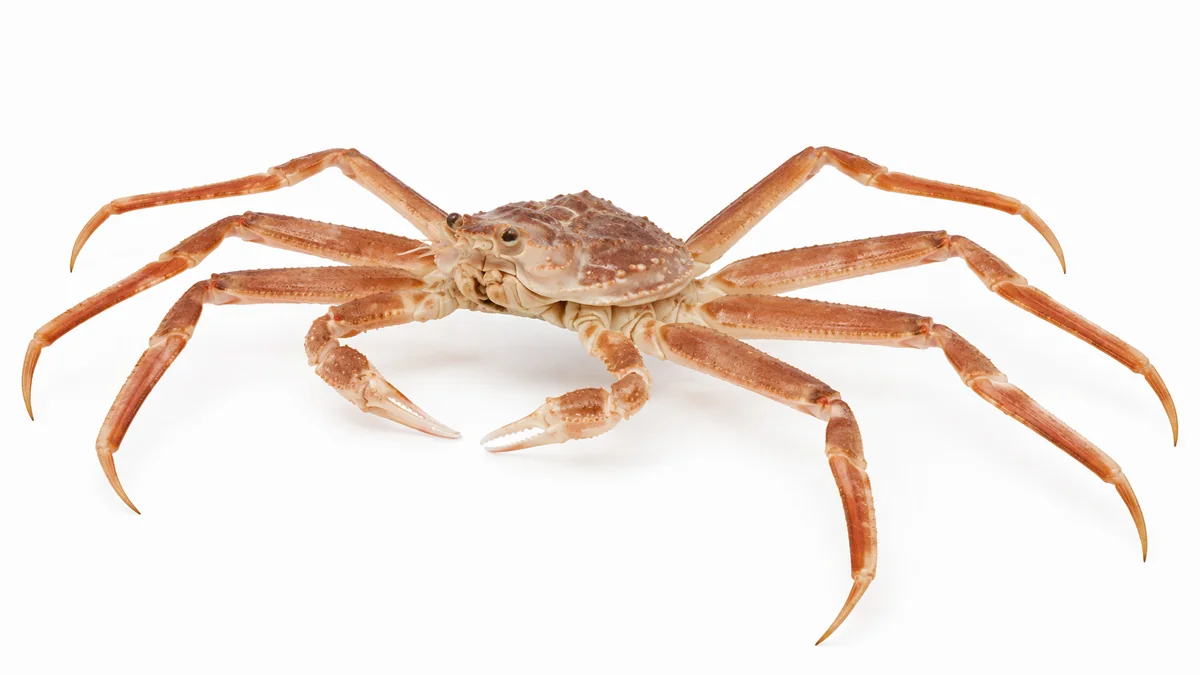
Snow Crab: Identification, Habitat & Diet
The snow crab (Chionoecetes opilio) is the long-legged, cold-water crab behind the clusters of slender legs that fill seafood counters from Alaska to Atlantic Canada. It is much smaller than a king crab but fished in enormous numbers, and its life history — including a final moult that permanently caps a male's growth — makes it one of the most closely studied crustaceans in the world. This profile covers snow crab identification, habitat, diet, size, moulting, the size limits and seasons, price, and how it compares to king crab.
Quick ID Card
| Field | Details |
|---|---|
| Scientific name | Chionoecetes opilio |
| Common names | Snow crab, queen crab, tanner crab (related), opilio |
| Family | Oregoniidae |
| Typical size | Legal males about 3–5.5 inches (78–140 mm) carapace width |
| Maximum size | To about 6 inches (15 cm) carapace width; leg span near 1 m |
| Water type | Deep, cold North Pacific and North Atlantic |
| Depth range | About 65–2,600 ft (20–800 m) |
| Active water temperature | Roughly 30–39°F (−1 to 4°C) |
| Difficulty | Commercial pot fishery; recreational access very limited |
| Best season | Autumn through winter in Alaska; varies by zone in Canada |
How to Identify a Snow Crab
Snow crab identification comes down to shape and proportion. The carapace is round to slightly triangular, flatter than a king crab's, and coloured from pale tan and reddish-brown on top to a lighter underside. The legs are the signature: long, slender, and much longer relative to the body than on a Dungeness, which is why snow crab is sold as leg clusters rather than whole crabs.
The claws are small compared with a king crab's. A mature male has a wider carapace and longer chelipeds (claw arms) than a female, and only males above the legal size are kept. Females carry a broad abdomen and are protected. The species has no bright blue and no white-tipped claws; it is a subdued, mottled crab built for cold, deep water.
Juveniles and females are smaller and harder to sex from a distance, which is one reason the fishery relies on strict size gauges and male-only rules. On the dock, snow crab is graded by shell condition as well as size, and "new-shell" or "white" crabs are the premium product.
Snow Crab vs King Crab and Other Lookalikes
Snow crab vs king crab is the classic menu question. A king crab is far larger, with thick, meaty legs, heavy claws, and a leg span up to 1.5 m; its shell is deep red and heavily spined. A snow crab is smaller, with a flatter body, long thin legs, small claws, and a paler, mottled shell. King crab meat is chunky and rich; snow crab meat is delicate and sweet, and you eat it mostly from the legs.
Among close relatives, the Tanner crab (Chionoecetes bairdi) is the snow crab's larger cousin from the same North Pacific waters and is managed separately. In Europe and Japan, spider crabs occupy a similar niche but belong to different families. The snow crab's combination of a small round body and very long legs separates it from all of them.
Is the Snow Crab Dangerous?
The snow crab has no venom and no poison glands. Its claws are small and its pinch is far less severe than a king crab's, but the shell edges and leg spines are sharp enough to scratch, and a chilled crab should still be handled with care. Cook snow crab thoroughly, and as with any crab, avoid the viscera.
Unlike warm-water reef crabs, snow crab lives in deep, cold water and is not associated with ciguatera. It is also not a red-tide shellfish concern in the way that some shallow-water species are, because it lives deep and is fished and processed under cold-chain rules. The main safety issues are ordinary food handling: keep it cold, cook it properly, and buy from a reputable supplier.
For anglers and deckhands, the real hazard is the environment. Snow crab is fished in the Bering Sea and the North Atlantic in winter, on icy decks in heavy weather. Cold-water immersion and deck injuries are the genuine risks, which is why the commercial fishery is treated as dangerous work.
Where Do Snow Crabs Live?
Where do snow crabs live? Across the cold North Pacific and North Atlantic. In the Pacific they range through the Bering Sea, the Sea of Okhotsk, and northern Japanese waters. In the Atlantic they occur off Greenland, around Iceland, and along the east coast of Canada — the Gulf of St. Lawrence, Newfoundland, and the Scotian Shelf — and in the Barents Sea.
Snow crab habitat is deep and cold: roughly 65 to 2,600 feet, with the densest commercial concentrations in a few hundred feet, at water temperatures near or just below freezing to about 4°C. They prefer soft mud and mixed bottom and tolerate very cold water that most crabs avoid. The species is built for a life in the dark and the cold, and its range tracks the cold-water masses of the northern oceans.
The Bering Sea and Atlantic Canada are the great production centres. Stock levels swing with ocean temperature and recruitment, and the Bering Sea stock in particular suffered a sharp collapse that led to the unprecedented closure of the Alaska snow crab season in 2022, a reminder of how quickly a cold-water crab population can turn.
Habits and Diet: What Do Snow Crabs Eat?
What do snow crabs eat? A bottom-based diet of invertebrates and small fish: brittle stars, shrimp, clams, worms, small crabs, and fish, plus carrion. They are opportunistic predators and scavengers, and they will gather around food on the mud. Their small claws suit picking and tearing rather than heavy crushing.
Snow crabs are slow-growing and cold-adapted. Females moult and mate, then carry their eggs under the abdomen for many months in the near-freezing water. Larvae drift as plankton before settling to the bottom. Growth is by moulting, and the timing and number of moults are central to how the fishery is managed.
When do snow crabs molt? Moulting happens mainly in summer and autumn, tied to water temperature and to the crab's life stage. The key fact is the terminal moult: mature male snow crabs undergo a final moult after which they stop growing for the rest of their lives. The fishery targets these terminal-moult males, which is why shell condition matters so much. "New-shell" crabs have recently completed their terminal moult and carry full meat; "old-shell" crabs are older and often lighter. Females and juveniles moult on their own schedule and are protected from harvest.
Size, Limits and Regulations
How big do snow crabs get? Legal males are small compared with king crab: about 78 mm (roughly 3 inches) carapace width in the Alaska Bering Sea fishery, and about 95 mm in Canada, depending on the zone. The largest males reach around 6 inches (15 cm) across the carapace, with a leg span approaching a metre. Lifespan is roughly 12 to 15 years.
The snow crab size limit is measured across the carapace and applies to males only; females must be released. Alaska (ADF&G) sets a minimum carapace width for the Bering Sea snow crab fishery and manages it under an individual fishing quota system. Canada's Department of Fisheries and Oceans (DFO) sets minimum sizes by area, along with male-only rules and trap limits.
The snow crab season varies by region. In Alaska, the Bering Sea snow crab season traditionally opens around October 15 and runs into winter, though the 2022 closure and subsequent low quotas have made recent seasons unpredictable — check ADF&G's current announcement. In Atlantic Canada, seasons run by zone, often spring through summer. Norway and Russia manage Barents Sea snow crab under their own rules.
As of 2025, the details change year to year and by area. Confirm the current size limit, season, gear rules, and quota with ADF&G in Alaska, DFO in Canada, and the relevant national authority in Europe. Recreational snow crab fishing is very limited; almost all snow crab reaches the market through commercial trap fisheries. Last verified: November 2025.
How to catch snow crab: commercially, with baited traps set on deep, cold bottom and hauled after a soak, then graded by size and shell condition. For recreational anglers in Canada and Alaska, opportunities are narrow and require a licence, trap limits, and strict size and sex rules. The practical route for most people is the seafood counter, not the pot.
On snow crab price: it is a premium product, sold mostly as frozen clusters and legs, with prices that move sharply with quota and stock. The Bering Sea collapse tightened supply and pushed prices up in the early 2020s. Expect snow crab to cost more than Dungeness by weight but less than red king crab.
FAQ
How big do snow crabs get? Legal males are about 78 mm (Alaska) to 95 mm (Canada) carapace width. The largest reach about 6 inches (15 cm) across, with a leg span near 1 m.
When do snow crabs molt? Mainly in summer and autumn. Mature males have a terminal moult and stop growing afterward, which is why the fishery targets new-shell terminal males.
When is snow crab season? About October 15 onward in the Alaska Bering Sea, and spring through summer by zone in Atlantic Canada. The Bering Sea season has been disrupted by closures — check ADF&G.
Where do snow crabs live? Deep, cold water of the North Pacific (Bering Sea, Okhotsk, Japan) and North Atlantic (Greenland, Iceland, Atlantic Canada, Barents Sea), roughly 65–2,600 feet.
Snow crab vs king crab: what is the difference? Snow crab is smaller with a flatter body, long thin legs, and small claws. King crab is much larger with thick legs, big claws, and a leg span to 1.5 m.
What do snow crabs eat? Brittle stars, shrimp, clams, worms, small crabs, fish, and carrion. They are predators and scavengers on soft bottom.
How do you catch snow crab? Mostly with commercial traps on deep cold bottom. Recreational access is very limited and requires a licence plus strict size, sex, and trap rules.
Why is snow crab so expensive? It is a premium, quota-managed cold-water crab sold as leg clusters, and the Bering Sea stock collapse cut supply and raised prices.
Related Articles
- Red King Crab — the giant it is most often compared with on menus.
- Dungeness Crab — a Pacific coast crab with the same male-only, minimum-size principle.
- Brown Crab — Europe's big edible crab from the other side of the Atlantic.
- Atlantic Cod — a cold-water neighbour in the North Atlantic fishery.
- Northern Shrimp — a small cold-water crustacean from the same northern seas.
- All species profiles
The snow crab is a cold-water specialist: a small body, very long legs, and a terminal moult that shapes both its biology and its fishery. Learn the flat carapace and slender legs, respect the male-only minimum-size rule, and check the current season — in Alaska especially, the stock can change the rules overnight. Handled with care at the counter and on the water, this delicate crab remains one of the great seafoods of the north.
Ready to catch one? Read our step-by-step guide: How to Catch Snow Crab.
About the author and how this was tested
About the author
FishermanGuy
Bank, boat and kayak angler · fishing, crabbing and shrimping since 2021
I buy the gear, fish it for a season and write down what failed. No sponsored verdicts, no free-sample flattery. Every rig on this page has landed fish in water I can point at on a map.
How this was tested
- Every rig gets at least six trips on the same water before it is published.
- Gear is bought at retail. Free samples are labelled in the first paragraph.
- Dates show first publication and the last time the page was updated.