Field notes
Northern Shrimp: Identification, Habitat & Diet
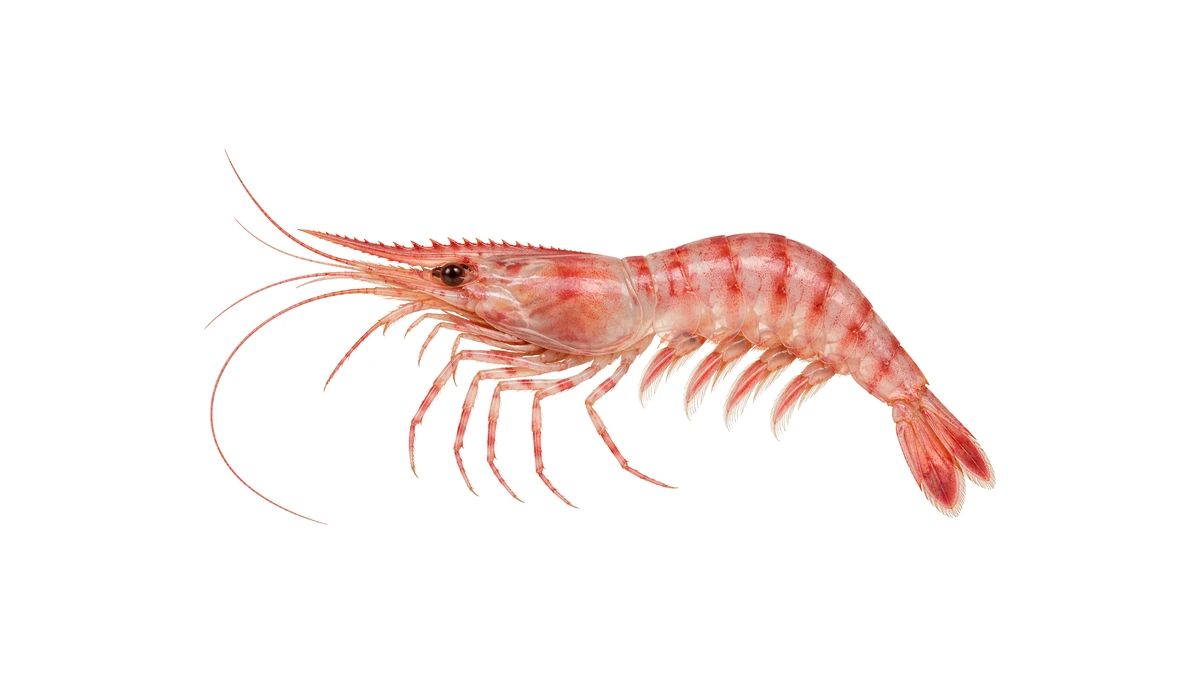
Northern Shrimp: Identification, Habitat & Diet
The northern shrimp (Pandalus borealis) is a small, translucent, cold-water shrimp that lives in deep water on both sides of the North Atlantic and North Pacific. Adults run about 3 to 4.5 inches, sit on muddy bottom in roughly 100 to 500 meters of water, and rarely see temperatures above 45°F. It is the shrimp behind the "coldwater shrimp" sold cooked and frozen in supermarkets, the sweet amaebi on sushi counters, and a lot of the frozen bait in northern tackle shops. It is also one of the few animals that starts life as a male and finishes as a female. This profile covers northern shrimp identification, habitat, diet, size, spawning, and how the species fits into fishing.
Quick ID Card
| Field | Details |
|---|---|
| Scientific name | Pandalus borealis |
| Common names | Northern shrimp, coldwater shrimp, northern pink shrimp, deep-sea prawn; marketed as amaebi in Japan |
| Family | Pandalidae (caridean shrimp) |
| Typical size | 3–4.5 inches (8–12 cm); large females reach about 6.5 inches |
| Water type | Deep, cold marine bottom; mostly 100–500 m |
| Active water temperature | Roughly 34–45°F (1–7°C) |
| Depth range | About 65–2,000 ft (20–600 m), most commonly 330–1,640 ft |
| Difficulty | Not a rod-and-reel target; commercial trawl fishery and bait item |
| Best season | Winter and early spring for most fisheries, depending on the stock |
How to Identify a Northern Shrimp
A northern shrimp looks like a small, glassy pink prawn with too much antenna. The shell is thin and semi-translucent, pale pink to reddish, often with darker red bands and fine speckling across the abdomen. When cooked, it turns the familiar opaque pink-red of a shrimp cocktail.
The head carries the giveaway features. There is a long, saw-toothed rostrum projecting forward between the eyes, with a row of spines along its top edge. Two pairs of antennae trail from the head, and one pair is extremely long, often longer than the body. The eyes are dark and round.
Look at the legs and tail. A northern shrimp has five pairs of walking legs, and the first pair is slender, not built into the big claws you see on a prawn. The abdomen curves down into a fan-shaped tail. Berried females carry a mass of eggs under the abdomen, usually greenish or gray-brown, which makes them look thicker and darker than males.
Size and sex are linked in this species. Males are smaller and mature early. Females are larger, and the biggest ones are the ones that carry eggs. A shrimp over 5 inches is almost certainly a female.
Northern Shrimp vs Pink Shrimp
"Pink shrimp" is a loose market name, and that is where most confusion starts. In the North Atlantic, the true northern shrimp is often sold as northern pink shrimp. But a smaller cousin, the striped pink shrimp (Pandalus montagui), also shows up in the same cold water and the same markets.
| Feature | Northern shrimp | Striped pink shrimp | Gulf pink shrimp |
|---|---|---|---|
| Scientific name | Pandalus borealis | Pandalus montagui | Farfantepenaeus duorarum |
| Family | Pandalidae | Pandalidae | Penaeidae |
| Size | 3–4.5 inches, females larger | Usually under 3 inches | 4–6 inches |
| Markings | Pale pink with red bands and speckles | Distinct dark red stripes | Brownish to pink, no long toothed rostrum |
| Habitat | Deep, cold northern water | Shallower cold water, often with sand shrimp | Warm Gulf and South Atlantic estuaries |
| Commercial use | Large trawl fishery, bait | Smaller fishery, mixed catches | Major warm-water shrimp fishery |
The Gulf pink shrimp is a different family entirely and lives in warm southern estuaries, so geography alone rules it out in New England or Norway. The striped pink shrimp is the closer problem, because it shares the northern range and the trawl net. It is smaller, more strongly striped, and less common in the deep cold water where northern shrimp aggregate.
On the Pacific coast, the look-alike to know is the spot shrimp (Pandalus platyceros). It is much larger, often 7 to 9 inches, and carries obvious white spots on the shell. If a "pink shrimp" is big and spotted, it is not a northern shrimp.
Is the Northern Shrimp Dangerous?
There is no venom and no stinger. A northern shrimp cannot hurt you the way a crab or a stingray can. The rostrum is still a serrated spike, though, and a handful of fresh shrimp can prick a finger. Handle them by the body, not by the head.
Two real risks matter more. The first is food allergy. Shellfish allergy can be severe, and shrimp is one of the most common triggers. Anyone with a known shellfish allergy should not handle or eat them, and steam from a pot of cooking shrimp can carry allergens.
The second is spoilage. Shrimp spoil fast, and bait shrimp thawed and refrozen repeatedly turn into mush that fouls the water and stays on the hook poorly. Keep bait frozen until you use it, keep it cool on the boat, and discard anything that smells of ammonia. Cooked shrimp bought for bait should not go back into the freezer for human food.
Where Do Northern Shrimp Live?
Northern shrimp habitat is the deep, cold shelf. They live on soft mud and sandy mud, usually between 100 and 500 meters down, in water that stays near freezing to about 45°F. Deeper records exist, but the fish is most abundant on the upper shelf. They are not a shallow-water or surf-zone shrimp.
The range is circumpolar in the north. In the western Atlantic they run from the Gulf of Maine north through the Scotian Shelf, the Gulf of St. Lawrence, Newfoundland, and Labrador, then around Greenland. In the eastern Atlantic they occur off Iceland, Svalbard, Norway, and into the Barents Sea off Russia. In the North Pacific they are found in the Gulf of Alaska and the Bering Sea; Pacific populations are sometimes classified as a separate species, Pandalus eous, but the biology is nearly identical.
They do not stay put around the clock. Northern shrimp rise off the bottom at night to feed in the water column and settle back to the mud by day. That daily vertical migration is one reason trawlers time their tows and why the shrimp appear and disappear on sonar.
The Gulf of Maine marks the southern edge of the western Atlantic range. That matters for U.S. anglers, because the Maine fishery is the one most Americans have heard of, and it has been closed for years.
Habits and Diet: What Do Northern Shrimp Eat?
What do northern shrimp eat? They are opportunistic feeders and scavengers rather than hunters. The diet includes small crustaceans such as copepods and krill, worms, tiny mollusks, fish eggs, and organic debris on the bottom. They will also feed on dead animals. In an aquarium they will pick at almost anything edible that settles.
That diet puts them low in the food web, and a lot of things eat them. Cod, haddock, halibut, redfish, and salmon all take northern shrimp, and so do seals and seabirds. Shrimp are a natural forage item for cold-water groundfish, which is exactly why their meat works as bait. If you are looking for the best bait for northern shrimp, the answer is the shrimp itself: a whole or half shrimp hooked through the body is hard for a cod or haddock to refuse.
The life cycle is the strangest part. Northern shrimp are protandric hermaphrodites: they mature first as males, spawn as males for a year or two, then change sex and spend the rest of their lives as females. The timing depends on water temperature and latitude; in cold northern stocks the change comes later and the shrimp grow more slowly.
When do northern shrimp spawn? Females carry fertilized eggs under the abdomen for many months, often from late summer or fall through the winter. The larvae hatch in spring, drift as plankton for a few weeks, then settle to the bottom. A female can carry well over a thousand eggs, and the berried females are the ones most prized by fishermen because the roe is considered a delicacy.
Size, Records and Regulations
How big do northern shrimp get? Most adults are 3 to 4.5 inches long. Large females can reach about 6 inches, occasionally a little more. They are small animals with slow growth and a lifespan of roughly five to eight years, and northern stocks grow slower than southern ones.
There is no IGFA record, because this is not a game fish. The northern shrimp season, where one exists, is set by fishery managers rather than by a rod-and-reel opening day, and the meaningful numbers are commercial quotas and closures. In the United States, the Atlantic States Marine Fisheries Commission (ASMFC) manages northern shrimp in the Gulf of Maine. The fishery has been under a moratorium since 2014, driven by poor recruitment and warm water, and the closure has been extended year after year. As of late 2025 it remained closed; check the ASMFC website before assuming any season exists.
In Canada, Fisheries and Oceans Canada (DFO) sets quotas for northern shrimp stocks off Newfoundland, Labrador, and in the Gulf of St. Lawrence. In Europe, Norway and Russia set a bilateral quota in the Barents Sea, and Norway manages its own coastal fishery. These are trawl fisheries, not recreational ones.
For anglers, the practical rules are about bait and transport. Many states restrict the use or transport of raw shrimp, especially in fresh water, to slow the spread of disease and non-native species. Cooked shrimp are usually treated differently from live or raw bait. Read your state's bait rules before you carry a bag of frozen shrimp to a lake, and never dump bait water or leftover shrimp into a waterbody.
How to catch northern shrimp is mostly a commercial question, not a sport-fishing one. For most U.S. anglers, the honest answer is that you cannot. The Gulf of Maine recreational fishery is closed along with the commercial one. Elsewhere, where a season exists, the methods are small traps, dip nets, and commercial trawls rather than hook and line. Check the current rules with ASMFC, DFO, or your national fisheries agency. Last verified: November 2025.
FAQ
How big do northern shrimp get? Most are 3 to 4.5 inches. Large females can reach about 6 to 6.5 inches, but those are old, slow-grown shrimp from cold northern stocks.
Where do northern shrimp live? On muddy bottom in the North Atlantic and North Pacific, mostly 100 to 500 meters deep, in water from about 34 to 45°F. The western Atlantic range runs from the Gulf of Maine north to Greenland.
What do northern shrimp eat? Plankton, krill, small crustaceans, worms, fish eggs, and organic debris. They are opportunistic feeders and scavengers, not active hunters.
When do northern shrimp spawn? Females carry eggs under the abdomen from fall through winter, and larvae hatch in spring. The species is protandric: shrimp mature as males, then change to females.
What is the difference between northern shrimp and pink shrimp? Northern shrimp are larger, live deeper and colder, and have a long toothed rostrum. Striped pink shrimp are smaller and striped; Gulf pink shrimp belong to a different family and live in warm southern estuaries.
Can you still catch northern shrimp in the U.S.? The Gulf of Maine fishery has been under an ASMFC moratorium since 2014 and remained closed as of 2025. Check current rules before planning anything.
Is northern shrimp good bait? Yes. Whole or half shrimp are a strong bait for cod, haddock, halibut, and other cold-water bottom fish. Keep it frozen until use and check state rules on shrimp as bait.
Is northern shrimp the same as amaebi? It is the same group of cold-water Pandalus shrimp sold as amaebi in Japan. Pacific populations may be classified as Pandalus eous, but they are treated as northern shrimp in the marketplace.
Related Articles
- Tarpon — a warm-water giant that also feeds heavily on shrimp and crabs.
- Striped Bass — a striped predator that takes shrimp and shrimp-shaped baits.
- Cobia — a crab-and-shrimp specialist of the Gulf and Atlantic coasts.
- Mahi-Mahi — an offshore speedster that hunts baitfish and squid.
- All species profiles
A northern shrimp is small, cold, and easy to overlook, but it sits at the center of the northern food web. It feeds cod and halibut, fills bait freezers, and shows up on sushi counters from Tokyo to Toronto. Knowing the northern shrimp is knowing what a lot of northern fishing is built on.
Ready to catch one? Read our step-by-step guide: How to Catch Northern Shrimp.
About the author and how this was tested
About the author
FishermanGuy
Bank, boat and kayak angler · fishing, crabbing and shrimping since 2021
I buy the gear, fish it for a season and write down what failed. No sponsored verdicts, no free-sample flattery. Every rig on this page has landed fish in water I can point at on a map.
How this was tested
- Every rig gets at least six trips on the same water before it is published.
- Gear is bought at retail. Free samples are labelled in the first paragraph.
- Dates show first publication and the last time the page was updated.