Field notes
Arctic Grayling: Identification, Habitat & Diet
Arctic Grayling: Identification, Habitat & Diet
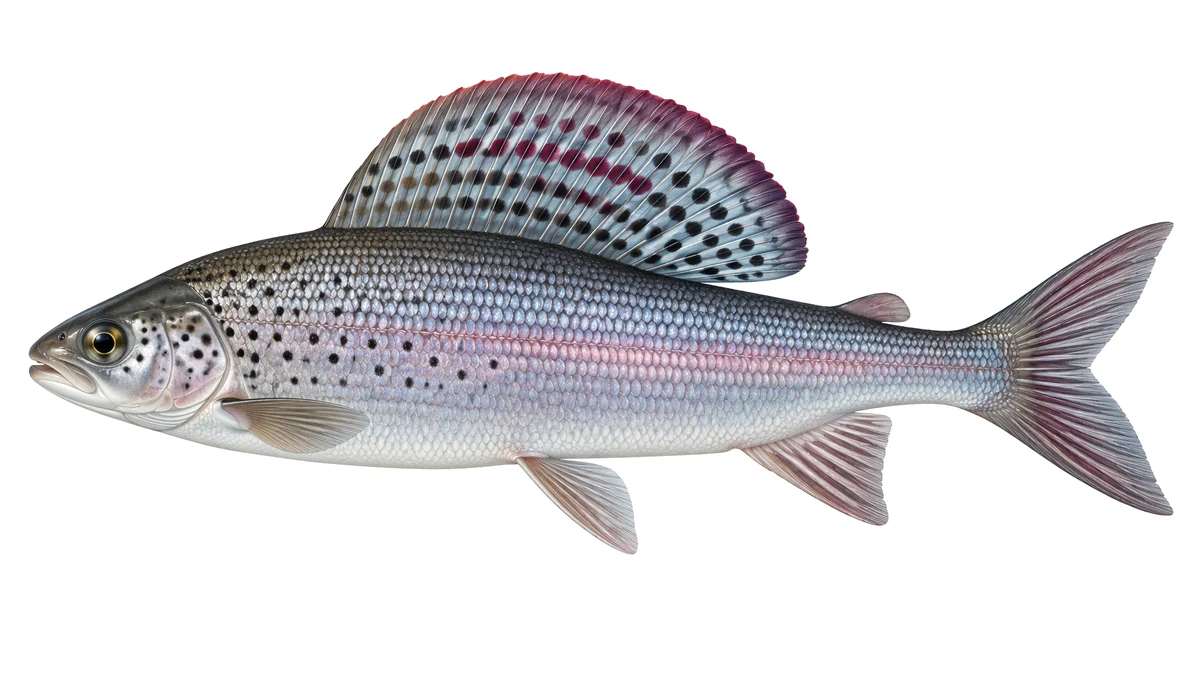
The Arctic grayling is the most elegant fish in cold northern water. It is built around one feature: a tall, sail-like dorsal fin covered in spots and edged in color, so large that it looks out of proportion on a fish that rarely tops two pounds. That fin, plus a silvery body and a habit of rising to the surface, makes the grayling a favorite of fly anglers from Alaska to Siberia. This profile covers Arctic grayling identification, habitat, diet, size, spawning, and how to catch one, including the special rules that protect the last native populations in the lower 48.
Quick ID Card
| Field | Details |
|---|---|
| Scientific name | Thymallus arcticus |
| Common names | Arctic grayling, grayling, sailfin; in Asia, grayling or "huaziyu" in Chinese |
| Family | Salmonidae, subfamily Thymallinae |
| Typical size | 8–15 inches (20–38 cm) |
| Trophy size | 18–24 inches and up to about 5 pounds |
| Water type | Cold, clear, well-oxygenated rivers and lakes |
| Active water temperature | Roughly 43–72°F (6–22°C) |
| Difficulty | Easy to moderate; eager surface feeder, fragile in warm water |
| Best season | Late spring through early fall; June for the spawning run |
How to Identify an Arctic Grayling
Arctic grayling identification is almost too easy: look at the dorsal fin. A grayling has an enormous, sail-like dorsal fin with 17 to 25 rays, usually more than 20. On a mature fish the fin is taller than the body is deep, and it carries rows of dark spots and a colorful edge. No other freshwater fish in North America has a fin like it.
The body is silvery blue-gray with a pinkish or lavender iridescence, especially along the sides. Small dark spots are scattered over the front half of the body, and the scales are fine. The mouth is small, the snout is short, and the eye is relatively large. There is a small adipose fin near the tail, as on other salmonids.
The tail is deeply forked, more so than a trout's. The lower fins are pale with darker edges and sometimes a reddish tint. Spawning males deepen in color, and the dorsal fin grows even taller and more colorful.
Young grayling look like small adults, with a proportionally large dorsal fin. The fin grows with the fish, so even a 6-inch grayling shows the signature sail.
The combination of the huge dorsal fin, small mouth, silvery body, and forked tail is unique. If you are unsure, the fin settles it.
Arctic Grayling vs Brook Trout
These two share cold, clear water across the North, and anglers new to the species sometimes mix them up at a glance.
| Feature | Arctic grayling | Brook trout |
|---|---|---|
| Dorsal fin | Huge, sail-like, 17–25 rays, spotted and colorful | Normal size, dark with pale mottling |
| Body pattern | Silvery blue-gray with small dark spots on the front half | Dark olive-green with light worming, light spots, and red spots with blue halos |
| Mouth | Small | Larger, reaching past the eye |
| Tail | Deeply forked | Square or slightly forked |
| Scales | Fine | Fine |
| Range | Circumpolar north; native to Montana in the lower 48 | Native to eastern North America, widely stocked |
The dorsal fin is decisive. A brook trout's dorsal fin is ordinary. A grayling's is a sail. The body color is the second clue: grayling are silver and pale, brook trout are dark with worming.
Compared with rainbow trout, grayling lack the broad pink stripe and the heavy spotting over the whole body. Compared with whitefish, grayling have a much larger dorsal fin and a small mouth. In grayling country, the fin is unmistakable.
Is the Arctic Grayling Dangerous?
No. Arctic grayling are harmless. They have small teeth, no venom, and no spines. The dorsal fin looks dramatic, but it is soft and flexible.
The risk is to the fish. Grayling are sensitive to warm water and low oxygen, and they stress easily. In summer, when rivers warm, handling a grayling can kill it even if it swims away. Keep the fish in the water, use a wet hand or a rubber net, and release it quickly. Avoid lifting it by the jaw, which is small and fragile.
The northern environment is the other hazard. Grayling water is often remote, cold, and far from help. Weather changes fast, rivers run high with glacial silt, and bears are present in much of the range. Carry layers, tell someone your plan, and follow local wildlife advice.
In Montana's Big Hole basin, native grayling are protected, and handling rules are strict. Treat every grayling as a fish that matters, because in the southern part of the range it does.
Arctic Grayling Habitat and Range
Where do Arctic grayling live? Across the circumpolar north. They occur in Alaska, the Yukon and Northwest Territories, and much of northern Canada, and across Siberia and northern Asia. In China, they are found in the Amur basin, including the Heilongjiang system. The species is built for cold, clean, oxygen-rich water.
In the lower 48 states, the picture is different. Arctic grayling are native to Montana, where the last native populations survive in the Big Hole River basin and a few connected waters. They were once more widespread in the upper Missouri basin. Reintroduction efforts are under way in Michigan and elsewhere, but those are restoration projects, not natural range.
Grayling prefer cold rivers and lakes with gravel bottoms and good flow. In rivers, they hold in pools, riffles, and current seams, often in schools. In lakes, they cruise the shallows and inlets, especially in spring and fall. They need cold water, and they suffer when streams warm, silt up, or lose shade.
Temperature is the key limit. Grayling do best from about 45 to 65°F, and they seek springs and deep pools when the surface warms. In the southern edge of the range, that sensitivity makes them vulnerable to drought and climate warming. Montana manages its native fish closely, and the Big Hole population is the focus of long-running conservation work.
What Do Arctic Grayling Eat?
Arctic grayling eat insects, and they are famous for taking them on the surface. What do Arctic grayling eat? Aquatic nymphs, especially mayflies, caddisflies, and stoneflies, plus terrestrials such as ants, beetles, and grasshoppers. Lake fish also eat zooplankton, and larger grayling take small fish.
Grayling are surface-oriented. They rise readily to dry flies, and a small attractor pattern drifted over a pool often brings a strike. In rivers, they hold high in the water column and pick off drifting insects. In lakes, they cruise the shoreline and inlet, feeding on emergers and plankton.
When do Arctic grayling spawn? In spring, generally from April into June, when water warms toward the mid-40s. Fish move upstream into small tributaries and gravel riffles, sometimes traveling long distances. They cut redds and scatter eggs, then drop back to feeding water.
Growth is moderate. A 12-inch grayling is a good fish; an 18-inch fish is a trophy. Most adults live several years, and the largest fish come from big northern rivers and lakes with abundant food.
Grayling are not as wary as brown trout, but they are not careless either. In heavily fished water, they become selective about size and presentation. A drag-free drift and a light tippet still matter.
Size, Records and Regulations
How big do Arctic grayling get? Most adults run 8–15 inches. An 18-inch fish is large, and a 20-inch grayling is exceptional. The biggest approach 5 pounds, but most fish weigh under 2. The all-tackle records come from Alaska and northern Canada, where the growing season is short but the water is rich.
Regulations vary widely. In Alaska and much of Canada, grayling are managed for sport and subsistence, with generous seasons and limits in many areas. In Montana, native grayling are protected. The Big Hole and connected waters have special rules, often catch-and-release or artificial-lure only, to protect the last native populations in the lower 48. Check the Montana Fish, Wildlife and Parks regulations before you fish.
In Asia, grayling are managed under local and national rules, and the species is not a major sport fish in most of its range. In China, the Amur basin populations are limited, and local rules apply.
A fishing license is required everywhere. Some jurisdictions add a stamp or a special permit. The agency that manages the water is the authority: the Alaska Department of Fish and Game, Fisheries and Oceans Canada, Montana Fish, Wildlife and Parks, or the relevant provincial or regional agency. Last verified: November 2025.
The best bait for Arctic grayling, where bait is legal, is a small worm or a single salmon egg. But grayling are at their best on a fly. A small dry fly, such as an Adams or an elk hair caddis, fished drag-free over a pool, is the classic approach. Small spinners and spoons also work, especially in lakes.
How to catch Arctic grayling: find cold, clean water, fish early and late, and watch for rising fish. In rivers, cast upstream and let the fly drift naturally. In lakes, work the inlet and the shoreline drop-off. Stay low, keep a light tippet, and set the hook gently, because the mouth is small and soft. Land the fish quickly, keep it wet, and release it with care.
The grayling is a fish of clean, cold places. Catching one is a reminder of how much those places are worth.
FAQ
How big do Arctic grayling get? Most are 8–15 inches. An 18-inch fish is large, and the biggest approach 5 pounds. Most adults weigh under 2 pounds.
How do you identify an Arctic grayling? By the huge sail-like dorsal fin with 17–25 rays, a silvery blue-gray body with small dark spots on the front half, a small mouth, and a deeply forked tail.
What is the difference between an Arctic grayling and a brook trout? A grayling has a tall, spotted dorsal fin and a silvery body. A brook trout has a normal dorsal fin and a dark olive body with light worming and red spots with blue halos.
Where do Arctic grayling live? Across the circumpolar north: Alaska, northern Canada, and Siberia. In the lower 48, native populations survive only in Montana's Big Hole River basin.
What do Arctic grayling eat? Aquatic insect nymphs, terrestrial insects such as ants and grasshoppers, zooplankton in lakes, and small fish.
When do Arctic grayling spawn? In spring, generally April through June, in small tributaries and gravel riffles after water warms toward the mid-40s.
What is the best bait for Arctic grayling? A small dry fly fished drag-free is the classic approach. Where bait is legal, a small worm or salmon egg works. Small spinners also catch fish in lakes.
How do you catch an Arctic grayling? Fish cold, clean water early and late, watch for rising fish, and drift a small dry fly or nymph naturally. Stay low, use a light tippet, and release fish wet.
Related Articles
- Golden Trout — a rare native trout of the California high country.
- Apache Trout — a threatened native trout of Arizona's White Mountains.
- Chinook Salmon — the largest Pacific salmon.
- Brook Trout — the native char of cold eastern streams.
- All species profiles
Ready to catch one? Read our step-by-step guide: How to Catch Arctic Grayling.
About the author and how this was tested
About the author
FishermanGuy
Bank, boat and kayak angler · fishing, crabbing and shrimping since 2021
I buy the gear, fish it for a season and write down what failed. No sponsored verdicts, no free-sample flattery. Every rig on this page has landed fish in water I can point at on a map.
How this was tested
- Every rig gets at least six trips on the same water before it is published.
- Gear is bought at retail. Free samples are labelled in the first paragraph.
- Dates show first publication and the last time the page was updated.