Field notes
Chinook Salmon: Identification, Habitat & Diet
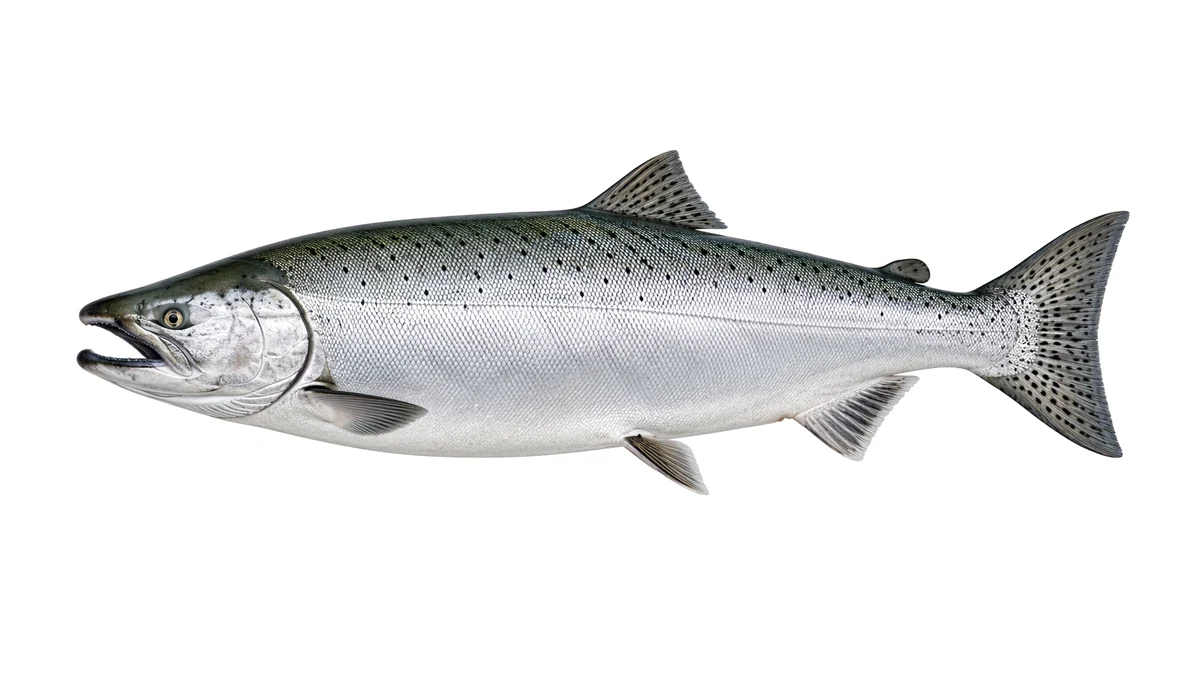
Chinook Salmon: Identification, Habitat & Diet
The Chinook salmon is the largest Pacific salmon, and the fish most anglers mean when they say "king." A big Chinook is a heavy, deep-bodied fish with a dark mouth and a stubborn fight, and it carries more prestige per pound than almost anything else in fresh water. It is also a fish of complicated status: abundant in some Alaska rivers, struggling in parts of the Pacific Northwest, and subject to tight rules in others. This profile covers Chinook salmon identification, habitat, diet, size, the world record, spawning, and how to catch one.
Quick ID Card
| Field | Details |
|---|---|
| Scientific name | Oncorhynchus tshawytscha |
| Common names | Chinook salmon, king salmon, blackmouth, tyee; spring salmon in parts of British Columbia |
| Family | Salmonidae, genus Oncorhynchus (Pacific salmon) |
| Typical size | 10–40 pounds (4.5–18 kg); 24–40 inches |
| Trophy size | 50+ pounds in big Alaska and British Columbia rivers |
| Water type | Cold coastal rivers, estuaries, and the open North Pacific |
| Active water temperature | Roughly 41–64°F (5–18°C) |
| Difficulty | Moderate to hard; big fish, strong current, run-specific rules |
| Best season | Late summer and fall for most runs; spring and summer for spring Chinook |
How to Identify a Chinook Salmon
Chinook salmon identification comes down to the mouth and the tail. Open the fish's mouth. A Chinook has black gums and a black base to the mouth, which is why it is called "blackmouth." A coho has white or gray gums. That single check separates the two most commonly confused salmon.
Look at the tail next. A Chinook has small black spots on both lobes of the tail and on the back. A coho has spots only on the upper lobe. The spots on a Chinook are fine and scattered, not large and round.
Count the anal rays if you want to be certain. A Chinook has 13 to 19 anal rays; a coho has 12 to 15. The ranges overlap slightly, so use the count with the mouth and tail marks, not alone.
Ocean-phase Chinook are bright silver with a dark olive or blue-green back and a white belly. As they enter fresh water and mature, they darken to olive, red, or almost black. Spawning males develop a hooked lower jaw, a pronounced kype, and a humped back. Females stay rounder and cleaner.
Juvenile Chinook in fresh water carry parr marks, the vertical bars common to young salmon. In the ocean, the fish is sleek and powerful. A fresh-run Chinook in a tidewater river is one of the cleanest-looking fish in the Pacific.
Chinook Salmon vs Coho Salmon
This is the comparison that matters most on a river where both species run.
| Feature | Chinook salmon | Coho salmon |
|---|---|---|
| Mouth | Black gums and black mouth base | White or gray gums |
| Tail spots | Both lobes | Upper lobe only |
| Back spots | Small, scattered | Few or none |
| Anal rays | 13–19 | 12–15 |
| Typical weight | 10–40 pounds | 6–12 pounds |
| Body shape | Deep and heavy | More slender |
| Spawning color | Dark olive to red or black | Bright red sides, green back |
Size is a clue but not a rule. A 10-pound fish could be a small Chinook or a big coho. The mouth is the fast test, and the tail spots confirm it. On many rivers, anglers are required to release one species and keep the other, so getting the ID right is not just a bragging matter. It is a legal one.
Chinook also differ from sockeye, which have no spots, a bright silver body, and a green head in the ocean, and from chum, which lack body spots and develop bold vertical bars when spawning. Pink salmon are smaller and have large oval spots on the back and tail.
Is the Chinook Salmon Dangerous?
Not in the venomous sense. Chinook have no spines or poison. But they are big, strong fish with sharp teeth, and a hooked, thrashing Chinook in a small boat can hurt someone or break gear.
Spawning males are the ones to watch. A mature male has a hooked jaw and enlarged teeth, and it will bite. Keep your fingers clear of the mouth when you unhook a fish, and use a net rather than lifting a big fish by the line. On rocky banks, a fish that surges while you are holding it can pull you off balance.
The bigger safety issue is the environment. Chinook rivers in Alaska and British Columbia run through bear country, and a cleaned fish or a stringer left on the bank attracts animals. Keep a clean camp, store fish properly, and carry bear spray where it is legal and appropriate. Cold water, fast current, and rising tides are hazards too. Wear a life jacket in a boat, watch the tide charts, and do not wade deeper than you can handle.
Handle fish you release with care. A big Chinook is an old fish, often four to seven years old, and it has already survived years at sea. Keep it in the water, support it, and let it recover before release where rules require it.
Chinook Salmon Habitat and Range
Where do Chinook salmon live? They are anadromous, born in fresh water, raised in rivers and estuaries, and grown in the North Pacific before returning to their natal streams to spawn. Their range runs from the Arctic coast of Alaska and the Yukon south through British Columbia, Washington, Oregon, and into California, where the Sacramento and San Joaquin systems mark the southern edge. Across the Pacific, they occur in Russia's Kamchatka and in northern Japan.
Chinook are also stocked in the Great Lakes, where they support a popular fishery in Lake Michigan, Lake Huron, and Lake Ontario. Those fish are landlocked in the sense that they never reach the sea, but they still run up tributaries to spawn.
In fresh water, Chinook need cold, clean, gravel-bottomed rivers with good flow. They spawn in main-stem gravel and in tributaries, often well upstream. Juveniles rear in rivers and estuaries before migrating to sea, and the estuary phase matters more than people once thought. Dams, water diversion, logging, and urban development have cut into that habitat across the southern part of the range.
Temperature sets the limits. Chinook do best in water from about 41 to 64°F. Above that, they hold in cold pockets and deep pools, and warm water stresses them badly. That is why many fisheries close or restrict when rivers get too warm.
Some runs are in trouble. The Sacramento River winter-run Chinook is listed as endangered, and several Columbia River runs are listed as threatened. Others, especially in Alaska, remain strong. The status depends on the run and the river, which is why regulations differ so much from place to place.
Chinook also appear, rarely, in Northeast Asia and in Chinese waters. Records from the Heilongjiang and Tumen river systems exist, but the fish is not a common target there. The heart of the range is the North Pacific coast of North America.
What Do Chinook Salmon Eat?
In the ocean, Chinook are predators. What do Chinook salmon eat? Mostly fish, including herring, sand lance, anchovy, and juvenile salmon, plus squid and krill. Big Chinook are opportunistic and will take whatever is abundant, which is one reason they grow so large.
In fresh water, juveniles start on insects and small crustaceans, then shift to fish as they grow. Adults returning to spawn mostly stop feeding, though they will still strike a lure or bait out of aggression or habit. That is why salmon anglers fish for reaction, not hunger.
In rivers, Chinook hold in deep pools, behind boulders, in current seams, and in the soft water at the edge of fast runs. They move upstream in pulses, often with the tide or after rain. In tidewater, they can be found where salt and fresh water mix, and those fish are often the brightest and hardest-fighting.
When do Chinook salmon spawn? Timing depends on the run. Spring Chinook enter rivers in spring and spawn in late summer or early fall. Fall Chinook enter in late summer and fall and spawn from September into December, depending on the river. All Pacific salmon die after spawning, and Chinook are no exception.
Size, Records and Regulations
How big do Chinook salmon get? Most adults run 10–40 pounds. A 40-pound fish is a serious Chinook. In big Alaska and British Columbia rivers, fish over 50 pounds are caught every year, and a handful reach 60 or more.
The world record Chinook salmon on rod and reel is 97 pounds 4 ounces, caught in the Kenai River, Alaska, in 1985. That fish still stands as the IGFA all-tackle record. Commercial catches have produced larger fish historically, but the rod-and-reel mark is the one anglers chase.
Regulations depend on the state, the river, and the run. Alaska, Washington, Oregon, California, and British Columbia each set their own seasons, limits, and gear rules. Many jurisdictions require a salmon stamp, tag, or record card in addition to a license. Some rivers are hatchery-only, with wild fish released. Some are closed entirely to protect weak runs.
The agency that manages the water is the authority: the Alaska Department of Fish and Game, the Washington Department of Fish and Wildlife, the Oregon Department of Fish and Wildlife, the California Department of Fish and Wildlife, or Fisheries and Oceans Canada. Read the emergency rules before you go, because salmon seasons can change mid-season. Last verified: November 2025.
The best bait for Chinook salmon depends on the water. In rivers, cured salmon roe is the classic, fished under a bobber or back-bounced along the bottom. In tidewater and the ocean, trolling with spoons, plugs, or bait behind a downrigger is standard. Spinners and large flies work in both. Check whether bait is legal, because many wild-salmon fisheries are artificial-lure only.
How to catch Chinook salmon: find cold, deep water with current, fish early and late, and match the run. In rivers, back-bounce roe through deep slots or drift a bobber along seams. In the ocean, troll deep and slow. In tidewater, cast spinners and spoons to moving fish. Use heavy enough gear for a big fish, set the drag properly, and land the fish quickly so it can be released if required.
A Chinook is a fish worth preparing for. The fight is long, the fish is old, and the rules that protect the runs are the reason there are still fish to catch.
FAQ
How big do Chinook salmon get? Most adults are 10–40 pounds and 24–40 inches. Fish over 50 pounds are caught in big Alaska and British Columbia rivers, and the rod-and-reel world record is 97 pounds 4 ounces.
What is the world record Chinook salmon? The IGFA all-tackle record is 97 pounds 4 ounces, caught in the Kenai River, Alaska, in 1985.
How do you tell a Chinook from a coho? A Chinook has black gums and a black mouth base, spots on both tail lobes, and 13–19 anal rays. A coho has white or gray gums, spots only on the upper tail lobe, and 12–15 anal rays.
Where do Chinook salmon live? In the North Pacific, from Alaska and British Columbia south to California, and across to Russia and Japan. They are also stocked in the Great Lakes. They spawn in cold coastal rivers.
What do Chinook salmon eat? In the ocean, fish such as herring and sand lance, plus squid and krill. Juveniles eat insects and small crustaceans in fresh water. Adults returning to spawn mostly stop feeding.
When do Chinook salmon spawn? Spring-run fish spawn in late summer and early fall; fall-run fish spawn from September into December, depending on the river. All die after spawning.
What is the best bait for Chinook salmon? Cured salmon roe in rivers, and spoons, plugs, or bait behind a downrigger in the ocean. Many wild-salmon fisheries require artificial lures only, so check the rules.
How do you catch a Chinook salmon? Fish cold, deep water with current. Back-bounce roe or drift a bobber in rivers, troll deep in the ocean, and cast spinners in tidewater. Use heavy gear and land fish quickly.
Related Articles
- Chum Salmon — the dog salmon, and the widest-ranging Pacific salmon.
- Cutthroat Trout — the native western trout with the red jaw slash.
- Arctic Grayling — a cold-water northern cousin with a sail-like dorsal fin.
- Brown Trout — a wary introduced trout of cold rivers.
- All species profiles
Ready to catch one? Read our step-by-step guide: How to Catch Chinook Salmon.
About the author and how this was tested
About the author
FishermanGuy
Bank, boat and kayak angler · fishing, crabbing and shrimping since 2021
I buy the gear, fish it for a season and write down what failed. No sponsored verdicts, no free-sample flattery. Every rig on this page has landed fish in water I can point at on a map.
How this was tested
- Every rig gets at least six trips on the same water before it is published.
- Gear is bought at retail. Free samples are labelled in the first paragraph.
- Dates show first publication and the last time the page was updated.