Field notes
Chum Salmon: Identification, Habitat & Diet
Chum Salmon: Identification, Habitat & Diet
The chum salmon is the most widespread Pacific salmon and one of the least appreciated. Anglers chase kings and coho, and often ignore chum as a late-season nuisance. That is a mistake. A fresh chum fights hard, hits lures and flies with abandon, and gives you a reason to be on the river in November when the crowd has gone home. This profile covers chum salmon identification, habitat, diet, size, the "dog salmon" name, spawning, and how to catch one.
Quick ID Card
| Field | Details |
|---|---|
| Scientific name | Oncorhynchus keta |
| Common names | Chum salmon, dog salmon, calico salmon, fall salmon; salmon in parts of Asia |
| Family | Salmonidae, genus Oncorhynchus (Pacific salmon) |
| Typical size | 8–15 pounds (3.5–7 kg); 24–30 inches |
| Trophy size | 20–30 pounds; fish over 30 are rare |
| Water type | Cold coastal rivers, estuaries, and the North Pacific |
| Active water temperature | Roughly 46–61°F (8–16°C) |
| Difficulty | Easy to moderate; aggressive biters, strong fighters |
| Best season | October through December for most runs |
How to Identify a Chum Salmon
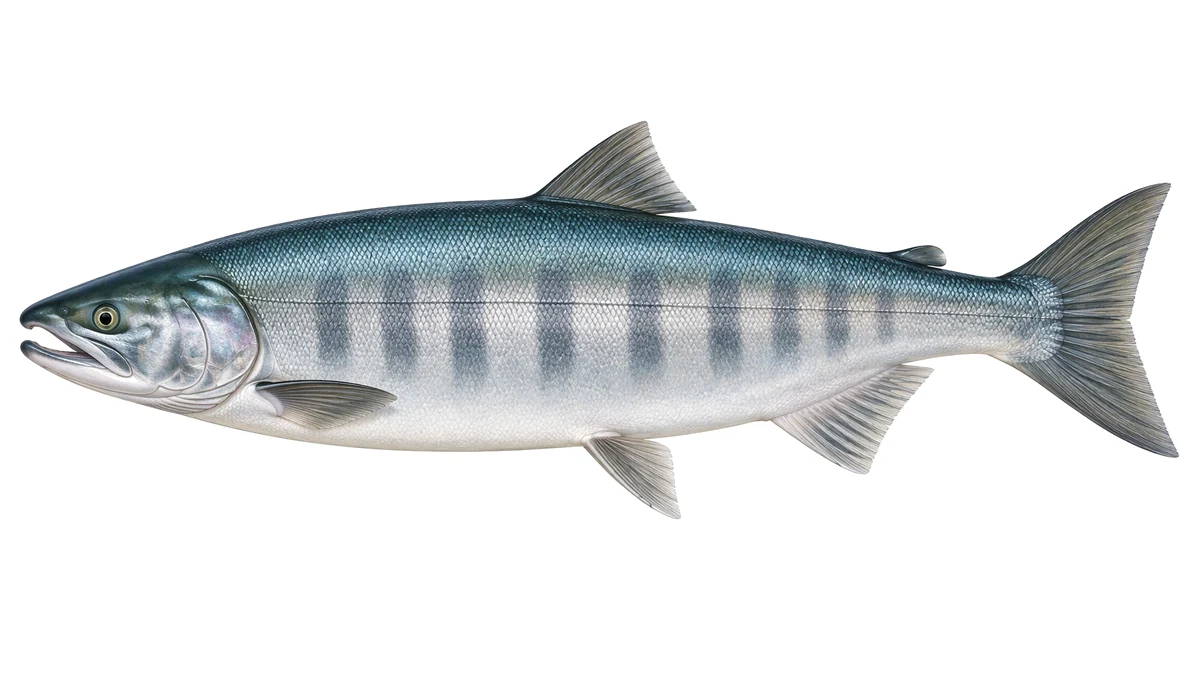
Chum salmon identification starts with what is missing: spots. A chum has no black spots on its body or tail. That alone separates it from Chinook, coho, and pink salmon, all of which carry spots somewhere.
An ocean-fresh chum is bright silver with a metallic blue-green or olive back and a white belly. Faint dusky vertical bars run down the sides, and they become bold as the fish enters fresh water. The body is more slender than a Chinook's, and the snout is slightly pointed. The tail is forked and clean, without spots.
As chum mature and spawn, the transformation is dramatic. The fish develops a calico pattern of vertical bars in olive, red, purple, and black, over a darker body. Males grow a humped back and large, fang-like teeth, which is where the "dog salmon" name comes from. Females stay plainer but also darken and bar up.
The teeth are a real field mark on spawning fish. A mature male chum has canine-like teeth that are much larger than those of other Pacific salmon. Combined with the barred, spotless body, it is hard to confuse with anything else.
Juveniles carry parr marks in fresh water. In the ocean, the clean silver body and absence of spots are the quickest checks.
Chum Salmon vs Pink Salmon
Both species are common in the same fall rivers, and both are often called "humpies" or lumped together by casual anglers. They are different fish.
| Feature | Chum salmon | Pink salmon |
|---|---|---|
| Body spots | None | Large oval black spots on back and tail |
| Typical weight | 8–15 pounds | 3–8 pounds |
| Size | 24–30 inches | 18–24 inches |
| Life cycle | 3–5 years | 2 years, fixed |
| Run pattern | Annual, with variability | Strong odd-year or even-year runs by region |
| Spawning color | Calico vertical bars, dark body | Dull gray-green back, pinkish sides, humped males |
The spots are the fast test. A pink salmon has big, oval black spots scattered over the back and the entire tail. A chum has none. Size helps too: a 12-pound fall salmon with no spots is a chum, not a pink.
Both species develop a hump, which causes confusion. Pink males hump heavily and turn gray-green with a pink flush. Chum males hump less and show the bold calico bars. On many rivers, the run timing overlaps, so learn both.
Chum also differ from Chinook, which have black gums and spots on both tail lobes, and from coho, which have white gums and spots on the upper tail lobe only.
Is the Chum Salmon Dangerous?
Chum are not venomous and have no spines. The hazard is their teeth and their size. A spawning male chum has large canine-like teeth and will bite a hand that reaches into its mouth.
Unhook fish with pliers or a hook-out, and keep your fingers away from the jaw. A net is the safest way to land a chum, especially on a rocky bank. Big fish thrash, and a hook can end up in a finger.
The environment deserves respect too. Chum spawn late, in cold weather, often in lower rivers and tidewater where banks are slick and water is deep. Wear cleats, watch the tide, and do not wade into current you cannot read. In Alaska and northern British Columbia, bear country adds another layer: keep fish and food secured, and follow local bear-safety advice.
Because chum are often released, handling matters. Keep the fish in the water, support the belly, and avoid lifting by the jaw. A chum that is bleeding from a deep hook should be kept if rules allow, rather than released to die.
Chum Salmon Habitat and Range
Where do chum salmon live? They have the widest range of any Pacific salmon. They occur from Japan and Korea north through Russia's Kamchatka and Sakhalin, across the Bering Sea to Alaska, and south through British Columbia, Washington, and Oregon, with a few runs reaching California. In Asia, they enter rivers in China's Heilongjiang and Tumen systems, though those runs are limited.
Chum are anadromous: born in fresh water, reared in rivers and estuaries, grown in the North Pacific, and back to spawn. Unlike Chinook, which often run far upstream, chum tend to spawn lower in the system, in main-stem gravel, side channels, and tidewater reaches. That makes them accessible to shore anglers and also exposed to habitat loss in the lower river.
The species prefers cold water, roughly 46–61°F. It tolerates a wide range of conditions but needs clean gravel and cool flows for spawning. In the southern part of its range, urbanization, diking, and water diversion have damaged the lower-river habitat chum depend on. Some stocks are in trouble: Hood Canal summer chum in Washington and Columbia River chum are listed as threatened under the Endangered Species Act.
In Alaska and much of British Columbia, chum are abundant and support large commercial and sport fisheries. The contrast is a reminder that "chum salmon" is not one status. It is dozens of runs with different fates.
What Do Chum Salmon Eat?
In the ocean, what do chum salmon eat? Mostly zooplankton, squid, and small fish. Chum feed lower on the food chain than Chinook, which is one reason they grow fast but do not reach the same size. They are often found in schools, feeding on krill and other plankton concentrated by currents.
Juveniles eat insects and small crustaceans in fresh water and estuaries before moving to sea. Adults returning to spawn stop feeding, and their stomachs shrink. They strike lures and baits out of aggression and reflex, often defending a redd or a holding lie.
In rivers, chum hold in deep, slow water, in pools below riffles, and in tidewater where they stage before moving up. They are strong, steady swimmers and often push through heavy current.
When do chum salmon spawn? In fall, generally from October into December, depending on latitude and river. They spawn in gravel, often in the lower reaches, and both sexes die after spawning. The timing is late compared with most other salmon, which is why chum fishing is a cold-weather game.
Size, Records and Regulations
How big do chum salmon get? Most adults run 8–15 pounds and 24–30 inches. A 20-pound chum is a big fish, and a 30-pound chum is exceptional. The largest chum are caught in Alaska and British Columbia, where rich ocean feeding produces heavy fish.
Record keeping for chum is less prominent than for kings, but state and IGFA records exist. Because chum are often released or kept for smoking, fewer fish are weighed officially. For most anglers, a 15-pound chum on a fly rod is a memorable catch.
Regulations vary by state and province. Alaska, British Columbia, Washington, Oregon, and California each set seasons, limits, and gear rules. Some rivers allow chum harvest; others require release of wild fish or close the fishery to protect weak runs. A license is required, and some jurisdictions add a salmon tag or record card.
The managing agency is the authority: the Alaska Department of Fish and Game, Fisheries and Oceans Canada, the Washington Department of Fish and Wildlife, the Oregon Department of Fish and Wildlife, or the California Department of Fish and Wildlife. Read the current rules, including emergency closures, before you fish. Last verified: November 2025.
The best bait for chum salmon is often salmon roe, fished under a float or drifted along the bottom. Spinners, spoons, and large flies also work, and chum will chase a bright lure aggressively. In many rivers, bait is restricted, so carry flies and artificial lures. Chum are not shy, and a simple presentation fished in the right water beats a fancy one.
How to catch chum salmon: fish late in the season, target deep holding water and tidewater, and cover water until you find a school. Cast spinners or spoons across the current and swing them through the lie. Fly anglers do well with weighted flies and sink tips. Fight the fish hard, land it quickly, and release it wet if you are not keeping it.
Chum are also excellent smoked, and their roe is prized. That combination has made them a commercial mainstay in Alaska and Japan. For the sport angler, the reward is a hard-fighting fish in quiet, cold water.
FAQ
How big do chum salmon get? Most are 8–15 pounds and 24–30 inches. A 20-pound chum is large, and fish over 30 pounds are rare.
Why are chum salmon called dog salmon? Spawning males develop large, canine-like teeth and a humped back, which reminded early observers of a dog. The name stuck.
How do you tell a chum from a pink salmon? A chum has no black spots, runs 8–15 pounds, and develops bold calico vertical bars. A pink has large oval spots on the back and tail, weighs 3–8 pounds, and lives only two years.
Where do chum salmon live? Across the North Pacific, from Japan and Russia to Alaska, British Columbia, Washington, and Oregon, with a few runs in California. They spawn in lower rivers and tidewater.
What do chum salmon eat? Zooplankton, squid, and small fish in the ocean; insects and small crustaceans as juveniles in fresh water. Adults stop feeding when they return to spawn.
When do chum salmon spawn? From October into December, later than most other salmon. They spawn in lower-river gravel and die after spawning.
What is the best bait for chum salmon? Salmon roe under a float or drifted on the bottom. Spinners, spoons, and large flies work well, and chum strike aggressively. Check whether bait is legal.
How do you catch a chum salmon? Fish late in the fall, target deep holding water and tidewater, and swing spinners, spoons, or flies through the lie. Land fish quickly and release them wet.
Related Articles
- Chinook Salmon — the largest Pacific salmon, with black gums and spotted tail lobes.
- Arctic Grayling — a cold-water northern fish with a sail-like dorsal fin.
- Brown Trout — a wary trout of cold rivers.
- Cutthroat Trout — the native western trout with a red jaw slash.
- All species profiles
Ready to catch one? Read our step-by-step guide: How to Catch Chum Salmon.
About the author and how this was tested
About the author
FishermanGuy
Bank, boat and kayak angler · fishing, crabbing and shrimping since 2021
I buy the gear, fish it for a season and write down what failed. No sponsored verdicts, no free-sample flattery. Every rig on this page has landed fish in water I can point at on a map.
How this was tested
- Every rig gets at least six trips on the same water before it is published.
- Gear is bought at retail. Free samples are labelled in the first paragraph.
- Dates show first publication and the last time the page was updated.