Field notes
Brown Trout: Identification, Habitat & Diet
Brown Trout: Identification, Habitat & Diet
The brown trout is the fish that taught a lot of anglers humility. It comes from Europe, it has been stocked around the world, and it lives in the same cold rivers as rainbow and brook trout. Yet it is harder to fool than either one. Brown trout see well, feed at night, hide under banks, and inspect a fly or lure before committing. That wariness is why the phrase "brown trout are smart" survives in fishing camps on both sides of the Atlantic. This profile covers brown trout identification, habitat, diet, size, records, spawning, regulations, and how to catch one.
Quick ID Card
| Field | Details |
|---|---|
| Scientific name | Salmo trutta |
| Common names | Brown trout, German brown, European brown, sea trout (migratory form), brownie |
| Family | Salmonidae (trout, salmon, char, whitefish) |
| Typical size | 8–16 inches (20–41 cm), 0.5–3 lb |
| Trophy size | 20+ inches, 5+ lb; giants over 20 lb exist |
| Water type | Cold streams, rivers, tailwaters, and lakes |
| Active water temperature | 41–68°F (5–20°C); best around 50–60°F |
| Difficulty | Moderate to high; wary, cover-oriented, often nocturnal |
| Best season | Spring and fall; fall for spawning-run fish |
How to Identify a Brown Trout
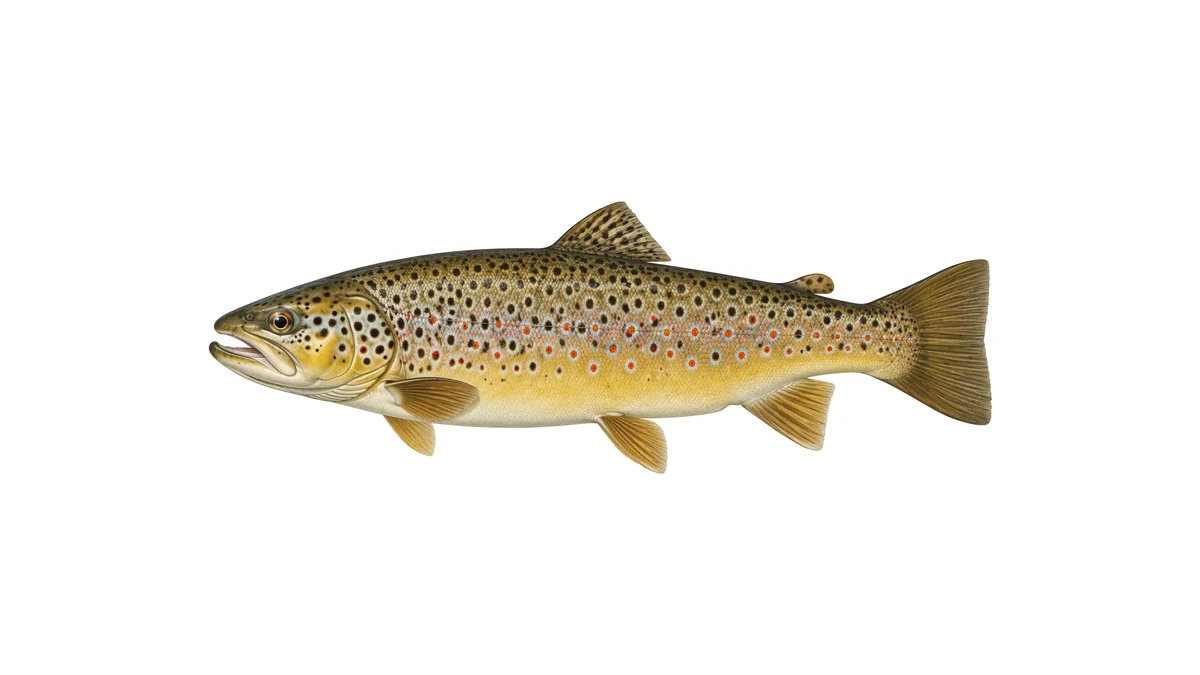
Start with the spots. A brown trout carries dark spots on a light background, and many of those spots are red or orange with pale halos. The spots are irregular, they scatter across the back and sides, and they appear on the gill cover. The tail is the key field mark: a brown trout's tail carries few spots or none, while a rainbow trout's tail is heavily spotted.
The body color shifts with habitat. Fish from dark, peaty water look almost black. Fish from chalk streams and clear rivers are golden brown with butter-yellow bellies. The back is olive to dark brown, the sides fade to gold, and the belly runs yellow to cream. Spawning males darken further and develop a hooked lower jaw.
The tail is square or slightly convex, not deeply forked. The mouth is large, and on big adults the upper jaw extends past the rear of the eye. The scales are small, and the overall build is thicker and more powerful than a brook trout of the same length.
Juveniles, called parr, carry dark vertical bars along the sides and a series of red spots. Parr marks fade as the fish grows. A young brown can be confused with a young Atlantic salmon, which also has parr marks. Location and fin shape help, but positive identification of parr is a job for a biologist.
Brown Trout vs Rainbow Trout
Brown trout and rainbow trout share water across much of the United States, so the comparison comes up constantly. The differences are visible in the hand.
| Feature | Brown trout | Rainbow trout |
|---|---|---|
| Background color | Brown, gold, olive | Silver to green-blue |
| Lateral stripe | None; spots instead | Pink to red stripe along the side |
| Spots | Dark spots with red-orange spots mixed in | Small black spots, often dense |
| Tail | Few or no spots | Heavily spotted |
| Mouth | Large; jaw passes the eye on adults | Smaller; jaw usually ends near the eye |
| Preferred water | Slightly warmer, more tolerant of degraded streams | Colder, cleaner water |
The stripe is the fastest test. A rainbow has a pink or red band running from gill to tail. A brown does not. If the fish also has an unspotted tail and red spots with halos, it is a brown.
Brook trout differ in the opposite direction. A brook trout has light spots on a dark background, plus worm-like markings on the back and white-edged lower fins. A brown trout has dark spots on a light background. Once you see both fish side by side, the pattern is hard to mix up again.
Is the Brown Trout Dangerous?
No. Brown trout are not venomous and have no spines that can hurt a person. Their teeth are small and built for gripping insects and small fish. A hooked fish can scrape a knuckle, but that is the extent of the risk.
The real hazard is handling. Trout are delicate compared with bass or catfish. Their scales are small, their slime coat is thin, and their gills are fragile. A dry hand or a rough landing strips that protection and invites infection. Wet your hands, use a rubber-mesh net, and keep the fish in the water as much as possible. If you lift a trout for a photo, support the belly and keep the fish horizontal. Do not squeeze it or hold it by the jaw.
Range and Habitat
Brown trout are native to Europe, North Africa, and western Asia. They were brought to North America in the 1880s, with the first successful stocking in Michigan in 1883, and they have since been planted across the continent. They are now established in most U.S. states with cold water, in Canada, and in parts of South America, Australia, New Zealand, and Asia. The species is the most widely introduced salmonid in the world.
Where do brown trout live? In cold, clean water with cover. They hold in streams, rivers, tailwaters below dams, and lakes. A good brown trout stream has undercut banks, root wads, log jams, boulders, and deep pools. The fish likes a roof over its head and a current seam nearby. In lakes, browns cruise shorelines, drop-offs, and stream mouths, especially in fall.
Temperature sets the boundaries. Brown trout feed best between about 50°F and 60°F (10–16°C) and stay active from roughly 41°F to 68°F (5–20°C). They tolerate warmer water than brook trout, which is one reason browns have replaced brook trout in many degraded streams. Above the mid-70s Fahrenheit, oxygen drops and the fish struggle.
Brown trout also adapt to still water. Large reservoirs and the Great Lakes produce the biggest fish, because forage is abundant and the growing season is long. Sea-run populations, called sea trout, migrate to salt water in Europe and parts of the Northeast.
Behavior and Diet
What do brown trout eat? Almost anything that fits in the mouth and looks natural. Aquatic insects make up the core diet: mayflies, caddisflies, stoneflies, midges, and nymphs of all kinds. Browns also eat terrestrials such as ants, beetles, and grasshoppers when they fall in. Larger fish add crayfish, sculpins, minnows, and other small fish. Big browns are notorious for taking mice and even small birds at night.
Feeding is tied to light. Brown trout are most active at dawn, dusk, and after dark. In heavily fished water, they often feed only at night. During the day they hold tight to cover and move little. That habit is why a brown trout stream can look empty at noon and come alive at last light.
Browns are ambush feeders. They sit under a bank or behind a boulder, watch a current lane, and take food that drifts past. They rarely chase far. A well-drifted nymph or a natural-looking worm presented without splash catches more fish than a fast retrieve.
When do brown trout spawn? In fall, usually October through December in the northern hemisphere, when water drops into the 40s Fahrenheit. Fish move upstream to gravel riffles. The female cuts a redd with her tail, deposits eggs, and the male fertilizes them. The eggs incubate through winter and hatch in late winter or early spring. Spawning fish are focused on reproduction, not food, and should be left alone where runs are small.
Size, Records and Regulations
How big do brown trout get? Most stream fish run 8–16 inches and half a pound to 3 pounds. A 20-inch brown is a good fish anywhere, and a 5-pounder is a trophy in a small river. Big-river and Great Lakes fish grow much larger. A brown over 20 pounds is exceptional but not unheard of.
The all-tackle world record brown trout is 40 pounds 4 ounces, caught in 1995 on the Little Red River in Arkansas by Howard "Rip" Collins. The fish has stood as the IGFA record for decades. Some larger browns have been caught and released or not entered, but the record book remains the Arkansas fish. State records vary widely, with the biggest fish coming from large tailwaters and the Great Lakes.
Regulations depend on the water. Many states manage wild brown trout with special rules: catch-and-release sections, single-hook or artificial-only water, minimum lengths, and reduced bag limits. Stocked put-and-take fisheries are more liberal. Fall spawning seasons are often closed or restricted on spawning tributaries. Some states protect brown trout in tailwaters year-round.
A fishing license is required, and many states add a trout stamp or permit. The rules on the Little Red River, for example, come from the Arkansas Game and Fish Commission. Other waters fall under their own state agencies. Do not assume the rule from one river carries to the next. Check the current regulation booklet or website for the water you plan to fish. Last verified: November 2025.
FAQ
How big do brown trout get? Most adults are 8–16 inches and under 3 pounds. Fish over 20 inches and 5 pounds are trophies, and exceptional browns pass 20 pounds in big rivers and lakes.
What is the world record brown trout? A 40-pound 4-ounce brown trout caught by Howard "Rip" Collins on Arkansas's Little Red River in 1995. It remains the IGFA all-tackle record.
What do brown trout eat? Aquatic insects, especially mayflies, caddisflies, and stoneflies, plus terrestrials, crayfish, sculpins, minnows, and other small fish. Large browns also take mice at night.
Where do brown trout live? In cold streams, rivers, tailwaters, and lakes across North America and much of the world. They favor cover: undercut banks, logs, boulders, deep pools, and current seams.
What is the difference between a brown trout and a rainbow trout? A brown has dark spots on a light brown or gold body, red spots with halos, and few or no spots on the tail. A rainbow has a pink lateral stripe, dense black spots, and a spotted tail.
When do brown trout spawn? In fall, usually October through December, when water falls into the 40s Fahrenheit. Fish move upstream to gravel riffles and cut redds.
What is the best bait for brown trout? Nightcrawlers, worms, and salmon eggs work where bait is legal. Spinners, spoons, minnow plugs, and flies also catch fish. In clear water, natural presentations and light line matter more than the bait itself.
How do you catch a brown trout? Fish low light, stay out of sight, and cast upstream to cover. Drift nymphs or bait naturally through pools and undercut banks, and work streamers or spinners along current seams. In pressured water, fish at night.
The brown trout rewards patience more than power. It is not the biggest fish in the river or the easiest to catch, but it is one of the most satisfying. Fish quietly, handle it wet, and release the big ones. The next generation of smart browns depends on it.
Related Articles
- Brook Trout — the native char of cold eastern streams, often found upstream of browns.
- Lake Trout — a deep-water char that shares northern lakes.
- Cutthroat Trout — a western native with a red slash under the jaw.
- Paddlefish — an ancient filter feeder of big rivers.
- All species profiles
Ready to catch one? Read our step-by-step guide: How to Catch Brown Trout.
About the author and how this was tested
About the author
FishermanGuy
Bank, boat and kayak angler · fishing, crabbing and shrimping since 2021
I buy the gear, fish it for a season and write down what failed. No sponsored verdicts, no free-sample flattery. Every rig on this page has landed fish in water I can point at on a map.
How this was tested
- Every rig gets at least six trips on the same water before it is published.
- Gear is bought at retail. Free samples are labelled in the first paragraph.
- Dates show first publication and the last time the page was updated.