Field notes
Lake Trout: Identification, Habitat & Diet
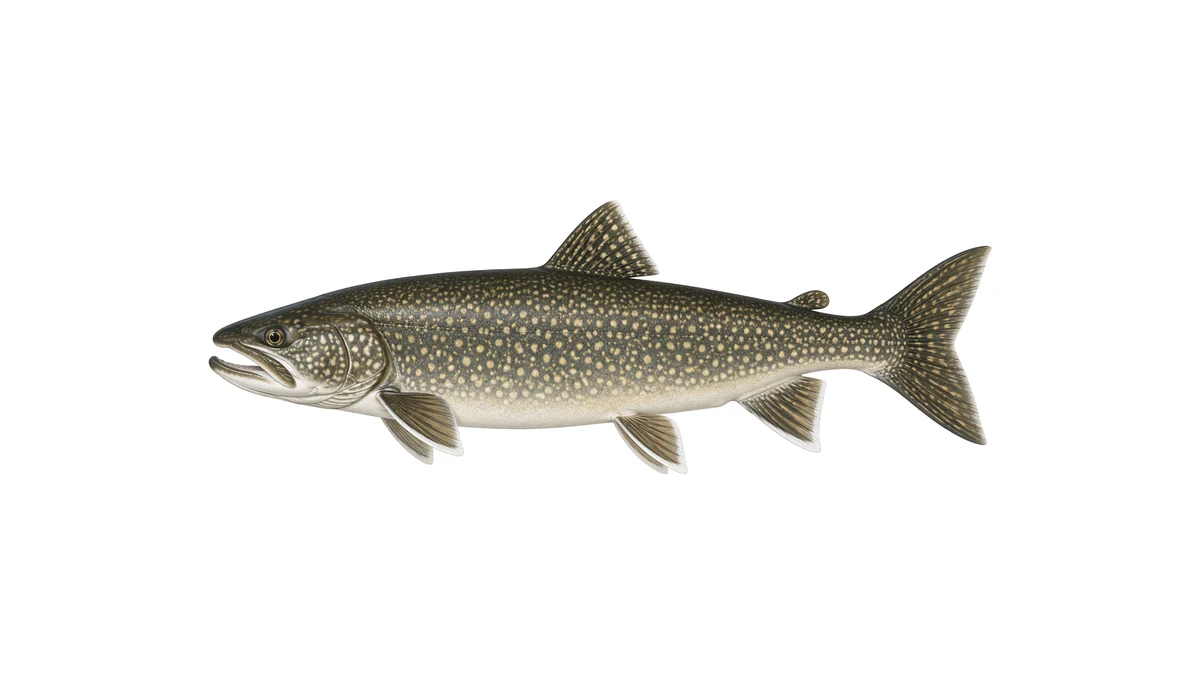
Lake Trout: Identification, Habitat & Diet
The lake trout is the biggest native char in North America, and it lives in some of the coldest, deepest water on the continent. Anglers know it as the mackinaw, the grey trout, or the togue. It is not a true trout at all. It belongs to the char genus Salvelinus, along with brook trout and Arctic char. Lake trout grow slowly, live for decades, and spend summer far below the surface, which makes them a puzzle for anyone used to casting at banks. This profile covers lake trout identification, habitat, diet, size, records, spawning, regulations, and how to catch one.
Quick ID Card
| Field | Details |
|---|---|
| Scientific name | Salvelinus namaycush |
| Common names | Lake trout, mackinaw, grey trout, togue, siscowet (fat form in Lake Superior) |
| Family | Salmonidae, genus Salvelinus (chars) |
| Typical size | 18–30 inches, 2–10 lb |
| Trophy size | 30+ inches, 15+ lb; giants over 40 lb |
| Water type | Large, deep, cold, clear lakes with high oxygen |
| Active water temperature | 40–55°F (4–13°C); best around 45–50°F |
| Difficulty | Moderate to hard; deep water, specialized tackle |
| Best season | Spring and fall near shore; summer deep; winter through the ice |
How to Identify a Lake Trout
The tail is the first thing to check. A lake trout has a deeply forked tail, more like a salmon than a brook trout. That fork separates it from the square tail of a brook trout and the slightly convex tail of a brown.
The body is long and torpedo-shaped, with a dark olive, gray, or greenish back and a pale belly. Light spots cover the back and sides, the same light-on-dark pattern as a brook trout, but the lake trout lacks the brook trout's red spots and worm-like markings. Some fish show faint orange or yellow on the lower fins, but the overall look is silvery-gray rather than painted.
The lower fins have a white leading edge, but there is no black stripe behind it. That black stripe is a brook trout mark. The lake trout's mouth is large, and the head is more pointed than a brook trout's. Big adults can look almost shark-like in the water.
Juveniles are slimmer and more silver, and they can be mistaken for other char or small salmon. The forked tail and the light spots on a dark body are the steady clues.
Lake Trout vs Brook Trout
Both are chars, so the comparison is natural. Size and habitat do most of the separating, but the field marks are clear.
| Feature | Lake trout | Brook trout |
|---|---|---|
| Tail | Deeply forked | Square or slightly forked |
| Size | Commonly 2–10 lb, up to 40+ lb | Commonly under 1 lb in streams, 2–4 lb in lakes |
| Body markings | Light spots, no red spots or worming | Light spots, red spots, worm-like markings |
| Lower fins | White edge, no black stripe | White edge with a black stripe behind it |
| Habitat | Deep, cold lakes | Cold streams, spring seeps, shallow lake edges |
| Growth | Slow, lives for decades | Faster, shorter-lived |
The forked tail is the fastest test on a big fish. A 10-pound char with a deeply forked tail is a lake trout. A 10-pound char with a square tail and red spots is a brook trout, and a very unusual one at that.
Lake trout also differ from brown trout and rainbow trout. Those fish have dark spots on a light body. Lake trout have light spots on a dark body. Once you see the pattern, the family tree makes sense.
Is the Lake Trout Dangerous?
No. Lake trout are not venomous and have no dangerous spines. Their teeth are sharp enough to cut a finger, and a big fish thrashing in a boat can drive a hook into a hand, but the species itself is harmless.
The bigger issue is barotrauma. Lake trout are often caught in deep water, and a fish pulled quickly from 100 feet can suffer internal injury from expanding gas. If you plan to release deep-caught fish, reel slowly, use single hooks where allowed, and be ready to vent or use a release device only if you know the technique and the rules. Many fisheries now encourage keeping a legal fish rather than releasing one that may not survive.
Handle lake trout with a wet hand or net, support the body, and avoid the gills. They are tough fish, but a long fight in warm surface water is hard on them.
Range and Habitat
Lake trout are native to northern North America. Their range covers most of Canada, from Labrador to British Columbia, plus Alaska and the Great Lakes. They are not native to the lower 48 outside the Great Lakes basin, but stocking has moved them into deep reservoirs and lakes across the West, including the famous trophy fishery at Flaming Gorge Reservoir on the Utah-Wyoming border.
Lake trout habitat means cold, deep, oxygen-rich water. They need lakes with a summer thermocline that holds a band of 45–55°F water, and they need rocky substrate for spawning. Shallow, warm, weedy lakes do not support them. Oligotrophic lakes, with clear water and low nutrient levels, are ideal.
Where do lake trout live in summer? Deep. In big lakes they often sit 60–200 feet down, following the temperature and the baitfish. In spring and fall, when the surface cools, they move shallow and can be caught near shore, over rocky points, and around islands. In winter, ice anglers target them over deep structure.
The Great Lakes once held enormous lake trout populations. Sea lamprey invasion, overfishing, and habitat change crashed them in the mid-1900s. Restoration stocking and lamprey control have brought some populations back, but the fish remains a management priority. In Lake Superior, a fat morph called the siscowet lives deeper and grows slower than the lean form.
Behavior and Diet
What do lake trout eat? Fish, mostly. Ciscoes, whitefish, smelt, sculpins, alewives, and perch form the core diet in big lakes. Lake trout also eat large invertebrates, and big adults are cannibalistic. They are top predators in the cold-water zone, and their diet shifts toward fish as they grow.
Lake trout are slow growing and late to mature. A fish may take 6–8 years to spawn for the first time, and some live 30 years or more. That life history makes populations vulnerable to overharvest. A trophy fish is old, often older than the angler who catches it.
Feeding happens in low light, often at dawn, dusk, and through the night. Lake trout chase baitfish schools and ambush prey around structure. In summer, they follow the thermocline and the bait. In fall, they move shallow to spawn and feed heavily.
When do lake trout spawn? In fall, usually September through November, when water drops into the mid-40s to low 50s Fahrenheit. There is no nest. Fish gather over rocky shoals, reefs, and rubble, and the female broadcasts eggs that settle into crevices. The eggs incubate through winter. Spawning fish are vulnerable to angling, and many states restrict or close fall fishing on spawning reefs.
Size, Records and Regulations
How big do lake trout get? Most adults run 18–30 inches and 2–10 pounds. A 30-inch, 15-pound fish is a trophy in most waters. Giants over 40 pounds come from a handful of northern lakes and western reservoirs.
The all-tackle world record lake trout is 72 pounds, caught in 1995 on Great Bear Lake in Canada's Northwest Territories by Lloyd Bull. That fish is the benchmark for the species. Flaming Gorge Reservoir has produced fish over 50 pounds, and it is one of the best trophy lake trout fisheries in the lower 48.
Regulations vary widely because lake trout populations differ so much. Native populations in the Great Lakes and Canada are managed with quotas, seasons, and size limits. Some lakes are closed to lake trout fishing entirely. Western reservoirs often encourage harvest of smaller fish to improve growth rates and protect forage.
In the Great Lakes, each state and province sets its own rules, and the U.S. Fish and Wildlife Service and tribal agencies also play a role. In western reservoirs, the state wildlife agency manages the fishery. Check the current rules for the specific lake, including depth restrictions and gear limits. Last verified: November 2025.
FAQ
How big do lake trout get? Most adults are 18–30 inches and 2–10 pounds. Fish over 30 inches and 15 pounds are trophies, and exceptional lake trout pass 40 pounds.
What is the world record lake trout? A 72-pound fish caught by Lloyd Bull on Great Bear Lake, Northwest Territories, Canada, in 1995. It remains the IGFA all-tackle record.
What do lake trout eat? Mostly fish: ciscoes, whitefish, smelt, sculpins, alewives, and perch. They also eat large invertebrates, and big adults eat smaller lake trout.
Where do lake trout live? In deep, cold, oxygen-rich lakes across northern North America, including the Great Lakes, Canada, and Alaska, plus stocked western reservoirs such as Flaming Gorge.
What is the difference between a lake trout and a brook trout? A lake trout has a deeply forked tail, grows much larger, and lacks red spots and the brook trout's white-and-black lower fin edge. A brook trout has a square tail and red spots with blue halos.
When do lake trout spawn? In fall, usually September through November, over rocky shoals and reefs. They scatter eggs with no nest, and the eggs incubate through winter.
What is the best bait for lake trout? Big spoons, plugs, and swimbaits trolled deep or jigged with tube jigs. Sucker meat and other cut bait work where legal. Ice anglers use heavy jigs tipped with bait.
How do you catch a lake trout? Find the thermocline and the baitfish, then troll deep with downriggers or jig heavy spoons and tube jigs. In spring and fall, fish shallow rocky structure. In winter, ice fish over deep points and reefs. Reel deep fish slowly if you plan to release them.
The lake trout is a relic of the ice age that still rules the deep water. It grows old, grows big, and asks for patience. Learn the temperature band, find the bait, and fish slowly. Then release the old ones so the lake keeps its giants.
Related Articles
- Brook Trout — the smaller char of cold streams and shallow lake edges.
- Brown Trout — a wary trout of rivers and lakes.
- Cutthroat Trout — a western native with a red slash under the jaw.
- Paddlefish — an ancient filter feeder of big rivers.
- All species profiles
Ready to catch one? Read our step-by-step guide: How to Catch Lake Trout.
About the author and how this was tested
About the author
FishermanGuy
Bank, boat and kayak angler · fishing, crabbing and shrimping since 2021
I buy the gear, fish it for a season and write down what failed. No sponsored verdicts, no free-sample flattery. Every rig on this page has landed fish in water I can point at on a map.
How this was tested
- Every rig gets at least six trips on the same water before it is published.
- Gear is bought at retail. Free samples are labelled in the first paragraph.
- Dates show first publication and the last time the page was updated.