Field notes
Brook Trout: Identification, Habitat & Diet
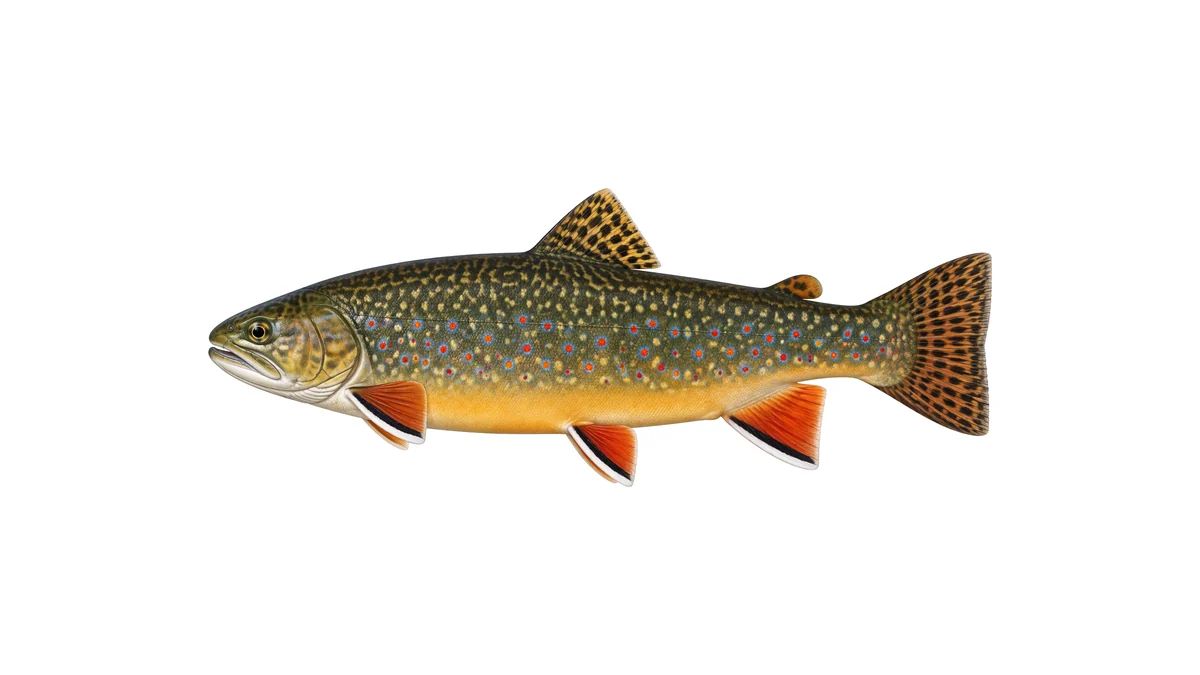
Brook Trout: Identification, Habitat & Diet
The brook trout is the most colorful fish in many eastern streams, and one of the most demanding. It needs cold water, clean gravel, and high oxygen. Where those conditions exist, it wears a pattern of olive worms, red dots, and white-tipped fins that looks painted on. Where they fail, it disappears. That sensitivity is why anglers treat a native brook trout stream as a sign of a healthy watershed. This profile covers brook trout identification, habitat, diet, size, records, spawning, regulations, and how to catch one.
Quick ID Card
| Field | Details |
|---|---|
| Scientific name | Salvelinus fontinalis |
| Common names | Brook trout, brookie, speckled trout, squaretail, speck, coaster (Great Lakes form), salter (sea-run form) |
| Family | Salmonidae, genus Salvelinus (chars) |
| Typical size | 6–10 inches in small streams; 12–16 inches in lakes and big water |
| Trophy size | 18+ inches; the record is far larger |
| Water type | Cold, clear, high-gradient streams, spring seeps, beaver ponds, and cold lakes |
| Active water temperature | 41–68°F (5–20°C); best below 65°F |
| Difficulty | Easy to catch where abundant, but fragile and sensitive to handling |
| Best season | Spring and fall; ice fishing on northern lakes |
How to Identify a Brook Trout
The pattern is the giveaway. A brook trout has light markings on a dark background, the reverse of a brown trout. The back and upper sides are dark olive to green-brown, covered with pale, worm-like squiggles called vermiculations. Below the lateral line, red spots with blue halos scatter across the flank. The belly ranges from pale yellow to bright orange, especially on spawning males.
Look at the lower fins. The pectoral, pelvic, and anal fins have white leading edges, and just behind the white sits a black stripe. That white-and-black edge is one of the most reliable brook trout marks. The tail is square or slightly forked, which is why the fish is called a squaretail in parts of Canada and New England.
The body is streamlined and the head is large relative to the body. The mouth is smaller than a brown trout's, and the upper jaw usually ends near the eye. Spawning males develop a hooked lower jaw, a deep orange belly, and brighter fins.
Juveniles carry parr marks, dark vertical bars that fade with age. A young brook trout still shows the light worming and the white-edged fins, which separate it from young browns and rainbows.
Brook Trout vs Brown Trout
These two share a lot of water, but they are different animals with different needs. The table below covers the marks that matter in the field.
| Feature | Brook trout | Brown trout |
|---|---|---|
| Background | Dark olive-green | Light brown to gold |
| Spot pattern | Light spots and worm-like markings on dark | Dark spots on light, plus red-orange spots |
| Red spots | Yes, with blue halos | Yes, but usually fewer and less haloed |
| Lower fins | White edge with a black stripe behind it | No striking white-black edge |
| Tail | Square or slightly forked | Square or slightly convex, unspotted |
| Water needs | Coldest, cleanest, highest oxygen | Slightly warmer, more tolerant of degraded water |
| Origin in the U.S. | Native to the East | Introduced from Europe |
The rule of thumb is simple: light spots on a dark fish point to a brook trout; dark spots on a light fish point to a brown. Habitat tells the rest. Brook trout hold the coldest headwaters and spring seeps. Browns dominate farther downstream, where water warms and habitat degrades.
Brook trout also differ from lake trout, their larger cousin. A lake trout grows much bigger, has a deeply forked tail, and lacks the brook trout's white-edged fins and red spots. Both are chars, but they are built for different water.
Is the Brook Trout Dangerous?
No. Brook trout are harmless to people. They have small teeth, no venom, and no spines. The only risk is to the fish. Brook trout are delicate, and a careless release can kill one even if it swims away.
Keep the fish in the water. Wet your hands or use a rubber net. Avoid touching the gills and eyes, and do not hold the fish with dry hands or let it flop on rocks. In warm weather, fight fish quickly and release them without lifting them for photos. A brook trout that is out of the water for thirty seconds in July may not survive, even if it kicks away.
Range and Habitat
Brook trout are native to eastern North America. Their historic range ran from Labrador and Quebec south along the Appalachians to Georgia, and west through the Great Lakes and upper Mississippi basin. They were the dominant trout in countless cold streams before logging, dams, and introduced species changed the landscape.
Today, native brook trout populations survive mostly in headwater streams, spring-fed creeks, and remote lakes. The species has also been stocked widely. It now lives in western North America, Europe, South America, and New Zealand. In parts of the West, introduced brook trout compete with native cutthroat and bull trout, which creates management problems.
Brook trout habitat is narrow and specific: cold, clean, well-oxygenated water with gravel bottoms and stable flow. Spring seeps and groundwater-fed channels are prime. The fish needs water below about 68°F (20°C) and does best at 50–60°F. It is sensitive to silt, acid rain, and rising temperatures. A stream that loses its shade or its spring flow usually loses its brook trout.
Where do brook trout live in bigger water? In cold lakes, beaver ponds, and the lower reaches of clean rivers. Great Lakes populations, called coasters, move between lake and tributary. Sea-run populations, called salters, live along the North Atlantic coast. Both forms grow larger than stream fish because they feed in richer water.
Behavior and Diet
What do brook trout eat? Aquatic insects first: mayflies, caddisflies, stoneflies, and midges in all stages. The fish also eats terrestrial insects, worms, crayfish, amphipods, and small fish. Big brook trout in lakes and rivers become predatory and eat minnows, smelt, and even small frogs or mice.
Brook trout are aggressive for their size. They rise readily to dry flies, hit small spinners, and take bait without much hesitation. That eagerness is why they are a favorite first trout for new anglers. It also makes them vulnerable to overharvest in small streams.
They hold in current seams, plunge pools below riffles and waterfalls, undercut banks, and the tails of pools. In beaver ponds they cruise the edges and sit near structure. In lakes they gather around spring holes, inlet streams, and rocky shoreline.
When do brook trout spawn? In fall, usually September through November, when water drops into the 40s Fahrenheit. Fish move upstream to gravel riffles with good groundwater flow. The female cuts a redd, lays eggs, and the male fertilizes them. The eggs overwinter in the gravel and hatch in late winter or early spring. Spawning fish are easy to spot and easy to disturb, so leave them alone.
Size, Records and Regulations
How big do brook trout get? In small streams, most adults are 6–10 inches. A 12-inch brookie is a good fish in tight water. In lakes, beaver ponds, and large rivers, fish reach 14–20 inches and 2–4 pounds. The world record is a different scale entirely.
The all-tackle world record brook trout is 14 pounds 8 ounces, caught in 1916 on the Nipigon River in Ontario, Canada. The fish has held the record for more than a century. Modern trophy brook trout come from large northern lakes, Labrador rivers, and a few big spring creeks, but fish over 5 pounds are rare.
Regulations reflect the species' fragility. Many states protect native brook trout with catch-and-release rules, artificial-lure-only sections, and closed spawning seasons. Some set minimum lengths or reduced bag limits on wild trout streams. Stocked fisheries are managed more liberally.
Because brook trout are native in the East and often stocked in the West, the rules differ by region. In the eastern native range, the emphasis is conservation. In western waters, brook trout may be managed as an introduced species, and some agencies ask anglers not to spread them into native cutthroat water.
A license is required, and many states add a trout stamp. The agency that manages the water is the authority, whether that is a state fish and wildlife department, a provincial ministry, or a national park. Check the current rules for the exact stream or lake before you fish. Last verified: November 2025.
FAQ
How big do brook trout get? Stream fish typically run 6–10 inches. Lake and big-river fish reach 14–20 inches and 2–4 pounds. The world record is 14 pounds 8 ounces.
What is the world record brook trout? A 14-pound 8-ounce fish caught on Ontario's Nipigon River in 1916. It remains the IGFA all-tackle record.
What do brook trout eat? Aquatic and terrestrial insects, worms, crayfish, amphipods, and small fish. Large fish in lakes and rivers become more predatory.
Where do brook trout live? In cold, clean, oxygen-rich streams, spring seeps, beaver ponds, and lakes across eastern North America, plus stocked waters in the West and around the world. They need water below about 68°F.
What is the difference between a brook trout and a brown trout? A brook trout has light spots and worm-like markings on a dark body, red spots with blue halos, and white-edged lower fins. A brown trout has dark spots on a light body and no white-black fin edge.
When do brook trout spawn? In fall, usually September through November, when water falls into the 40s Fahrenheit. They cut redds in gravel riffles with groundwater flow.
What is the best bait for brook trout? Worms, waxworms, and small salmon eggs work where bait is legal. Small spinners, spoons, and flies are effective. In tiny streams, a single worm drifted through a pool is hard to beat.
How do you catch a brook trout? Fish small streams and spring creeks with light tackle, stay low, and cast upstream. Drift bait or nymphs through pools and current seams, or cast tiny spinners and dry flies. In lakes, fish near inlets and springs, and ice fish in winter where legal.
A brook trout is a measure of the water it lives in. Find a stream with native fish and you have found cold, clean water that still works the way it should. Keep a few where rules allow, release the rest, and protect the shade and springs that keep them alive. The fish will do the rest.
Related Articles
- Brown Trout — the wary European transplant that often lives downstream.
- Lake Trout — the giant char of deep northern lakes.
- Cutthroat Trout — a western native with a red slash under the jaw.
- Paddlefish — an ancient river filter feeder.
- All species profiles
Ready to catch one? Read our step-by-step guide: How to Catch Brook Trout.
About the author and how this was tested
About the author
FishermanGuy
Bank, boat and kayak angler · fishing, crabbing and shrimping since 2021
I buy the gear, fish it for a season and write down what failed. No sponsored verdicts, no free-sample flattery. Every rig on this page has landed fish in water I can point at on a map.
How this was tested
- Every rig gets at least six trips on the same water before it is published.
- Gear is bought at retail. Free samples are labelled in the first paragraph.
- Dates show first publication and the last time the page was updated.