Field notes
Paddlefish: Identification, Habitat & Diet
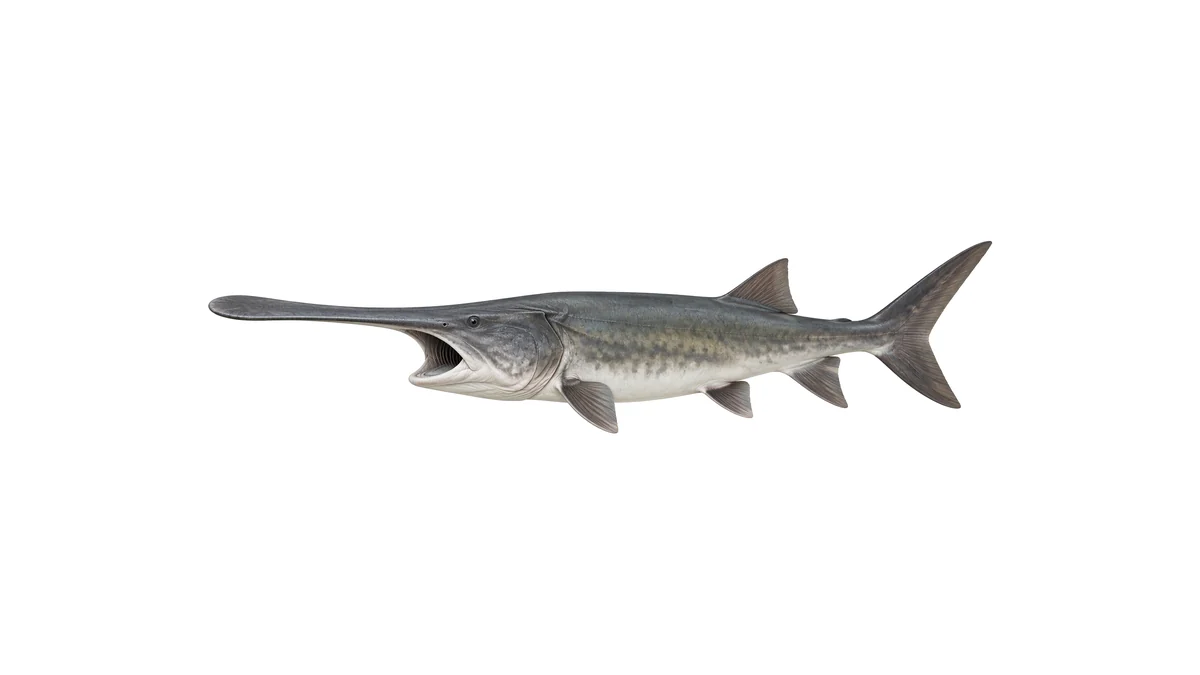
Paddlefish: Identification, Habitat & Diet
The paddlefish is one of the strangest fish in North American fresh water, and one of the oldest. It has no scales worth mentioning, no real teeth as an adult, and a snout shaped like a boat paddle. It filters plankton instead of chasing prey, which means it will not eat a lure, a worm, or anything else an angler dangles in front of it. That single fact changes how people fish for paddlefish, and it is the reason the species has its own special seasons in several states. This profile covers paddlefish identification, habitat, diet, size, spawning, caviar, regulations, and how to catch one legally.
Quick ID Card
| Field | Details |
|---|---|
| Scientific name | Polyodon spathula |
| Common names | Paddlefish, spoonbill, spoonbill catfish, duck-billed catfish |
| Family | Polyodontidae (paddlefishes), order Acipenseriformes |
| Typical size | 4–6 ft (1.2–1.8 m), 30–60 lb |
| Trophy size | 6+ ft and over 100 lb |
| Water type | Large free-flowing rivers, deep pools, oxbows, and some reservoirs |
| Active water temperature | Roughly 50–80°F (10–27°C); spawning triggered near 55–60°F |
| Difficulty | Specialized; not a bait fish, and snagging rules vary by state |
| Best season | Spring, during the upstream spawning run |
How to Identify a Paddlefish
The rostrum settles it. A paddlefish has a long, flat, spatula-shaped snout that can run a third of the fish's total length. Nothing else in North American fresh water looks like that. The snout is not a weapon or a shovel. It is a sensory organ packed with electroreceptors that detect the faint electrical fields of tiny prey.
Behind the paddle, the body is shark-like and smooth. Paddlefish skin carries only tiny, scattered scales, so the fish feels like wet rubber rather than a scaled game fish. The color is usually blue-gray to olive on the back, fading to white underneath. The tail is heterocercal, meaning the upper lobe is longer than the lower one, much like a shark's tail.
The mouth is huge and toothless in adults. It opens wide under the snout and works like a net. Inside, long gill rakers strain food from the water. A paddlefish swimming with its mouth open looks like it is yawning, but it is feeding.
Juveniles are easy to overlook. Young fish have a shorter paddle and a more normal-looking head, and they can be mistaken for other river fish at a glance. The smooth skin, shark-like tail, and cartilaginous skeleton are the giveaways.
Paddlefish vs Sturgeon
Paddlefish and sturgeon are distant relatives, both survivors of the ancient order Acipenseriformes. Anglers confuse them because both are big, primitive-looking river fish. The differences are clear once you know where to look.
| Feature | Paddlefish | Sturgeon |
|---|---|---|
| Snout | Long, flat, paddle-shaped | Pointed or blunt, no paddle |
| Barbels | None | Four barbels in front of the mouth |
| Mouth | Huge, gaping, under the paddle | Small, protrusible, on the underside |
| Body armor | Smooth skin, tiny scattered scales | Five rows of bony scutes |
| Feeding | Filters zooplankton | Roots on the bottom for invertebrates and fish |
| Tail | Shark-like, upper lobe longer | Shark-like, upper lobe longer |
The barbels are the fastest test. A sturgeon has four whisker-like barbels dangling in front of a small, sucking mouth. A paddlefish has no barbels at all and a mouth wide enough to swallow a softball. If the fish has a paddle and no whiskers, it is a paddlefish.
Is the Paddlefish Dangerous?
No. The paddlefish is not venomous, has no spines, and cannot bite a person with anything worse than a gum. Adults have no functional teeth. It is a filter feeder, not a predator.
That said, the fish is large, powerful, and often caught by snagging, which raises the risk to the angler. A treble hook dragged through the water can find a hand as easily as a fish. A thrashing 60-pound paddlefish in a small boat can break tackle, bruise shins, and throw hooks. Wear gloves, keep the net ready, and control the fish before you touch it.
Handle a paddlefish by supporting the body and avoiding the gill covers and the base of the tail. Do not lift a big fish by the paddle; the rostrum is not a handle. If you are releasing the fish, keep it in the water, remove the hook quickly, and revive it before letting go.
Range and Habitat
The paddlefish is native to the Mississippi River basin and its major tributaries. Its historic range took in the Missouri, Ohio, and Mississippi drainages, from Montana and North Dakota south to Louisiana and east to Alabama and Pennsylvania. It lived in roughly two dozen states. Today, wild populations are concentrated in the Mississippi and Missouri river systems, with smaller populations in the Ohio and several southern rivers.
Paddlefish habitat is big water with current and depth. The fish prefers large rivers with deep pools, slow eddies, and wide backwaters. It also lives in oxbow lakes and in some reservoirs, where it can grow fat on plankton but often fails to reproduce. Free-flowing river reaches with gravel bars are the key to spawning. Dams block migration and cut off the upstream runs the species depends on, which is a major reason paddlefish have declined across much of the range.
Water temperature shapes movement. Paddlefish become active in spring as water warms into the 50s and 60s Fahrenheit. In summer they spread through the river channel and feed in the current. In winter they gather in deep holes and slow down.
Water quality matters less than flow, but silt and pollution still take a toll. The species is long-lived and slow to mature, so populations recover slowly from overharvest and habitat loss. Several states list paddlefish as a species of concern, and some waters are closed to harvest entirely.
Behavior and Diet
What do paddlefish eat? Almost entirely zooplankton, the tiny drifting animals and larvae suspended in the water. Daphnia, copepods, insect larvae, and small shrimp make up most of the diet. The fish swims with its mouth open, often in slow, steady runs, and strains food through its gill rakers. It also uses the electroreceptors on its paddle to sense swarms of plankton and possibly to navigate.
Because it feeds on creatures too small to see, a paddlefish has no interest in bait. It does not chase minnows, take worms, or strike spoons. Anglers who catch one on a rod and reel almost always snag it by accident while fishing for something else, usually a catfish or a sturgeon.
Paddlefish are built for current. They cruise the channel, hold in deep pools, and move upstream when conditions change. They are not territorial in the way bass or pike are. They school loosely at times, especially in winter and during spawning runs.
When do paddlefish spawn? The run begins in spring, usually from March into May, when water reaches about 55–60°F (13–16°C). Fish move upstream to gravel bars and rocky riffles in free-flowing reaches. Females scatter eggs over the bottom, and the eggs stick to gravel and debris. There is no nest and no parental care. Fish may skip spawning in years when flows or temperatures are wrong, and females can live for decades, spawning only a handful of times. That slow cycle is why paddlefish populations are fragile.
Size, Records and Regulations
How big do paddlefish get? Most adults run 4–6 feet and 30–60 pounds. A fish over 6 feet and 100 pounds is a trophy. The largest paddlefish on record reach about 7 feet (2.2 m) and close to 200 pounds (90 kg), though fish that size are rare today.
Record keeping is complicated. Many paddlefish are taken by snagging, and IGFA does not recognize snagged fish for world records. State agencies often keep their own records, and some list snagged and fair-caught fish separately. If a record matters to you, read the state's rules before you go; the numbers vary and change.
Regulations are where paddlefish fishing gets serious. Because the fish is slow to mature and vulnerable to overharvest, states regulate it closely. Common tools include closed seasons, limited snagging seasons, daily limits of one or two fish, minimum lengths, and mandatory reporting. Some states prohibit harvest altogether.
Snagging is legal only in specific seasons and waters. Missouri, for example, allows spring snagging for paddlefish on parts of the Missouri and Mississippi rivers, usually from mid-March through April, with strict limits. Other states run similar spring seasons, and some allow bowfishing. Carrying a snagged paddlefish out of season, or keeping one from closed water, can bring a heavy fine.
Paddlefish roe is sold as caviar, and that trade drives poaching. Several states tightly control commercial harvest, and illegal caviar trafficking is a real enforcement issue in the Mississippi basin. If you plan to keep a paddlefish, know the rules for the exact water you are on. The state fish and wildlife agency is the authority. Last verified: November 2025.
FAQ
How big do paddlefish get? Most adults are 4–6 feet and 30–60 pounds. Exceptional fish reach about 7 feet and close to 200 pounds, but fish over 100 pounds are uncommon today.
What is the difference between a paddlefish and a sturgeon? A paddlefish has a long paddle-shaped snout, no barbels, and a huge filter-feeding mouth. A sturgeon has a pointed snout, four barbels, a small ventral mouth, and rows of bony scutes.
What do paddlefish eat? Zooplankton, mainly tiny crustaceans and insect larvae, strained from the water through gill rakers. They do not eat bait, fish, or lures.
Where do paddlefish live? In large rivers, deep pools, oxbows, and some reservoirs of the Mississippi River basin, from Montana and the Dakotas south to Louisiana and east to Alabama. Free-flowing reaches are essential for spawning.
When do paddlefish spawn? In spring, usually March through May, when water reaches about 55–60°F. Fish run upstream to gravel bars in free-flowing rivers and scatter eggs with no nest or parental care.
What is the best bait for paddlefish? There is no bait. Paddlefish are filter feeders and do not take bait or lures. They are caught by legal snagging or bowfishing where allowed, or incidentally on other gear.
How do you catch a paddlefish? Check your state's rules first, then fish a legal spring snagging season with heavy tackle and a large treble hook. Cast into concentrations of fish in deep runs, retrieve steadily, and be ready for a hard fight. Bowfishing is legal in some states.
Is paddlefish caviar legal to sell? Only under state commercial rules. Paddlefish roe is regulated as caviar, and illegal harvest or sale is prosecuted. Recreational anglers should check possession and sale rules before keeping roe.
The paddlefish has survived since the age of the dinosaurs by doing one thing well: filtering the river and staying out of the way. Dams, caviar poaching, and lost spawning runs have pushed it back across much of its range. Learn to identify it, follow the snagging rules, and let the big ones go. A fish this old deserves a few more decades in the current.
Related Articles
- Brown Trout — a cold-water fish of clear rivers and tailwaters.
- Lake Trout — the deep-water giant of northern lakes.
- Cutthroat Trout — a native western trout with a red slash under the jaw.
- Brook Trout — the colorful native char of cold eastern streams.
- All species profiles
Ready to catch one? Read our step-by-step guide: How to Catch Paddlefish.
About the author and how this was tested
About the author
FishermanGuy
Bank, boat and kayak angler · fishing, crabbing and shrimping since 2021
I buy the gear, fish it for a season and write down what failed. No sponsored verdicts, no free-sample flattery. Every rig on this page has landed fish in water I can point at on a map.
How this was tested
- Every rig gets at least six trips on the same water before it is published.
- Gear is bought at retail. Free samples are labelled in the first paragraph.
- Dates show first publication and the last time the page was updated.