Field notes
Alligator Gar: Identification, Habitat & Diet
Alligator Gar: Identification, Habitat & Diet
The alligator gar is the biggest gar in the world and one of the largest freshwater fish in North America. It has a broad, crocodile-like snout, two rows of big teeth, and a body that can pass 8 feet and 300 pounds. It is a living fossil, a river giant, and a fish that state agencies now manage carefully after decades of decline. This profile covers alligator gar identification, habitat, diet, size, the world record, spawning, regulations, and how to fish for one with the right tackle and the right attitude.
Quick ID Card
| Field | Details |
|---|---|
| Scientific name | Atractosteus spatula |
| Common names | Alligator gar, gator gar, gar |
| Family | Lepisosteidae (gars) |
| Typical size | 4–6 feet (1.2–1.8 m), 20–60 lb |
| Trophy size | 7+ feet, 100+ lb |
| Water type | Large rivers, bayous, oxbows, and reservoirs |
| Active water temperature | 70–85°F (21–29°C) |
| Difficulty | High; giant size and heavy tackle required |
| Best season | Spring floods and warm months; summer for big fish |
How to Identify an Alligator Gar
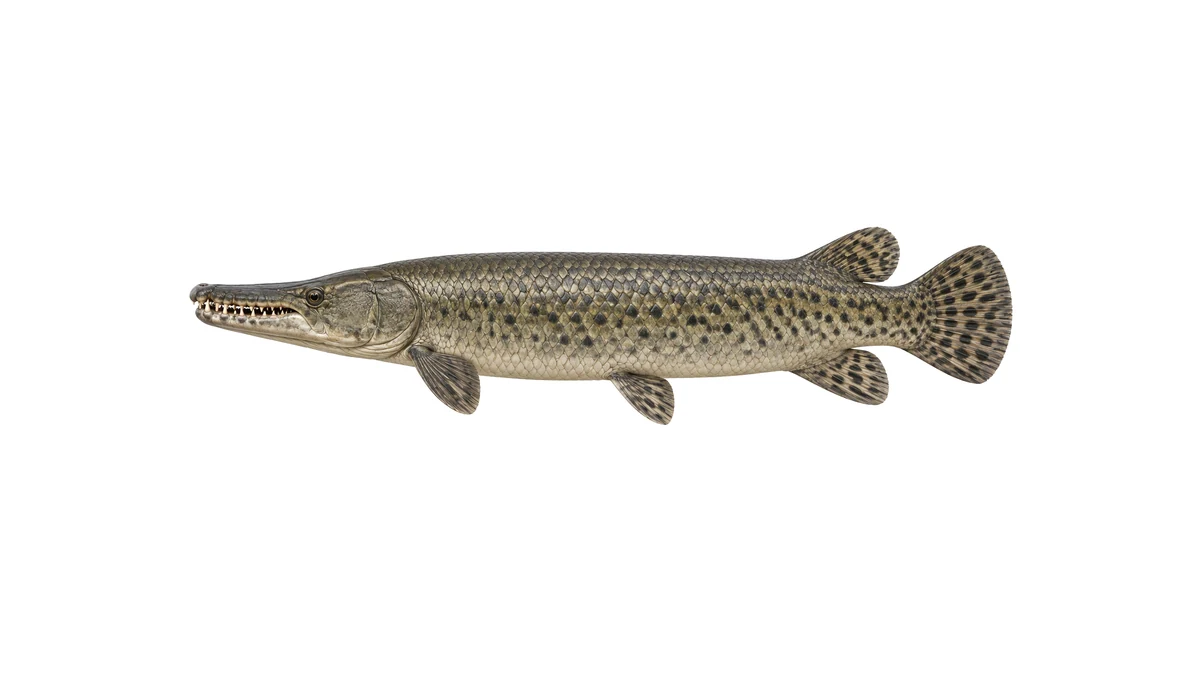
The snout is unmistakable. An alligator gar has a short, broad, blunt snout that looks like an alligator's, not the needle bill of a longnose gar. The upper jaw carries two rows of large, sharp teeth, a feature unique among the gars. The lower jaw is heavy and the head is wide.
The body is massive and cylindrical, covered in thick ganoid scales that feel like armor. Coloration is olive, brown, or grayish on the back, fading to a pale belly, with dark spots scattered over the body and fins. Big adults can look almost uniform, especially in turbid water. The dorsal and anal fins sit far back near the tail, and the tail is rounded.
Size is part of the identification. A 4-foot gar with a broad snout is likely an alligator gar; a 4-foot gar with a needle snout is a longnose. Small alligator gar can be confused with other gars, but the broad bill and the two rows of upper-jaw teeth settle it.
The scales are so hard that they have been used for tools and jewelry. They also make the fish difficult to measure, tag, or fillet, which is one reason alligator gar handling takes planning.
Alligator Gar vs Longnose Gar
These two gars are often compared because they share southern rivers. They are not close in size or build.
| Feature | Alligator gar | Longnose gar |
|---|---|---|
| Snout | Short, broad, alligator-like | Very long, narrow, needle-like |
| Upper jaw teeth | Two rows of large teeth | Single row of sharp teeth |
| Maximum size | About 10 feet (3 m), 300+ lb | About 6 feet (1.8 m); rarely over 30 lb |
| Body | Massive and thick | Slim and cylindrical |
| Range | Lower Mississippi basin and Gulf Coastal Plain | Much of eastern North America |
| Typical weight | 20–100+ lb | 3–10 lb |
If the fish has a bill like a crocodile and teeth in two rows, it is an alligator gar. If it has a bill like tweezers, it is a longnose. The size difference is obvious once you have seen both, but small alligator gar and big longnose gar can overlap in length, so check the snout and teeth.
The spotted gar is another relative in the same waters, but it is much smaller, has a shorter snout than a longnose, and is heavily spotted on the head. It is not a realistic case of mistaken identity for a mature alligator gar.
Is the Alligator Gar Dangerous?
The alligator gar is not venomous, but it is a large predator with serious teeth. A hooked fish can bite, thrash, and roll, and its ganoid scales have sharp edges. Handling a 100-pound gar is a two-person job with heavy gloves, a jaw grip or a tail rope, and a plan for releasing it without injury to fish or angler.
The eggs are toxic to humans and other animals. Gar roe can cause serious illness, and it should never be eaten. The flesh is edible when cleaned properly, but the eggs must be discarded, kept away from pets, and never fed to anyone. Wash your hands after handling a ripe female.
There is also a legal risk. Alligator gar are protected or tightly regulated in much of their range, and killing one without the right permit or in the wrong water can be a violation. Know the rules before you target them, and release big fish whenever possible.
Range and Habitat
The alligator gar is native to the lower Mississippi River basin and the Gulf Coastal Plain, from the Florida panhandle west through Alabama, Mississippi, Louisiana, and Texas, and south into northeastern Mexico. Historically it ranged farther up the Mississippi and Ohio rivers, but populations declined through the twentieth century.
Alligator gar habitat is big, slow water with access to floodplains. Large rivers, oxbows, bayous, backwater lakes, and reservoirs all hold fish. The species needs warm water, abundant prey, and shallow, vegetated areas that flood in spring for spawning. Dams and levees that cut off the floodplain have hurt populations in many rivers.
The fish tolerates low oxygen because it can breathe air. A vascularized swim bladder lets it gulp at the surface, and alligator gar are often seen rolling in quiet backwaters on hot days. That ability helps them survive in stagnant oxbows where other big predators cannot.
Look for alligator gar in deep holes near current, along channel edges, around sunken timber, and in the slack water below dams. Big fish often hold in the same areas year after year. In spring, they move onto flooded flats to spawn.
Outside North America, released aquarium fish have established populations in parts of Asia. That is a reminder that this giant does not belong in every water, and moving live fish between systems is a bad idea.
Behavior and Diet
The alligator gar is an ambush predator built for big prey. It lies in wait near cover or in a current break, then lunges with a sideways snap. The two rows of teeth and powerful jaws hold fish that would escape most predators.
What do alligator gar eat? Fish make up most of the diet: carp, buffalo, shad, mullet, catfish, and other rough fish. Big adults also take waterfowl, turtles, crabs, and small mammals. An alligator gar is opportunistic, and a 6-foot fish can swallow prey that would surprise an angler used to bass.
Feeding is strongest in low light and warm water, but alligator gar also feed during the day in turbid rivers. They are not fast swimmers over long distances. They conserve energy, hold in cover, and strike when prey comes close.
When do alligator gar spawn? Spawning is tied to spring flooding, usually from April into June. Fish move onto flooded vegetation and shallow flats, often at night, and scatter eggs over plants and debris. The eggs are toxic, and the young grow in shallow backwaters. Because females mature late and do not spawn every year, populations recover slowly. That biology is why the species is managed so carefully.
Size, Records and Regulations
Most adult alligator gar run 4–6 feet and 20–60 pounds. A 7-foot fish is a trophy, and the species can reach about 10 feet (3 m) and more than 300 pounds. Females grow larger and live longer than males, and the biggest fish may be decades old; the species can live 50 years or more.
The IGFA all-tackle world record alligator gar is 327 pounds (148 kg), caught in 2011 at Lake Chotard, Mississippi, by Kenny Williams. The fish was over 8 feet long. Other records, including bowfishing records, have produced even heavier fish, but the IGFA mark is the standard rod-and-reel reference.
Regulations are strict and vary by state. Texas, which holds some of the best populations, uses a 48-inch minimum and a one-fish daily limit on most waters, and the state wildlife agency publishes detailed rules by water body. Louisiana, Mississippi, Arkansas, and Alabama all have their own limits, seasons, or protections, and some waters are catch-and-release only. Alligator gar are protected in some states where populations are depleted.
Do not rely on a blog for the rule that applies to your river. Check the current regulations from the agency that manages the water: Texas Parks and Wildlife Department, Louisiana Department of Wildlife and Fisheries, Mississippi Department of Wildlife, Fisheries, and Parks, Arkansas Game and Fish Commission, or the equivalent. Last verified: November 2025.
FAQ
How big do alligator gar get? Most adults are 4–6 feet and 20–60 pounds. Fish over 7 feet and 100 pounds are trophies, and the species can reach about 10 feet (3 m) and more than 300 pounds.
What is the world record alligator gar? The IGFA all-tackle record is 327 pounds (148 kg), caught by Kenny Williams at Lake Chotard, Mississippi, in 2011. Some bowfishing and other records are heavier.
What do alligator gar eat? Mostly fish, including carp, buffalo, shad, mullet, and catfish. Large adults also eat waterfowl, turtles, crabs, and small mammals.
Where do alligator gar live? In large rivers, bayous, oxbows, and reservoirs of the lower Mississippi basin and the Gulf Coastal Plain, from the Florida panhandle through Texas into northeastern Mexico. They need warm water, deep holes, and spring floodplains.
What is the difference between an alligator gar and a longnose gar? The snout and teeth. An alligator gar has a short, broad, alligator-like snout with two rows of large teeth on the upper jaw. A longnose gar has a long, narrow, needle-like snout with a single row of teeth, and it is far smaller.
When do alligator gar spawn? From April to June, when spring floods cover shallow vegetation. They scatter eggs on flooded flats, and the eggs are toxic.
What is the best bait for alligator gar? Live or fresh cut bait such as mullet, carp, or buffalo is the standard. Big swimbaits and rope lures also work. Use heavy braid, a strong leader, and a large circle or J hook.
How do you catch an alligator gar? Fish deep holes and current breaks in big rivers, and present bait on the bottom or under a float. Use tackle rated for a 100-pound fish, keep the drag set, and plan the release before you cast. Handle the fish with gloves and a jaw grip, and keep it in the water as much as possible.
The alligator gar is a relic that survived the dinosaurs and then nearly lost a fight with dams and overharvest. It is back in many rivers because people chose to protect it. Treat every one you meet as a release fish, follow the state rules, and the giants will stay.
Related Articles
- Longnose Gar — the needle-snouted relative that shares southern rivers.
- Spotted Gar — a smaller, heavily spotted gar of the same backwaters.
- Bowfin — another ancient air-breathing predator of the Gulf Coastal Plain.
- All species profiles
Ready to catch one? Read our step-by-step guide: How to Catch Alligator Gar.
About the author and how this was tested
About the author
FishermanGuy
Bank, boat and kayak angler · fishing, crabbing and shrimping since 2021
I buy the gear, fish it for a season and write down what failed. No sponsored verdicts, no free-sample flattery. Every rig on this page has landed fish in water I can point at on a map.
How this was tested
- Every rig gets at least six trips on the same water before it is published.
- Gear is bought at retail. Free samples are labelled in the first paragraph.
- Dates show first publication and the last time the page was updated.