Field notes
Longnose Gar: Identification, Habitat & Diet
Longnose Gar: Identification, Habitat & Diet
The longnose gar is the needle-nosed wanderer of eastern North America. Its snout looks like a pair of forceps, its body is a cylinder of armored scales, and its teeth are made for holding slippery prey. It lives in slow rivers, reservoirs, and even brackish water, and it is far more common than most anglers realize. This profile covers longnose gar identification, habitat, diet, size, spawning, regulations, and how to catch one.
Quick ID Card
| Field | Details |
|---|---|
| Scientific name | Lepisosteus osseus |
| Common names | Longnose gar, needle-nose gar, garfish, gar |
| Family | Lepisosteidae (gars) |
| Typical size | 24–48 inches (61–122 cm), 3–10 lb |
| Trophy size | 54+ inches, 15+ lb |
| Water type | Slow rivers, reservoirs, lakes, and brackish estuaries |
| Active water temperature | 70–85°F (21–29°C) |
| Difficulty | Moderate; hard mouth, sharp teeth, bony scales |
| Best season | Late spring through summer; tailwaters in spring |
How to Identify a Longnose Gar
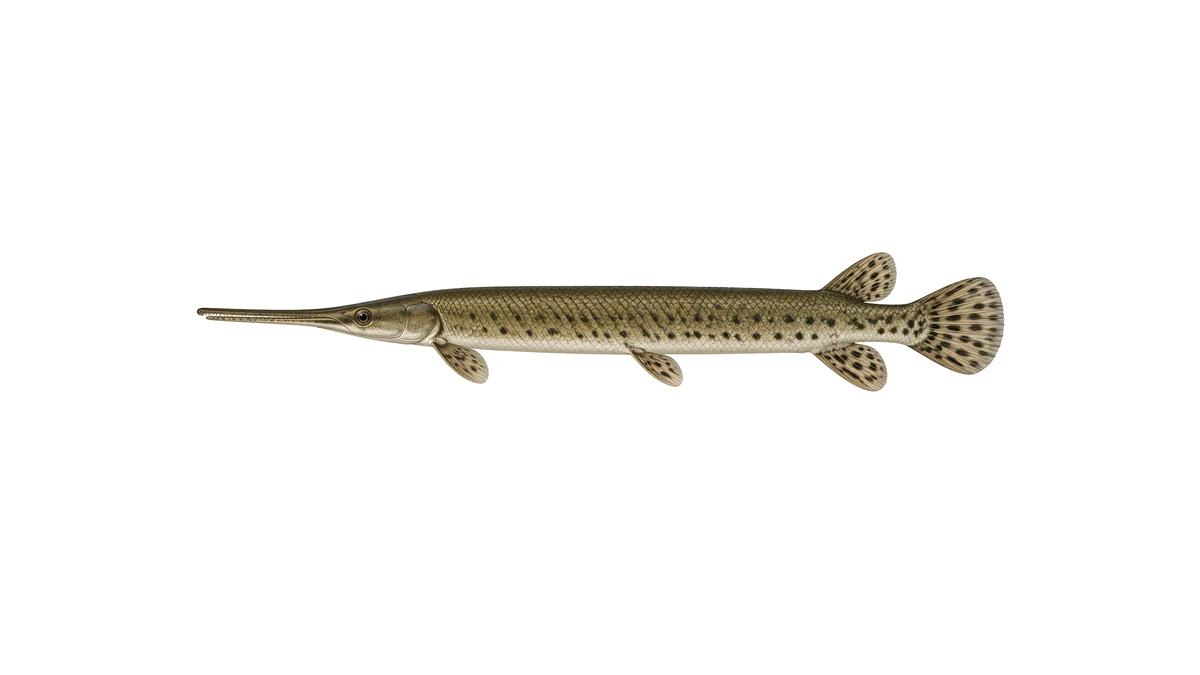
The snout is the whole story. A longnose gar has an extremely long, slender bill, narrow from every angle, lined with rows of sharp teeth. The snout makes up a large share of the head length, and it looks like a beak built for snatching small fish from tight cover. No other gar in most of its range has a snout that long and narrow.
The body is slim and cylindrical, covered in ganoid scales, the hard, diamond-shaped plates that give gars their armored feel. Coloration is olive to brown above, pale below, with dark spots scattered over the body and fins. The spots are usually smaller and less dense than a spotted gar's, and the top of the head is often plain or lightly marked. Young longnose gar carry a dark stripe along the side, which fades with age.
The dorsal and anal fins sit far back near the tail, and the tail fin is rounded. The eyes are large. A longnose gar hanging at the surface in calm water looks like a floating stick until you see the bill.
Size helps but is not decisive. Longnose gar grow much larger than spotted gar, but a small longnose can be confused with a spotted gar. Check the snout shape and the head spots.
Longnose Gar vs Alligator Gar
Both are gars, both have teeth, and both can look prehistoric in a photo. They are very different fish in size, snout shape, and range.
| Feature | Longnose gar | Alligator gar |
|---|---|---|
| Snout | Very long, narrow, needle-like | Short, broad, alligator-like |
| Upper jaw teeth | Single row of sharp teeth | Two rows of large teeth |
| Maximum size | About 6 feet (1.8 m) | Up to about 10 feet (3 m) and 300+ lb |
| Body | Slender | Massive, thick |
| Native range | Broad eastern North America | Lower Mississippi basin and Gulf Coastal Plain |
| Typical weight | 3–10 lb | 20–100+ lb |
The snout settles it. An alligator gar has a wide, blunt bill that looks like a crocodile's snout, with two rows of big teeth on the upper jaw. A longnose gar has a thin bill with a single row of teeth. A longnose gar is also a fish you can handle alone; an alligator gar is not.
The spotted gar is the other common lookalike. It has a shorter, broader snout and heavy spots on top of its head. The longnose has the long bill and a plainer head.
Is the Longnose Gar Dangerous?
The longnose gar is not venomous, but it has real teeth and a hard, bony body. A hooked fish can twist and rake a hand with those needle teeth, and the ganoid scales have sharp edges. Handle gar with a jaw grip or a firm hold behind the head, and keep fingers away from the bill.
The eggs are the hidden danger. Gar roe is toxic to humans and other animals, and eating it can cause serious illness. The flesh is edible when cleaned properly, but the eggs should be discarded, not cooked. Keep roe away from pets and children, and wash your hands after handling a ripe female.
A longnose gar also has a habit of lying still at the surface, which can make it look dead or easy to grab. It is not. Use a net and pliers, and let the fish go if you are not keeping it.
Range and Habitat
The longnose gar has the widest range of the North American gars. It is native from the St. Lawrence River and the Great Lakes through the Mississippi River drainage to the Gulf Coast, and along the Atlantic slope from around Delaware south to Florida. It reaches into northern Mexico and tolerates brackish water in estuaries and coastal rivers.
Longnose gar habitat is slow water with some cover nearby. Rivers, reservoirs, oxbows, lakes, and tidal creeks all hold fish. Unlike the spotted gar, the longnose often uses more open water, including the tailwaters below dams, the edges of channels, and the surface layer over deep water. In spring, fish run upstream and gather below barriers.
The fish tolerates low oxygen and warm water because it can breathe air. A vascularized swim bladder lets it gulp at the surface, which is why longnose gar show up in stagnant backwaters and summer reservoirs where other predators struggle. In hot weather, you may see a gar roll and take air every few minutes.
Cover still matters. Look for longnose gar around weed edges, flooded timber, riprap, bridge pilings, and current seams. In rivers, the slack water behind a wing dam or a sandbar is a good place to start.
Behavior and Diet
The longnose gar is a lie-in-wait predator with a fast strike. It hangs near the surface or at mid-depth, often at an angle, and waits for a school of shad or minnows to drift close. Then it snaps sideways, traps prey on those needle teeth, and works it down head-first.
What do longnose gar eat? Mostly fish: shad, minnows, shiners, sunfish, crappie, and small bass. Crayfish and aquatic insects matter more for young fish. Big longnose gar are capable of taking surprisingly large prey, and they are not shy about feeding at the surface at dusk.
Feeding is best in low light, but longnose gar also feed during the day in shaded or turbid water. They often concentrate where baitfish funnel: below dams, at the mouth of a tributary, along a current seam, or under lights at night.
When do longnose gar spawn? Spawning runs from spring into early summer, usually April to June, when shallow water warms into the 60s and low 70s Fahrenheit. Fish move into vegetated shallows, often in groups, and scatter eggs over plants and debris. The eggs hatch quickly, and the young stay in shallow cover.
Size, Records and Regulations
Most longnose gar run 24–48 inches and 3–10 pounds. A 54-inch fish is a trophy, and the species can reach about 6 feet (1.8 m). Big females are the largest, and fish over 15 pounds are exceptional in most waters.
Record keeping varies. Longnose gar are not a mainstream IGFA category, and many states do not track them separately. Where state records exist, they are measured in tens of pounds. Check the state agency if a record matters to you.
Regulations differ by state. In many places, longnose gar are classified as rough fish or unprotected, with no closed season and no bag limit. Some states set limits, and bowfishing rules can differ from rod-and-reel rules. Longnose gar are native and important to the ecosystem, so catch-and-release is a good default where harvest is not needed.
Some states protect alligator gar but leave longnose gar open, so do not assume the rules are the same for every gar. Check the current regulation booklet or website for the agency that manages your water. Last verified: November 2025.
FAQ
How big do longnose gar get? Most adults are 24–48 inches and 3–10 pounds. Fish over 54 inches and 15 pounds are trophies, and the species can reach about 6 feet (1.8 m).
What is the difference between a longnose gar and an alligator gar? The snout and the teeth. A longnose gar has a long, narrow, needle-like snout with a single row of teeth. An alligator gar has a short, broad, alligator-like snout with two rows of large teeth, and it grows far larger, up to about 10 feet and 300 pounds.
What do longnose gar eat? Mostly fish, including shad, minnows, sunfish, crappie, and small bass. Young fish also eat crayfish and insects. They are ambush predators that feed heavily in low light.
Where do longnose gar live? In slow rivers, reservoirs, lakes, oxbows, and brackish estuaries across eastern North America, from the Great Lakes and St. Lawrence system through the Mississippi drainage to the Gulf and the Atlantic coast.
When do longnose gar spawn? From April to June, when shallow water warms into the 60s and low 70s Fahrenheit. They gather in vegetated shallows and scatter eggs over plants and debris.
Are longnose gar dangerous to eat? The flesh is edible when cleaned properly, but the eggs are toxic. Never eat gar roe, and keep it away from pets and children.
What is the best bait for longnose gar? Live minnows, shad, and cut fish are reliable. Gar also take small swimbaits and flies. A frayed nylon rope lure tangles in the teeth and is a classic gar tactic.
How do you catch a longnose gar? Fish tailwaters, weed edges, and current seams in warm months. Present bait under a float or work a rope lure slowly. Gar have hard mouths, so wait for the fish to turn before setting the hook, and use a net at the boat.
The longnose gar is a survivor, built from bone and patience. It is native, widespread, and often misunderstood. Release the big ones, follow the rules, and the next float that vanishes may be a gar.
Related Articles
- Spotted Gar — the short-snouted cousin with heavy spots on its head.
- Alligator Gar — the giant of the gar family, with a much broader snout.
- Bowfin — another ancient air-breather that shares slow southern water.
- All species profiles
Ready to catch one? Read our step-by-step guide: How to Catch Longnose Gar.
About the author and how this was tested
About the author
FishermanGuy
Bank, boat and kayak angler · fishing, crabbing and shrimping since 2021
I buy the gear, fish it for a season and write down what failed. No sponsored verdicts, no free-sample flattery. Every rig on this page has landed fish in water I can point at on a map.
How this was tested
- Every rig gets at least six trips on the same water before it is published.
- Gear is bought at retail. Free samples are labelled in the first paragraph.
- Dates show first publication and the last time the page was updated.