Field notes
Cutthroat Trout: Identification, Habitat & Diet
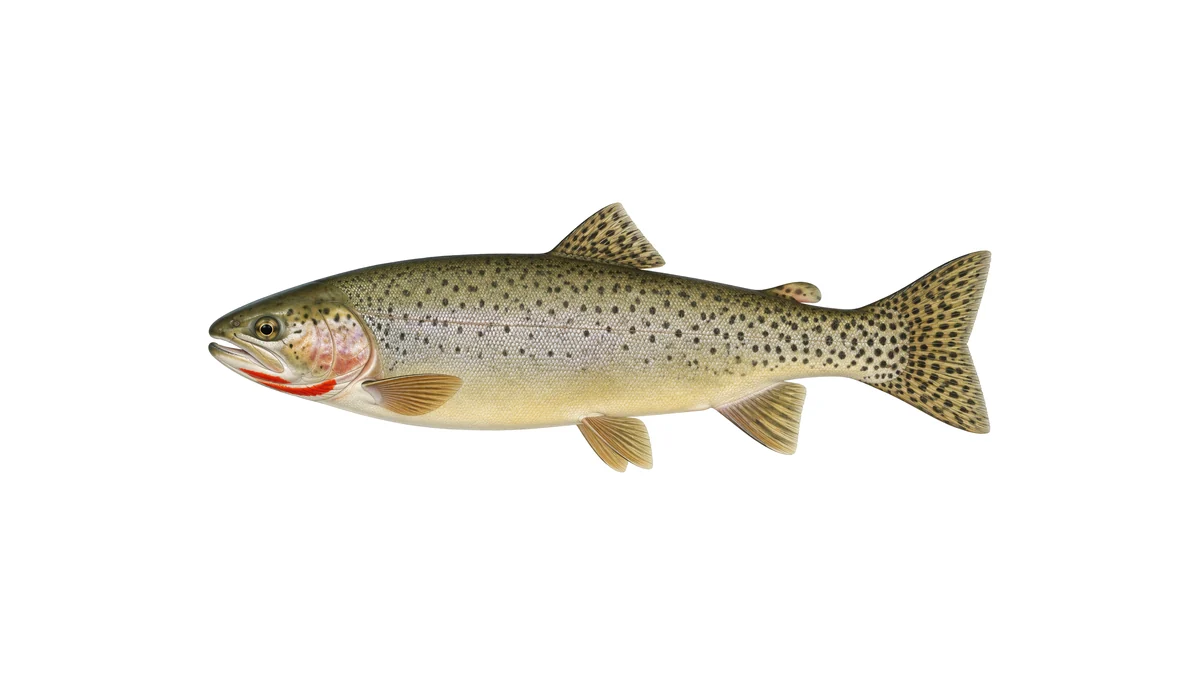
Cutthroat Trout: Identification, Habitat & Diet
The cutthroat trout is the native trout of the American West, and the red slash under its jaw is one of the most useful field marks in freshwater fishing. The species is named for that mark, which looks like a cut throat. It lives in cold mountain streams, alpine lakes, and big western rivers, and it comes in more than a dozen subspecies that differ in size, color, and range. Some are secure. Others are threatened, and one was once declared extinct before a remnant population was found. This profile covers cutthroat trout identification, habitat, diet, size, records, spawning, regulations, and how to catch one.
Quick ID Card
| Field | Details |
|---|---|
| Scientific name | Oncorhynchus clarkii |
| Common names | Cutthroat trout, cutt, native trout, red-throat trout; subspecies include coastal, westslope, Yellowstone, Lahontan, Bonneville, Rio Grande, greenback, and Colorado River cutthroat |
| Family | Salmonidae, genus Oncorhynchus (Pacific trout and salmon) |
| Typical size | 6–16 inches (15–41 cm) in streams; larger in lakes |
| Trophy size | 20+ inches; Lahontan giants historically far bigger |
| Water type | Cold, clear, high-oxygen streams, headwaters, and lakes |
| Active water temperature | Roughly 45–65°F (7–18°C) |
| Difficulty | Moderate; often remote water, sensitive fish |
| Best season | Late spring through fall; summer for high-country lakes |
How to Identify a Cutthroat Trout
Look under the jaw. A cutthroat trout has a red, orange, or pink slash on the lower jaw, usually on both sides. The mark can be faint on young fish and bright on spawning adults, but it is the species signature. No other North American trout has it.
The spotting pattern helps as well. Cutthroat are heavily spotted, and the spots tend to be small, irregular, and concentrated toward the tail. The body color varies by subspecies and water: coastal fish are silvery, westslope fish are often olive with few spots, and Lahontan fish can be golden with large spots. The belly is usually pale yellow or white.
The mouth is another clue. Cutthroat trout have teeth on the base of the tongue, a feature rainbow trout lack. You need to look carefully, but a biologist or a serious angler can check it. The upper jaw usually ends near or slightly past the eye.
The tail is slightly forked on young fish and becomes more square with age. The lower fins lack the striking white-and-black edge of a brook trout. The overall impression is a native fish shaped by cold, clear water, not a hatchery product.
Cutthroat Trout vs Rainbow Trout
The comparison matters because the two species overlap across the West and hybridize where they meet. A hybrid, called a cutbow, can show a mix of marks, which makes identification harder.
| Feature | Cutthroat trout | Rainbow trout |
|---|---|---|
| Throat mark | Red or orange slash under the lower jaw | None |
| Tongue teeth | Present at the base of the tongue | Absent |
| Lateral stripe | Absent or faint | Prominent pink to red stripe |
| Spots | Small, irregular, concentrated toward the tail | Small, even, often dense over the body and tail |
| Mouth | Usually ends near the eye | Usually ends near the eye; white mouth lining |
| Origin in the West | Native | Native to the Pacific slope, widely stocked |
The slash is the first test. If the fish has a red mark under the jaw, it is a cutthroat or a cutbow. If it has a bright pink stripe and no slash, it is a rainbow. If it has both a faint slash and a stripe, it may be a hybrid. In native cutthroat water, hybrids are a conservation problem, and many agencies ask anglers to keep rainbows and cutbows where rules allow.
Cutthroat also differ from brown trout, which have dark spots on a light body and no throat slash, and from brook trout, which have light worming and white-edged fins. The cutthroat's combination of a slash, heavy spotting, and a native western range is unique.
Is the Cutthroat Trout Dangerous?
No. Cutthroat trout are harmless. They have small teeth, no venom, and no spines. The only real concern is handling, because these fish are often caught in remote, cold water where they are already stressed.
Keep the fish wet. Use a rubber net, wet your hands, and avoid squeezing the body. Do not drag fish onto dry rocks or let them thrash in the bottom of a boat. In high-country lakes, a cutthroat released in warm shallows may not survive; move it to cooler, deeper water and revive it before letting go.
Because many cutthroat populations are native and fragile, check the regulations before you fish. Some waters are catch-and-release only, and some are closed to protect spawning fish. Handle every fish as if it is the one that matters, because in small native populations it often is.
Range and Habitat
Cutthroat trout are native to western North America. Their range runs from coastal Alaska and British Columbia south to California, and inland across the Rocky Mountains into Montana, Wyoming, Colorado, Utah, Nevada, Idaho, and New Mexico. Different subspecies occupy different basins, and some are isolated in a single lake or river system.
Where do cutthroat trout live? In cold, clear, well-oxygenated water. Stream fish hold in riffles, pools, undercut banks, and beaver ponds. Lake fish cruise shorelines, inlets, and drop-offs. Coastal cutthroat can be anadromous, moving between fresh water and the sea, while lake forms, such as the Yellowstone and Lahontan cutthroat, spend most of their lives in lakes and run up tributaries to spawn.
Temperature and clean water set the limits. Cutthroat do best in the 45–65°F range and suffer when streams warm, silt up, or lose shade. Grazing, logging, roads, and water diversion have damaged a lot of habitat. Nonnative trout, especially rainbows and lake trout, add competition and hybridization.
The Yellowstone cutthroat is a good example of the stakes. Yellowstone Lake once held a huge native population. Illegally introduced lake trout began eating young cutthroat, and the population crashed. Agencies now run a gillnetting program to suppress lake trout and protect the native fish. The story shows how fast a native trout can decline and how much work recovery takes.
Several cutthroat subspecies are listed under the Endangered Species Act or managed as species of concern. The Lahontan cutthroat was listed as threatened in 1970. The greenback cutthroat was thought extinct by the 1930s, rediscovered later, and is now the state fish of Colorado. The Rio Grande cutthroat remains a conservation priority in New Mexico and Colorado.
Behavior and Diet
What do cutthroat trout eat? Aquatic and terrestrial insects make up most of the diet, especially mayflies, caddisflies, stoneflies, midges, ants, beetles, and grasshoppers. They also eat crustaceans, worms, and small fish. Lake-dwelling cutthroat add zooplankton and baitfish, and big Lahontan fish are piscivorous.
Cutthroat are opportunistic and often less selective than brown trout. In remote water with little fishing pressure, they rise readily to dry flies and strike small spinners without much inspection. In heavily fished water, they become cautious. The fish tends to hold in current seams, pool tails, undercut banks, and the edges of cover.
When do cutthroat trout spawn? In spring, usually from February through June depending on elevation and subspecies, when water warms toward the mid-40s to low 50s Fahrenheit. Fish move upstream into tributaries and smaller streams, cut redds in gravel, and scatter eggs. Some populations spawn in fall. Spawning fish are vulnerable, and many waters are closed or restricted during the run.
Cutthroat are not long-lived compared with lake trout, but they can reach 6–10 years in good habitat. Growth depends on water temperature, food, and subspecies. Stream fish stay small; lake fish grow larger.
Size, Records and Regulations
How big do cutthroat trout get? Most stream fish run 6–16 inches and under 2 pounds. A 16-inch cutthroat is a good fish in a small stream. Lake fish and coastal fish grow larger, and some subspecies produce true giants.
The largest cutthroat on record is a Lahontan cutthroat of about 41 pounds, caught in Pyramid Lake, Nevada, in 1925. Modern trophy fish are much smaller. A 5- to 10-pound Lahontan or Yellowstone cutthroat is a fish of a lifetime today. State records vary by subspecies and by state.
Regulations are complex because the species is managed subspecies by subspecies. Many native cutthroat waters are catch-and-release only, with artificial-lure or single-hook rules. Some are closed entirely. Others allow limited harvest under a permit or tag. Where rainbows and cutthroat overlap, agencies may ask anglers to keep rainbows to reduce hybridization.
A license is required, and some states add a trout stamp or a native trout permit. The agency that manages the water is the authority, whether that is a state fish and wildlife department, the National Park Service, or the U.S. Forest Service. Read the rules for the specific drainage before you go, because a rule that applies on one creek may not apply on the next. Last verified: November 2025.
FAQ
How big do cutthroat trout get? Stream fish are usually 6–16 inches. Lake and coastal fish grow larger, and the historical record is a Lahontan cutthroat of about 41 pounds from Pyramid Lake, Nevada, in 1925.
What is the world record cutthroat trout? The largest documented fish is a Lahontan cutthroat of roughly 41 pounds taken from Pyramid Lake in 1925. Modern records are far smaller, and record categories vary by subspecies and state.
What do cutthroat trout eat? Aquatic and terrestrial insects, crustaceans, worms, and small fish. Lake forms also eat zooplankton and baitfish.
Where do cutthroat trout live? In cold, clear streams, headwaters, and lakes across western North America, from Alaska and British Columbia to California and inland to the Rocky Mountains. Different subspecies occupy different basins.
What is the difference between a cutthroat trout and a rainbow trout? A cutthroat has a red or orange slash under the lower jaw, teeth at the base of the tongue, and no pink lateral stripe. A rainbow has a pink stripe, a white mouth, and no throat slash.
When do cutthroat trout spawn? In spring, usually February through June depending on elevation, when water reaches the mid-40s to low 50s Fahrenheit. Some populations spawn in fall. Fish cut redds in gravel tributaries.
What is the best bait for cutthroat trout? Worms, salmon eggs, and small spinners work where bait and lures are legal. Flies, especially attractor dries and nymphs, are effective. In remote water, cutthroat are often eager.
How do you catch a cutthroat trout? Hike into cold headwater streams or alpine lakes, fish current seams and pool tails, and present small flies, spinners, or bait naturally. Stay low, cast upstream, and check the rules for native trout before you fish.
The cutthroat trout is a reminder of what the West looked like before hatcheries and highways. It is native, beautiful, and in places hanging on by a thread. Learn the slash, fish the cold water, and follow the rules that protect the native fish. The next angler deserves to find them there too.
Related Articles
- Brown Trout — the wary introduced trout of cold rivers.
- Brook Trout — the native char of eastern streams.
- Lake Trout — the deep-water char of northern lakes.
- Paddlefish — an ancient filter feeder of big rivers.
- All species profiles
Ready to catch one? Read our step-by-step guide: How to Catch Cutthroat Trout.
About the author and how this was tested
About the author
FishermanGuy
Bank, boat and kayak angler · fishing, crabbing and shrimping since 2021
I buy the gear, fish it for a season and write down what failed. No sponsored verdicts, no free-sample flattery. Every rig on this page has landed fish in water I can point at on a map.
How this was tested
- Every rig gets at least six trips on the same water before it is published.
- Gear is bought at retail. Free samples are labelled in the first paragraph.
- Dates show first publication and the last time the page was updated.