Field notes
Golden Trout: Identification, Habitat & Diet
Golden Trout: Identification, Habitat & Diet
The golden trout is one of the most beautiful freshwater fish in North America, and one of the hardest to reach. It is a small, high-country trout native to a couple of cold drainages in the southern Sierra Nevada of California, and it lives where the air is thin and the snow stays late. Anglers hike for hours to catch one. This profile covers golden trout identification, habitat, diet, size, spawning, regulations, and how to catch one without harming a fragile native population.
A quick note on names, because this trips people up. The true golden trout is Oncorhynchus aguabonita, the California golden trout. There is also a hatchery color morph of rainbow trout sold as "golden rainbow trout" or "palomino trout," stocked in several eastern states. They look similar at a glance but are different fish. This article is about the native California species.
Quick ID Card
| Field | Details |
|---|---|
| Scientific name | Oncorhynchus aguabonita |
| Common names | Golden trout, California golden trout, Kern River golden trout; the Volcano Creek form is sometimes treated as a subspecies, O. a. whitei |
| Family | Salmonidae, genus Oncorhynchus (Pacific trout and salmon) |
| Typical size | 6–10 inches (15–25 cm) |
| Trophy size | 12+ inches is exceptional |
| Water type | High-elevation alpine lakes and cold headwater streams |
| Active water temperature | Roughly 50–65°F (10–18°C) |
| Difficulty | Hard; remote water, thin air, sensitive native fish |
| Best season | July through September, after snowmelt |
How to Identify a Golden Trout
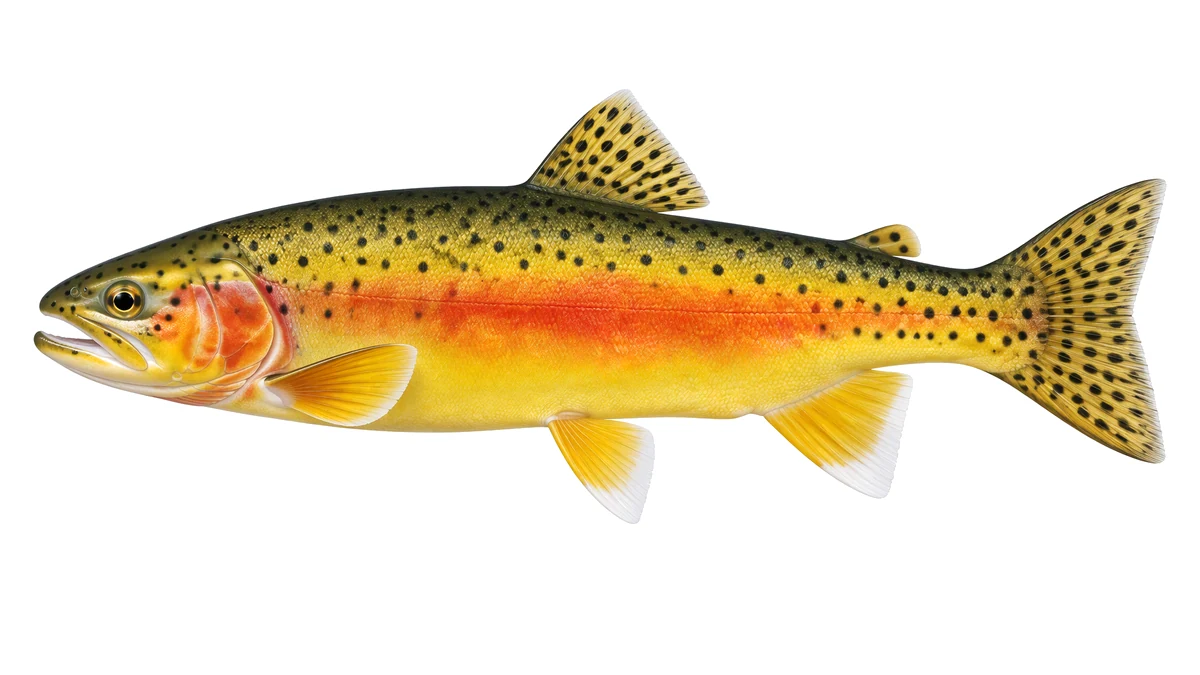
Golden trout identification starts with color. The body is a bright golden yellow, and a red-orange band runs along the lateral line from the gill cover toward the tail. The back is darker, an olive or bronze-green, and the belly fades to a pale yellow-white. No other native trout in the Sierra looks like this.
The spots are small and round, scattered over the back and upper sides, and they usually stop above the lateral line. The dorsal fin and tail carry dark spots too. The lower fins, especially the pelvic and anal fins, often have white or pale tips, a mark shared with some other trout but useful in combination with the golden color.
The body is streamlined and trout-shaped, with a slightly forked tail that squares off in older fish. The mouth is moderate, and the upper jaw reaches about to the eye. Parr marks, the faint vertical bars of young fish, can linger on adults in some populations.
Color shifts with water and light. Fish from dark, deep lakes look more intensely golden. Fish from clear, shallow streams can be paler. Spawning males deepen in color and develop a slight hook to the lower jaw. A 6-inch fish in a high lake may be a mature adult, so do not judge age by size.
Where the species overlaps with stocked rainbows, hybrids appear. A fish with a strong pink stripe, heavy even spotting over the whole body, and no clean golden base is probably a rainbow or a hybrid. In native golden trout water, that distinction matters for conservation, and many anglers are asked to keep rainbows where rules allow.
Golden Trout vs Rainbow Trout
This is the comparison most anglers search for, and it has two answers depending on which "golden trout" you are holding.
The native California golden trout is a separate species. It has a golden-yellow body, a red-orange lateral band, spots concentrated on the upper body, and white-tipped lower fins. The rainbow trout has a silver body, a broad pink-to-red stripe, and dense black spots over the body and tail. A pure golden trout has no strong silver sheen and no heavy spotting below the lateral line.
The hatchery golden rainbow trout is a genetic color variant of the rainbow, bred for a uniform yellow-gold body. It is stocked in states such as West Virginia, Pennsylvania, and Virginia, usually in put-and-take waters. It grows larger than a native golden trout, often 10–16 inches, and its color is flatter and more uniform, without the red-orange band or the fine wild spotting pattern. If you catch a golden fish in a stocked lowland lake in the East, it is almost certainly a golden rainbow, not O. aguabonita.
| Feature | California golden trout | Golden rainbow trout (hatchery) |
|---|---|---|
| Species | Oncorhynchus aguabonita | Oncorhynchus mykiss, color morph |
| Color | Golden yellow with orange-red lateral band | Uniform yellow-gold, flatter |
| Spots | Small, upper body, fine pattern | Sparse or absent, variable |
| Size | Usually 6–10 inches | Often 10–16 inches |
| Range | Native to the southern Sierra Nevada | Stocked in eastern and Midwestern states |
| Status | Native, fragile, regulated | Hatchery product |
Compared with brook trout, golden trout lack the light worming on the back and the dark background with pale spots. Compared with cutthroat trout, they lack the red slash under the jaw and the heavy body spotting. The golden base color plus the red band is the giveaway.
Is the Golden Trout Dangerous?
No. Golden trout are harmless. They have small teeth, no venom, and no spines. The real risk is to the fish, not the angler.
These trout live in cold, nutrient-poor water at high elevation, and they are slow to recover from stress. A fish held out of water for a photo, squeezed, or dropped on dry granite may not survive even if it swims away. Wet your hands, use a rubber net, keep the fish in the water, and release it quickly. If you must lift it, support the belly and keep the air exposure under a few seconds.
The bigger danger is ecological. Golden trout are native to a tiny range, and they hybridize with rainbow trout and compete with introduced brook trout. Moving fish between waters, or releasing a rainbow into golden trout water, can damage a population that took decades to protect. Never transplant fish, and never dump baitfish or aquarium fish into alpine water.
Some golden trout waters sit above 10,000 feet, where weather changes fast. Afternoon thunderstorms, snowfields, and cold water are real hazards. Carry layers, tell someone your plan, and turn around before the weather does.
Golden Trout Habitat and Range
Where do golden trout live? Natively, in just two drainages in Tulare County, California: the South Fork Kern River and Golden Trout Creek, a tributary system that feeds the Kern. These streams sit on the Kern Plateau in the southern Sierra Nevada, mostly between about 6,900 and 10,000 feet. The water is cold, clear, and low in minerals, and the growing season is short.
The species has been stocked into many high lakes across the Sierra and beyond, so you can find golden trout outside the native range. Those introduced populations are often in alpine lakes above treeline, with rocky shorelines and inlet streams. The fish use the inlets to spawn and the lake for feeding.
The native range is protected in part by geography. The Golden Trout Wilderness, within Inyo National Forest and Sequoia National Forest, covers much of the core habitat. Access is by trail, often a long one. That isolation has saved the fish from some of the pressure that hit other western trout.
Habitat quality depends on cold water and clean gravel. Grazing, roads, water diversion, and climate warming all press on the species. Warmer summers shrink the cold-water window, and drought dries small streams. Rainbow trout stocked in the same basins add hybridization pressure. Managers respond with barriers to keep nonnative fish out of key creeks, with removal projects, and with strict angling rules.
Temperature is the limiting factor. Golden trout do best in water from the low 50s to mid-60s Fahrenheit. Above that, they seek springs, shaded pools, and deeper lake water. If a stream feels warm to your hand in July, the fish are probably stacked in the few cold pockets that remain.
What Do Golden Trout Eat?
Golden trout eat insects, and they eat them at every level of the water column. Aquatic nymphs, especially mayflies, caddisflies, stoneflies, and midges, make up the base of the diet. In summer, terrestrial insects matter a lot: ants, beetles, grasshoppers, and anything else that falls from the brush and grass along the bank.
In lakes, golden trout also feed on zooplankton, which pulls them offshore and makes them harder to find. Fish in lakes often cruise the drop-offs and inlets, picking off insects and plankton. Fish in streams hold in pools, undercut banks, and the soft water behind boulders, where drifting food collects.
Golden trout are not especially selective in remote water. They see few artificial flies, and they rise readily to a small dry fly or strike a tiny spinner. In heavily visited lakes, they become wiser. A drag-free drift and a light tippet make the difference.
When do golden trout spawn? In late spring and early summer, generally from May into August, as snowmelt recedes and water warms. Fish move into inlet streams and gravel riffles, cut redds, and scatter eggs. Spawning fish are easy to see and easy to disturb, so stay back and avoid walking on gravel.
Growth is slow in cold, sterile water. A 7-inch golden trout may be several years old. That slow growth is one reason harvest rules are tight and why a big golden trout is such a rare catch.
Size, Records and Regulations
How big do golden trout get? Most adults run 6–10 inches, and a 12-inch fish is a trophy in native water. Lake fish can reach the low teens in inches, but true giants are rare. The hatchery golden rainbow, a different fish, grows much larger.
Because the native fish is small and slow-growing, record keeping is complicated. State and line-class records exist, but many big "golden trout" in record books are hatchery golden rainbows from stocked waters. If a record matters to you, read the category carefully. For the native species, the catch of a lifetime is usually a fish measured in inches, not pounds.
Regulations are where this species demands attention. California manages golden trout as a heritage species, and many waters in the native range are catch-and-release only, with artificial-lure and barbless-hook rules. Some lakes allow limited harvest. Some streams are closed to protect spawning fish. The California Department of Fish and Wildlife sets the rules, and the U.S. Forest Service and National Park Service manage much of the land.
A valid California fishing license is required. Some waters need a report card or a special validation. Before you hike in, read the current CDFW freshwater regulations for the specific drainage. Rules can differ from one lake to the next, and ignorance is not a defense. If you plan to fish the Golden Trout Wilderness, check both the fishing rules and any wilderness or fire restrictions. Last verified: November 2025.
The best bait for golden trout depends on the rules. Where bait is legal, a small worm or a salmon egg fished gently in a pool works. Where it is not, a small dry fly, a bead-head nymph, or a 1/16-ounce spinner is the standard. In most native water, artificial lures and flies are the only legal option, so pack accordingly.
How to catch golden trout comes down to access and stealth. Hike into high lakes or headwater streams, fish early and late, and stay low so you do not spook fish in clear water. Cast upstream in streams and let the fly drift naturally. In lakes, work the inlet and the drop-off, and watch for cruising fish. Keep the fight short, release the fish wet, and leave the water cleaner than you found it.
Golden trout are a bucket-list fish for a reason. They are small, wild, and beautiful, and they live in places that reward effort. Treat every one as the rare thing it is.
FAQ
How big do golden trout get? Most adults are 6–10 inches. A 12-inch native golden trout is exceptional. Hatchery golden rainbow trout, a different fish, grow larger.
What is the difference between a golden trout and a rainbow trout? The native California golden trout is a separate species with a golden-yellow body, an orange-red lateral band, and fine spots on the upper body. A rainbow trout is silver with a broad pink stripe and heavy spotting. A hatchery "golden rainbow" is a color morph of the rainbow, not the native species.
Where do golden trout live? Natively in the South Fork Kern River and Golden Trout Creek drainages in the southern Sierra Nevada of California, mostly at 6,900–10,000 feet. They have been stocked into many high lakes elsewhere in the Sierra.
When do golden trout spawn? From late spring into summer, generally May through August, as snowmelt recedes. Fish spawn in inlet streams and gravel riffles.
What do golden trout eat? Aquatic insects such as mayflies, caddisflies, stoneflies, and midges, plus terrestrial insects in summer. Lake fish also eat zooplankton.
What is the best bait for golden trout? Where bait is legal, a small worm or salmon egg works. In most native water, rules require artificial lures or flies, so use a small dry fly, nymph, or 1/16-ounce spinner.
How do you catch a golden trout? Hike to high lakes or headwater streams, fish early and late, stay low, and present small flies or lures naturally. Check CDFW rules first, because many native waters are catch-and-release with artificial-lure and barbless-hook requirements.
Are golden trout endangered? The California golden trout is not listed under the federal Endangered Species Act, but it has a tiny native range and is managed as a heritage species. Hybridization, nonnative trout, and habitat loss are ongoing threats.
Related Articles
- Apache Trout — another rare native trout of the desert Southwest.
- Cutthroat Trout — the native trout of the American West, with its red jaw slash.
- Brook Trout — the native char of cold eastern streams.
- Arctic Grayling — the sail-finned cold-water cousin of the far north.
- All species profiles
Ready to catch one? Read our step-by-step guide: How to Catch Golden Trout.
About the author and how this was tested
About the author
FishermanGuy
Bank, boat and kayak angler · fishing, crabbing and shrimping since 2021
I buy the gear, fish it for a season and write down what failed. No sponsored verdicts, no free-sample flattery. Every rig on this page has landed fish in water I can point at on a map.
How this was tested
- Every rig gets at least six trips on the same water before it is published.
- Gear is bought at retail. Free samples are labelled in the first paragraph.
- Dates show first publication and the last time the page was updated.