Field notes
Apache Trout: Identification, Habitat & Diet
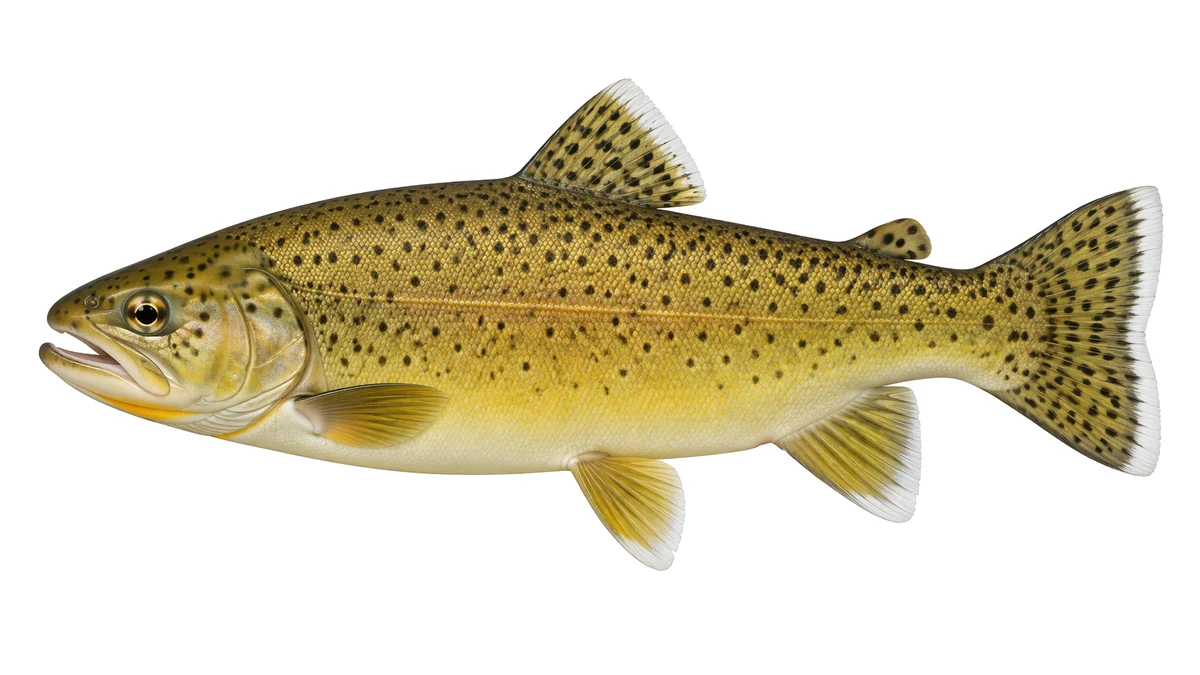
Apache Trout: Identification, Habitat & Diet
The Apache trout is a survivor. It is the state fish of Arizona, a native trout of the White Mountains, and one of the rarest salmonids in the United States. By the 1970s, hybridization and habitat loss had pushed it to the edge, and it was listed as threatened under the Endangered Species Act in 1975. Decades of recovery work by state, federal, and tribal biologists have brought it back from the brink, but it is still a fish that lives behind careful rules. This profile covers Apache trout identification, habitat, diet, size, spawning, recovery status, and how to catch one legally and responsibly.
Quick ID Card
| Field | Details |
|---|---|
| Scientific name | Oncorhynchus apache |
| Common names | Apache trout, Arizona trout; formerly classified as a cutthroat trout subspecies |
| Family | Salmonidae, genus Oncorhynchus (Pacific trout and salmon) |
| Typical size | 6–12 inches (15–30 cm) |
| Trophy size | Up to about 16 inches and roughly 2 pounds |
| Water type | Cold, clear high-elevation streams and small lakes |
| Active water temperature | Roughly 45–60°F (7–16°C) |
| Difficulty | Moderate; remote water, strict regulations |
| Best season | Spring and early summer, after runoff; fall |
How to Identify an Apache Trout
Apache trout identification rests on three marks: a golden-yellow body, small dark spots, and white tips on the fins.
The body color runs from golden yellow to olive-bronze, with a lighter yellow belly. The back is darker. Small black spots are scattered over the back and sides, and they often extend onto the dorsal fin and tail. The most reliable field mark is the white or cream-colored tip along the outer edge of the dorsal fin and the upper and lower lobes of the tail. Those white margins stand out against the dark water.
Under the jaw, there is a faint yellow-orange mark, a leftover of the species' old classification as a cutthroat trout. It is not the bright red slash of a true cutthroat. The mouth is moderate, and the body is sturdy and slightly deep, built for holding in fast current.
Spawning fish darken and develop a red-orange tint along the sides and belly. Males may show a slight kype. Young fish carry faint parr marks, the vertical bars common to juvenile salmonids.
The combination of a golden body, small spots, and white-tipped fins separates Apache trout from most other trout in Arizona. Where hatchery rainbows have been stocked, hybrids can appear, and pure fish are the ones biologists are trying to protect.
Apache Trout vs Brook Trout
Anglers confuse these two because both have white-edged lower fins. The rest of the fish is different.
| Feature | Apache trout | Brook trout |
|---|---|---|
| Body color | Golden yellow to olive-bronze | Dark olive-green with a marbled, worm-like pattern on the back |
| Spots | Small black spots on a light body | Light spots on a dark body, plus red spots with blue halos |
| Fin edges | White tips on dorsal and tail | White front edge on lower fins, dark background |
| Tail | Square to slightly forked, white-tipped | Square, no white tip |
| Range | White Mountains of Arizona | Native to eastern North America, widely stocked |
| Status | Threatened, native | Not listed; introduced in Arizona |
The simplest test is the background color. An Apache trout is light with dark spots. A brook trout is dark with light spots and worming. If the fish has a dark olive back covered in pale squiggles, it is a brook trout, even if the fins have white edges.
Compared with a cutthroat trout, the Apache has no bright red jaw slash and a more golden body. Compared with a rainbow, it has no broad pink stripe and no heavy spotting over the whole body. In Arizona, a golden trout with white-tipped fins and a faint throat mark is almost certainly an Apache.
Is the Apache Trout Dangerous?
No. Apache trout are harmless to people. They have small teeth, no venom, and no spines.
The serious issue is the fish's protected status and fragile populations. Apache trout are listed as threatened, and many waters are catch-and-release only. Some are closed. Handling a fish roughly can kill it, and in a small native stream one dead fish matters. Keep the fish in the water, use a rubber net, wet your hands, and release it quickly.
There is also a legal risk. Fishing without the right license or permit, or keeping a fish in a closed water, can bring a citation. On the White Mountain Apache Reservation, a separate tribal permit is required, and the tribe sets its own seasons and limits. Check the rules for the exact water before you cast.
Weather is the other hazard. These streams sit above 6,500 feet, and summer thunderstorms build fast. Flash floods, lightning, and cold water are real. Fish with a partner, carry rain gear, and leave the canyon if the sky turns.
Apache Trout Habitat and Range
Where do Apache trout live? Only in the White Mountains of east-central Arizona, in the upper Salt River and Little Colorado River drainages. The native range is tiny, and it sits mostly above 6,500 feet, in cold, clear headwater streams running through ponderosa pine and mixed conifer forest.
The fish favors pools, undercut banks, riffles, and the shaded pockets behind boulders. It needs clean gravel for spawning, stable flows, and cold water. Springs and small tributaries can hold fish when the main stem warms. Logging, grazing, roads, and water diversion have degraded a lot of the historic habitat, and nonnative trout brought competition and hybridization.
The Apache trout recovery effort is one of the bright spots in native trout management. By the 1970s, pure Apache trout survived in only a fraction of their historic range. A joint effort by the Arizona Game and Fish Department, the U.S. Fish and Wildlife Service, the U.S. Forest Service, and the White Mountain Apache Tribe rebuilt populations. Biologists built barriers to keep nonnative trout out of key streams, treated and restocked waters, and monitored purity. Today dozens of populations are managed, and the species is no longer on the immediate edge of extinction.
It is still listed as threatened as of 2025, and recovery remains a work in progress. Delisting has been discussed, but the fish still depends on active management. That is why so many Apache trout waters are catch-and-release.
The species is also one of only two native trout in Arizona. The other, the Gila trout, is similarly rare and protected. Together they represent the last native trout of the desert Southwest.
What Do Apache Trout Eat?
Apache trout eat insects, and they are not picky. Aquatic nymphs, especially mayflies, caddisflies, and stoneflies, form the base of the diet. In summer, terrestrial insects matter: grasshoppers, crickets, ants, and beetles that fall from the banks. The fish also take small crustaceans and worms.
In small streams, they hold in pools and undercut banks and pick off drifting food. In beaver ponds and small lakes, they cruise the edges and inlets. Feeding peaks in low light, early and late in the day, when insects are most active and the fish feel safe.
When do Apache trout spawn? In spring, generally from March into May, when water warms toward the mid-40s to low 50s Fahrenheit. Fish move into gravel riffles, cut redds, and scatter eggs. Spawning fish are easy to see and easy to disturb. Stay out of the gravel, watch from the bank, and leave them alone.
Growth is slow in cold, sterile water. A 10-inch Apache trout is a good fish, and a 14-inch fish is a trophy. Most adults live several years, and some reach older ages in stable populations.
Size, Records and Regulations
How big do Apache trout get? Most adults run 6–12 inches. A fish of 14–16 inches and close to 2 pounds is exceptional. The species does not grow as large as a rainbow or brown trout, and its small size reflects the cold, food-poor streams it calls home.
Record keeping is limited because so few fish are harvested. State and tribal records exist, but the more important number is the population count, not the weight of a single fish. For most anglers, the prize is catching a pure native fish in its home water.
Regulations are strict and vary by jurisdiction. On Arizona state waters, many Apache trout streams are catch-and-release only, with artificial-lure and barbless-hook requirements. Some waters allow limited harvest of nonnative trout to reduce competition. On the White Mountain Apache Reservation, a tribal fishing permit is required, and the tribe sets its own rules, which can include limited harvest.
The Arizona Game and Fish Department is the authority on state waters. The U.S. Fish and Wildlife Service manages the federal listing. The White Mountain Apache Tribe manages tribal waters. Read the current regulations for the specific stream before you go, because a rule on one creek may not apply on the next. Last verified: November 2025.
The best bait for Apache trout, where bait is legal, is a small worm or a single salmon egg drifted through a pool. In most native water, bait is not legal. Then the answer is a small dry fly, a bead-head nymph, or a tiny spinner. A 5- to 6-foot ultralight rod with 4-pound line is plenty.
How to catch Apache trout is mostly about access and stealth. Hike into the upper drainages, fish early, stay low, and cast upstream. Present a small fly or lure naturally and keep the fight short. In small streams, a bow-and-arrow cast or a short roll cast keeps you out of the brush. Release fish wet and quickly, and leave the stream as you found it.
These fish survived because people decided they were worth saving. Fishing for them is a privilege, and the rules are the price.
FAQ
How big do Apache trout get? Most adults are 6–12 inches. A 14–16 inch fish near 2 pounds is exceptional. Cold, food-poor streams keep them small.
Are Apache trout endangered? They are listed as threatened under the U.S. Endangered Species Act, a step below endangered. Recovery programs have rebuilt populations, but the species still depends on active management as of 2025.
Where do Apache trout live? Only in the White Mountains of east-central Arizona, in the upper Salt River and Little Colorado River drainages, mostly above 6,500 feet.
What is the difference between an Apache trout and a brook trout? An Apache trout is golden-yellow with small dark spots and white-tipped dorsal and tail fins. A brook trout is dark olive with light worming, light spots, and red spots with blue halos.
When do Apache trout spawn? In spring, generally March through May, in gravel riffles. Spawning fish are vulnerable and should not be disturbed.
What do Apache trout eat? Aquatic insect nymphs such as mayflies, caddisflies, and stoneflies, plus terrestrial insects in summer, and small crustaceans and worms.
What is the best bait for Apache trout? Where bait is legal, a small worm or salmon egg. In most native water, rules require artificial lures or flies, so use a small dry fly, nymph, or tiny spinner.
How do you catch an Apache trout? Hike into upper White Mountain streams, fish early, stay low, and cast upstream with small flies or lures. Check Arizona Game and Fish or tribal rules first, because most waters are catch-and-release.
Related Articles
- Golden Trout — the brilliant native trout of the California high country.
- Cutthroat Trout — the native western trout with the red jaw slash.
- Brook Trout — the native eastern char, often confused with Apache trout.
- Chinook Salmon — the largest Pacific salmon, another Oncorhynchus.
- All species profiles
Ready to catch one? Read our step-by-step guide: How to Catch Apache Trout.
About the author and how this was tested
About the author
FishermanGuy
Bank, boat and kayak angler · fishing, crabbing and shrimping since 2021
I buy the gear, fish it for a season and write down what failed. No sponsored verdicts, no free-sample flattery. Every rig on this page has landed fish in water I can point at on a map.
How this was tested
- Every rig gets at least six trips on the same water before it is published.
- Gear is bought at retail. Free samples are labelled in the first paragraph.
- Dates show first publication and the last time the page was updated.