Field notes
Tarpon: Identification, Habitat & Diet
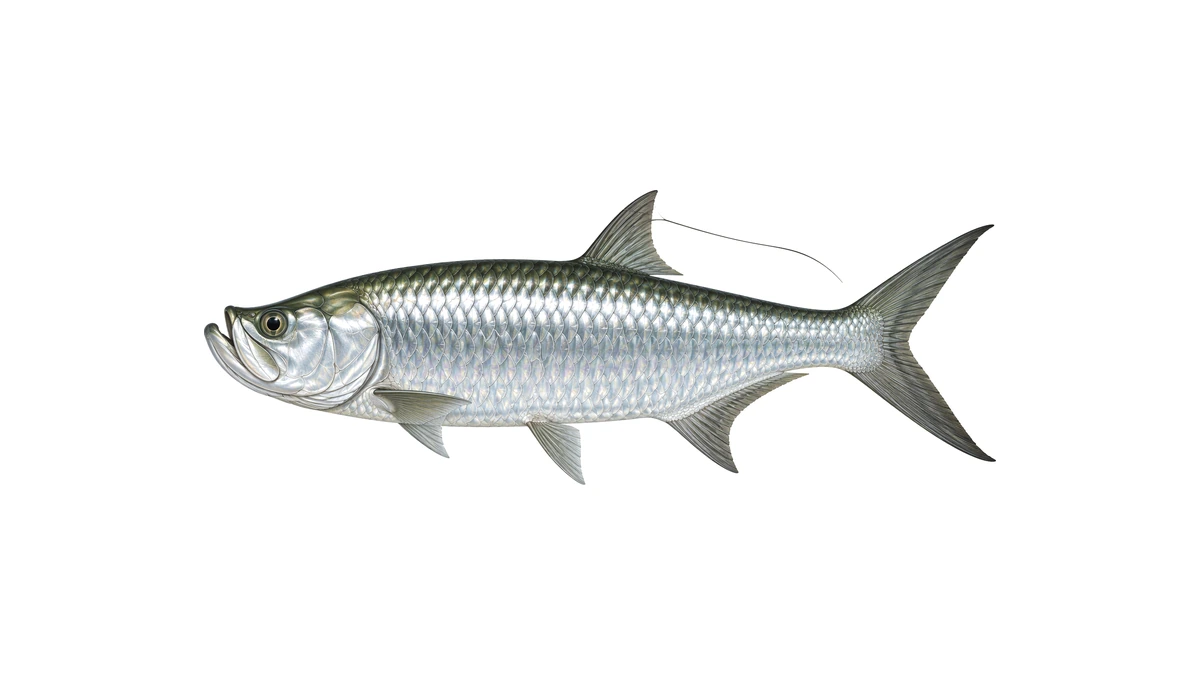
Tarpon: Identification, Habitat & Diet
The tarpon (Megalops atlanticus) is the fish that built a cult. It is a big, mirror-scaled silver fish with a bucket mouth and a habit of throwing itself into the air the moment it feels a hook. Anglers call it the silver king, and a hundred-pound tarpon is still a benchmark fish on both coasts of the Atlantic. Tarpon are slow to mature, mostly released, and tightly regulated in Florida. This profile covers tarpon identification, habitat, diet, size, the world record, spawning, and how to catch one.
Quick ID Card
| Field | Details |
|---|---|
| Scientific name | Megalops atlanticus |
| Common names | Tarpon, Atlantic tarpon, silver king, sabalo |
| Family | Megalopidae (tarpon family) |
| Typical size | 20–80 pounds; 24–48 inches |
| Trophy size | 100–200 pounds; the largest exceed 250 pounds |
| Water type | Coastal bays, passes, beaches, estuaries, and mangrove creeks |
| Active water temperature | Roughly 72–86°F (22–30°C) |
| Difficulty | Hard; big fish, hard mouth, spectacular jumps, strict rules |
| Best season | Late spring and summer for the big migratory fish; juveniles year-round in the south |
How to Identify a Tarpon
Tarpon identification starts with the scales. A tarpon has enormous, mirror-like scales, each one the size of a silver dollar on a big fish. The body is bright silver with a dark olive or blue-green back and no spots, bars, or stripes.
The head is blunt and the mouth is large and upturned, with the lower jaw projecting. Inside the mouth the bone is hard and rough, which is one reason hooksets need to be firm. The eye is large.
The fins are distinctive. The single dorsal fin sits near the middle of the back, and the last ray of that fin extends into a long, whip-like filament. The tail is deeply forked. The anal fin is long-based and also ends in a filament.
There is no confusing a fresh tarpon with much else. The fish is deep-bodied, heavy through the shoulders, and silver enough to flash in the sun like a sheet of metal. The Pacific tarpon (Megalops cyprinoides) looks similar but is a separate, smaller species found in the Indo-Pacific, including the South China Sea and waters off southern Taiwan.
Tarpon vs Snook
Tarpon and snook share the same inshore water, the same mullet, and often the same angler, so the comparison gets made constantly.
| Feature | Tarpon | Snook |
|---|---|---|
| Body color | Bright silver, no stripes | Silvery to yellowish, with a bold black lateral line |
| Scales | Very large, mirror-like | Smaller, ordinary |
| Head shape | Blunt, steep forehead | Sloping forehead with a protruding lower jaw |
| Mouth | Large and upturned | Large, with the lower jaw extending past the upper |
| Dorsal fins | One, with a long trailing filament | Two, separated |
| Tail | Deeply forked | Forked, but less extreme |
| Gill cover | Smooth | Sharp, prominent spine on the gill cover |
| Typical weight | 20–80 pounds | 5–20 pounds |
The lateral line is the fast check. A snook has a black line running along its flank from the gill cover to the tail. A tarpon has no such line. The snook also has a razor-sharp spine on the gill cover, which is why experienced anglers grip snook with care. Tarpon have no gill-cover blade, but their scales and mouth are rough enough to cause damage.
Both fish jump. A snook jumps once or twice and heads for structure. A tarpon may jump eight or ten times and run a hundred yards between jumps.
Is the Tarpon Dangerous?
Tarpon are not venomous and have no spines or stingers. The danger is size and momentum. A hundred-pound fish that launches itself into a boat can break tackle, bruise legs, and knock a standing angler overboard. Keep loose gear low, stay seated during a jump if the fish is close, and never stand between a green tarpon and the gunwale.
The mouth is rough and the jaws are strong. Do not put fingers inside the mouth to unhook a tarpon. Use a long-handled release tool, a dehooking device, or cut the leader close if the hook is deep. A tarpon's gill plates are not sharp like a snook's, but the fish is powerful enough to crush a hand against the hull.
Sharks are a real factor in some fisheries. A hooked tarpon fights long and hard, and bull sharks and hammerheads know it. Off parts of the Florida coast, sharks take a significant share of hooked tarpon. That is one reason anglers use heavy leaders and try to land or release fish quickly.
Handle released fish properly. Do not hang a tarpon vertically by the jaw, and do not drag it over sand or dry deck. Support the body horizontally, keep the fish in the water if possible, and revive it head-first into the current until it kicks away.
Where Do Tarpon Live?
Tarpon habitat is warm coastal water, not the open Atlantic. On the western side of the ocean they range from Nova Scotia and Bermuda south through Florida, the Gulf of Mexico, and the Caribbean to Brazil. On the eastern side they occur from Senegal to Angola. The heart of the U.S. fishery is Florida, with strong populations in the Keys, Tampa Bay, Charlotte Harbor, and the Everglades.
They are not offshore fish in the usual sense. Tarpon live in passes, bays, beaches, estuaries, and mangrove creeks. Adults move along the coast with the seasons. In spring and summer they push north as far as Georgia, the Carolinas, and occasionally Virginia. In fall they move back south. Some fish stay resident in South Florida and the Caribbean year-round.
Juveniles are the overlooked part of the population. Young tarpon live in mangrove-lined creeks, salt marshes, and low-oxygen backwaters where few other predators can survive. Their air-breathing swim bladder lets them gulp air at the surface and tolerate water that would kill most fish. That adaptation is why tarpon can live in stagnant, mosquito-control ditches and tidal ponds.
Temperature sets the northern limit. Tarpon feed best from about 72 to 86°F. Below 60°F they become sluggish, and a hard cold snap can kill fish in shallow bays. That is why the fishery collapses north of Florida in winter.
Habits and Diet: What Do Tarpon Eat?
What do tarpon eat? Mostly fish, plus crabs and shrimp. Mullet, pinfish, sardines, anchovies, and small jacks are staples. Tarpon also eat blue crabs, pass crabs, and other crustaceans, especially around spawning season in the Keys.
Tarpon are opportunistic and change their feeding style with the water. In passes they sit in current seams and pick off bait swept past. On flats they cruise and hunt. At night they feed under lights and along docks. During the annual crab spawn in the Florida Keys, big tarpon line up to eat crabs drifting on the tide, and that is one of the most famous sight-fishing opportunities in North America.
When do tarpon spawn? Spawning happens offshore, mostly in late spring and summer. In Florida the peak is May through July, tied to warm water and often to moon and tide. Females release large numbers of eggs, and the larvae that hatch are ribbon-like leptocephali, a larval form unusual among bony fish. Those larvae drift in the plankton for weeks to months before transforming and moving into estuaries.
Tarpon are long-lived and slow to mature. Females can live for decades, and a big fish may be older than the angler who catches it. That slow life history is the reason catch-and-release rules matter so much.
Size, Records and Regulations
How big do tarpon get? Most adults in the U.S. fishery run 20 to 80 pounds, with 30 to 60 pounds a good average for migratory fish. A 100-pound tarpon is a serious fish. Fish over 150 pounds are caught every year, and the true giants come from West Africa.
The world record tarpon on rod and reel is 286 pounds 9 ounces, caught off Pointe-Noire, Congo, in 2003. It remains the IGFA all-tackle record. Florida fish rarely approach that size; a 200-pound tarpon in Florida is exceptional.
Regulations are strict and state-specific. In Florida, tarpon have been catch-and-release only since 2013. Anglers may not harvest or possess a tarpon unless they hold a tarpon tag, which is issued for record purposes and requires a fee on top of the fishing license. Even with a tag, the rules on handling and weigh-in are tight. The Florida Fish and Wildlife Conservation Commission (FWC) is the authority, and its rules change, so read them before you fish.
Other states manage tarpon differently. Alabama, Louisiana, and Texas all have tarpon rules, and some allow limited harvest. In the Caribbean and Central America, regulations vary widely, and enforcement is uneven. Book with a local guide who knows the current law.
Gear rules matter too. Florida requires circle hooks with natural bait in many tarpon fisheries, and some areas restrict gear further. The best bait for tarpon is a live mullet, pinfish, or crab, but bait rules can force you into artificials. Check before you buy bait.
How to catch tarpon: find moving water with bait, fish the tide, and be ready for a violent strike. In passes, drift a live mullet or crab on a fish-finder rig. On flats, pole within casting range and lead a cruising fish. At night, cast plugs or live bait under dock lights. Use 20- to 30-pound spinning or conventional gear with a 60- to 80-pound leader, or a 10- to 12-weight fly rod with a big tarpon fly.
The fight is the point and the problem. Tarpon have a hard, bony mouth, so the hookset must be firm and repeated. When the fish jumps, bow to it, dropping the rod tip and giving slack so the fish cannot use the line to throw the hook. Keep the rod low, keep pressure steady, and do not try to bully a green fish. Land or release it quickly, especially where sharks are thick. Last verified: November 2025.
FAQ
How big do tarpon get? Most adults are 20–80 pounds. Fish over 100 pounds are common trophies, and the largest exceed 250 pounds, mainly in West Africa.
What is the world record tarpon? The IGFA all-tackle record is 286 pounds 9 ounces, caught off Pointe-Noire, Congo, in 2003.
Where do tarpon live? In warm Atlantic coastal water: Florida, the Gulf of Mexico, the Caribbean, and from Bermuda and Nova Scotia south to Brazil, plus West Africa. They use passes, bays, beaches, and mangroves.
What do tarpon eat? Fish such as mullet, pinfish, and sardines, plus crabs and shrimp. In the Florida Keys, migrating tarpon feed heavily on pass crabs.
Tarpon vs snook: how do you tell them apart? A tarpon is bright silver with huge scales, one dorsal fin with a trailing filament, and no lateral line stripe. A snook has a black lateral line, two dorsal fins, and a sharp gill-cover spine.
When do tarpon spawn? Offshore in late spring and summer, peaking May–July in Florida. Larvae drift as leptocephali before entering estuaries.
Can you keep a tarpon in Florida? No. Florida has been catch-and-release only since 2013. A tarpon tag is required only for a record fish, and the rules are strict.
How do you catch a tarpon? Fish moving water with live mullet or crabs, or cast flies and plugs to cruising fish. Set the hook hard, bow to the fish when it jumps, and release it quickly.
Related Articles
- Cobia — another big inshore fish that patrols the same Gulf passes.
- Striped Bass — the Atlantic's other great coastal game fish.
- Mahi-Mahi — an offshore jumper with a very different fight.
- Northern Shrimp — a shrimp that feeds the food chain tarpon depend on.
- All species profiles
A tarpon is not a fish you catch once and forget. The jump, the silver flash, and the sheer size of the thing stay with people. In Florida the fish is protected, in the Caribbean it is a livelihood, and everywhere it is a tarpon, the silver king of the inshore.
Ready to catch one? Read our step-by-step guide: How to Catch Tarpon.
About the author and how this was tested
About the author
FishermanGuy
Bank, boat and kayak angler · fishing, crabbing and shrimping since 2021
I buy the gear, fish it for a season and write down what failed. No sponsored verdicts, no free-sample flattery. Every rig on this page has landed fish in water I can point at on a map.
How this was tested
- Every rig gets at least six trips on the same water before it is published.
- Gear is bought at retail. Free samples are labelled in the first paragraph.
- Dates show first publication and the last time the page was updated.