Field notes
Mahi-mahi: Identification, Habitat & Diet
Mahi-mahi: Identification, Habitat & Diet
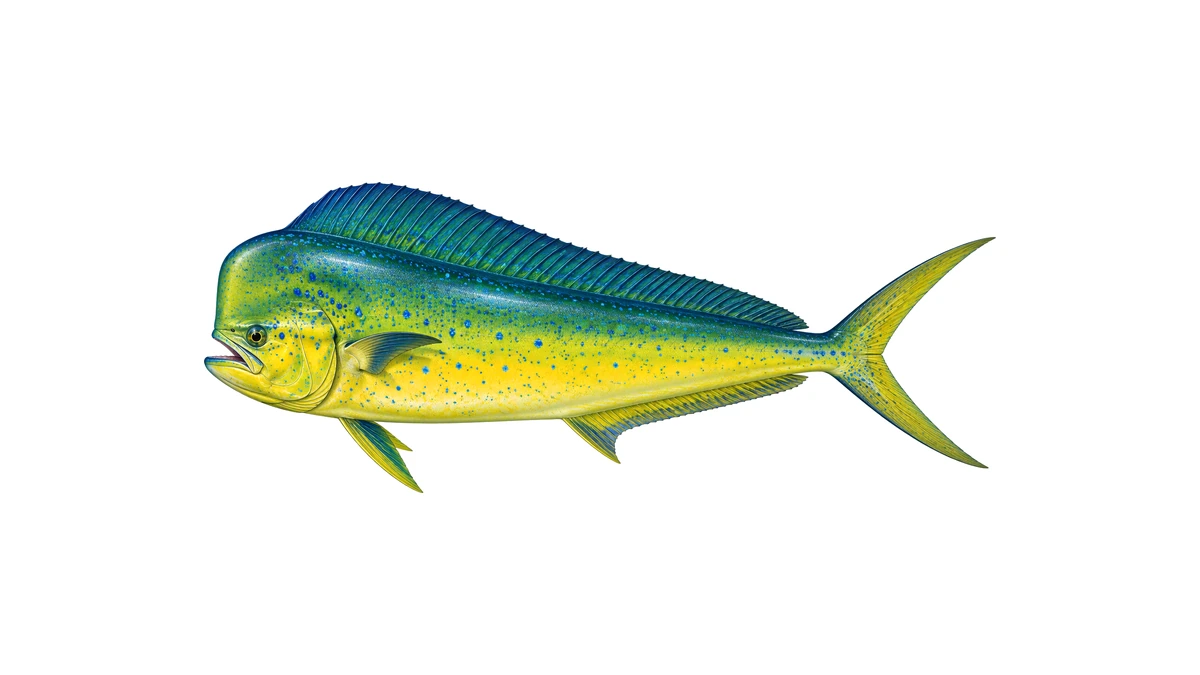
The mahi-mahi (Coryphaena hippurus) is the most colorful fish most anglers will ever catch. It is gold and green and electric blue at the same time, with a blunt forehead, a dorsal fin that runs the length of its back, and a habit of gathering under anything that floats. It also grows faster than almost any other fish in the sea and fights like a small missile. This profile covers mahi-mahi identification, habitat, diet, size, the world record, spawning, and how to catch one.
Quick ID Card
| Field | Details |
|---|---|
| Scientific name | Coryphaena hippurus |
| Common names | Mahi-mahi, dolphinfish, dorado, mahi; "dolphin" in older fishing writing |
| Family | Coryphaenidae (dolphinfish) |
| Typical size | 10–30 pounds; 20–40 inches |
| Trophy size | 40–60 pounds; the largest exceed 80 pounds |
| Water type | Open ocean surface, often around weed lines, flotsam, and fish aggregating devices |
| Active water temperature | Roughly 68–86°F (20–30°C) |
| Difficulty | Moderate; fast and acrobatic, but usually willing to bite |
| Best season | Late spring through fall in the Atlantic; year-round in the tropics |
How to Identify a Mahi-Mahi
Mahi-mahi identification is mostly about color and head shape. The body is compressed and deep, tapering to a slim tail base. The back is blue-green, the sides are brilliant gold and yellow, and the whole fish is scattered with small iridescent blue-green spots. The belly is pale yellow to white.
The head tells you the sex. Adult males, called bulls, have a tall, blunt, almost vertical forehead. Females and juveniles have a rounded, sloping head. A big bull looks like it swam into a wall.
The fins are unmistakable. A single long dorsal fin starts just behind the head and runs almost to the tail. The anal fin is long as well and mirrors the dorsal. The tail is deeply forked. The pelvic fins are long and can be blue or dark. In the water, a lit-up mahi looks like a neon sign with fins.
Color is not a reliable field mark after death. A mahi fades quickly once it is out of the water, turning muted yellow and silver-gray within minutes. That is why photos of dead mahi rarely match the fish people remember. The Hawaiian name mahi-mahi means "very strong," a reference to the fish's power rather than its flavor.
Mahi-Mahi vs Wahoo
Mahi and wahoo share the same offshore water and the same trolling spread, and both are fast. They are not closely related.
| Feature | Mahi-mahi | Wahoo |
|---|---|---|
| Body shape | Deep, compressed, blunt forehead | Long, slender, cylindrical |
| Color | Gold, green, and blue, with spots | Silver with bold vertical bars |
| Head | Blunt vertical forehead on bulls | Pointed snout, large mouth |
| Dorsal fin | One long fin from head to tail | Long first dorsal, then a second dorsal |
| Tail | Deeply forked | Forked, crescent-shaped |
| Teeth | Small, rasp-like | Large, sharp, cutting teeth |
| Typical weight | 10–30 pounds | 15–50 pounds |
The body shape is the fast answer. A mahi is tall and flat-sided; a wahoo is a silver torpedo with stripes. Wahoo also have a much more dangerous mouth, with teeth that can cut through a leader. Mahi have small teeth and rough jaws, but they are not line cutters in the same way.
Both fish are often caught in the same spread because both hunt around temperature breaks, weed lines, and floating structure. A trolled lure that draws a wahoo will often draw a mahi, and a mahi will usually be the first to arrive.
Is the Mahi-Mahi Dangerous?
Mahi are not venomous and have no stingers. Their teeth are small, and a hooked fish is more likely to damage the deck than the angler. The dorsal fin is long but not sharp enough to be a real hazard.
The danger is the boat. Mahi go crazy on deck, and a 30-pound fish thrashing with a hook in its mouth can throw blood, water, and gear. Keep the deck clear, control the fish with a net or a gaff, and stay out of the arc of a swinging lure. Offshore trolling involves multiple lines, and a hooked mahi that crosses the spread can tangle several rods at once.
There is also a naming trap. "Dolphin" in old cookbooks and fishing reports means dolphinfish, not the marine mammal. Mahi-mahi is the market name used to avoid confusion. No one is fishing for Flipper.
Handling is simple. Mahi are delicate compared with tuna, and their colors fade fast. If you plan to release a fish, do it quickly and keep it in the water. If you plan to keep it, bleed and ice it immediately; mahi spoil quickly and the flesh goes soft in warm air.
Where Do Mahi-Mahi Live?
Mahi-mahi habitat is the warm surface layer of the open ocean. They are found worldwide in tropical and subtropical seas: the Atlantic, Pacific, and Indian oceans, the Gulf of Mexico, the Caribbean, and the Gulf Stream. In the U.S. they are a staple of offshore fishing from Florida to the Carolinas, and in Hawaii they are one of the most important pelagic species.
Where do mahi-mahi live in the water column? Near the surface, usually in the top 100 feet, and often right at the top. They gather around floating objects: sargassum weed, driftwood, buoys, lost cargo, and purpose-built fish aggregating devices (FADs). A weed line or a floating pallet can hold a school of mahi in the middle of empty ocean.
That association with flotsam is the key to finding them. Birds, current edges, temperature breaks, and color changes in the water all concentrate bait, and bait concentrates mahi. In the Atlantic, the Gulf Stream edges off Florida and the Carolinas are classic grounds. In the Pacific, Hawaii's FADs and the waters off Central America produce big fish.
Mahi are warm-water fish. They are most active from about 68 to 86°F, and they follow warm currents seasonally. In the Atlantic, that means late spring through fall in the Mid-Atlantic and year-round action in Florida and the Caribbean.
Habits and Diet: What Do Mahi-Mahi Eat?
What do mahi-mahi eat? Fish, squid, and crustaceans. Flying fish, sardines, anchovies, mackerel, and juvenile tunas are staples. Mahi also eat squid and small crabs, and they are not picky. A hungry school will attack a bait ball from below and drive baitfish to the surface.
Mahi are fast, aggressive feeders and grow at an extraordinary rate. They can mature within their first year, and their lifespan is short, usually no more than four or five years. That fast turnover is why the species can support heavy fishing pressure, and why a mahi is often described as a weed of the ocean in the best sense: quick to grow, quick to reproduce, quick to replace itself.
When do mahi-mahi spawn? In warm water they spawn repeatedly through the year, with peaks in spring and summer in the Atlantic and year-round spawning in the tropics. Females release eggs in open water, and the eggs and larvae drift with the currents. Juveniles often shelter under floating weed, which is one reason FADs and sargassum lines hold so many small fish.
Mahi travel in schools, usually sorted by size. Small fish gather in big groups around flotsam; big bulls are more often alone or in pairs. A school at a weed line may hold dozens of 5- to 15-pound fish, with a big bull cruising the edge.
Size, Records and Regulations
How big do mahi-mahi get? Most caught fish are 10 to 30 pounds and 20 to 40 inches. A 40-pound mahi is a good one, and a 50- to 60-pound bull is a trophy. The species can reach about 6.5 feet and 80-plus pounds.
The world record mahi-mahi on rod and reel is 87 pounds, caught off Costa Rica in 1976. That fish still stands as the IGFA all-tackle record, and it is far larger than the average offshore mahi.
Regulations in the U.S. are split between federal and state waters. In the Atlantic, dolphin are managed under the Dolphin Wahoo Fishery Management Plan by the South Atlantic Fishery Management Council. There is no federal closed season for dolphin, but state rules on size and bag limits vary. Florida, for example, allows 10 mahi per person per day or 60 per vessel, whichever is less, and anglers should confirm the current size rule with the Florida Fish and Wildlife Conservation Commission. Hawaii and the Gulf states have their own rules.
The best bait for mahi-mahi is a live or fresh baitfish: pilchards, cigar minnows, ballyhoo, or squid. Trolling skirted lures, ballyhoo rigs, and small plugs is the standard offshore approach. When fish are gathered at a weed line, casting a bucktail jig, a soft plastic, or a popper is more fun and often more effective than trolling past them.
How to catch mahi-mahi: find a temperature break, a weed line, or a floating object, and work it thoroughly. Troll until you find fish, then stop and cast. Chunking with cut bait and sardines holds a school near the boat. Use 20- to 30-pound spinning or conventional tackle with a 40- to 60-pound leader, and keep a net ready. Mahi have soft mouths, so a heavy drag can pull the hook; play the fish smoothly rather than winching it.
Mahi are also excellent eating, which is why so many are kept. Bleed them immediately, ice them well, and fillet them the same day. The flesh is firm, mild, and versatile, and it holds up to grilling better than most offshore fish. Last verified: November 2025.
FAQ
How big do mahi-mahi get? Most are 10–30 pounds. A 40- to 60-pound bull is a trophy, and the species can exceed 80 pounds and 6 feet.
What is the world record mahi-mahi? The IGFA all-tackle record is 87 pounds, caught off Costa Rica in 1976.
Where do mahi-mahi live? In warm surface water worldwide, especially around weed lines, flotsam, and FADs. In the U.S. they are common from Florida to the Carolinas and around Hawaii.
What do mahi-mahi eat? Fish such as flying fish, sardines, and mackerel, plus squid and small crustaceans. They feed aggressively and grow very fast.
Mahi-mahi vs wahoo: how do you tell them apart? A mahi is deep-bodied, gold and blue, with a blunt forehead and one long dorsal fin. A wahoo is slender and silver with vertical bars, a pointed snout, and large cutting teeth.
When do mahi-mahi spawn? Repeatedly through the warm months in the Atlantic, and year-round in the tropics. Eggs and larvae drift in open water.
What is the best bait for mahi-mahi? Live or fresh pilchards, cigar minnows, ballyhoo, and squid. Skirted trolling lures and casting jigs also work well around weed lines.
How do you catch a mahi-mahi? Find a weed line, temperature break, or floating object. Troll to locate fish, then cast baits or lures. Use moderate tackle and a smooth drag, and ice the fish quickly if you keep it.
Related Articles
- Cobia — a coastal fish with the same curious approach to boats.
- Tarpon — an inshore acrobat with a very different address.
- Striped Bass — the Atlantic coast's great seasonal predator.
- Northern Shrimp — a cold-water forage species at the base of the food web.
- All species profiles
A mahi-mahi is a fish that looks like it was designed for a poster and fights like it was designed for a reel. Find the weed line, make the cast, and the reward is color, speed, and a dinner that justifies the fuel. That is the mahi-mahi deal.
Ready to catch one? Read our step-by-step guide: How to Catch Mahi-mahi.
About the author and how this was tested
About the author
FishermanGuy
Bank, boat and kayak angler · fishing, crabbing and shrimping since 2021
I buy the gear, fish it for a season and write down what failed. No sponsored verdicts, no free-sample flattery. Every rig on this page has landed fish in water I can point at on a map.
How this was tested
- Every rig gets at least six trips on the same water before it is published.
- Gear is bought at retail. Free samples are labelled in the first paragraph.
- Dates show first publication and the last time the page was updated.