Field notes
Striped Bass: Identification, Habitat & Diet
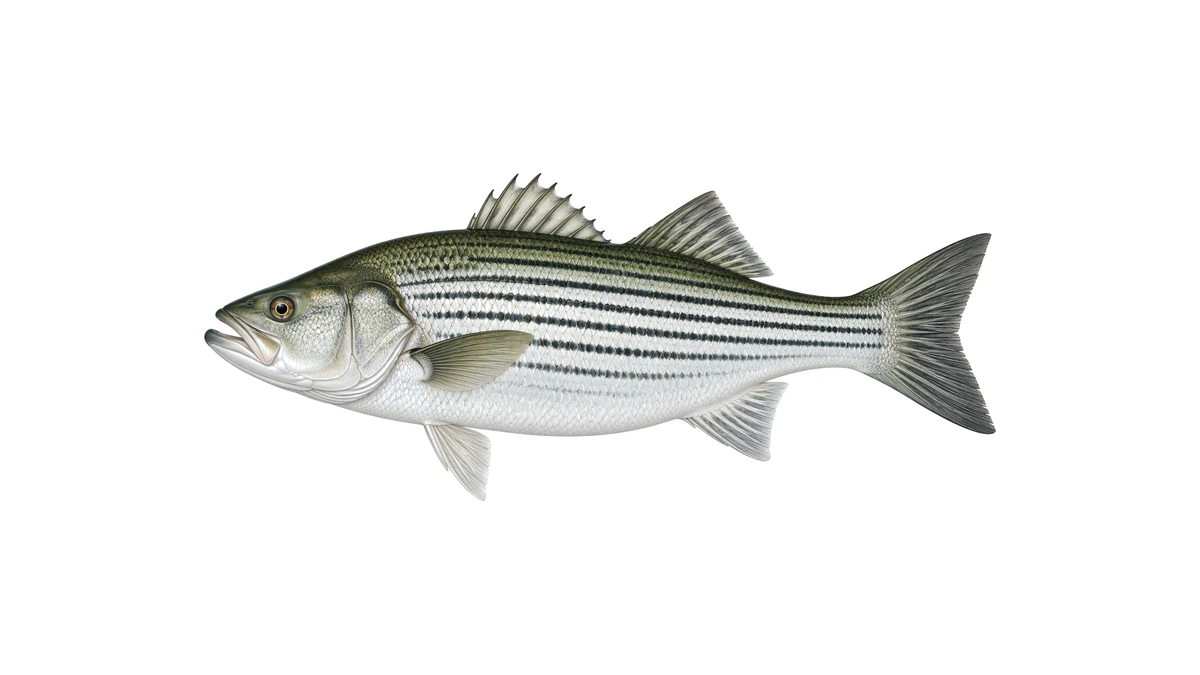
Striped Bass: Identification, Habitat & Diet
The striped bass (Morone saxatilis) is the fish that defines Atlantic coastal fishing. Seven or eight black stripes, a silver body, a taste for menhaden, and a spring and fall migration that turns beaches, inlets, and rivers into crowded fisheries. Anglers call it a striper or a rockfish, and it is the state fish of Maryland and several other states. It is also a fish under pressure, with rules that have tightened repeatedly. This profile covers striped bass identification, habitat, diet, size, records, spawning, and how to catch one.
Quick ID Card
| Field | Details |
|---|---|
| Scientific name | Morone saxatilis |
| Common names | Striped bass, striper, rockfish, linesider |
| Family | Moronidae (temperate basses) |
| Typical size | 5–20 pounds; 24–36 inches |
| Trophy size | 30–50 pounds; the largest exceed 70 pounds |
| Water type | Coastal surf, inlets, bays, tidal rivers, and freshwater reservoirs |
| Active water temperature | Roughly 50–77°F (10–25°C) |
| Difficulty | Moderate; abundant access, but finding fish takes work |
| Best season | Spring spawning run and fall migration; year-round in some waters |
How to Identify a Striped Bass
Striped bass identification is about the stripes, and the stripes are hard to miss. A striped bass has seven or eight dark horizontal lines running from the gill cover to the tail. The lines are continuous and unbroken. The background is silvery white, with an olive-green or blue-gray back.
The body is stout and deep, but not as deep as a white bass. The mouth is large, and the lower jaw protrudes slightly. The gill cover has a sharp spine at the top rear corner, which is a handling hazard. There are two dorsal fins: a spiny first dorsal and a soft second dorsal, separated by a small gap.
Juveniles look like miniature adults, with the same stripes and body shape. A young striper can be confused with a white bass or a hybrid, so check the tongue. A striped bass has two rough tooth patches on the tongue; a white bass has one. That is the fastest field test.
Striped bass are not closely related to largemouth or smallmouth bass, despite the name. They belong to the family Moronidae, the temperate basses, which also includes white bass and European sea bass. The name is a matter of appearance, not taxonomy.
Striped Bass vs White Bass
White bass (Morone chrysops) share the same family and some of the same water, and hybrids between the two are stocked in many reservoirs. Telling them apart matters because the rules often differ.
| Feature | Striped bass | White bass |
|---|---|---|
| Stripes | 7–8 bold, continuous stripes | Fainter stripes, often broken or faint on the front half |
| Body shape | Longer, less deep | Deeper, more compressed |
| Size | Commonly 5–20 pounds | Usually under 2 pounds, rarely 3–4 |
| Tongue teeth | Two tooth patches | One tooth patch |
| Dorsal fins | Two, clearly separated | Two, connected at the base |
| Habitat | Coastal and anadromous; also stocked reservoirs | Mostly freshwater rivers and reservoirs |
The hybrid, called a wiper or palmetto bass, falls in between. It usually has broken or dashed stripes, a deeper body than a striper, and two tongue patches. Hybrids fight hard and are popular in reservoirs, but they are not the same fish and may have different regulations.
The easiest check on the water is size plus stripes. A 10-pound fish with solid, unbroken lines is a striped bass. A 1-pound fish with faint, broken lines is a white bass.
Is the Striped Bass Dangerous?
Striped bass are not venomous. They have no poison spines and no stingers. The hazards are mechanical: a sharp spine on the gill cover, spiny dorsal fins, and teeth that can rasp a thumb.
The gill-cover spine is the one that draws blood. When you handle a striper, slide a hand under the belly and support the fish; do not jam your fingers under the gill cover. The dorsal spines can also stick you if you grab a fish across the back. A wet towel or a lip grip helps.
Surf and jetty fishing adds its own risks. Rocks are slippery, waves arrive without warning, and night fishing puts boats and other anglers in the dark. Wear a PFD on the rocks, use a headlamp, and never turn your back on the ocean. In boats, keep a safe distance from other vessels when fish stack up in an inlet.
Cold water is a real hazard in the fall and winter. A striper angler who falls into 45°F water has minutes, not hours. Dress for immersion, carry a knife, and fish with a partner when you can. The fish is not the danger; the water is.
Where Do Striped Bass Live?
Striped bass habitat is the Atlantic coast of North America, from the St. Lawrence River and Gulf of St. Lawrence in Canada south to the St. Johns River in Florida and the northern Gulf of Mexico. The center of the population is the Chesapeake Bay, which produces a large share of the coastwide stock, followed by the Hudson River, Delaware River, and Roanoke River systems.
They are anadromous, meaning they live in salt water and spawn in fresh or brackish water. Most fish spend the summer along the coast and in estuaries, then move into rivers in spring to spawn. Some populations are landlocked in reservoirs, where they live entirely in fresh water and spawn in tributary rivers when conditions allow.
Striped bass have been introduced far outside their native range. They were stocked in the Pacific coast, where San Francisco Bay and the Sacramento-San Joaquin Delta hold a well-known population. They are also stocked in reservoirs across the South and West, including Lake Texoma, Santee-Cooper, and lakes in California and Arizona.
Where do striped bass live in the water column? It depends on temperature and bait. In spring and fall they are shallow and aggressive, often chasing bait into the surf and up rivers. In summer they go deep and hold in cooler water, feeding at night or in low light. In winter they crowd into deep holes in rivers and bays.
Water temperature drives the whole pattern. Stripers are active from about 50 to 77°F. They feed best in the 55–68°F range, which is why spring and fall are the prime seasons.
Habits and Diet: What Do Striped Bass Eat?
What do striped bass eat? Fish first. Atlantic menhaden, also called bunker, is the classic forage, along with herring, alewives, shad, silversides, and eels. Stripers also eat crabs, squid, and worms. A big striper is an opportunistic predator that will take whatever bait is concentrated and vulnerable.
They feed by sight and by current. In a rip or an inlet, stripers hold on the down-current side and pick off bait swept past. On a beach, they herd baitfish into the wash. Around structure such as bridge pilings, jetties, and rock piles, they use the edge as an ambush line. Find the bait and the current, and the fish are usually close.
When do striped bass spawn? The run happens in spring, when river water warms to roughly 55–68°F. Fish move upstream to the fall line or into tidal freshwater, release eggs that drift in the current, and then drop back downstream. The Chesapeake, Hudson, Delaware, and Roanoke runs are the biggest. Timing shifts with the weather, so a cold spring pushes the run later.
Striped bass are long-lived. Females can live for decades and grow much larger than males. A 40-pound fish is usually an old female, which is why big-fish harvest is tightly regulated. The species matures later than many inshore fish, and that slow life history makes it vulnerable to overfishing.
Size, Records and Regulations
How big do striped bass get? Most anglers catch fish from 5 to 20 pounds. A 30-pound striper is a good fish, and a 50-pound fish is a trophy. The species can reach about 6 feet and 70-plus pounds, and the largest fish come from the Miramichi River in New Brunswick and from big coastal migrations.
The world record striped bass on rod and reel is 81 pounds 14 ounces, caught in Connecticut in 2011. It remains the IGFA all-tackle record and is far above the average keep.
Regulations are the most important part of striper fishing. The Atlantic States Marine Fisheries Commission (ASMFC) coordinates management along the coast, and each state sets its own seasons, size slots, and bag limits within that framework. Recent stock assessments have shown the population below target, and the rules have tightened several times.
As of 2025, the Atlantic ocean recreational fishery allows one striped bass per day inside a slot limit, while Chesapeake Bay and some state waters use a smaller slot. The exact size window has changed more than once in the past few years, so check the ASMFC website and your state agency before you fish. In Maryland, the Department of Natural Resources (DNR) posts the current Chesapeake rules; in Virginia, the Virginia Marine Resources Commission (VMRC); in New York, the Department of Environmental Conservation (DEC); in Massachusetts, the Division of Marine Fisheries (DMF).
Some fisheries are catch-and-release only, and some rivers have spring closures to protect spawning fish. Commercial harvest is limited and separately regulated. If you plan to keep a fish, know the slot, the bag limit, and whether a bonus tag or reporting requirement applies. Last verified: November 2025.
The best bait for striped bass depends on the water. Live menhaden, live eels, and live herring are the top natural baits. Chunked bunker, bloodworms, and fresh clams also work. On the artificial side, poppers, swimming plugs, bucktail jigs, soft swimbaits, spoons, and diamond jigs all catch fish. Fly anglers use Clouser Minnows and Deceivers.
How to catch striped bass: find bait, current, and structure. In spring, fish the spawning rivers and the beaches where fish push bait. In fall, follow the migration along the coast and fish the inlets and rips. At night, cast plugs and swimbaits around bridge lights and rock piles. Troll umbrella rigs or tube rigs where legal, jig deep structure in summer, and live-line menhaden in the current.
Use 15- to 30-pound spinning or conventional tackle for most fish, with a 30- to 50-pound leader around structure. In the surf, a 10- to 11-foot rod and a 5000- to 8000-size reel handle both plugs and bait. Play fish firmly, keep them out of the rocks, and release big females carefully.
FAQ
How big do striped bass get? Most are 5–20 pounds. A 30- to 50-pound fish is a trophy, and the species can exceed 70 pounds and 5 feet.
What is the world record striped bass? The IGFA all-tackle record is 81 pounds 14 ounces, caught in Connecticut in 2011.
Where do striped bass live? Along the Atlantic coast from the St. Lawrence to Florida and the northern Gulf, with the Chesapeake as the core. They are also stocked in Pacific and inland reservoirs.
What do striped bass eat? Menhaden, herring, alewives, shad, eels, crabs, squid, and worms. They feed by sight and current around bait concentrations.
Striped bass vs white bass: how do you tell them apart? A striper has 7–8 bold, unbroken stripes, a longer body, and two tooth patches on the tongue. A white bass has fainter, broken stripes, a deeper body, and one tongue patch.
When do striped bass spawn? In spring, when river water reaches about 55–68°F. Fish run upstream to tidal fresh water and release eggs that drift downstream.
What is the best bait for striped bass? Live menhaden, eels, and herring, plus chunk bait and bloodworms. Poppers, swimbaits, bucktails, and spoons cover the artificial side.
What is the striped bass fishing season? There is no single season. Spring and fall are prime on the coast, and state seasons, slots, and closures vary. Check ASMFC and your state agency for current rules.
Related Articles
- Tarpon — the Atlantic's other iconic inshore game fish.
- Cobia — a spring migrant that shares the Mid-Atlantic coast.
- Mahi-Mahi — an offshore species for the same saltwater angler.
- Northern Shrimp — a cold-water forage item in the northern food web.
- All species profiles
A striped bass is a fish of migrations and regulations. The spring run and the fall blitz are the reward, and the slot limits are the price of keeping the runs alive. Learn the stripes, learn the rules, and the striped bass will keep giving anglers something to chase.
Ready to catch one? Read our step-by-step guide: How to Catch Striped Bass.
About the author and how this was tested
About the author
FishermanGuy
Bank, boat and kayak angler · fishing, crabbing and shrimping since 2021
I buy the gear, fish it for a season and write down what failed. No sponsored verdicts, no free-sample flattery. Every rig on this page has landed fish in water I can point at on a map.
How this was tested
- Every rig gets at least six trips on the same water before it is published.
- Gear is bought at retail. Free samples are labelled in the first paragraph.
- Dates show first publication and the last time the page was updated.