Field notes
Yellowfin Tuna: Identification, Habitat & Diet
Yellowfin Tuna: Identification, Habitat & Diet
The yellowfin tuna (Thunnus albacares) is the warm-water tuna that most offshore anglers meet first, and for good reason. It is widespread, willing to eat, and built like a missile, with a pair of absurdly long yellow fins that make it one of the easiest tunas to name at the boat. Hawaiians call it ahi. Tournament anglers call it a paycheck fish. On a calm morning in the Gulf Stream or the Gulf of Mexico, a school of yellowfin smashing bait under diving birds is one of the great sights in saltwater fishing. This profile covers yellowfin tuna identification, habitat, diet, size, records, regulations, and how to catch one.
Quick ID Card
| Field | Details |
|---|---|
| Scientific name | Thunnus albacares |
| Common names | Yellowfin tuna, ahi, Allison tuna, yellowfin |
| Family | Scombridae (mackerels and tunas) |
| Typical size | 15–80 pounds; 30–60 inches fork length |
| Trophy size | 100–200 pounds; the largest push past 300 |
| Water type | Open ocean, warm surface water, current edges and temperature breaks |
| Active water temperature | Roughly 64–86°F (18–30°C), best near 70–80°F (21–27°C) |
| Difficulty | Hard; long runs, powerful surges, heavy tackle recommended |
| Best season | Year-round in the tropics and subtropics; late spring through fall in U.S. waters |
How to Identify a Yellowfin Tuna
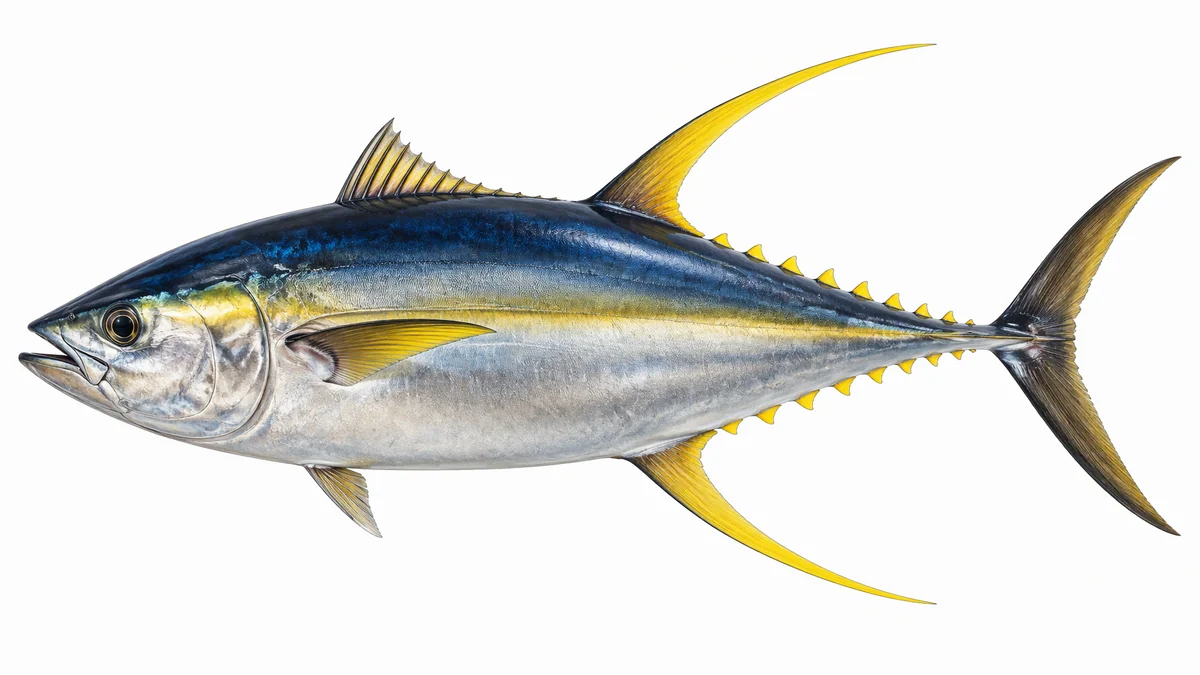
Yellowfin tuna identification comes down to fins and color, and you rarely need more than a glance at a healthy fish. The body is a streamlined torpedo, dark metallic blue on the back, silver on the belly, with a soft golden band running along the flank.
The giveaway is the second dorsal fin and the anal fin. In adults both stretch into long, curved, bright-yellow sickles that can trail back nearly to the tail. No other North American tuna has that profile. The tiny finlets along the upper and lower tail are also lemon yellow, often rimmed faintly in black. The first dorsal fin is short and yellowish, and it folds flat into a groove when the fish swims fast.
The pectoral fins are short to moderate and taper to a point. They sit well forward of the long sickle fins on the back and belly. That combination — short pectorals, very long yellow dorsal and anal fins, yellow finlets — separates a yellowfin from a bigeye, which has long pectorals and short rear fins. If you are still unsure, look at the liver when you clean the fish: a yellowfin's liver is smooth, while a bigeye's carries fine striations across the surface.
Juveniles are stockier and their sickle fins have not yet stretched out, so young yellowfin are easier to confuse with bigeye and albacore. The color still helps. That golden lateral stripe and the bright finlet row are present even in small fish.
Yellowfin vs Bluefin Tuna
Anglers mix up yellowfin and bluefin constantly, especially at a distance. Both are true tunas, both have yellow finlets, and both are electric fighters. They are not, however, interchangeable. A bluefin is a much heavier, deeper-bodied animal, and the rules for each are completely different.
| Feature | Yellowfin | Bluefin |
|---|---|---|
| Typical weight | 15–80 pounds | 100–500 pounds, often larger |
| Maximum size | About 400 pounds | Over 1,000 pounds |
| Body shape | Slender, streamlined | Massive, thick through the shoulders |
| Second dorsal and anal fins | Very long, yellow, sickle-shaped | Short |
| Pectoral fins | Short to moderate | Short |
| Finlets | Bright yellow | Yellow with dark edges |
| Core range | Tropical and subtropical seas worldwide | Temperate Atlantic and Mediterranean (Atlantic bluefin) |
| Status and rules | Least Concern; light-touch management | Heavily quota-managed; strict rules |
The practical difference is size and circumstance. A school of 30-pound fish crashing under terns in the Gulf is almost certainly yellowfin. A lone, barrel-bodied fish over 300 pounds off New England in the fall is more likely a bluefin, with a totally different set of regulations attached. For a deeper look, see the bluefin tuna profile.
Is the Yellowfin Tuna Dangerous?
Yellowfin are not venomous. They have no stingers and no poison glands, and their teeth are small. The danger is entirely mechanical and entirely about the fight.
A yellowfin hits a trolled lure at speed and then runs. A 100-pound fish can peel line off a heavy reel in long, unstoppable surges, and a careless angler gets hurt by a spinning handle, a rod butt in the ribs, or a leader that snaps under load. Keep your hands off the spool, keep the rod in a holder or braced against your hip during the initial run, and let the drag do the work.
At the boat, respect the billfish-like power of a green fish. A yellowfin that has been fought to the surface may make one last vertical run when it sees the hull. Wear gloves, keep the leader short, and never wrap it around your hand.
There is one quieter risk. Tuna flesh spoils fast and can develop scombrotoxin (histamine) if it is not chilled quickly. Bleed the fish immediately, ice it well, and keep it cold. Large yellowfin from some tropical reefs can also carry ciguatera, so check local advisories where that is a known issue.
Where Do Yellowfin Tuna Live?
Yellowfin tuna habitat is the warm open ocean, roughly between 40 degrees north and 40 degrees south latitude. They are found across the Atlantic, Pacific, and Indian oceans, and they are absent or rare in the Mediterranean. In the western Atlantic they range from Massachusetts and Bermuda south through the Gulf of Mexico and the Caribbean to Brazil. In the Pacific they run from Japan and Hawaii across to Mexico and, in warm years, up into Southern California.
The fish track warm water. They concentrate along current edges, temperature breaks, seamounts, and floating structure. A temperature break where 70-degree green water meets 78-degree blue water is classic yellowfin ground. So is any weed line or drifting debris holding bait.
Where do yellowfin tuna live in the water column? Small fish school right at the surface, often under birds, dolphins, or floating objects. Big adults can be far deeper, and many are caught on deep-drop jigs and on baits fished well below the boat. On calmer days you may see the long sickle fins slicing the surface as fish cruise just under the skin of the sea.
Habits and Diet: What Do Yellowfin Tuna Eat?
What do yellowfin tuna eat? Mostly small pelagic fish, plus squid and the occasional crustacean. Sardines, anchovies, mackerel, flying fish, and halfbeaks make up a large part of the diet. Yellowfin are fast, visual hunters that feed most actively at dawn and dusk and will herd bait into tight balls before slashing through them.
Yellowfin are schooling fish, especially when young. Schools often mix with skipjack and bigeye, and they frequently associate with dolphins, whale sharks, and floating logs. That association is why trolling under working birds is so effective: the birds are marking a bait ball, and the tuna are underneath it.
When do yellowfin tuna spawn? In warm tropical water they spawn year-round, with regional peaks in spring and summer. A mature female can release eggs almost daily during the peak season, broadcasting millions of tiny eggs into the open water. Yellowfin grow fast and mature in roughly three to five years, which is one reason the species supports heavy fishing pressure better than its larger relatives.
Yellowfin are warm-bodied, though not to the extreme of a bluefin. A specialized heat-exchange system keeps their swimming muscles warmer than the surrounding water, which lets them hunt in cooler depths and recover quickly between bursts.
Size, Records and Regulations
How big do yellowfin tuna get? Most rod-and-reel fish weigh 15 to 80 pounds. A 150-pound yellowfin is a serious fish, and anything over 200 pounds is a trophy almost anywhere. The species can reach roughly 400 pounds and about 7.5 to 8 feet in fork length, though fish that large are rare.
The world record yellowfin tuna on rod and reel sits in the low 400-pound range, a fish taken off Mexico in the 2010s. Records change and certification takes time, so check the IGFA record book for the current all-tackle number rather than trusting a memory or a forum post.
Regulations depend on where you fish and which ocean you are in. In the United States, tunas in federal waters are managed by NOAA Fisheries under the highly migratory species (HMS) program, and most anglers need an HMS permit to target them, even on a private boat. There is generally no federal minimum size for yellowfin in the Atlantic recreational fishery, but state rules, bag limits, and reporting requirements vary and do change. In the eastern Pacific, international closures and catch limits set through the Inter-American Tropical Tuna Commission affect when and where commercial and sport boats can fish.
Globally, yellowfin are managed by the regional tuna commissions — ICCAT in the Atlantic, IATTC in the eastern Pacific, WCPFC in the western Pacific, and IOTC in the Indian Ocean. The IUCN lists yellowfin as Least Concern worldwide, which is a far better position than the bluefin stocks. That does not mean the rules are loose. Read the current HMS and state regulations before you keep a fish. Last verified: November 2025.
How to catch yellowfin tuna: find warm, blue water with bait and birds, then present something that looks like a fleeing sardine. The best bait for yellowfin is a live baitfish such as a sardine, pilchard, or blue runner, or a fresh dead bait fished on a circle hook. Trolling skirted lures and cedar plugs is the classic search method, and once a school is located, casting poppers, stickbaits, and live baits into the melee is far more fun than dragging lures.
Use 30- to 80-pound class conventional gear for school fish and heavier tackle for giants. A fluorocarbon leader in the 40- to 100-pound range, a strong circle or J hook matched to the bait, and a smooth, well-set drag are the essentials. Chumming with cut bait and live sardines pulls fish to the boat and keeps them there. When a yellowfin eats, let it load the rod, then come tight and clear the line from the rail before the first run starts.
FAQ
How big do yellowfin tuna get? Most are 15–80 pounds. Fish over 150 pounds are trophies, and the species tops out near 400 pounds and about 8 feet.
What is the world record yellowfin tuna? The IGFA all-tackle record is in the low 400-pound range, taken off Mexico. Check IGFA for the current certified number.
Where do yellowfin tuna live? In warm water across the Atlantic, Pacific, and Indian oceans, from about 40°N to 40°S. They favor current edges, temperature breaks, and floating structure.
What do yellowfin tuna eat? Small fish such as sardines, anchovies, mackerel, and flying fish, plus squid. They feed hardest at dawn and dusk.
Yellowfin vs bluefin: how do you tell them apart? Yellowfin are slender with very long yellow sickle-shaped dorsal and anal fins. Bluefin are far heavier with short rear fins, and the rules for each differ sharply.
When do yellowfin tuna spawn? Year-round in the tropics, peaking in spring and summer. Females can spawn almost daily in season.
What is the best bait for yellowfin tuna? Live sardines, pilchards, or blue runners, or fresh dead bait on a circle hook. Trolled skirted lures find fish; live bait catches them.
How do you catch a yellowfin tuna? Find blue water with birds and bait, troll to locate a school, then cast live baits or poppers into the action. Use heavy tackle and a smooth drag.
Related Articles
- Bluefin Tuna — the heavyweight cousin with an entirely different rulebook.
- Bigeye Tuna — the deep-water look-alike, best told apart by the liver and fin length.
- Albacore Tuna — the long-finned "white meat" tuna of cooler water.
- Skipjack Tuna — the striped, fast-growing tuna that schools with yellowfin.
- All species profiles
A yellowfin is the complete offshore package: easy enough to find, hard enough to fight, and good enough to eat raw. Learn the fins, watch the birds, and keep the drag smooth, and the yellowfin tuna will keep you coming back to blue water.
Ready to catch one? Read our step-by-step guide: How to Catch Yellowfin Tuna.
About the author and how this was tested
About the author
FishermanGuy
Bank, boat and kayak angler · fishing, crabbing and shrimping since 2021
I buy the gear, fish it for a season and write down what failed. No sponsored verdicts, no free-sample flattery. Every rig on this page has landed fish in water I can point at on a map.
How this was tested
- Every rig gets at least six trips on the same water before it is published.
- Gear is bought at retail. Free samples are labelled in the first paragraph.
- Dates show first publication and the last time the page was updated.