Field notes
Bluefin Tuna: Identification, Habitat & Diet
Bluefin Tuna: Identification, Habitat & Diet
The bluefin tuna (Thunnus thynnus) is the biggest, fastest, most valuable tuna in the sea, and the most tightly regulated. A single fish can outweigh a grown man several times over, sell for six figures at a Tokyo auction, and be the subject of international quota negotiations that decide whether a boat is allowed to keep it. Bluefin are warm-bodied, ocean-crossing predators that can chase prey into cold water no other tuna would tolerate. They are also a conservation story in motion, recovering in the Atlantic while other bluefin stocks still struggle. This profile covers bluefin tuna identification, habitat, diet, size, records, quota status, and how to catch one without breaking the rules.
Quick ID Card
| Field | Details |
|---|---|
| Scientific name | Thunnus thynnus (Atlantic bluefin) |
| Common names | Bluefin tuna, Atlantic bluefin, northern bluefin, giant bluefin, hon-maguro |
| Family | Scombridae (mackerels and tunas) |
| Typical size | 100–500 pounds; 50–80 inches |
| Trophy size | 600–1,000 pounds; giants exceed 1,000 |
| Water type | Open ocean and shelf edges, temperate to subtropical |
| Active water temperature | Roughly 45–86°F (7–30°C); they tolerate cold better than other tunas |
| Difficulty | Very hard; hours-long fights, specialized heavy tackle |
| Best season | Late summer and fall in the western Atlantic; spring and summer in the Mediterranean |
How to Identify a Bluefin Tuna
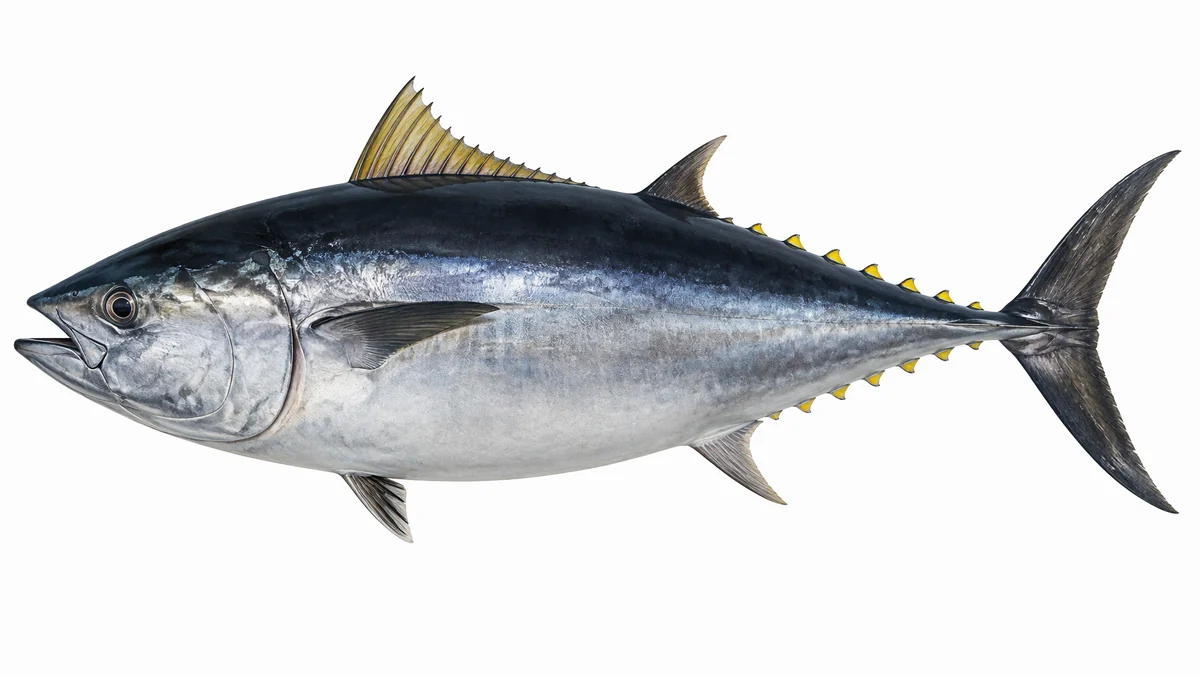
Bluefin tuna identification starts with bulk. This is a barrel of a fish: deep through the chest, thick at the shoulders, tapering to a stiff, crescent tail. The back is a dark, almost black-blue, and the belly is bright silver, often with faint rows of colorless spots and lines on the lower flank that fade after death.
The fin set is the field mark that separates bluefin from their relatives. The pectoral fins are short and pointed, reaching only to about the middle of the body, nowhere near the second dorsal fin. The second dorsal fin and the anal fin are short, not stretched into the long sickles a yellowfin carries. The first dorsal fin is short and edged in a yellowish or bluish tint. The finlets running toward the tail are yellow, each one neatly tipped with black.
That combination — massive body, short pectorals, short rear fins, yellow-and-black finlets — is the bluefin signature. A bigeye has long pectorals and a large eye. A yellowfin has long, curved yellow rear fins. An albacore has comically long pectorals. If the fish is the size of a small car and the pectorals stop halfway down the flank, you are looking at a bluefin.
Pacific bluefin (T. orientalis) look almost identical and are a separate species with their own rules. Southern bluefin (T. maccoyii) is a third species, found in the Southern Ocean. This profile focuses on the Atlantic bluefin, the one most Western anglers encounter.
Bluefin vs Yellowfin Tuna
Bluefin and yellowfin overlap in a few places and get confused at the boat, so the comparison matters — not least because the rules are completely different.
| Feature | Bluefin | Yellowfin |
|---|---|---|
| Typical weight | 100–500 pounds | 15–80 pounds |
| Maximum weight | Over 1,000 pounds | About 400 pounds |
| Body | Extremely deep and thick | Slender and streamlined |
| Second dorsal and anal fins | Short | Very long, yellow, sickle-shaped |
| Pectoral fins | Short, stops near mid-body | Short to moderate, tapering |
| Finlets | Yellow with black tips | Bright yellow |
| Fight | Heavy, dogged, can last hours | Fast, long runs, usually quicker |
| Rules | Strict quotas and size classes | Comparatively light-touch |
Size is the first filter. A 40-pound fish with long yellow rear fins is a yellowfin. A 300-pound tank with short rear fins is a bluefin. When in doubt, do not guess — a misidentified bluefin kept out of season is a serious violation. For the warm-water side of the family, see the yellowfin tuna profile.
Is the Bluefin Tuna Dangerous?
Bluefin are not venomous. They have no stingers and only small teeth. The danger is scale, speed, and the length of the fight.
A large bluefin on rod and reel is a genuinely physical event. Fish over 500 pounds have been fought for hours, and anglers have suffered heat exhaustion, back injuries, and heart strain in the process. The initial run can empty a heavy reel, and a green fish at the boat may surge straight down with enough force to break a gaff, bend a hook, or pull a person off balance. Stand-up harnesses, a fighting chair, and a crew that knows what it is doing are not luxuries on a giant.
Handle the fish carefully even when you plan to release it. Keep it in the water, support the body, never lift a big bluefin by the gill plate or tail alone, and revive it alongside the boat before release. Bluefin build up lactic acid fast, and a long fight leaves them exhausted.
The other risk is on the plate. Like all tunas, bluefin spoil quickly and can develop histamine if mishandled. Bleed and chill the fish immediately. The flesh itself is safe when fresh, but the fat content means it turns fast.
Where Do Bluefin Tuna Live?
Atlantic bluefin tuna habitat spans the entire North Atlantic and the Mediterranean. There are two well-known spawning grounds: the Gulf of Mexico, used by the western stock in spring, and the Mediterranean Sea, used by the eastern stock in early summer.
From those nurseries the fish fan out across an enormous range. Western bluefin show up from Newfoundland and Nova Scotia down the U.S. coast to the Carolinas and occasionally farther south. Eastern bluefin range from Norway and Iceland south to the Canary Islands and the Strait of Gibraltar. Tagging studies have shown that the two stocks mix on shared feeding grounds in the central Atlantic, which is one reason management is complicated: a fish caught off one country's coast may have been spawned in another.
Pacific bluefin live in the western and central North Pacific, spawning between Japan and the Philippines and ranging east to California and Mexico. Southern bluefin roam the Southern Ocean and spawn off the Indonesian archipelago.
Where do bluefin tuna live in the water column? They are pelagic and highly mobile, often hunting bait schools near the surface but fully capable of diving hundreds of feet. In cold months they can be found in water that would shut down a yellowfin. Their warm-bodied physiology lets them stay active where the water is genuinely cold.
Habits and Diet: What Do Bluefin Tuna Eat?
What do bluefin tuna eat? Mostly fish and squid, taken by high-speed pursuit. Herring, mackerel, sardines, anchovies, sand lance, and squid are staples. On the U.S. East Coast, bluefin are famous for blitzing schools of menhaden, sand eels, and squid, often driving bait right to the surface where birds and whales join the feast.
Bluefin are among the few fish that are functionally warm-blooded. A dense network of blood vessels, the rete mirabile, traps heat from the swimming muscles and keeps the core well above ambient water temperature. That lets a bluefin hunt in cold, deep water and recover quickly from bursts of speed. It also helps explain why the species can cross an ocean and still feed aggressively at the far end.
When do bluefin tuna spawn? Western Atlantic fish spawn in the Gulf of Mexico from roughly April into June. Eastern fish spawn in the Mediterranean in June and July. Females release huge numbers of eggs over several spawning events, but bluefin are slow to mature — often eight to twelve years old and well over five feet before they first spawn. That late maturity is the core reason the species is so vulnerable to overfishing: a fishery that takes big fish removes the breeders.
Conservation and Quota Status
Bluefin management is the most watched in all of tuna fishing, and the status differs sharply by stock.
The Atlantic bluefin was once listed as Endangered by the IUCN. After years of quota cuts and recovery, the IUCN reclassified the Atlantic bluefin as Least Concern globally in 2021. That is a real turnaround, driven by stricter catch limits and better enforcement. It is not a green light to keep every fish. The western Atlantic stock remains much smaller than the eastern stock, and both are still managed under hard quotas.
The Atlantic fishery is regulated by ICCAT, the International Commission for the Conservation of Atlantic Tunas. ICCAT sets an annual total allowable catch and divides it among member countries, including the United States. That quota has been raised in stages as the stock recovered, but it remains a binding limit, not a suggestion. In U.S. waters, NOAA Fisheries manages Atlantic bluefin under the highly migratory species program, with an HMS permit requirement, size classes, per-vessel and per-person retention limits, and a closure protecting bluefin in the Gulf of Mexico spawning grounds. Catch-and-release is encouraged, and circle hooks are required in parts of the recreational fishery.
Pacific bluefin are managed separately by the Western and Central Pacific Fisheries Commission and the Inter-American Tropical Tuna Commission. That stock was depleted by heavy fishing of juveniles and is rebuilding under strict international limits; U.S. recreational rules cap the number of Pacific bluefin a vessel may keep. Southern bluefin are managed by the Commission for the Conservation of Southern Bluefin Tuna and remain the most depleted of the three, still listed as Endangered by the IUCN.
The takeaway is simple: bluefin rules are strict, they change, and they differ by ocean and by stock. Read the current NOAA and ICCAT rules, know your size class, and never assume that a rule you read last year still applies. Last verified: November 2025.
Size, Records and Regulations
How big do bluefin tuna get? This is the largest tuna species. Atlantic bluefin commonly reach 500 pounds and can exceed 1,000, with the biggest recorded fish approaching 1,500 pounds and around 10 feet or more. Fish over 800 pounds are giants in any era.
The world record bluefin tuna on rod and reel is the IGFA all-tackle mark of about 1,496 pounds, a fish taken off Nova Scotia in 1979. It has stood for decades. Southern and Pacific bluefin run smaller. Check the IGFA book for the current certified figures rather than relying on dock talk.
Regulations are the hard part. In the U.S. Atlantic, recreational anglers fishing under the HMS permit must follow size-class limits — school, large school, small medium, large medium, and giant — with different bag limits and vessel limits for each, plus seasonal closures and a Gulf of Mexico spawning closure. Some fish may only be tagged and released. Commercial rules are stricter still, with quotas, permits, and reporting.
How to catch bluefin tuna: find bait and temperature structure, then present a big, natural-looking meal. The best bait for bluefin is a live mackerel, herring, or menhaden, or a fresh chunk of the same. Anglers also troll large skirted lures, spreader bars, and cedar plugs at speed to cover water. Chunking with cut bait and drifting is a deadly technique on the East Coast.
Use heavy conventional tackle in the 50- to 130-pound class, matched to the size of fish you expect. A short, strong fluorocarbon or mono leader, a heavy circle hook for bait, and a smooth, pre-set drag are essential. Fight the fish from a harness or chair, keep the rod loaded, and let the boat chase the fish when you can. If you plan to release, use circle hooks, keep the fight short, and revive the fish properly. For more on the smaller, more accessible tunas in the family, see bigeye tuna, albacore tuna, and skipjack tuna.
FAQ
How big do bluefin tuna get? Atlantic bluefin commonly reach 500 pounds and can top 1,000, with the largest near 1,500 pounds and 10 feet or more.
What is the world record bluefin tuna? The IGFA all-tackle record is about 1,496 pounds, caught off Nova Scotia in 1979. Check IGFA for current certification.
Where do bluefin tuna live? Atlantic bluefin range across the North Atlantic and Mediterranean, spawning in the Gulf of Mexico and the Mediterranean. Pacific and southern bluefin live in their own ocean basins.
What do bluefin tuna eat? Herring, mackerel, sardines, anchovies, sand lance, and squid, hunted at high speed.
Bluefin vs yellowfin: how do you tell them apart? Bluefin are far heavier with short rear fins; yellowfin are slender with very long yellow sickle fins. The rules differ sharply.
When do bluefin tuna spawn? Western Atlantic fish spawn in the Gulf of Mexico in spring; eastern fish spawn in the Mediterranean in early summer.
Are bluefin tuna endangered? Atlantic bluefin were reclassified to Least Concern in 2021 after recovery, but they remain under strict quotas. Southern bluefin are still Endangered.
How do you catch a bluefin tuna? Troll large lures or fish live bait around bait schools, using heavy tackle, circle hooks, and a smooth drag. Follow current quota and size rules.
Related Articles
- Yellowfin Tuna — the slender, warm-water tuna most often confused with bluefin.
- Bigeye Tuna — a deep-diving tuna with long pectorals and a big eye.
- Albacore Tuna — the long-finned white-meat tuna of cooler water.
- Skipjack Tuna — the striped, fast-growing tuna behind most canned light tuna.
- All species profiles
The bluefin tuna is a fish that demands respect twice: once for what it can do at the end of a line, and once for the rules that keep it in the ocean. Learn the fins, learn the quotas, and treat every one you release as a fish that will spawn again.
Ready to catch one? Read our step-by-step guide: How to Catch Bluefin Tuna.
About the author and how this was tested
About the author
FishermanGuy
Bank, boat and kayak angler · fishing, crabbing and shrimping since 2021
I buy the gear, fish it for a season and write down what failed. No sponsored verdicts, no free-sample flattery. Every rig on this page has landed fish in water I can point at on a map.
How this was tested
- Every rig gets at least six trips on the same water before it is published.
- Gear is bought at retail. Free samples are labelled in the first paragraph.
- Dates show first publication and the last time the page was updated.