Field notes
Skipjack Tuna: Identification, Habitat & Diet
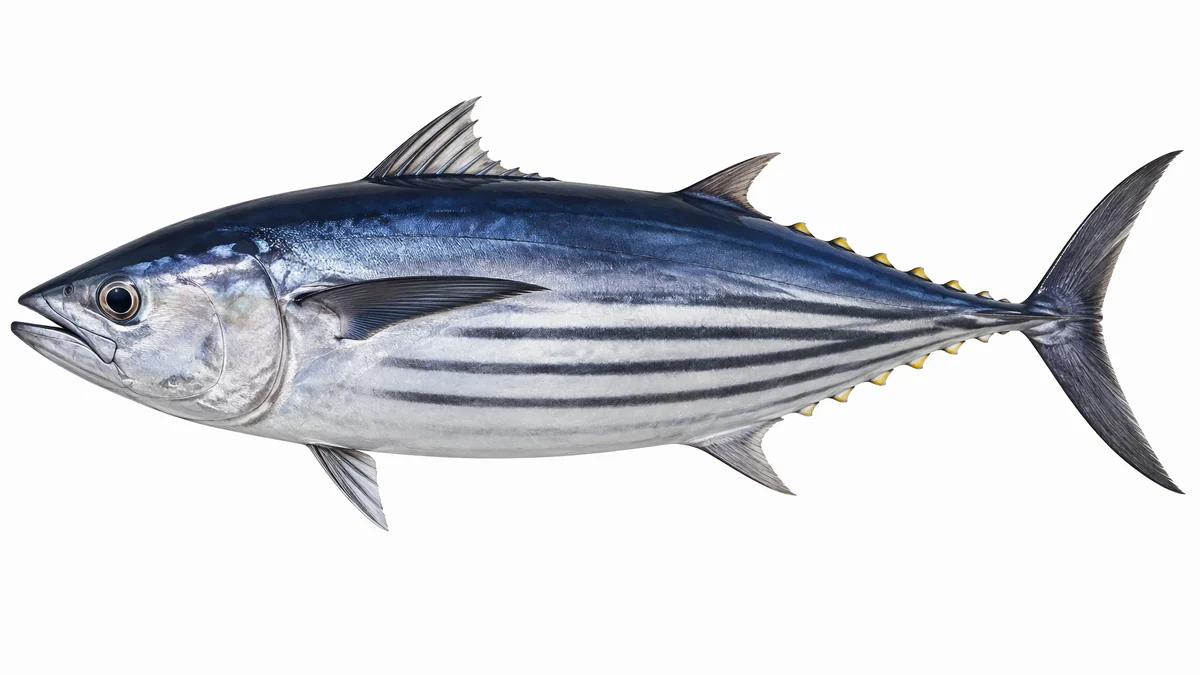
Skipjack Tuna: Identification, Habitat & Diet
The skipjack tuna (Katsuwonus pelamis) is the most abundant tuna in the ocean and the one most people eat without ever seeing it whole. It is the striped, fast-growing fish behind most canned light tuna and a large share of the world's katsuobushi. In Hawaii it is aku, a favorite of surface-fishing anglers. In Japan it is katsuo, the fish behind dashi. It is smaller than its famous cousins, but pound for pound it may be the most important tuna on Earth: the stock supports a huge share of global tuna landings and remains healthy. This profile covers skipjack tuna identification, habitat, diet, size, regulations, how it fits into canned tuna, and how to catch one.
Quick ID Card
| Field | Details |
|---|---|
| Scientific name | Katsuwonus pelamis |
| Common names | Skipjack tuna, skipjack, striped tuna, aku, katsuo, arctic bonito |
| Family | Scombridae (mackerels and tunas) |
| Typical size | 2–10 pounds; 16–24 inches |
| Trophy size | 20–35 pounds; the largest approach 70 |
| Water type | Open ocean, warm surface water, current edges and floating structure |
| Active water temperature | Roughly 64–86°F (18–30°C) |
| Difficulty | Easy to moderate; small but fast and acrobatic |
| Best season | Year-round in the tropics; summer and fall in warm temperate seas |
How to Identify a Skipjack Tuna
Skipjack tuna identification is mostly about stripes, and the stripes are unmistakable. Four to six bold, dark horizontal lines run along the lower flanks, from behind the pectoral fin toward the tail. The back above the stripes is dark blue to purple, with no markings. The belly below is bright silver.
No other tuna has those belly stripes. Yellowfin have a golden band and long yellow fins. Bigeye have a big eye and no stripes. Albacore have enormous pectorals and a white belly. If a small tuna shows dark bars on its belly and a clean, dark back, it is a skipjack.
The body is slender and fusiform, with a pointed snout and small teeth. The pectoral fins are short. The second dorsal fin and anal fin are small and followed by a row of yellow finlets. The tail is forked and stiff. Skipjack also lack a swim bladder, an unusual trait among tunas, and most of the body is nearly scaleless behind the corselet, the band of scales behind the head.
A small skipjack can be confused with a small yellowfin or a bonito, so check the stripes and the lack of any markings on the back. Stripes on the belly and nowhere else settle it.
Skipjack vs Yellowfin Tuna
Skipjack and yellowfin often school together, and young fish can look similar at a glance. The differences are clear once you know them.
| Feature | Skipjack | Yellowfin |
|---|---|---|
| Belly markings | 4–6 dark horizontal stripes | No stripes; golden lateral band |
| Dorsal color | Dark blue to purple, unmarked | Metallic blue with a golden side |
| Second dorsal and anal fins | Small | Very long, yellow, sickle-shaped |
| Typical weight | 2–10 pounds | 15–80 pounds |
| Maximum weight | About 70 pounds | About 400 pounds |
| Swim bladder | Absent | Present |
| Flesh | Dark, strong, canned or dried | Pink to red, steaked or sashimi |
| IUCN status | Least Concern | Least Concern |
The size gap is the fastest clue. A striped 4-pound fish in a surface school is a skipjack. A 40-pound fish with long yellow rear fins is a yellowfin. For the warm-water giant of the family, see yellowfin tuna and bluefin tuna.
Is the Skipjack Tuna Dangerous?
Skipjack are not dangerous to people. They have no venom, no stingers, and only small teeth. They are small enough that most anglers handle them by hand, and a 5-pound skipjack is not going to pull anyone overboard.
The real risk is minor and practical. Skipjack are fast and acrobatic, and a hooked fish can throw a small hook or a lure back at the boat. Wear glasses if you are casting near other people. Their tails and fins are stiff and can scratch.
The bigger issue is the meat. Skipjack have dark, strong-tasting flesh that spoils very quickly in warm air. Bleed each fish immediately and get it on ice. If you plan to eat it fresh, treat it like any tuna: chill it fast, keep it cold, and do not let it sit. Poorly handled skipjack can develop histamine and cause scombroid poisoning, and skipjack are among the species most often linked to that problem in the tropics. For canning or drying, the fish is processed quickly, which is part of why it works so well for those products.
Where Do Skipjack Tuna Live?
Skipjack tuna habitat is the warm surface water of the tropical and subtropical oceans, worldwide. They are found across the Atlantic, Pacific, and Indian oceans, and they reach into warm temperate seas in summer. They are the most widely distributed and most abundant of the tunas.
Skipjack are surface-oriented. They school in huge numbers near the top of the water column, often around current edges, temperature fronts, seamounts, and floating objects. They associate heavily with birds, dolphins, whales, and drifting logs, and they are the classic fish found under a flock of working terns. In the eastern Pacific, skipjack are famous for schooling beneath dolphins, a association that shaped the history of the tuna fishery.
Where do skipjack tuna live in the water column? Mostly in the upper 100 to 300 feet, though they can dive deeper. They are warm-water fish and rarely range far into cold seas. In the Atlantic they occur from New England south through the Gulf of Mexico and the Caribbean to Brazil; in the Pacific they range from Japan and Hawaii to Mexico and beyond.
Habits and Diet: What Do Skipjack Tuna Eat?
What do skipjack tuna eat? Small fish, squid, and crustaceans, taken in fast surface attacks. Anchovies, sardines, small mackerel, and other baitfish are staples, along with squid and shrimp. Skipjack are visual, schooling predators that herd bait into tight balls and slash through them, often with birds diving overhead.
Skipjack are among the fastest-growing tunas. They mature at about one year old and rarely live beyond seven or eight years, which lets the stock withstand heavy fishing pressure far better than the long-lived bluefin. They spawn repeatedly in warm water, often year-round in the tropics, releasing eggs into the open sea.
When do skipjack tuna spawn? In tropical waters, essentially year-round, with peaks that vary by region. A female can spawn many times in a season. The larvae grow quickly, and young skipjack recruit into surface schools within months.
Skipjack are warm-bodied but less extreme than bluefin. Their lack of a swim bladder and their streamlined shape suit a life of constant motion near the surface. They are strong, fast swimmers that use schooling as their main defense, and a big school can darken the water over a wide area.
Size, Records and Regulations
How big do skipjack tuna get? Most are 2 to 10 pounds. A 20-pound skipjack is a big one, and the species can reach roughly 3.5 feet and 70 pounds, though fish that size are rare. The all-tackle world record skipjack on rod and reel is in the 40-pound range; check the IGFA book for the current certified weight, since records change and are recertified.
Skipjack are lightly regulated compared with bluefin and bigeye, because the stock is productive and the fish are short-lived. In U.S. Atlantic waters they are managed under the highly migratory species program, and an HMS permit may be required to target them in federal waters, but there is generally no minimum size and no restrictive bag limit. Pacific and Indian Ocean stocks are managed by the regional tuna commissions, and the main management concerns are not the skipjack stock itself but bycatch — especially dolphins, sharks, and juvenile tunas taken alongside skipjack.
The IUCN lists skipjack as Least Concern worldwide. It is the healthiest of the major tuna stocks and the reason canned light tuna remains widely available. That does not make bycatch rules irrelevant: how a skipjack is caught matters as much as how many are caught. Last verified: November 2025.
How to catch skipjack tuna: find birds, bait, and surface disturbance, then cast something small and fast. The best bait for skipjack is a live anchovy or sardine, or a small strip of fresh fish, but skipjack are also aggressive lure eaters. Small poppers, stickbaits, metal jigs, and trolled feathers all work. Casting into a boiling school and ripping a small popper back is one of the most exciting light-tackle games in saltwater.
Use light to medium tackle: 10- to 30-pound spinning or conventional gear is plenty for most skipjack, with a 20- to 40-pound leader and a small circle or J hook. Skipjack have good eyesight and can be leader-shy in clear water, so lighter leaders and natural presentations get more bites. Keep the fish out of the sun, bleed it immediately, and ice it down.
Skipjack Tuna Canned
Skipjack tuna canned is the product most readers already know. The mild, flaky "chunk light" tuna in a standard can is mostly skipjack, sometimes blended with yellowfin. Albacore is the "white meat" can; skipjack is the "light meat" can. Skipjack is also the raw material for katsuobushi, the dried, smoked, fermented fish that becomes the base of Japanese dashi. Its dark, strong flesh is not ideal for raw sashimi, but it is excellent for canning, drying, and cooking, which is why the species supports one of the largest fisheries in the world.
FAQ
How big do skipjack tuna get? Most are 2–10 pounds. A 20-pound fish is big, and the species can reach about 3.5 feet and 70 pounds.
Where do skipjack tuna live? In warm surface water across the tropical and subtropical Atlantic, Pacific, and Indian oceans, often in large schools under birds or around floating objects.
What do skipjack tuna eat? Small fish, squid, and crustaceans, taken in fast surface attacks.
Skipjack vs yellowfin: how do you tell them apart? Skipjack have four to six dark stripes on the belly and a plain dark back. Yellowfin have a golden band, long yellow sickle fins, and no belly stripes.
When do skipjack tuna spawn? Year-round in the tropics, with regional peaks. They mature at about one year and are short-lived.
Are skipjack tuna good to eat? Fresh skipjack is dark and strong. It is best canned, dried, or cooked, and it spoils fast, so bleed and ice it immediately.
Is canned light tuna skipjack? Usually yes. Most "chunk light" tuna is skipjack, sometimes with yellowfin. Albacore is the "white meat" can.
How do you catch a skipjack tuna? Find birds and surface bait, then cast small poppers, jigs, or live bait on light tackle. Bleed and ice the fish right away.
Related Articles
- Yellowfin Tuna — the larger, warm-water tuna that schools with skipjack.
- Bluefin Tuna — the giant of the family, under strict quotas.
- Bigeye Tuna — the deep-diving tuna with the big eye.
- Albacore Tuna — the long-finned white-meat tuna of the canning trade.
- All species profiles
The skipjack tuna is the workhorse of the tuna world: fast, abundant, and quietly feeding millions of people. Learn the belly stripes, find the birds, and fish light. Then bleed it fast, because a skipjack handled well is a fine meal, and a skipjack handled badly is a lesson in why tuna boats carry ice.
Ready to catch one? Read our step-by-step guide: How to Catch Skipjack Tuna.
About the author and how this was tested
About the author
FishermanGuy
Bank, boat and kayak angler · fishing, crabbing and shrimping since 2021
I buy the gear, fish it for a season and write down what failed. No sponsored verdicts, no free-sample flattery. Every rig on this page has landed fish in water I can point at on a map.
How this was tested
- Every rig gets at least six trips on the same water before it is published.
- Gear is bought at retail. Free samples are labelled in the first paragraph.
- Dates show first publication and the last time the page was updated.