Field notes
Albacore Tuna: Identification, Habitat & Diet
Albacore Tuna: Identification, Habitat & Diet
The albacore tuna (Thunnus alalunga) is the tuna that most people have already eaten without knowing it. It is the "white meat" in a premium can, the pale, mild fillet sold as white tuna, and the fish behind a sushi order of bincho. On the water it is a cool-water wanderer with a pair of almost comically long pectoral fins, a species that crosses whole oceans and turns up off California, the Azores, and the west of Ireland in the same year. This profile covers albacore tuna identification, habitat, diet, size, records, regulations, and how to catch one.
Quick ID Card
| Field | Details |
|---|---|
| Scientific name | Thunnus alalunga |
| Common names | Albacore, longfin tuna, longfin, white tuna, tombo, germon |
| Family | Scombridae (mackerels and tunas) |
| Typical size | 10–30 pounds; 25–40 inches fork length |
| Trophy size | 40–70 pounds; the largest approach 90 |
| Water type | Open ocean, temperate to subtropical, often cool blue water |
| Active water temperature | Roughly 59–77°F (15–25°C) |
| Difficulty | Moderate; smaller than bluefin but fast and stubborn |
| Best season | Summer and fall in the North Atlantic and North Pacific |
How to Identify an Albacore Tuna
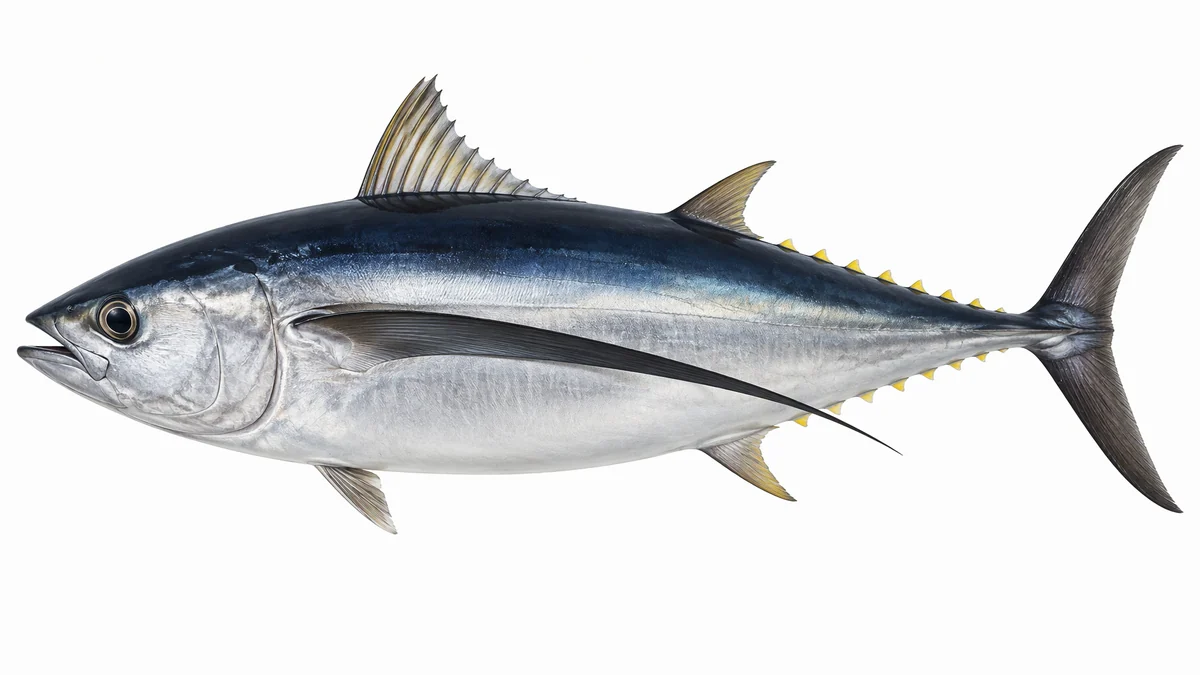
Albacore tuna identification is one of the easiest in the family, because the fish carries its own ruler. The pectoral fins are extraordinarily long and slender, often more than 30 percent of the body length, sweeping back well past the origin of the anal fin. No other tuna has pectorals like that. If the fins reach most of the way to the tail, you are looking at an albacore.
The body is sleek and torpedo-shaped, dark blue-black on the back and silvery-white on the belly, with no stripes and no golden band. The second dorsal fin and anal fin are small and short, not stretched into the long sickles of a yellowfin. The finlets are small and yellow, sometimes edged in dark. The tail is deeply forked, and the caudal keel is modest compared with a bluefin's.
The overall impression is a smaller, more streamlined tuna with a fighter-plane silhouette. Young albacore have proportionally even longer pectorals, which makes the identification even more obvious.
One more clue is on the plate. Albacore flesh is pale pink to nearly white, lighter than the deep red of a yellowfin or bigeye, because the muscle holds less myoglobin. That pale color is why the market calls it white tuna, and it is a useful confirmation when you are cleaning your catch.
Albacore vs Yellowfin Tuna
Albacore and yellowfin are both widespread tunas, but they look and behave differently, and they prefer different water.
| Feature | Albacore | Yellowfin |
|---|---|---|
| Pectoral fins | Extremely long, past the anal fin | Short to moderate |
| Second dorsal and anal fins | Short | Very long, yellow, sickle-shaped |
| Body color | Dark back, silvery-white belly, no stripes | Blue back with a golden lateral band |
| Flesh color | Pale pink to white | Pink to deep red |
| Typical weight | 10–30 pounds | 15–80 pounds |
| Preferred water | Cooler temperate water | Warm tropical and subtropical water |
| Market name | White tuna | Ahi, yellowfin |
If the fins are short and the rear fins are long, it is a yellowfin. If the pectorals run most of the length of the fish, it is an albacore. For the warm-water species, see the yellowfin tuna profile; for the giant of the family, see bluefin tuna.
Is the Albacore Tuna Dangerous?
Albacore are not venomous. They have no stingers, no poison spines, and only small teeth. They are also smaller than bluefin, so the physical risk is lower — but not zero.
An albacore hits a trolled lure hard and runs fast, and a 30-pound fish on light tackle can burn line and exhaust an unprepared angler. Keep your fingers clear of a spinning spool, brace the rod, and let the drag work. At the boat, albacore are lively and can thrash; a flying hook or a whipping tail can cut or bruise. Wear glasses if you are in the cockpit, and control the fish before you handle it.
The bigger concern is the meat. Albacore are high in oil and spoil quickly. Bleed each fish immediately, then ice it thoroughly. Tuna that sits warm can develop histamine and cause scombroid poisoning, which feels like an allergic reaction and can be serious. Fresh, well-chilled albacore is excellent; warm albacore is a mistake.
Where Do Albacore Tuna Live?
Albacore tuna habitat is the temperate and subtropical open ocean, and the species is unusual for how far it roams into cool water. There are several distinct stocks: North Atlantic, South Atlantic, Mediterranean, North Pacific, South Pacific, and Indian Ocean. They do not mix freely, and each is managed separately.
North Atlantic albacore range from the mid-Atlantic and the Azores north to the Bay of Biscay and the waters west of Ireland and Scotland. Some cross the Atlantic. North Pacific albacore are famous off the U.S. West Coast, from California north to Oregon, Washington, and British Columbia in summer and fall, and they range west toward Japan. The Mediterranean has its own stock.
Where do albacore tuna live in the water column? Mostly in the upper layers, often from the surface down a few hundred feet, hunting where cool blue water meets structure or temperature breaks. They are attracted to temperature fronts and current edges, and they often show up where the water is in the low 60s to mid 70s Fahrenheit. Unlike bigeye, they are not a deep-dwelling species, though they will follow bait downward.
Habits and Diet: What Do Albacore Tuna Eat?
What do albacore tuna eat? Small fish, squid, and crustaceans. Anchovies, sardines, saury, and small mackerel are common prey, along with squid and the occasional shrimp. Albacore feed by sight and by speed, often driving bait into tight balls at the surface, where birds and other predators join the attack.
Albacore are strong schoolers, and a school can stretch for miles. They associate with temperature fronts, current edges, and floating debris, and they often travel with other tunas. On the U.S. West Coast, the summer albacore run is a genuine event, with boats running far offshore to find the blue water where the fish are holding.
When do albacore tuna spawn? Spawning happens in warm tropical and subtropical water, generally in spring and summer, and the timing varies by stock. North Atlantic albacore spawn in the western Atlantic and Sargasso Sea region; Mediterranean fish spawn in the Mediterranean; Pacific fish spawn in tropical waters. Females release large numbers of eggs, and the larvae drift with the currents before recruiting into the stocks.
Albacore are warm-bodied tunas with a heat-exchange system, though they are less extreme than bluefin. They are fast, endurance-oriented swimmers built to cover distance, which is exactly what a transoceanic migrant needs.
Size, Records and Regulations
How big do albacore tuna get? Most rod-and-reel fish weigh 10 to 30 pounds. A 40-pound albacore is a good one, and fish over 60 pounds are rare trophies. The species can reach about 4.5 feet and roughly 60 kilograms (130 pounds), but fish anywhere near that size are exceptional.
The world record albacore tuna on rod and reel is a fish in the high 80s of pounds. Records are recertified over time, so check the IGFA book for the current all-tackle weight rather than trusting a number you heard at the dock.
Regulations vary by ocean and by country. In the United States, albacore are managed under the highly migratory species program, and anglers generally need an HMS permit to target them in federal waters. The North Pacific fishery is managed internationally through the Western and Central Pacific Fisheries Commission and domestically by NOAA Fisheries, with state rules layered on top. The North Atlantic stock is managed by ICCAT, and the Mediterranean stock has its own measures. Size limits, bag limits, and seasons differ, so confirm the current rules before you fish.
On conservation, the IUCN lists albacore as Least Concern globally, but the North Atlantic and Mediterranean stocks have drawn concern and are closely managed. Albacore are also a bycatch concern in some longline and driftnet fisheries, which is one reason sourcing and gear rules matter. Last verified: November 2025.
How to catch albacore tuna: find cool blue water with birds and bait, then troll fast and cover ground until you find a school. The best bait for albacore is a live anchovy or sardine, or a fresh-dead bait fished on a circle hook. Trolling small skirted lures, feathers, cedar plugs, and diving plugs at six to eight knots is the standard search method, and once a school is found, stopping to chunk and fly-line baits keeps it around.
Use 20- to 50-pound class conventional or heavy spinning tackle. A fluorocarbon leader in the 30- to 60-pound range, a small circle hook for bait, and a smooth drag are all you need. Albacore have good eyesight, so lighter leaders and natural presentations get more bites in clear water. Keep the boat quiet, cast live baits into the foam, and be ready for a fast, circling fight.
FAQ
How big do albacore tuna get? Most are 10–30 pounds. Fish over 40 pounds are good, and the species can reach about 4.5 feet and 130 pounds.
What is the world record albacore tuna? The IGFA all-tackle record is in the high 80s of pounds. Check IGFA for the current certified weight.
Where do albacore tuna live? In temperate and subtropical oceans worldwide, in separate Atlantic, Pacific, Mediterranean, and Indian stocks. They favor cool blue water and temperature fronts.
What do albacore tuna eat? Small fish such as anchovies, sardines, and saury, plus squid and crustaceans.
Albacore vs yellowfin: how do you tell them apart? Albacore have extremely long pectorals, short rear fins, and pale flesh. Yellowfin have short pectorals, long yellow sickle fins, and redder flesh.
When do albacore tuna spawn? In warm tropical and subtropical water, mostly in spring and summer, varying by stock.
Why is albacore called white tuna? Its flesh is pale pink to white because it holds less myoglobin. It is the fish behind premium canned white-meat tuna.
How do you catch an albacore tuna? Troll fast with small lures or feathers to find a school, then stop and fish live or fresh-dead bait on a circle hook with 20–50 pound tackle.
Related Articles
- Yellowfin Tuna — the warm-water tuna with long yellow sickle fins.
- Bluefin Tuna — the giant of the family, under strict quotas.
- Bigeye Tuna — the deep-diving tuna with long pectorals and big eyes.
- Skipjack Tuna — the striped tuna behind most canned light tuna.
- All species profiles
The albacore tuna is proof that a fish does not have to be a giant to be a prize. Find the cool blue water, watch for the birds, and troll until the long fins show up in the wake. Then bleed it fast, ice it down, and you will understand why the white-meat can costs more than the rest.
Ready to catch one? Read our step-by-step guide: How to Catch Albacore Tuna.
About the author and how this was tested
About the author
FishermanGuy
Bank, boat and kayak angler · fishing, crabbing and shrimping since 2021
I buy the gear, fish it for a season and write down what failed. No sponsored verdicts, no free-sample flattery. Every rig on this page has landed fish in water I can point at on a map.
How this was tested
- Every rig gets at least six trips on the same water before it is published.
- Gear is bought at retail. Free samples are labelled in the first paragraph.
- Dates show first publication and the last time the page was updated.