Field notes
Bigeye Tuna: Identification, Habitat & Diet
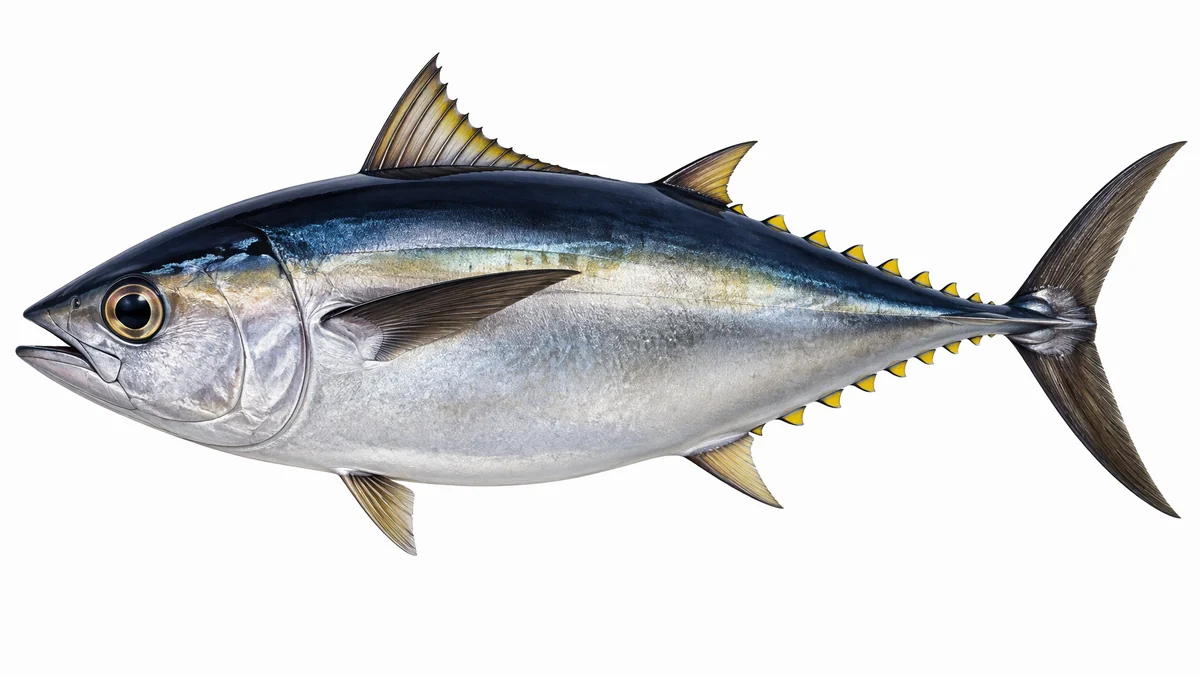
Bigeye Tuna: Identification, Habitat & Diet
The bigeye tuna (Thunnus obesus) is the deep-water specialist of the tuna family, a stocky, big-eyed predator that spends its days far below the surface and its nights hunting in the dark. Anglers who chase it divide into two camps: those who mistake it for a yellowfin at the dock, and those who know that its rich, fatty flesh is closer to the prized bluefin than to the leaner yellowfin. Sashimi buyers know exactly what a bigeye is worth. Catching one takes a different approach than school fishing, because the fish is usually well below the boat. This profile covers bigeye tuna identification, habitat, diet, size, records, regulations, and how to catch one.
Quick ID Card
| Field | Details |
|---|---|
| Scientific name | Thunnus obesus |
| Common names | Bigeye tuna, bigeye, ahi (shared in Hawaii), fat tuna |
| Family | Scombridae (mackerels and tunas) |
| Typical size | 20–120 pounds; 40–60 inches fork length |
| Trophy size | 150–300 pounds; the largest approach 460 |
| Water type | Open ocean, often deep; tropical and subtropical |
| Active water temperature | Roughly 55–85°F (13–29°C), best near 63–72°F (17–22°C) |
| Difficulty | Hard; deep presentation, strong runs, heavy tackle |
| Best season | Year-round in the tropics; summer and fall in U.S. Atlantic waters |
How to Identify a Bigeye Tuna
Bigeye tuna identification begins with the eye, but the eye alone is not enough. The eye is large and round, bigger relative to the head than a yellowfin's, an adaptation for hunting in dim light far below the surface. The body is deeper and more robust than a yellowfin's, especially through the belly, giving bigeye a stouter, more bluefin-like build.
The fins are where most anglers go wrong. A bigeye has long pectoral fins that reach back past the origin of the anal fin, unlike the shorter pectorals of a yellowfin. Its second dorsal fin and anal fin are short, not drawn out into the long yellow sickles that make adult yellowfin so distinctive. The finlets are yellow with dark edges. The first dorsal fin carries 13 or 14 spines, the second dorsal 14 to 16 rays, and the anal fin 11 to 15 rays. There is a strong caudal keel on each side of the tail.
The details that settle it are on the inside. A bigeye's liver has a striated, ridged surface, while a yellowfin's liver is smooth. Experienced skippers cut into the fish's belly and look at the liver before they commit to a species on a tournament weigh-in, because a misidentified fish can be disqualified.
Bigeye also tend to look darker and more bronzed on the flank than yellowfin, but color shifts with light and handling, so trust fins, eye, and liver over shade. For the species most often confused with it, see the yellowfin tuna profile.
Bigeye vs Yellowfin Tuna
Bigeye and yellowfin overlap across much of the tropics, land in the same fish boxes, and get mixed up on a regular basis. The distinctions are real and worth learning.
| Feature | Bigeye | Yellowfin |
|---|---|---|
| Eye | Large, round, adapted to low light | Smaller, proportionate |
| Body | Deep, robust, bluefin-like | Slender, streamlined |
| Pectoral fin | Long, reaches past anal fin origin | Short to moderate |
| Second dorsal and anal fins | Short | Very long, yellow, sickle-shaped |
| Liver | Striated / ridged surface | Smooth surface |
| Typical depth | Deep by day, surface by night | Often near the surface |
| Flesh | Fatty, rich, sashimi-grade | Leaner, firmer |
| IUCN status | Vulnerable | Least Concern |
The quick rule: if the rear fins are long and curved, it is a yellowfin. If the pectorals are long and the rear fins are short, it is a bigeye. If you still cannot tell, cut and look at the liver. For the heavyweight of the family, see bluefin tuna.
Is the Bigeye Tuna Dangerous?
Bigeye are not venomous. They have no spines or stingers and only modest teeth. The danger is in the deep, powerful fight and in handling a heavy fish at the boat.
A bigeye hooked deep will often run straight down and stay there, using its body weight and the current to make the angler work. Fish over 150 pounds can take a long time to land, and the combination of heavy tackle, a deep rod bend, and a stubborn fish is a recipe for pulled muscles and bruised ribs if you fight it badly. Use a harness, keep the rod loaded, and pace yourself.
At the boat, a green bigeye can surge hard enough to break light leaders or pull a gaff out of a hand. Keep the leader short and controlled, wear gloves, and respect the fish's weight. If you release it, revive it in the water before letting go.
As with all tunas, handling the flesh matters. Bigeye spoil quickly and can develop histamine if they are not bled and iced promptly. Bleed the fish as soon as it is landed, chill it thoroughly, and keep it cold. Bigeye are less associated with ciguatera than some reef species, but local advisories still apply in tropical areas.
Where Do Bigeye Tuna Live?
Bigeye tuna habitat is the tropical and subtropical open ocean, across the Atlantic, Indian, and Pacific oceans. They are absent from the Mediterranean. In the western Atlantic they range from New England and Bermuda south through the Caribbean to Brazil, and they are common in the Gulf of Mexico and off the U.S. Southeast coast.
Unlike yellowfin, bigeye are strongly associated with depth. During the day they can be found 800 feet or more down, well below the thermocline, where the water is cold and dim. At night they rise toward the surface to feed, following the daily vertical migration of squid and small fish. This pattern — deep by day, shallow by night — is the single most important fact for anyone trying to catch one.
Where do bigeye tuna live relative to temperature? They tolerate a wide range, roughly 55 to 85°F, but they concentrate where the water is about 63 to 72°F. That often means fishing the deep edge of a warm current, or dropping baits below a warm surface layer into the cooler water beneath. Bigeye can also tolerate lower oxygen levels than other tunas, which is part of why they can hunt in depths that would send a yellowfin back up.
Habits and Diet: What Do Bigeye Tuna Eat?
What do bigeye tuna eat? Fish, squid, and crustaceans, taken both in deep water and near the surface at night. Small fish, lanternfish, and squid are important prey in the deep scattering layer, the band of small animals that rises toward the surface after dark. Bigeye follow that layer up and down, feeding heavily at night and resting or moving in deeper water by day.
Bigeye are solitary or loosely schooling, and large adults are often caught alone rather than in the tight surface schools that yellowfin form. Juveniles and smaller fish do school at the surface, sometimes with yellowfin and skipjack under floating objects.
When do bigeye tuna spawn? In tropical waters they spawn year-round, with peaks that vary by region. Females release eggs over many spawning events, and the species is relatively long-lived for a tuna, reaching roughly 15 to 17 years. That longevity, combined with heavy longline pressure on adults, is part of why bigeye are more vulnerable than yellowfin.
Bigeye are warm-bodied like other tunas, and their large eye and deep-diving habit let them exploit a niche that shallower tunas cannot. They are strong, fast swimmers, and a hooked bigeye uses that power to bore downward rather than run across the surface.
Size, Records and Regulations
How big do bigeye tuna get? Most rod-and-reel fish weigh 20 to 120 pounds. A 200-pound bigeye is an excellent fish, and the species can reach about 250 centimeters (over 8 feet) and roughly 460 pounds. Fish at that size are rare and usually come from longline gear rather than rods.
The world record bigeye tuna on rod and reel is a fish of several hundred pounds. Records are recertified and occasionally updated, so check the IGFA record book for the current all-tackle weight instead of trusting an old number.
Bigeye are the most heavily managed of the smaller tunas, because longline fleets target them for the sashimi market. In the Atlantic, ICCAT sets catch limits and the United States manages bigeye under the highly migratory species program. Recreational anglers in U.S. Atlantic waters need an HMS permit, and bigeye carry a minimum size (27 inches curved fork length) plus a daily bag limit that has changed over the years. Always confirm the current size, bag, and gear rules with NOAA Fisheries and your state before you fish. In the Pacific and Indian oceans, bigeye are managed by the relevant regional commissions, and some fisheries face observer and bycatch rules.
The IUCN lists bigeye as Vulnerable worldwide, a step worse than yellowfin, reflecting decades of heavy fishing pressure. That status is a reason to handle and release fish carefully and to follow quotas closely. Last verified: November 2025.
How to catch bigeye tuna: fish deep, and fish at night when you can. The best bait for bigeye is a whole squid, a live or fresh-dead small fish, or a chunk fished on a deep drop. Trolling with skirted lures and deep-running plugs works, but the classic bigeye techniques are deep-drop baiting, chunking with a weighted line, and vertical jigging over deep structure.
Use heavy conventional tackle, 50- to 80-pound class or more, with a long fluorocarbon leader and a circle hook matched to the bait. To reach the fish, use a downrigger, a weighted bait, or an electric reel where legal. At night, fish baits just below the surface lights, where bigeye rise to feed. Keep the drag smooth and expect a long, downward fight rather than a sprinter's run.
FAQ
How big do bigeye tuna get? Most are 20–120 pounds. Fish over 200 pounds are trophies, and the species can reach about 8 feet and 460 pounds.
What is the world record bigeye tuna? The IGFA all-tackle record is a fish of several hundred pounds. Check IGFA for the current certified weight.
Where do bigeye tuna live? In tropical and subtropical oceans worldwide, except the Mediterranean, usually deep by day and near the surface at night.
What do bigeye tuna eat? Fish, squid, and crustaceans, including the small animals of the deep scattering layer that rise after dark.
Bigeye vs yellowfin: how do you tell them apart? Bigeye have larger eyes, deeper bodies, long pectorals, short rear fins, and a striated liver. Yellowfin have long yellow sickle fins and a smooth liver.
When do bigeye tuna spawn? Year-round in the tropics, peaking by region. They can live 15–17 years and mature slowly.
Are bigeye tuna endangered? The IUCN lists bigeye as Vulnerable globally, mainly due to longline fishing pressure.
How do you catch a bigeye tuna? Fish deep with squid or fish bait, especially at night, using heavy tackle, a weighted or downrigger presentation, and a smooth drag.
Related Articles
- Yellowfin Tuna — the slender surface tuna most often mistaken for bigeye.
- Bluefin Tuna — the giant of the family, with strict quotas.
- Albacore Tuna — the long-finned white-meat tuna.
- Skipjack Tuna — the striped, fast-growing tuna of surface schools.
- All species profiles
The bigeye tuna rewards anglers who think in three dimensions. Fish the deep edge, drop a bait where the light fades, and be ready for a fight that goes straight down. Learn to read the liver and the fins, and you will never mistake a bigeye for a yellowfin again.
Ready to catch one? Read our step-by-step guide: How to Catch Bigeye Tuna.
About the author and how this was tested
About the author
FishermanGuy
Bank, boat and kayak angler · fishing, crabbing and shrimping since 2021
I buy the gear, fish it for a season and write down what failed. No sponsored verdicts, no free-sample flattery. Every rig on this page has landed fish in water I can point at on a map.
How this was tested
- Every rig gets at least six trips on the same water before it is published.
- Gear is bought at retail. Free samples are labelled in the first paragraph.
- Dates show first publication and the last time the page was updated.