Field notes
Sailfish: Identification, Habitat & Diet
Sailfish: Identification, Habitat & Diet
The sailfish (Istiophorus platypterus) is the flashiest fish in the billfish family, and one of the fastest animals in the ocean. It raises a huge, spotted dorsal fin like a boat sail, streaks across the surface in bursts that shred line off a reel, and cartwheels through the air when hooked. Few saltwater sights match a sailfish lit up in cobalt and silver, tail-walking behind a boat. This guide covers sailfish identification, habitat, diet, size, records, spawning, and how to catch one — plus the rules that increasingly require releasing them.
Quick ID Card
| Field | Details |
|---|---|
| Scientific name | Istiophorus platypterus (Indo-Pacific and Atlantic sailfish) |
| Common names | Sailfish, Pacific sailfish, Atlantic sailfish, umbrella fish |
| Family | Istiophoridae (billfishes) |
| Typical size | 40–130 pounds; 6–8 feet overall |
| Trophy size | 150–200+ pounds |
| Water type | Warm surface waters of open ocean and shelf edges |
| Preferred temperature | Roughly 70–86°F (21–30°C) |
| Difficulty | Hard; fast, aerial, and tackle-stressing |
| Best season | Summer and early fall in the Atlantic; warm months in the Pacific |
How to Identify a Sailfish
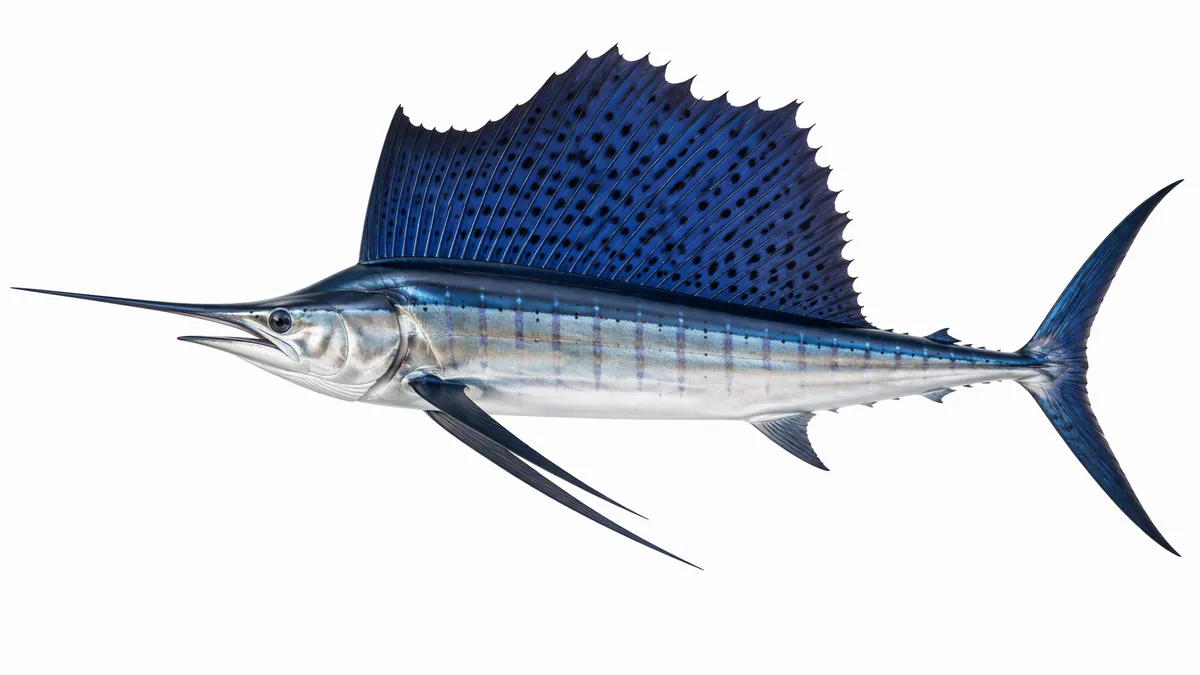
Sailfish identification is mostly a matter of one feature: the dorsal fin. It is enormous, taller than the fish is deep, and runs almost the length of the back. The fish can fold it down into a groove while swimming fast, or raise it into a full, rounded sail that is covered in black spots. No other billfish carries a fin like that.
The rest of the fish is built for speed. The body is slim and compressed, the bill is long and round in cross-section (unlike the flat sword of a swordfish), and the pectoral fins are long and pointed. The pelvic fins are remarkable too — long, narrow ribbons that trail under the belly. Color is dark blue-black on top, silver-white below, with faint vertical bars that flash brighter when the fish is excited. Some fish show a scattering of spots on the flank.
Length is easy to misjudge because so much of it is bill. A sailfish with a 7-foot body may measure close to 9 or 10 feet overall. Anglers usually quote weight, not length, and a 100-pound sailfish is a serious fish anywhere.
One naming note: Atlantic sailfish were long classified as a separate species, Istiophorus albicans, but most authorities now treat Atlantic and Indo-Pacific fish as a single species, I. platypterus. For anglers, the practical difference is mainly where you fish.
Sailfish vs Marlin
Sailfish vs marlin is the most common billfish mix-up, and the dorsal fin settles it. A sailfish's first dorsal fin is a tall, flexible sail. A marlin's first dorsal fin is short, stiff, and pointed, and sits far forward like a small shark fin.
There are other tells. Sailfish are slimmer than marlins, with a smaller, lighter bill and those long ribbon pelvic fins. Blue marlin are far heavier through the shoulders, carry a much thicker bill, and have short, pointed pectoral fins that fold flat against the body. White marlin are closer to sailfish in size but lack the sail and have a rounded, pointed dorsal fin. If the fish looks like it is carrying a spotted umbrella, it is a sailfish.
The difference matters at the boat because the rules differ. Sailfish are managed separately from marlin in most fisheries, and in several places — Florida especially — sailfish must be released. Misidentifying a billfish is not just embarrassing; it can be a violation. For the heavyweights, see the blue marlin and swordfish profiles.
Is the Sailfish Dangerous?
Sailfish are not venomous and have no cutting teeth worth worrying about — their mouths are lined with small, rasp-like teeth. The danger is the bill and the speed.
A hooked sailfish jumps, slashes, and sometimes comes into the boat. That long, pointed bill can open a serious wound, and a fish thrashing on deck can break tackle, rods, and fingers. Keep your face and hands clear of the bill, wear gloves when you handle the leader, and never lift a sailfish by the bill alone. If you bring one aboard for a photo, support the body horizontally and keep the fish out of the water for only a few seconds.
The other risk is line burn and tackle failure. Sailfish are not heavy, but they are violent. A screaming drag, a loose shirt, or an ungloved hand near a spinning spool is a recipe for a burn or a cut. Set the drag properly before the strike and keep the boat moving toward the fish to take pressure off the leader.
Sailfish are excellent on the table — firm, mild, and good grilled or seared — but in most of the sport fishery they are released. Treat a sailfish as a release fish unless local rules and your own plans say otherwise.
Where Do Sailfish Live?
Sailfish habitat is the warm surface layer of the open ocean. They are tropical and subtropical fish, found in the Atlantic, Pacific, and Indian oceans, generally in water warmer than about 70°F (21°C). They are pelagic and highly mobile, following bait and current edges rather than holding on structure.
Where do sailfish live in practical terms? Anglers find them along temperature breaks, color changes, weed lines, and current rips where bait concentrates. In the Atlantic, the species ranges from the U.S. East Coast and Gulf of Mexico down through the Caribbean to Brazil, and across to West Africa. In the Pacific, they occur from Mexico and Central America across to Asia and Australia. They are usually a surface-to-upper-water fish, though they will dive when chasing bait or escaping pressure.
Sailfish are not strictly offshore. They often appear over reefs, shelf edges, and current rips within reach of smaller boats, which is part of why they are so popular. A calm, warm day with a clean current edge and birds working bait is the classic setup.
Habits and Diet: What Do Sailfish Eat?
What do sailfish eat? Mostly small, fast, schooling prey: sardines, anchovies, ballyhoo (halfbeaks), flying fish, small mackerel, and squid. They are pursuit predators that use the bill to slash and stun, then circle back to swallow injured baitfish. Sailfish sometimes hunt in loose groups, herding bait into a tight ball and taking turns slashing through it.
Feeding is intense but not constant. Sailfish are built to sprint, and they burn a lot of energy doing it. When a school of bait is pinned against the surface, the action can be spectacular — bills slashing, sails up, fish launching through the school. When the bait sound or scatter, the fish disappear.
When do sailfish spawn? Spawning happens in warm surface water, often over many weeks in the warmer months. In the Atlantic, the season generally runs from late spring through summer and into fall, peaking in water around 75–80°F. Females release eggs in batches over the season rather than all at once, and the eggs and larvae are pelagic. Sailfish grow fast and live relatively short lives compared with marlin, which is part of why the stock can withstand some fishing pressure — but not unlimited pressure.
Size, Records and Regulations
How big do sailfish get? Most fish caught by anglers weigh 40 to 130 pounds, with a 7- to 8-foot body and a bill adding another foot or two. A 150-pound sailfish is a big one; fish over 200 pounds are exceptional. The largest certified fish are in the low 200-pound range.
The world record sailfish is an IGFA all-tackle mark of roughly 220 pounds, taken decades ago; check the current IGFA record book for the certified figure and line-class records, because records are occasionally updated. Any sailfish over 150 pounds is a fish of a lifetime for most anglers.
Regulations vary widely by country and state, and they are getting stricter. In the U.S. Atlantic, billfish are managed under the Highly Migratory Species (HMS) program, which requires an HMS permit for recreational vessels targeting them. Sale of sailfish is prohibited in the recreational fishery, and several states — Florida most notably — require release of sailfish. The International Commission for the Conservation of Atlantic Tunas (ICCAT) sets the international framework for Atlantic billfish, and NOAA Fisheries implements it domestically. Rules on gear, permits, and retention change, so check the current NOAA and state regulations before you fish. Last verified: November 2025.
How to catch sailfish comes down to finding bait and presenting something that looks alive. The best bait for sailfish is a rigged ballyhoo, a small skipjack or tuna, or a live baitfish drifted or slow-trolled through the zone. Anglers also catch them on trolled skirted lures, dredges, and teasers, and sailfish are a favorite fly-rod target in places like Guatemala and Mexico.
The classic spread uses light-to-medium heavy tackle: a 20- to 30-pound conventional outfit is plenty for most fish, with a fluorocarbon leader and a sharp circle hook for bait. Teasers raise fish; a pitch bait or a switch to a fly finishes the job. Keep the drag smooth, let the fish run, and chase it with the boat. For release, keep the fish in the water, use a dehooker or cut the leader close, and revive it before letting go. Circle hooks reduce gut hooking and are required in some billfish fisheries.
FAQ
How big do sailfish get? Most are 40–130 pounds and 6–8 feet. Fish over 150 pounds are large, and the biggest certified fish reach the low 200s.
What is the world record sailfish? The IGFA all-tackle record is roughly 220 pounds; check IGFA for the current certified figure.
Where do sailfish live? In warm surface waters of the Atlantic, Pacific, and Indian oceans, usually above 70°F, along current edges and bait concentrations.
What do sailfish eat? Sardines, anchovies, ballyhoo, flying fish, small mackerel, and squid, slashed and stunned with the bill.
Sailfish vs marlin: how do you tell them apart? The sailfish has a huge spotted sail-like dorsal fin; marlins have short, stiff, pointed dorsal fins and heavier bodies.
When do sailfish spawn? In warm surface water during the warmer months, with Atlantic fish spawning from late spring into fall.
What is the best bait for sailfish? Rigged ballyhoo, live baitfish, small skipjack or tuna, and trolled skirted lures. Teasers help raise fish.
Do you keep sailfish? In many places, no. Florida and several other jurisdictions require release, and sale is prohibited in the U.S. recreational fishery. Check local rules.
Related Articles
- Blue Marlin — the heavyweight cousin with a short, stiff dorsal fin.
- Swordfish — a deep-water billfish with a flat, sword-like bill.
- Yellowfin Tuna — a fast pelagic predator that shares sailfish water.
- Mahi-Mahi — a warm-water surface fish often found near the same current edges.
- All species profiles
The sailfish is a fish you remember for the jump, not the fillet. Learn the sail, learn the rules, and plan on letting most of them go — the show is the point.
Ready to catch one? Read our step-by-step guide: How to Catch Sailfish.
About the author and how this was tested
About the author
FishermanGuy
Bank, boat and kayak angler · fishing, crabbing and shrimping since 2021
I buy the gear, fish it for a season and write down what failed. No sponsored verdicts, no free-sample flattery. Every rig on this page has landed fish in water I can point at on a map.
How this was tested
- Every rig gets at least six trips on the same water before it is published.
- Gear is bought at retail. Free samples are labelled in the first paragraph.
- Dates show first publication and the last time the page was updated.