Field notes
Swordfish: Identification, Habitat & Diet
Swordfish: Identification, Habitat & Diet
The swordfish (Xiphias gladius) is the strangest of the big billfish and, for many anglers, the most mysterious. It hunts in near-darkness hundreds of meters down, then rises to the surface at night. Its bill is not a round spear like a marlin's but a flat, broad blade that looks forged. And a big swordfish is heavy enough to bend a fighting chair and stubborn enough to fight straight down for hours. This profile covers swordfish identification, habitat, diet, size, records, mercury and handling cautions, and how to catch one legally.
Quick ID Card
| Field | Details |
|---|---|
| Scientific name | Xiphias gladius |
| Common names | Swordfish, broadbill, broadbill swordfish, gladiator |
| Family | Xiphiidae (swordfishes) |
| Typical size | 50–300 pounds; 5–9 feet overall |
| Trophy size | 400–1,000+ pounds |
| Water type | Deep open ocean; surface at night |
| Depth range | Surface to roughly 2,000+ feet (600+ m) |
| Difficulty | Very hard; heavy tackle, deep or night fishing |
| Best season | Summer and fall in the North Atlantic; variable elsewhere |
How to Identify a Swordfish
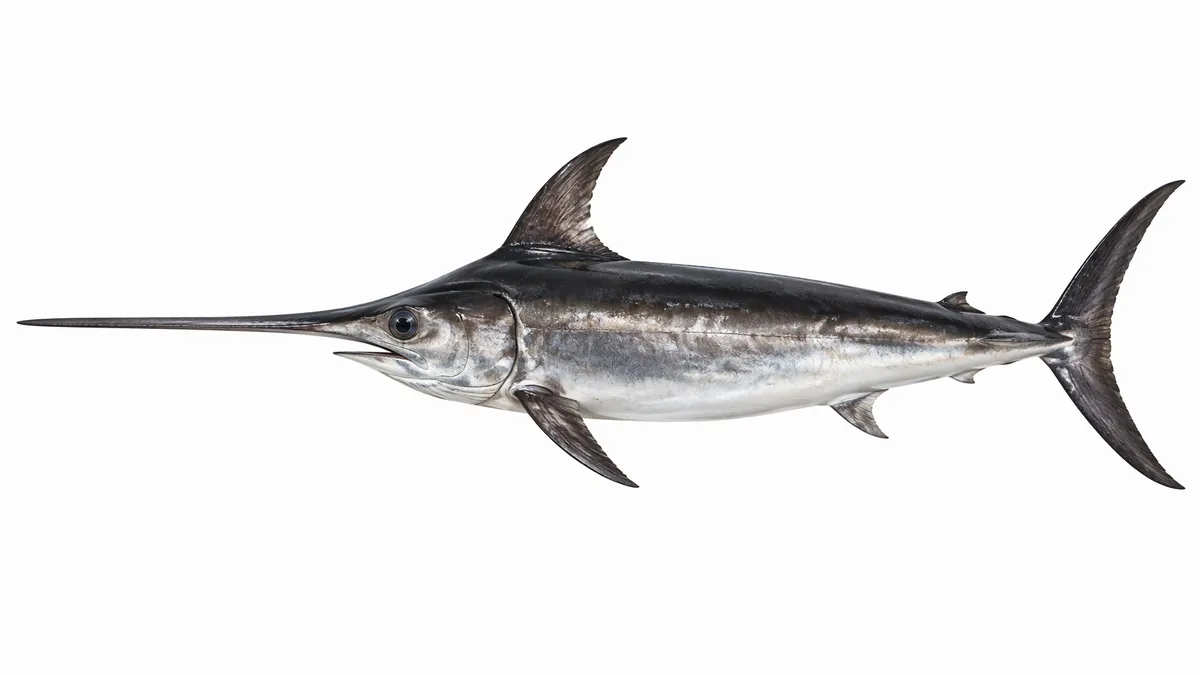
Swordfish identification starts with the bill. It is long, flat, and wide — oval in cross-section rather than round — and can be close to a third of the fish's total length. That flat blade is the single best way to tell a swordfish from a marlin or sailfish at a glance.
The body is stout and torpedo-shaped, not as compressed as a marlin's. Adults have no teeth and no scales, and they lack pelvic fins entirely. The dorsal fin is small and set far forward, quite unlike the tall fin of a sailfish or the pointed fin of a marlin. The tail carries a single keel on each side of the base. The eye is enormous, an adaptation for hunting in dim light. Color is dark brown to blackish on the back, fading to silvery white below, sometimes with a faint bronze sheen.
Size is deceptive because of the bill. A fish with an 8-foot body might measure 11 or 12 feet overall. Most anglers talk in pounds, and a 200-pound swordfish is a good fish; 500 pounds is a giant.
Swordfish vs Marlin
Swordfish vs marlin is an easy call once you know the bill. A swordfish bill is flat and broad, like a cricket bat scaled down to a blade. A marlin bill is round and tapering, like a spear. Swordfish also have no pelvic fins, no teeth as adults, and a small dorsal fin set well forward. Marlins have pelvic fins, rough rasping teeth, and a taller first dorsal fin.
Body shape helps too. Swordfish are thicker and more cylindrical; marlins are laterally compressed and more streamlined. Marlins also tend to show vertical bars and a more brilliant blue back, while swordfish are duller, darker, and more uniform.
The difference matters for rules as well as identification. Swordfish are managed under separate quotas and size limits from marlin, and in the U.S. Atlantic a swordfish may be retained under an HMS permit with specific minimum sizes, while blue and white marlin are largely release-oriented. When a billfish comes to the boat, identify it before anyone reaches for a gaff. See the blue marlin and sailfish profiles for the comparison fish.
Is the Swordfish Dangerous?
Swordfish are not venomous, and adults have no teeth. The bill is the hazard, and it is a serious one. A swordfish bill can punch through a wooden deck, and hooked fish have driven their bills into boats and through hatch covers. On deck, a thrashing swordfish can swing that blade with enough force to injure or kill. Keep the bill pointed away from people, and never straddle or kneel beside a green fish.
Handling a large swordfish is a crew job. A 300-pound fish is heavy, slippery, and powerful, and the tail can batter anyone in range. Use a flying gaff or a tail rope, control the bill first, and secure the fish before bringing it aboard. If you plan to release a swordfish — increasingly common — keep it in the water, use a dehooker or cut the leader, and revive it alongside the boat.
There is a second safety issue that has nothing to do with the fight: mercury. Large swordfish accumulate methylmercury, and public health agencies advise that pregnant women, women who may become pregnant, nursing mothers, and young children avoid swordfish entirely. Others are usually advised to limit how much they eat. The fish is not contaminated in a way that makes occasional consumption dangerous for most adults, but it is not a fish to eat daily. Follow current FDA and local advisories.
Where Do Swordfish Live?
Swordfish habitat is the deep open ocean, worldwide in tropical, subtropical, and temperate seas. They occur in the Atlantic, Pacific, and Indian oceans and the Mediterranean Sea. In the Atlantic they range from Canada and the British Isles south to Argentina and South Africa, and they are present through the Gulf of Mexico and the Caribbean.
Where do swordfish live in the water column? This is the key to the species. During the day, swordfish typically hold deep — often 1,500 to 2,500 feet (roughly 450 to 800 meters) — where light is faint and prey is concentrated. At night they rise toward the surface to feed, sometimes basking at the top with their bills and dorsal fins breaking the water. That daily vertical migration shapes how anglers fish for them: deep-drop during the day, drift or bait at night.
Swordfish are also unusual in their tolerance for cold. They can hunt in deep water far cooler than most billfish would accept, using specialized tissues that warm the eyes and brain. That lets them stay active in the cold, dim layer where squid and deep-water fish live.
Habits and Diet: What Do Swordfish Eat?
What do swordfish eat? Mainly squid and fish, including hake, mackerel, sardines, and other deep-water species. Swordfish are opportunistic and take whatever is available in the deep scattering layer, the band of squid and small fish that rises at night.
The bill is used to slash and stun rather than to skewer. Swordfish have been filmed swinging the bill through schools of prey, then turning to eat the stunned or injured fish. They also feed on the surface at night, and stomach contents often include squid that live far deeper than the fish's daytime depth would suggest.
When do swordfish spawn? Spawning takes place in warm subtropical and tropical waters, with timing that varies by region. Mediterranean fish spawn in late spring and summer. Atlantic fish spawn in warmer waters to the south, and some populations appear to spawn over extended seasons. Females release eggs in batches, and larvae are pelagic. Swordfish grow quickly early in life and can live well over a decade, but they mature relatively late and are not highly fecund compared with some tunas, which makes them vulnerable to heavy fishing.
Size, Records and Regulations
How big do swordfish get? Most commercial and recreational fish run 50 to 300 pounds and 5 to 9 feet overall. Large adults reach 400 to 600 pounds, and exceptional fish exceed 1,000. The maximum is around 1,100 to 1,200 pounds and roughly 14 to 15 feet overall.
The world record swordfish is an IGFA all-tackle mark of about 1,182 pounds (536 kg), caught off Chile in 1953. That record has stood for more than seventy years. Check the current IGFA book for line-class records and any updates.
Regulations are strict and region-specific. In the North Atlantic, swordfish are managed by ICCAT and implemented in U.S. waters by NOAA Fisheries under the HMS program. The North Atlantic stock rebuilt after severe depletion in the 1990s and is now considered healthy, but it remains under quota. U.S. recreational anglers need an HMS permit and must respect minimum sizes (roughly 47 inches lower jaw fork length in the Atlantic), daily bag limits, and gear rules. Sale of recreationally caught swordfish is generally prohibited without the appropriate commercial permits. In the Pacific, separate international and domestic rules apply, and some regions restrict certain gear types to reduce bycatch. Mercury advisories apply regardless of legality. Check current NOAA, ICCAT, and state rules before you fish. Last verified: November 2025.
How to catch swordfish depends on where and when you fish. The best bait for swordfish is squid — whole or rigged — along with mackerel, bonito, and other oily fish. Deep-drop fishing with an electric reel or heavy conventional tackle presents a bait near the bottom during the day. Night fishing uses lights to attract squid and baitfish, then drifts a bait down or fishes it near the surface. Trolling with skirted lures and swimming plugs takes fish in some areas, especially at dawn and dusk.
Use heavy tackle — 50- to 130-pound class — with a strong leader and a sharp circle or J hook. Swordfish fight deep and dogged, and a big fish may take hours. Keep the rod loaded, use a harness, and let the boat chase the fish. If you plan to release, use circle hooks where allowed, keep the fight as short as practical, and revive the fish carefully.
FAQ
How big do swordfish get? Most are 50–300 pounds and 5–9 feet. Large adults reach 400–600 pounds, and the biggest exceed 1,000 pounds and 14 feet.
What is the world record swordfish? The IGFA all-tackle record is about 1,182 pounds, caught off Chile in 1953.
Where do swordfish live? Worldwide in deep tropical, subtropical, and temperate ocean, holding 1,500–2,500 feet down by day and rising near the surface at night.
What do swordfish eat? Mostly squid and deep-water fish, slashed and stunned with the flat bill.
Swordfish vs marlin: how do you tell them apart? The swordfish bill is flat and broad; a marlin's is round. Swordfish also lack pelvic fins and adult teeth and have a small, forward-set dorsal fin.
When do swordfish spawn? In warm subtropical and tropical waters, varying by region — Mediterranean fish in late spring and summer.
What is the best bait for swordfish? Squid is the top bait, with mackerel, bonito, and oily fish close behind. Deep-drop by day or drift at night.
Is swordfish safe to eat? It is safe for most adults in moderation, but it is high in mercury. Pregnant women, nursing mothers, and young children are advised to avoid it.
Related Articles
- Sailfish — a surface-hunting billfish with a sail-like dorsal fin.
- Blue Marlin — the heaviest of the marlins, with a round spear of a bill.
- Yellowfin Tuna — a fast open-ocean predator that shares swordfish water.
- Bigeye Tuna — a deep-diving tuna with a taste for the same low-light layer.
- All species profiles
The swordfish is a fish of extremes: a blade for a bill, an eye built for the dark, and a fight that happens straight down. Respect the bill, respect the mercury advisory, and know the quota before you leave the dock.
Ready to catch one? Read our step-by-step guide: How to Catch Swordfish.
About the author and how this was tested
About the author
FishermanGuy
Bank, boat and kayak angler · fishing, crabbing and shrimping since 2021
I buy the gear, fish it for a season and write down what failed. No sponsored verdicts, no free-sample flattery. Every rig on this page has landed fish in water I can point at on a map.
How this was tested
- Every rig gets at least six trips on the same water before it is published.
- Gear is bought at retail. Free samples are labelled in the first paragraph.
- Dates show first publication and the last time the page was updated.