Field notes
Blue Marlin: Identification, Habitat & Diet
Blue Marlin: Identification, Habitat & Diet
The blue marlin (Makaira nigricans) is the fish that made big-game fishing famous. Cobalt-backed, heavy-shouldered, and capable of a thousand pounds, it is the species Hemingway put on the end of Santiago's line, and the one that still draws boats to Kona, the Azores, and the Caribbean every summer. A blue marlin is not a fish you simply land. It is a fish you survive, photograph, and — more often than not these days — release. This guide covers blue marlin identification, habitat, diet, size, the world record, how it differs from a black marlin, spawning, and how to catch one within the rules.
Quick ID Card
| Field | Details |
|---|---|
| Scientific name | Makaira nigricans (Atlantic blue marlin) |
| Common names | Blue marlin, Atlantic blue marlin, Pacific blue marlin, a'u |
| Family | Istiophoridae (billfishes) |
| Typical size | 100–400 pounds; 7–10 feet overall |
| Trophy size | 500–1,000+ pounds |
| Water type | Warm open ocean, surface to deep |
| Preferred temperature | Roughly 75–86°F (24–30°C) |
| Difficulty | Extreme; hours-long fights, specialized heavy tackle |
| Best season | Summer in the Atlantic; warm months in the Pacific |
How to Identify a Blue Marlin
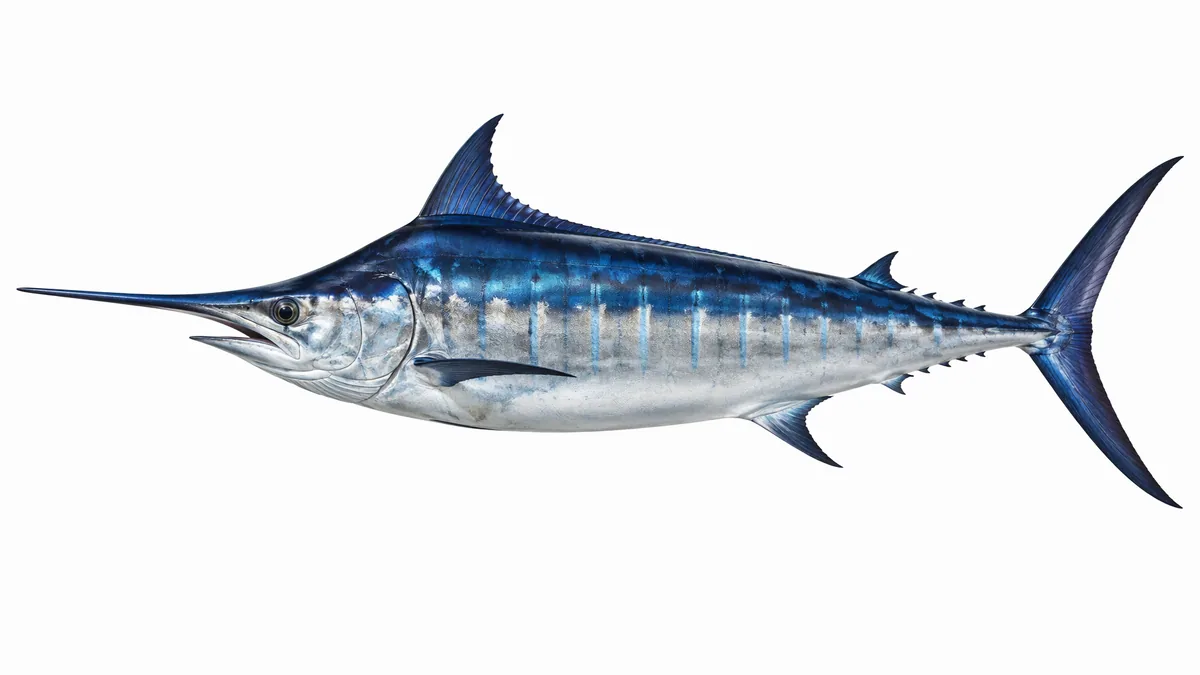
Blue marlin identification begins with the bill and the fins. The bill is long and round, tapering to a point — a spear, not a blade. The pectoral fins are short, pointed, and can be folded flat against the body. That last detail separates blue marlin from black marlin, which have stiff pectorals that stay out.
The first dorsal fin is short and pointed, set well forward. It is nothing like a sailfish's tall sail. The second dorsal and anal fins are also pointed, and the tail is a stiff crescent. The body is deep through the chest and laterally compressed, built to turn fast and run. Color is a deep, almost electric blue-black on top, silver-white below, often with faint vertical stripes that flare when the fish is excited.
Size and sex are linked in a way that surprises many anglers. Female blue marlin grow far larger than males. A 500-pound fish is almost certainly female; males rarely exceed about 150 to 200 pounds and may never reach the sizes that make the record books. That means big-fish fisheries are effectively fishing for females, a fact that drives much of the conservation concern around the species.
Blue Marlin vs Black Marlin
Blue marlin vs black marlin is a real identification problem in the Indo-Pacific, where both species occur. The fastest check is the pectoral fin. A blue marlin can fold its pectorals flat against its flank. A black marlin's pectorals are rigid and stick out sideways, and cannot be folded down.
Bill shape helps too. Black marlin have a shorter, thicker bill relative to body size, and they are generally heavier-bodied. Blue marlin bills are longer and more slender. Black marlin also tend to be a darker, more uniform blackish-blue, while blue marlin show the brighter cobalt back and silver flank.
Range is a clue, not a rule. Black marlin are an Indo-Pacific species; blue marlin occur in the Atlantic, Pacific, and Indian oceans. In the Atlantic, a blue marlin is essentially the only marlin of that size, though white marlin and longbill spearfish are also present and much smaller. In the Pacific, you have to look at the fins. When the fish is at the boat, get the identification right before anyone decides what to do with it — the rules and the records depend on it. Compare the sailfish and swordfish profiles for the other billfish.
Is the Blue Marlin Dangerous?
Blue marlin are not venomous, but they are among the most dangerous fish an angler can bring to the boat. The bill is a heavy, pointed weapon, and a hooked marlin can drive it through planking, cushioning, and people. Fish have jumped into cockpits and injured crews. Never stand in line with the bill, and never assume a tired fish is a safe fish.
The fight itself is a hazard. A big blue marlin can take hours, and anglers have suffered heat exhaustion, back injuries, and heart problems during long battles. The initial run may empty a large reel, and a green fish at the boat can surge, jump, and thrash with enough force to break gaffs and bend heavy hooks. Use a fighting chair or harness, keep the drag smooth, and let the crew lead the release.
Handling for release requires discipline. Keep the fish in the water, lead it by the leader or use a release stick, and never lift a large marlin by the bill for a photo. Support the body if you must touch it, keep the fish level, and revive it alongside the boat until it kicks away. A marlin that is exhausted from a long fight needs time to recover; cutting it loose early is better than dragging it for a trophy shot.
The meat is edible and firm, but large marlin carry mercury like other big predators, and public health agencies advise that pregnant women, nursing mothers, and young children avoid high-mercury fish. In most of the sport fishery, blue marlin are released by rule or by choice.
Where Do Blue Marlin Live?
Blue marlin habitat is the warm surface layer of the open ocean, generally in water from about 75°F to 86°F (24–30°C). They are found throughout the tropical and subtropical Atlantic, Pacific, and Indian oceans, and they are highly migratory, following warm currents and bait.
Where do blue marlin live in the Atlantic? The species ranges from the U.S. East Coast and Gulf of Mexico through the Caribbean and down to Brazil, and across to West Africa and the Azores. In the Pacific, they occur from Mexico and Central America across to Hawaii and Japan, and south through the islands. They are usually pelagic, hunting near current edges, temperature breaks, and bait concentrations, though they can dive deep and will follow prey below the surface layer.
Blue marlin are solitary compared with tunas. You rarely find a school of them; a boat typically raises one fish at a time, sometimes two. That solitary habit and the huge range make them hard to find, which is why good marlin fisheries are measured in bites per day, not fish per hour.
Habits and Diet: What Do Blue Marlin Eat?
What do blue marlin eat? Big, fast prey: skipjack tuna, yellowfin tuna, mahi-mahi, small billfish, mackerel, and squid. They are ambush-and-pursuit predators that use the bill to slash and stun bait, then turn to swallow it. A marlin working a bait ball is a violent, splashy event — bills slashing, fish launching, water flying.
Blue marlin feed most actively in warm surface water, often around current edges and weed lines where bait gathers. They are visual hunters in good light but also feed at depth. Their eyes and physiology are built for a wide range of conditions, and they can tolerate water cooler than their preferred surface range for short periods.
When do blue marlin spawn? Spawning occurs in warm tropical and subtropical water, generally in the warmer months. In the Atlantic, the season runs roughly from late spring through summer, with peaks that vary by region. Females release eggs in multiple batches over the season, and the larvae are pelagic. Blue marlin mature relatively late and produce comparatively few young for their size, which is why heavy pressure on large females is a conservation problem.
Size, Records and Regulations
How big do blue marlin get? Females commonly reach 300 to 600 pounds and can exceed 1,000. The maximum is often quoted at around 2,000 pounds (900 kg) and 16 feet overall, though fish over 1,000 pounds are rare anywhere. Males rarely exceed 150 to 200 pounds. The all-tackle record is a fish of about 1,400 pounds — a true giant.
The world record blue marlin is the IGFA all-tackle mark of 1,402 pounds (636 kg), caught off Vitoria, Brazil, in 1992. It remains one of the most famous records in sport fishing. Check the current IGFA book for line-class records and any updates, since records and classifications do change.
Regulations are where blue marlin fishing gets serious. In the Atlantic, the species is managed by ICCAT and implemented in U.S. waters by NOAA Fisheries under the HMS program. U.S. recreational rules include an HMS permit, a minimum size of roughly 99 inches lower jaw fork length for Atlantic blue marlin, a strict bag limit, mandatory reporting in some fisheries, and a prohibition on sale. Circle hooks are required in many bait fisheries, and release is strongly encouraged. The Atlantic stock is not considered overfished, but it is depleted relative to historic levels and remains under international quota. Pacific blue marlin are managed separately by regional fisheries bodies, with their own size and retention rules.
The practical takeaway: blue marlin are a release fishery in most of the world, and the rules differ by ocean. Read the current ICCAT and NOAA measures, know the minimum size, and never assume a rule from last season still applies. Last verified: November 2025.
How to catch blue marlin is a game of raising fish and presenting a bait at the right moment. The best bait for blue marlin is a live skipjack or small tuna, or a large rigged baitfish. Anglers also troll skirted lures — Ilanders, daisy chains, and plungers — and use teasers to bring fish into the pattern. When a marlin shows on a teaser, the crew switches it to a pitch bait or a lure.
Use 50- to 130-pound class tackle, a heavy reel with a smooth drag, and a leader heavy enough to survive the bill and the boat. Circle hooks are increasingly required for bait fishing and are better for release. Keep the fight as short as you safely can, and plan the release before the fish is at the boat.
FAQ
How big do blue marlin get? Females commonly reach 300–600 pounds and can exceed 1,000; the maximum is often quoted around 2,000 pounds. Males rarely exceed 150–200 pounds.
What is the world record blue marlin? The IGFA all-tackle record is 1,402 pounds, caught off Brazil in 1992.
Where do blue marlin live? In warm surface water of the Atlantic, Pacific, and Indian oceans, usually 75–86°F, along currents and bait concentrations.
What do blue marlin eat? Skipjack and yellowfin tuna, mahi-mahi, mackerel, small billfish, and squid.
Blue marlin vs black marlin: how do you tell them apart? Blue marlin can fold their pectoral fins flat; black marlin pectorals are rigid and stick out. Black marlin also have shorter, thicker bills and live in the Indo-Pacific.
When do blue marlin spawn? In warm tropical and subtropical water during the warmer months, with females spawning in batches.
What is the best bait for blue marlin? Live skipjack or small tuna, large rigged baitfish, and trolled skirted lures worked with teasers.
Do you keep blue marlin? Rarely. Most fisheries require or encourage release, sale is prohibited in the U.S. recreational fishery, and there are minimum sizes and strict limits.
Related Articles
- Sailfish — the sail-finned billfish that shares marlin water.
- Swordfish — a deep-water billfish with a flat blade for a bill.
- Yellowfin Tuna — a primary prey species and a great light-tackle target.
- Mahi-Mahi — fast-growing surface fish often found around the same weed lines.
- All species profiles
The blue marlin is the benchmark for big-game fishing: a fish that can outweigh its angler, jump like a missile, and still be released to fight again. Learn the fins, know the minimum size, and treat every fish as a breeder worth putting back.
Ready to catch one? Read our step-by-step guide: How to Catch Blue Marlin.
About the author and how this was tested
About the author
FishermanGuy
Bank, boat and kayak angler · fishing, crabbing and shrimping since 2021
I buy the gear, fish it for a season and write down what failed. No sponsored verdicts, no free-sample flattery. Every rig on this page has landed fish in water I can point at on a map.
How this was tested
- Every rig gets at least six trips on the same water before it is published.
- Gear is bought at retail. Free samples are labelled in the first paragraph.
- Dates show first publication and the last time the page was updated.