Field notes
Shortfin Mako: Identification, Habitat & Diet
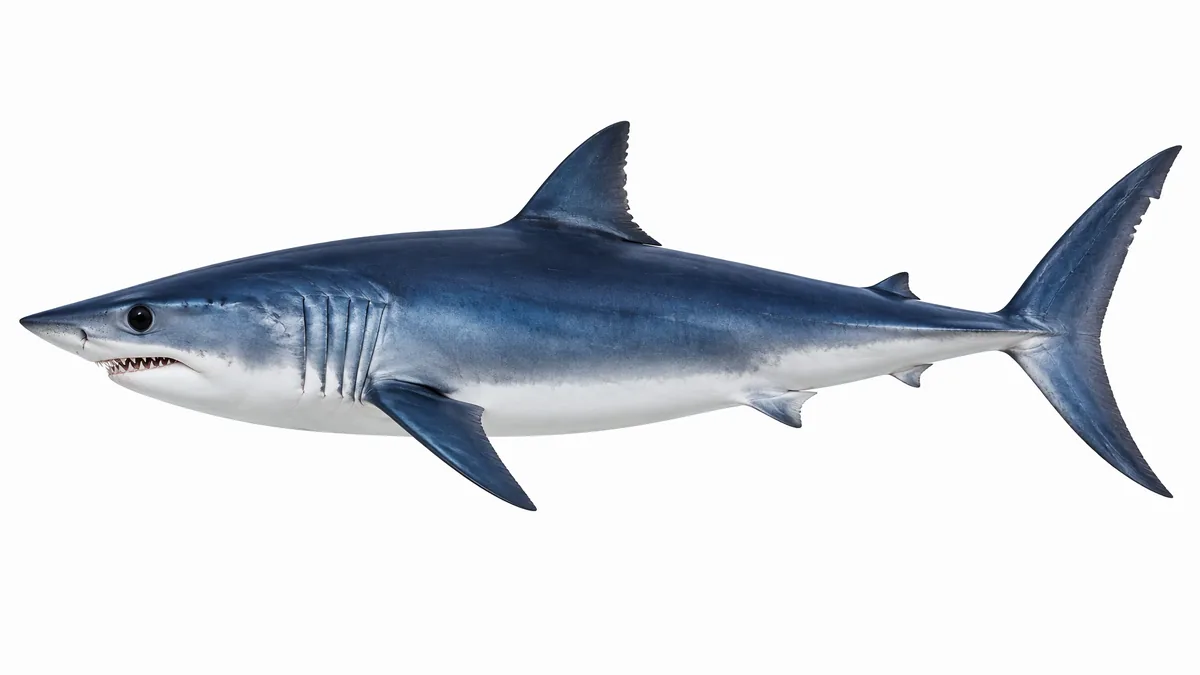
Shortfin Mako: Identification, Habitat & Diet
The shortfin mako (Isurus oxyrinchus) is the fastest shark in the sea and one of the most exciting animals an angler can hook. It is a blue-backed, white-bellied missile with a pointed snout and teeth that curve out of its mouth even when it is closed. Makos jump, sprint, and sometimes charge the boat. They are also in trouble: the species is listed as Endangered, and in much of its Atlantic range it is now a catch-and-release-only fish. This profile covers shortfin mako identification, habitat, diet, size, records, safety, and the conservation rules you need to know before you fish for one.
Quick ID Card
| Field | Details |
|---|---|
| Scientific name | Isurus oxyrinchus |
| Common names | Shortfin mako, mako shark, bonito shark, blue pointer |
| Family | Lamnidae (mackerel sharks) |
| Typical size | 5–8 feet; 100–300 pounds |
| Trophy size | 9–12 feet; 500–1,000+ pounds |
| Water type | Open ocean and shelf edges, temperate to tropical |
| Depth range | Surface to roughly 1,600 feet (500 m) |
| Difficulty | Hard; fast, aerial, and tackle-testing |
| Best season | Summer in the North Atlantic; warm months elsewhere |
How to Identify a Shortfin Mako
Shortfin mako identification is about shape and teeth. The snout is sharply pointed and conical, not blunt or rounded. The body is a slender spindle, widest at the shoulders and tapering to a narrow caudal peduncle with a strong keel and a crescent tail. The pectoral fins are short and narrow — shorter than a blue shark's — and the second dorsal fin is tiny and set far back.
Color is a clean two-tone: deep indigo blue on top, pure white underneath, with a sharp line between them. The eyes are black and relatively large. The dorsal fin is a tall triangle.
The clincher is the teeth. Shortfin mako teeth are long, narrow, and strongly curved, with smooth edges, and they protrude from the mouth even when it is closed. A great white's teeth are broad triangles with serrated edges; a blue shark's are smaller and more triangular. If you see a slender blue shark with a pointed snout and a mouth full of curved needles, it is a mako.
Shortfin Mako vs Great White
Shortfin mako vs great white is a comparison every offshore angler should know, because the two share water and both are protected in many places. The mako is the smaller, slimmer, more pointed fish. The great white is heavier through the body, with a more conical, less needle-like snout and a much broader head. White sharks are also counter-shaded in a duller grey-brown, while makos show a cleaner, brighter blue.
Teeth settle it. Mako teeth are slender, smooth-edged, and hooked. Great white teeth are broad, triangular, and serrated like a saw. A white shark also has a black eye and a more robust jaw, and its pectoral fins are larger relative to body size.
Size is a guide, not a rule. A 6-foot shark could be a young white or an average mako, so never identify by length alone. If there is any doubt, treat the fish as protected and release it without bringing it aboard. For the other common pelagic shark, see the blue shark profile.
Is the Shortfin Mako Dangerous?
Yes — the teeth make shortfin mako genuinely dangerous, and this is not a fish to handle casually. Mako teeth are long, curved, and razor-sharp, and the shark can twist and bite with almost no warning. There are recorded incidents of makos biting boats, and the species is one of the few sharks known to have attacked divers and swimmers. A green mako at the boat is a serious hazard.
Never bring a live mako aboard. Do not gaff a mako you intend to release, and do not put your hands near the mouth or gills. Use a heavy steel or wire leader, a long-handled dehooker, and bolt cutters to cut the hook or leader close to the mouth. Keep the fish in the water alongside the boat, hold it by the leader or use a tail rope if necessary, and let it swim off under its own power. If the shark is exhausted, revive it in the current before release.
Mako meat is sold commercially and is good eating, but the conservation status means most anglers should not be killing them. Large sharks also accumulate mercury, and public health agencies advise that pregnant women, nursing mothers, and young children avoid high-mercury fish. In the U.S. Atlantic, retention of shortfin mako is prohibited in the recreational fishery, so the question of eating one usually does not arise.
Where Do Shortfin Mako Live?
Shortfin mako habitat spans the temperate and tropical Atlantic, Pacific, and Indian oceans. They are found from the surface down to roughly 1,600 feet (500 m), often near shelf edges, seamounts, and current fronts where bait concentrates. They are warm-bodied sharks, able to keep their swimming muscles above ambient water temperature, which lets them hunt in cooler water than many sharks.
Where do shortfin mako live in the Atlantic? The species ranges from Canada and New England down through the Gulf of Mexico and the Caribbean to South America, and across to Europe and Africa. In the Pacific, they occur from California and Mexico across to Japan, Australia, and New Zealand. They are highly migratory and can cross ocean basins, though tagging shows that many individuals stay within broad regional areas.
Makos are usually solitary or loosely associated, not schooling. They are most often encountered around bait concentrations, temperature breaks, and structures that attract tuna and billfish, which are both prey and fellow predators.
Habits and Diet: What Do Shortfin Mako Eat?
What do shortfin mako eat? A lot, and fast. Their diet includes mackerel, tuna, bonito, swordfish, squid, and sea turtles, along with other sharks and billfish. Makos are apex predators that use speed and teeth rather than ambush. They can burst to roughly 45 mph (about 74 km/h) in short sprints, making them the fastest shark measured, and they are known for leaping clear of the water when hooked or feeding.
Makos are warm-bodied, with a heat-exchange system that keeps the core and swimming muscles warm. That physiology supports explosive speed and allows them to hunt in cool, deep water as well as warm surface layers. They are also known to scavenge and to follow longline gear, which is one reason they are so vulnerable to bycatch.
When do shortfin mako spawn? Makos do not spawn like bony fish; they give birth to live young. Females are ovoviviparous, carrying embryos that hatch inside the body and are born as free-swimming pups. Litters are small — typically 4 to 16 pups — after a gestation of well over a year, and females may reproduce only every two or three years. That slow reproduction is the core reason the species cannot withstand heavy fishing pressure.
Size, Records and Regulations
How big do shortfin mako get? Most adults run 5 to 8 feet and 100 to 300 pounds. Large females reach 9 to 12 feet and can exceed 500 pounds, with the biggest approaching 4 meters and well over 1,000 pounds. Males are much smaller.
The world record shortfin mako is the IGFA all-tackle mark of about 1,221 pounds (554 kg), caught off Chatham, Massachusetts, in 2001. It is one of the most famous shark records in sport fishing. Check the current IGFA book for line-class records and updates.
Regulations now dominate mako fishing. The shortfin mako was reclassified as Endangered on the IUCN Red List in 2019, reflecting steep declines driven by longline bycatch and the fin trade. The North Atlantic stock is overfished and has been the focus of ICCAT measures. In the U.S. Atlantic, NOAA Fisheries prohibits retention of shortfin mako in the recreational fishery, making it a catch-and-release-only fish; commercial retention is tightly limited and subject to quota. Many tournaments have moved to release-only formats. Elsewhere, rules vary, but the trend is toward protection.
That means the ethics and the law point the same way: do not target makos for the table. If you hook one, use heavy tackle, fight it quickly, keep it in the water, and release it properly. Never remove a mako from the water for a photo. Report the release if your fishery requires it, and check the current NOAA, ICCAT, and state rules before you leave the dock — mako regulations have changed repeatedly in recent years. Last verified: November 2025.
How to catch shortfin mako, if you are fishing under rules that allow it, is a matter of bait and patience. The best bait for shortfin mako is a fresh mackerel, bluefish, bonito, or tuna chunk, fished on a heavy wire or steel leader. Anglers drift or slow-troll baits around temperature breaks and bait concentrations, and chumming can bring sharks into the spread. Heavy conventional tackle in the 50- to 130-pound class is appropriate, with a smooth drag and a leader that can survive the teeth.
Expect jumps, runs, and a fish that may come at the boat. Keep the leader short and controlled, use a dehooker or cut the hook, and release the shark without lifting it. If you are not equipped to release a big mako safely, do not target them.
FAQ
How big do shortfin mako get? Most are 5–8 feet and 100–300 pounds; large females reach 9–12 feet and can exceed 500 pounds, with the biggest over 1,000.
What is the world record shortfin mako? The IGFA all-tackle record is about 1,221 pounds, caught off Massachusetts in 2001.
Where do shortfin mako live? Worldwide in temperate and tropical oceans, from the surface to about 1,600 feet, often near shelf edges and bait concentrations.
What do shortfin mako eat? Mackerel, tuna, bonito, swordfish, squid, sea turtles, and other sharks, hunted at high speed.
Shortfin mako vs great white: how do you tell them apart? Makos are slimmer with a pointed snout and long, smooth, curved teeth. Great whites are heavier with broad, serrated triangular teeth.
When do shortfin mako spawn? They give birth to live young — typically 4–16 pups after a long gestation — and females reproduce only every few years.
What is the best bait for shortfin mako? Fresh mackerel, bluefish, bonito, or tuna chunks on a heavy wire leader, drifted or slow-trolled.
Can you keep a shortfin mako? In the U.S. Atlantic, no — recreational retention is prohibited. The species is Endangered, and release is required or strongly encouraged in most fisheries.
Related Articles
- Blue Shark — the slender, long-finned pelagic shark most often confused with a mako.
- Blue Marlin — a billfish that shares mako water and appears in its diet.
- Yellowfin Tuna — a fast pelagic predator and a key mako prey fish.
- Swordfish — a deep-water billfish hunted by large makos.
- All species profiles
The shortfin mako is a fish worth protecting precisely because it is so impressive: fast, powerful, and slow to replace itself. Fish for it only where it is legal, plan the release before the hookup, and leave the teeth in the water where they belong.
Ready to catch one? Read our step-by-step guide: How to Catch Shortfin Mako.
About the author and how this was tested
About the author
FishermanGuy
Bank, boat and kayak angler · fishing, crabbing and shrimping since 2021
I buy the gear, fish it for a season and write down what failed. No sponsored verdicts, no free-sample flattery. Every rig on this page has landed fish in water I can point at on a map.
How this was tested
- Every rig gets at least six trips on the same water before it is published.
- Gear is bought at retail. Free samples are labelled in the first paragraph.
- Dates show first publication and the last time the page was updated.