Field notes
Blue Shark: Identification, Habitat & Diet
Blue Shark: Identification, Habitat & Diet
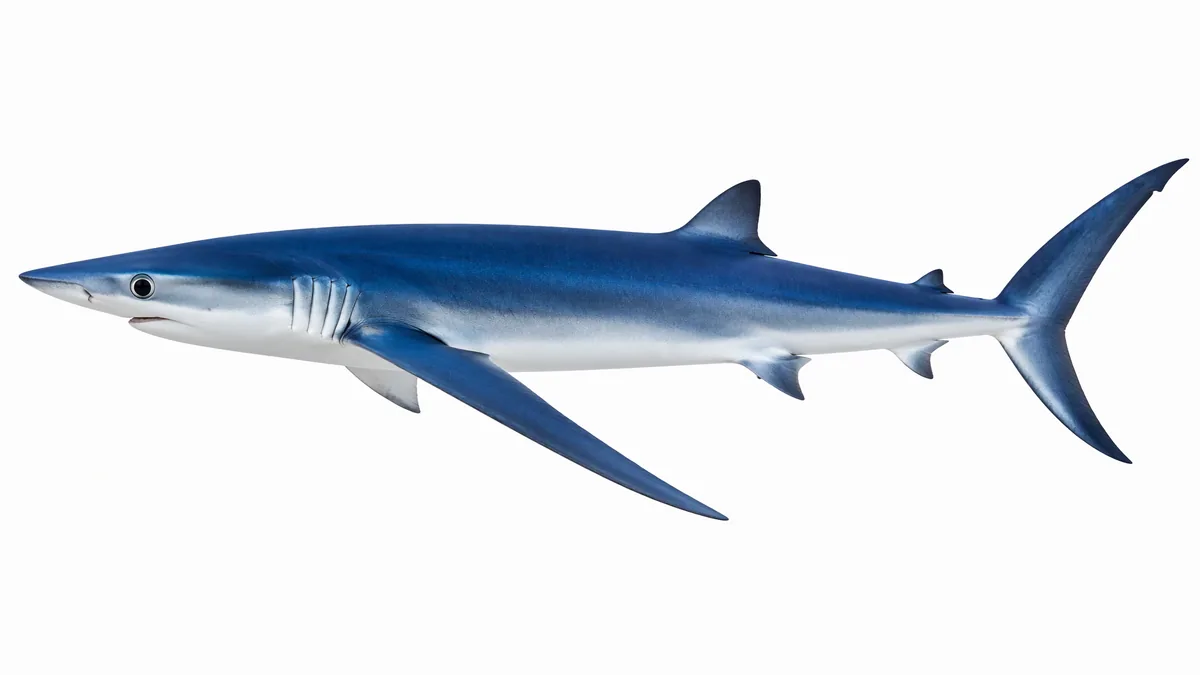
The blue shark (Prionace glauca) is the most wide-ranging shark in the ocean and one of the most beautiful. It is impossibly slim, painted indigo blue above and pure white below, with pectoral fins so long they look borrowed from a glider. Blue sharks cross entire ocean basins, gather in loose feeding groups, and are the shark most offshore anglers are likely to meet. They are also among the most heavily caught sharks in the world, largely as bycatch in longline fisheries. This guide covers blue shark identification, habitat, diet, size, records, how it differs from a mako, and the release practices that keep the species in the water.
Quick ID Card
| Field | Details |
|---|---|
| Scientific name | Prionace glauca |
| Common names | Blue shark, blue whaler, great blue shark |
| Family | Carcharhinidae (requiem sharks) |
| Typical size | 6–8 feet; 80–200 pounds |
| Trophy size | 9–12 feet; 300–500+ pounds |
| Water type | Open ocean, temperate to tropical |
| Depth range | Surface to roughly 1,150 feet (350 m) |
| Difficulty | Moderate; fast runs, but generally a released fish |
| Best season | Summer and fall in the North Atlantic; warm months elsewhere |
How to Identify a Blue Shark
Blue shark identification comes down to proportions. This is the slenderest of the large sharks: a long, pointed snout, a slim body, and pectoral fins that are extraordinarily long and narrow, sweeping back like wings. The first dorsal fin is small and set far back toward the tail, and there is no ridge between the dorsal fins. The tail is crescent-shaped with a long upper lobe.
The color is unmistakable. The back is a vivid, almost metallic indigo blue, and the belly is bright white, with a fairly sharp transition along the flank. Large, round eyes sit on a pointed head. There are no spots, no bands, and no markings beyond the two-tone body.
That long pectoral fin is the easiest field mark. A mako has short, narrow pectorals; a great white has broad, paddle-like ones. A blue shark's pectorals can be a quarter of its body length, and they give the fish its glider look. If the shark is pencil-slim, blue on top, white below, with wings for fins, it is a blue shark.
Blue Shark vs Mako
Blue shark vs mako is a common mix-up because both are blue-backed pelagic sharks. The body shape separates them instantly. The blue shark is slender and elongated, with a long conical snout and very long pectoral fins. The mako is thicker through the body, with a shorter, more pointed snout and short pectoral fins.
Teeth are the other giveaway. Mako teeth are long, thin, and curved, and they show even when the mouth is closed. Blue shark teeth are shorter, broader, and triangular with serrated edges, and they are mostly hidden. The mako also has a stronger keel and a more powerful, tuna-like build; the blue shark looks built for cruising rather than sprinting.
Size overlaps, so do not rely on length alone. A 7-foot fish could be either. Look at the fins and the teeth, and if you are unsure, treat the fish as protected and release it without bringing it aboard. For the fast cousin, see the shortfin mako profile.
Is the Blue Shark Dangerous?
Blue sharks are not aggressive by shark standards, and they are not responsible for the kind of attacks associated with great whites or bull sharks. That does not make them safe. They have a full set of serrated teeth, powerful jaws, and a habit of investigating baits and boats closely. A blue shark can bite a hand, a leader, or a gunwale in a fraction of a second.
The bigger risk is handling. Blue sharks are often caught, brought alongside, and released, and that is exactly when people get hurt. Do not put your hands near the mouth, do not try to drag a shark aboard by the gills, and do not straddle a fish on deck. Use a heavy leader, a long dehooker, and bolt cutters. Keep the shark in the water, control the head with the leader if you must, and let it swim away.
Blue sharks are also caught for meat and fins in some fisheries, and they accumulate mercury like other large predators. Public health agencies advise that pregnant women, nursing mothers, and young children avoid high-mercury fish. For most recreational anglers, the blue shark is a release fish — and in many places, that is required or strongly encouraged.
Where Do Blue Shark Live?
Blue shark habitat is the open ocean, worldwide, from temperate to tropical waters. They are among the most widely distributed sharks on Earth, found in the Atlantic, Pacific, and Indian oceans and the Mediterranean. They are oceanic rather than coastal, usually staying well offshore, though they come closer to shore where the shelf is narrow or currents push blue water in.
Where do blue shark live in the water column? Mostly in the upper layers, from the surface down to roughly 1,150 feet (350 m), and they are most often seen near the surface at night. They prefer cooler water than many tropical sharks — roughly 45°F to 77°F (7–25°C) — and they are common in the North Atlantic, off California, and around southern Africa and Australia.
Blue sharks are champion migrators. Tagging has shown individuals crossing the Atlantic and traveling more than 5,000 miles, and the species is thought to have one of the longest migrations of any shark. Genetic studies show broad mixing between ocean regions, which complicates management: a shark caught in one country's waters may have been born in another.
Habits and Diet: What Do Blue Shark Eat?
What do blue shark eat? Mostly small, schooling prey: mackerel, sardines, anchovies, herring, and squid, along with occasional seabirds, carrion, and small sharks. Blue sharks are opportunistic feeders that often hunt at night, when squid and small fish rise toward the surface. They are known to follow schools of bait and to gather in loose groups around feeding opportunities.
Blue sharks are not ambush predators in the way great whites are. They cruise, investigate, and pick off prey, and they are famously curious about boats and chum slicks. That curiosity is what makes them easy to catch — and what makes responsible release so important.
When do blue shark spawn? Blue sharks give birth to live young. Females are placental viviparous, and litters are large, typically 25 to 50 pups, after a gestation of roughly nine to twelve months. Females move to nursery areas in warmer waters to give birth. Even with large litters, the species is vulnerable to fishing pressure because it is caught in enormous numbers as bycatch before it can reproduce, and because females mature relatively late.
Size, Records and Regulations
How big do blue shark get? Most adults are 6 to 8 feet and 80 to 200 pounds. Large females reach 9 to 12 feet and can exceed 300 pounds, with the biggest approaching 12.5 feet (3.8 m) and several hundred pounds. Males are smaller.
The world record blue shark is the IGFA all-tackle mark of about 528 pounds, caught off Montauk, New York, in 1979. Check the current IGFA book for the certified figure and line-class records.
Regulations are evolving. The blue shark is assessed as Near Threatened globally on the IUCN Red List, with the main threats being longline bycatch and the fin trade. It is one of the most heavily fished sharks in the world by volume, even though it is rarely a target species. In U.S. waters, finning is prohibited, and sharks caught incidentally must be handled and released under specific rules; retention limits for blue sharks vary by region and fishery. Some countries and regional bodies have closed retention altogether, while others allow limited take. Many recreational fisheries and tournaments now promote release, and some require it.
The practical rule for anglers is simple: treat the blue shark as a catch-and-release fish unless you have confirmed that retention is legal where you are fishing. Use heavy tackle to shorten the fight, keep the shark in the water, and release it without lifting it aboard. Check current NOAA, ICCAT, and local rules, because blue shark management has been tightening. Last verified: November 2025.
How to catch blue shark, where legal, is mostly a night drift. The best bait for blue shark is a fresh mackerel, sardine, or squid, fished on a wire leader under a chum slick. Anglers drift or slow-troll, and blue sharks often show up in numbers once a slick is established. Medium-heavy tackle in the 30- to 80-pound class is plenty for most fish, with a smooth drag and a leader that can handle the teeth.
Expect fast runs and some jumps, especially from smaller fish. Keep the fish in the water at the boat, use a dehooker or cut the leader, and never bring a live blue shark aboard. If you are not set up to release safely, do not chum for them.
FAQ
How big do blue shark get? Most are 6–8 feet and 80–200 pounds; large females reach 9–12 feet and can exceed 300 pounds, with the biggest near 12.5 feet.
What is the world record blue shark? The IGFA all-tackle record is about 528 pounds, caught off Montauk, New York, in 1979.
Where do blue shark live? Worldwide in temperate and tropical open ocean, mostly in the upper 1,150 feet, often near the surface at night.
What do blue shark eat? Mackerel, sardines, anchovies, herring, squid, and occasional seabirds or carrion, often hunted at night.
Blue shark vs mako: how do you tell them apart? Blue sharks are much slimmer with very long pectoral fins and triangular teeth. Makos are thicker with short pectorals and long needle teeth.
When do blue shark spawn? Females give birth to live young, typically 25–50 pups after a gestation of about nine to twelve months.
What is the best bait for blue shark? Fresh mackerel, sardine, or squid on a wire leader, fished under a chum slick at night.
Can you keep a blue shark? Rules vary and are tightening. Many fisheries require or encourage release; confirm local retention rules before you fish.
Related Articles
- Shortfin Mako — the faster, thicker-bodied shark most often confused with a blue shark.
- Blue Marlin — a billfish that shares the same warm offshore currents.
- Yellowfin Tuna — a fast pelagic fish often found near blue shark water.
- Swordfish — a deep-water billfish of the same open-ocean range.
- All species profiles
The blue shark is a traveler first and a game fish second: a slim, blue, ocean-crossing animal that deserves a quick release and a clean send-off. Handle it carefully, keep it in the water, and let one of the ocean's great migrants keep moving.
Ready to catch one? Read our step-by-step guide: How to Catch Blue Shark.
About the author and how this was tested
About the author
FishermanGuy
Bank, boat and kayak angler · fishing, crabbing and shrimping since 2021
I buy the gear, fish it for a season and write down what failed. No sponsored verdicts, no free-sample flattery. Every rig on this page has landed fish in water I can point at on a map.
How this was tested
- Every rig gets at least six trips on the same water before it is published.
- Gear is bought at retail. Free samples are labelled in the first paragraph.
- Dates show first publication and the last time the page was updated.