Field notes
Cobia: Identification, Habitat & Diet
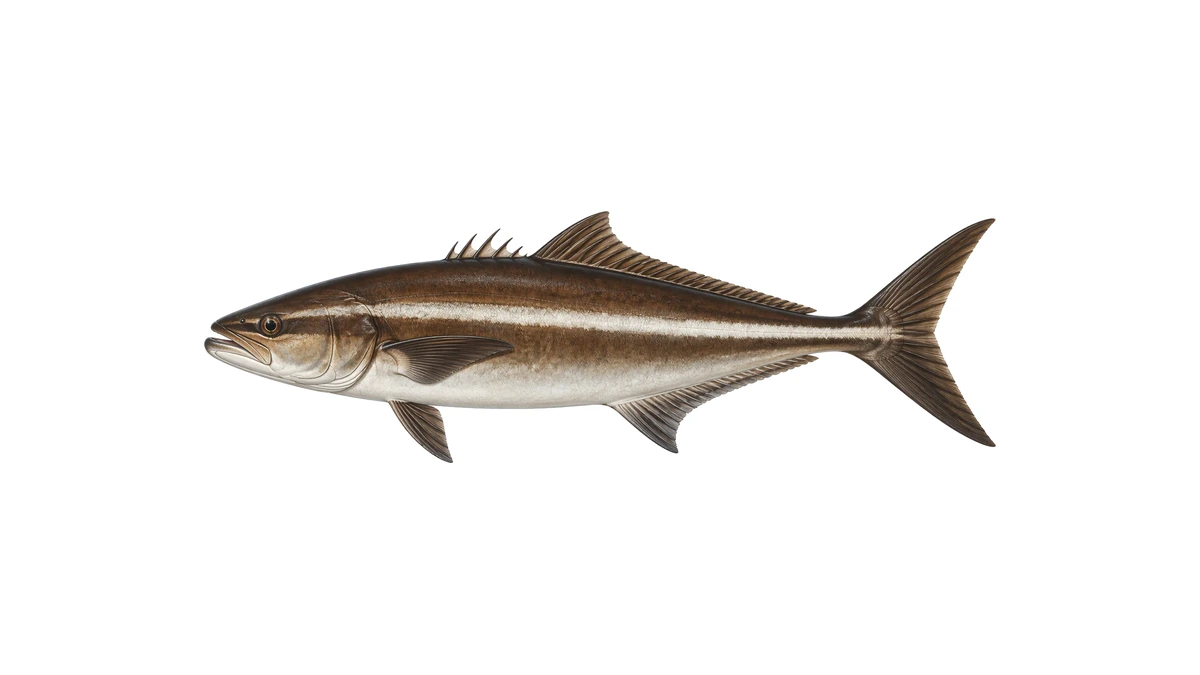
Cobia: Identification, Habitat & Diet
The cobia (Rachycentron canadum) is a long, dark, broad-headed fish with a single silver stripe and a bad attitude about being hooked. It cruises the Gulf of Mexico and the U.S. Atlantic coast every spring and summer, often swimming within sight of the surface, sometimes right up to the boat. Anglers call it the crabeater, the lemonfish, or the black kingfish, and it is one of the few inshore fish that can be spotted, cast to, and then fight like an offshore species. This profile covers cobia identification, habitat, diet, size, records, regulations, and how to catch one.
Quick ID Card
| Field | Details |
|---|---|
| Scientific name | Rachycentron canadum |
| Common names | Cobia, crabeater, lemonfish, black kingfish, ling, sergeant fish |
| Family | Rachycentridae (the only species in its family) |
| Typical size | 10–40 pounds; 20–40 inches |
| Trophy size | 50–80 pounds; the largest exceed 100 pounds |
| Water type | Coastal bays, passes, beaches, wrecks, buoys, and offshore structure |
| Active water temperature | Roughly 68–86°F (20–30°C) |
| Difficulty | Moderate to hard; strong runs, sharp eyesight, heavy gear needed |
| Best season | Spring through fall, with a famous spring run in the Mid-Atlantic |
How to Identify a Cobia
Cobia identification is usually easy once you see the whole fish. The body is long and torpedo-shaped, dark brown to bronze or almost black on top, fading to a pale belly. A bold silver-white stripe runs from the eye along the flank toward the tail. On some fish the stripe is bright and obvious; on others it fades as the fish ages or the light changes.
The head is broad and flat, wider than the body just behind it. The lower jaw sticks out past the upper, and the mouth is large. The eyes are small for the size of the fish. The skin looks smooth, almost leathery, because the scales are tiny and buried.
The fins are the clincher. Cobia have a short row of thick, separate dorsal spines just behind the head, followed by a long soft dorsal fin. The anal fin is long and similar in shape. The tail is forked, and the pectoral fins are small and dark. When a cobia swims near the surface, that short spiny dorsal breaks the water like a small shark fin, which causes a lot of false alarms.
Color varies with habitat. Fish over sand and in clear water tend to be lighter, while fish around structure and muddy water look darker. A cobia does not have spots, bars, or a lateral line stripe like a snook, and it does not have the silver scales of a tarpon.
Cobia vs Shark
The cobia's surface profile is the reason for the shark confusion. A cobia cruising with its dorsal fin out of the water looks like a small shark, and swimmers report "sharks" that are actually cobia.
| Feature | Cobia | Shark |
|---|---|---|
| Dorsal fin | Short, thick, isolated spines, then a long soft fin | Tall triangular fin, often with a second small fin near the tail |
| Tail | Forked, symmetrical | Asymmetrical, with a long upper lobe |
| Gill openings | Covered by a gill plate | Five to seven visible gill slits on the side |
| Skin | Smooth, leathery, tiny scales | Rough, sandpaper-like dermal denticles |
| Markings | Silver-white lateral stripe | Usually none; some sharks have spots or bands |
| Behavior near boats | Curious, often approaches | Usually wary or indifferent |
The gill slits settle it. A shark has exposed slits on the side of the head; a cobia has a normal gill cover. The tail is the second check: a shark's tail has a big upper lobe and a small lower lobe, while a cobia's tail is forked and even. And if the fish is following a ray or a turtle and swimming in lazy circles, it is almost certainly a cobia.
Is the Cobia Dangerous?
Cobia are not venomous. They have no stingers, no poison spines, and no razor gill covers. The short dorsal spines are stiff and can poke, but they are not venomous.
The real risk is the fight. Cobia are powerful, and a big one usually runs straight down and then bulldozes along the bottom. A 60-pound cobia on inshore gear can bend a hook, break a leader, or pull an angler into the rail. Keep the drag set and your feet planted, and do not try to stop the first run with your hand on the spool.
Cobia also have a habit of coming to the boat green. A fish that has been fought to the surface may explode into one last run when it sees the boat or the net. Keep your head down, keep the rod tip up, and let the net man do the work. Small cobia are harmless; big ones can damage a boat and the people in it.
Handling is straightforward. Cobia have small teeth and a strong jaw but are not biters in the way bluefish are. Support the body, avoid the dorsal spines, and use a lip grip or a hand under the belly. If you release the fish, keep it in the water and revive it before letting go.
Where Do Cobia Live?
Cobia habitat is tropical and subtropical coastal water almost worldwide, with one big exception: cobia are absent from the eastern Pacific. In the western Atlantic they range from Massachusetts south through the Gulf of Mexico and the Caribbean to Argentina. They also occur in the Indo-Pacific, from South Africa and the Red Sea across to Australia and Japan.
In the United States, the cobia season is a migration. Fish appear in the Gulf of Mexico in spring, moving north and east along the coast. The Florida Panhandle, Alabama, Mississippi, and Louisiana all see fish in April and May. On the Atlantic side, the famous run hits Cape Hatteras, North Carolina, in late spring, and Virginia's Chesapeake Bay in May and June. Some fish summer in the Mid-Atlantic, and a few push into New England in warm years.
Cobia like structure and something to follow. They hang around buoys, channel markers, wrecks, pilings, and bridge fenders. They also follow rays, turtles, sharks, and manatees, using the bigger animal as a moving cover. When a cobia finds a bait school or a crab flat, it may stay for days.
Where do cobia live in the water column? Often right at the surface, especially in the morning and on calm days. That is what makes them such a good sight-fishing target. At other times they are mid-column or on the bottom around structure.
Habits and Diet: What Do Cobia Eat?
What do cobia eat? Crabs first, then shrimp, squid, and fish. The nickname crabeater is accurate. Blue crabs, stone crabs, and swimming crabs are favorites, and cobia will root around bait on the bottom to find them. They also eat pinfish, mullet, menhaden, croakers, and small eels.
Cobia feed by sight and by smell. They are curious and will approach a boat, a diver, or a piece of structure to investigate. That curiosity is both a gift and a curse: it gives anglers a shot, and it also makes cobia easy to overfish in areas where they concentrate.
When do cobia spawn? Spawning happens offshore in spring and summer, with peaks that vary by latitude. Females release buoyant eggs that drift in the plankton. Cobia grow fast; they can mature in two or three years and may live a decade or more. In aquaculture, the species is prized because it puts on weight quickly, and farmed cobia can reach several kilograms in their first year.
Cobia are solitary or travel in small groups. A single fish on a buoy is a common sight, and a group of three or four is a bonus. They are not a schooling fish in the way mahi-mahi are.
Size, Records and Regulations
How big do cobia get? Most cobia caught by anglers are 10 to 40 pounds. A 50-pound fish is a good one, and an 80-pound cobia is a trophy. The species can reach about 6.5 feet and well over 100 pounds, with the largest recorded fish approaching 170 pounds.
The world record cobia on rod and reel is in the mid-130-pound range, taken in Australia. The IGFA all-tackle record is the benchmark, and it is well above the typical U.S. fish. Check the IGFA record book for the current number before you dream too hard.
Regulations vary a lot by state. Florida is a good example: the state sets a 33-inch fork-length minimum and a bag limit of one cobia per person, with different rules on the Gulf and Atlantic coasts and additional rules for federal waters. Virginia, North Carolina, South Carolina, Georgia, Alabama, Mississippi, Louisiana, and Texas each set their own size limits, bag limits, and seasons. Some states have changed cobia rules repeatedly in recent years in response to stock assessments.
The authority is the state agency: the Florida Fish and Wildlife Conservation Commission (FWC), the Virginia Marine Resources Commission (VMRC), the North Carolina Division of Marine Fisheries, and their counterparts elsewhere. Federally, cobia in the Atlantic are managed by the South Atlantic Fishery Management Council, and in the Gulf by the Gulf of Mexico Fishery Management Council. Read the current rules before you keep a fish, and check whether a cobia permit or reporting requirement applies. Last verified: November 2025.
How to catch cobia: find structure or a cruising fish, present a natural bait or a big lure, and hold on. The best bait for cobia is a live blue crab, a live eel, a live menhaden, or a fresh chunk of cut bait. Cobia also take bucktail jigs, swimbaits, spoons, and big soft plastics. Sight-fishing is the classic method: spot the fish, cast ahead of it, and let the bait sink into its path.
Use 20- to 30-pound spinning or conventional tackle with a 50- to 80-pound leader. Circle hooks are required or recommended in many fisheries for natural bait. Chumming with cut bait and sardines brings fish to the boat, but check whether chumming is legal where you fish. When a cobia eats, give it a moment, then set the hook hard and clear the line from the rail.
FAQ
How big do cobia get? Most are 10–40 pounds. Fish over 50 pounds are trophies, and the species can exceed 100 pounds and about 6.5 feet.
What is the world record cobia? The IGFA all-tackle record is in the mid-130-pound range, caught in Australia. Check IGFA for the current listing.
Where do cobia live? In warm coastal water worldwide except the eastern Pacific. In the U.S. they migrate up the Gulf and Atlantic coasts in spring and summer, favoring buoys, wrecks, passes, and beaches.
What do cobia eat? Crabs, shrimp, squid, and fish. Blue crabs are a favorite, which is why cobia are called crabeaters.
Cobia vs shark: how do you tell them apart? A cobia has a forked, symmetrical tail, a gill cover instead of exposed gill slits, smooth skin, and a silver lateral stripe. A shark has gill slits, an asymmetrical tail, and rough skin.
When do cobia spawn? Offshore in spring and summer, varying by latitude. Eggs drift in the plankton, and the fish grow fast.
What is the best bait for cobia? Live blue crab, live eel, live menhaden, or fresh cut bait. Big jigs and swimbaits also work, especially when sight-fishing.
How do you catch a cobia? Spot a fish on structure or the surface, cast ahead of it, and let the bait sink into its path. Use heavy inshore gear and a strong leader, and be ready for a long first run.
Related Articles
- Tarpon — another big inshore fish of Gulf passes and beaches.
- Mahi-Mahi — a fast offshore fish that shares the cobia's curiosity.
- Striped Bass — the Mid-Atlantic's other spring and fall migrant.
- Northern Shrimp — a cold-water shrimp that feeds coastal predators.
- All species profiles
A cobia is a fish that rewards looking. Spot the dark shape on the surface, make one good cast, and the reward is a fight that feels twice the size of the fish. That is the cobia bargain, and it is why anglers plan summers around it.
Ready to catch one? Read our step-by-step guide: How to Catch Cobia.
About the author and how this was tested
About the author
FishermanGuy
Bank, boat and kayak angler · fishing, crabbing and shrimping since 2021
I buy the gear, fish it for a season and write down what failed. No sponsored verdicts, no free-sample flattery. Every rig on this page has landed fish in water I can point at on a map.
How this was tested
- Every rig gets at least six trips on the same water before it is published.
- Gear is bought at retail. Free samples are labelled in the first paragraph.
- Dates show first publication and the last time the page was updated.