Field notes
Atlantic Cod: Identification, Habitat & Diet
Atlantic Cod: Identification, Habitat & Diet
The Atlantic cod (Gadus morhua) is the fish that shaped the modern North Atlantic. Entire fleets, ports, and treaties grew around it, and the collapse off Newfoundland in 1992 became the textbook example of what overfishing can do. For anglers, the Atlantic cod is a heavy, hard-fighting bottom fish with three dorsal fins, a chin barbel, and a taste for whatever is bleeding on the seabed. This profile covers Atlantic cod identification, habitat, diet, size, records, spawning, and how to catch one in European and North American waters.
Quick ID Card
| Field | Details |
|---|---|
| Scientific name | Gadus morhua |
| Common names | Atlantic cod, cod, codfish, skrei (spawning Norwegian stock) |
| Family | Gadidae (cods and haddocks) |
| Typical size | 2–20 pounds (1–9 kg); 20–35 inches (50–90 cm) |
| Trophy size | 30–50 pounds; the largest recorded reach about 210 pounds |
| Water type | Cold salt water, from shallow coast to deep shelf |
| Depth range | Roughly 0–600 m, mostly 20–200 m |
| Active water temperature | About 35–50°F (2–10°C) for the northern stocks |
| Difficulty | Easy to hook, hard to land; strong and heavy |
| Best season | Winter and early spring for big spawning fish; autumn offshore |
How to Identify an Atlantic Cod
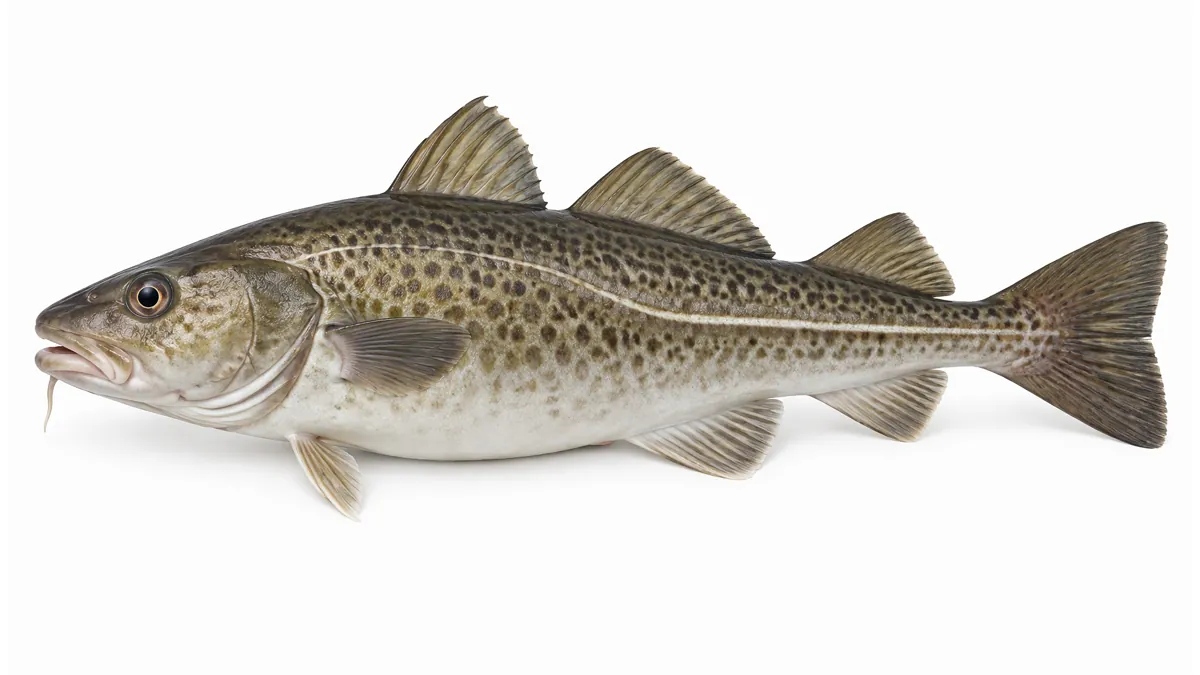
Atlantic cod identification is straightforward once you know the four signals: three dorsal fins, two anal fins, a pale lateral line, and a single barbel under the chin.
The body is torpedo-shaped and heavy, with a broad head and a mouth that opens wide. The upper jaw overhangs the lower jaw, and a short fleshy barbel hangs from the chin. The lateral line is pale and curves up over the pectoral fin before running straight to the tail. Colour varies with bottom type, from grey-green to red-brown, often with darker mottling and spots on the back and a pale belly.
The three dorsal fins are separated by clear gaps, and the two anal fins sit roughly opposite the last two dorsals. That fin pattern is the fastest way to separate a cod from a haddock, which has three dorsals but a very different look: a black "thumbprint" on each flank, a dark lateral line, and no barbel.
A cod's teeth are small but numerous, and the gill rakers are long and comb-like. The skin is covered in small, soft scales that are easy to damage, so handle fish with wet hands and support the belly. A big cod feels heavier than it looks, and the head alone can be a handful.
Atlantic Cod vs Pacific Cod
Atlantic cod and Pacific cod (Gadus macrocephalus) are close relatives, and they look alike at a glance. They do not share a range in the wild, which is the simplest way to tell them apart: one is an Atlantic fish, the other a North Pacific fish.
| Feature | Atlantic cod | Pacific cod |
|---|---|---|
| Range | North Atlantic, both sides | North Pacific, both sides |
| Maximum size | About 2 m and 96 kg | About 1.2 m, rarely more |
| Head and barbel | Larger head; barbel roughly as long as the eye | Shorter head; barbel shorter than the eye |
| Lateral line | Pale and clearly curved | Lighter, less conspicuous |
| Market name | Cod, codfish | Often sold as "Pacific cod" or "grey cod" |
In European fishmongers, the more common mix-up is cod with ling, saithe, or pollack. Ling has a similar long body but a single long dorsal fin; saithe and pollack belong to the same family but lack the three-dorsal pattern of a true cod. Check the chin barbel and count the dorsal fins before you decide what is on the line.
Is the Atlantic Cod Dangerous?
No. Atlantic cod are not venomous, and they have no poisonous spines. The hazards are ordinary handling problems and the weather that comes with cod fishing.
The dorsal spines are stiff, and the gill covers have sharp edges. A cod thrashing on a deck can rake a hand or a shin. Wet the hands, hold the fish across the back with the belly supported, and use a cloth or a grip if the fish is large. A knock on the head settles a fish quickly and protects both angler and catch.
Cod fishing often happens in winter, in cold water, from small boats. That combination is the real risk. Wear a life jacket, check the forecast twice, and treat a cold-water capsize as a survival situation, not a swim. On rocky shores, swell and spray do more damage than any fish.
One more point: cod is one of the most heavily managed fish in Europe, and rules change by area and by year. The safest habit is to check the current regulations before you leave the house, not after you have a fish in the cooler.
Where Do Atlantic Cod Live?
Atlantic cod habitat is the cold shelf water of the North Atlantic. On the western side, the range runs from Greenland and the Canadian Maritimes, including the Grand Banks, down through the Gulf of Maine to around North Carolina. On the eastern side, cod live from the Barents Sea and Iceland through Norway, the North Sea, the Irish Sea, and the Baltic, with smaller populations around the Faroes and the UK coast.
They are bottom fish, but not prisoners of the bottom. Cod feed on the seabed and also hunt well off it, especially where baitfish are suspended over reefs and wrecks. Depth matters less than structure and food: 20 to 200 m covers most fishing, though cod have been taken far deeper and in very shallow water at night.
Temperature controls the map. Northern stocks are comfortable near freezing, while southern stocks live at the warm edge of the range and are more sensitive to warming water. That is one reason the species is under pressure in the southern North Sea and the Celtic Sea, where stocks are small and tightly regulated.
Where do Atlantic cod live in summer and winter? In the northeast Atlantic, mature cod often move offshore and north in summer, then return toward spawning grounds in winter. The Norwegian stock, known as skrei, migrates from the Barents Sea to the Lofoten Islands to spawn. On the other side of the ocean, Gulf of Maine cod stay closer to home but still shift with temperature and bait.
Habits and Diet: What Do Atlantic Cod Eat?
What do Atlantic cod eat? Almost anything that fits in the mouth, which is why they are so catchable. The core diet is fish: capelin, herring, sandeels, whiting, haddock, and the young of their own kind. Cod also eat shrimp, crabs, squid, mussels, and worms. Large cod are serious predators and known cannibals, and a big fish will happily eat a smaller cod on the way up.
Feeding is often tied to light and tide. Cod hunt best in low light, at dawn, dusk, and through the night, and they use structure as an ambush line. Wrecks, reefs, mussel beds, and gravel banks all hold fish because they hold bait. In strong tide, cod sit in the slack behind a bank and pick off food swept past.
When do Atlantic cod spawn? Timing depends on the stock. In the northeast Atlantic, the main run is late winter into early spring, roughly January to April, with the Lofoten fishery peaking in February and March. Baltic cod spawn later, in spring and early summer, and western Atlantic stocks spawn in winter and spring. A large female can release millions of eggs in a season, and the eggs float in the current, which is why spawning grounds and currents matter so much to recruitment.
Cod grow slowly and live long. Fish of 20 years or more are recorded, and the biggest females are also the most productive. That slow life history is exactly why cod stocks collapse quickly and recover slowly.
Size, Records and Regulations
How big do Atlantic cod get? Most rod-caught fish run 2 to 20 pounds. A 30-pound cod is a good fish anywhere, and a 50-pound fish is a trophy. The species can reach about 2 m and 96 kg (212 lb), though fish anywhere near that size are museum pieces, not a realistic target.
The world record atlantic cod on rod and reel is a fish of roughly 100 pounds (about 45 kg), caught off Norway. FishBase lists a maximum recorded weight of 96 kg for the species, which shows how far the record fish sits below the absolute maximum.
Regulations are the hard part of cod fishing in Europe. Under EU and UK rules, the minimum conservation reference size for Atlantic cod is generally 35 cm (about 14 inches) in the North Sea and many adjacent waters, but Baltic stocks, the Irish Sea, and other areas have their own sizes, closures, and bag limits. ICES, the International Council for the Exploration of the Sea, has advised zero catches for several cod stocks in recent years, and both EU and UK authorities have responded with closed areas, reduced quotas, and recreational restrictions.
As of 2025, the practical advice is simple: assume nothing and check the rules for the exact area you plan to fish. In England, the Marine Management Organisation (MMO) and CEFAS publish the current sizes and closures; Marine Scotland covers Scottish waters; in Norway, the Directorate of Fisheries sets its own rules; in the EU, the relevant member state authority does the same. Last verified: November 2025.
The best bait for atlantic cod is fresh and smelly. Squid, peeler crab, lugworm, mackerel strips, and mussels all work from a boat or a shore mark. On the artificial side, heavy pirk jigs, big soft plastics on jig heads, shrimp flies, and metal spoons take fish, especially when cod are feeding on sandeels or herring.
How to catch atlantic cod: find structure, fish the tide, and use enough lead. Drift over wrecks and reefs with a flowing trace and a bait that moves, or anchor uptide and let scent do the work. In winter, shore anglers fish deep water and rough ground after dark. Heavy tackle is not a luxury; a big cod in tide will find every snag on the bottom.
FAQ
How big do Atlantic cod get? Most are 2–20 pounds. Fish over 50 pounds are rare, and the species maximum is about 96 kg (212 lb) and 2 m, according to FishBase.
What is the world record Atlantic cod? The IGFA all-tackle record is a fish of roughly 100 pounds (about 45 kg), caught off Norway.
Where do Atlantic cod live? On both sides of the North Atlantic, from the Canadian Grand Banks and Gulf of Maine to Iceland, Norway, the North Sea, and the Baltic. They are bottom fish of the cold shelf.
What do Atlantic cod eat? Fish such as capelin, herring, sandeels, and whiting, plus shrimp, crabs, squid, and worms. Large cod are cannibals.
Atlantic cod vs Pacific cod: what is the difference? Range is the main one: Atlantic cod live in the North Atlantic, Pacific cod in the North Pacific. Atlantic cod also grow much larger.
When do Atlantic cod spawn? Mostly late winter to spring. Norwegian skrei spawn off Lofoten in February and March; Baltic and western Atlantic stocks spawn at their own times.
What is the best bait for Atlantic cod? Squid, peeler crab, lugworm, mackerel, and mussels. Pirk jigs and big soft plastics work when fish are on baitfish.
How do you catch Atlantic cod? Fish wrecks, reefs, and gravel banks on the tide, with heavy tackle and fresh bait. Low light is better than bright sun.
Related Articles
- Atlantic Herring — the forage fish that cod follow.
- Turbot — another prized European bottom fish.
- European Seabass — a warmer-water inshore predator.
- Zander — a freshwater predator for anglers who fish both salt and fresh water.
- All species profiles
Atlantic cod is a fish of cold water and old rules. Learn the three fins and the barbel, respect the closures, and fish the structures where bait collects. The reward is one of the strongest bottom fights in the North Atlantic, and a fish with a history longer than any angler's lifetime.
Ready to catch one? Read our step-by-step guide: How to Catch Atlantic Cod.
About the author and how this was tested
About the author
FishermanGuy
Bank, boat and kayak angler · fishing, crabbing and shrimping since 2021
I buy the gear, fish it for a season and write down what failed. No sponsored verdicts, no free-sample flattery. Every rig on this page has landed fish in water I can point at on a map.
How this was tested
- Every rig gets at least six trips on the same water before it is published.
- Gear is bought at retail. Free samples are labelled in the first paragraph.
- Dates show first publication and the last time the page was updated.