Field notes
Atlantic Herring: Identification, Habitat & Diet
Atlantic Herring: Identification, Habitat & Diet
The Atlantic herring (Clupea harengus) is small, silver, and almost absurdly important. It is one of the most abundant fish in the North Atlantic, the engine of the food web that feeds cod, tuna, seals, and whales, and the raw material for pickled herring, kippers, and the infamous Swedish surströmming. For anglers, the Atlantic herring is a light-tackle target, a bait source, and the reason big predators turn up where they do. This profile covers Atlantic herring identification, habitat, diet, size, spawning, and how to catch herring.
Quick ID Card
| Field | Details |
|---|---|
| Scientific name | Clupea harengus |
| Common names | Atlantic herring, herring, sea herring, sild, strömming (Baltic form) |
| Family | Clupeidae (herrings and sardines) |
| Typical size | 8–12 inches (20–30 cm); 3–14 oz (100–400 g) |
| Maximum size | About 18 inches (45 cm) and roughly 1 kg (2 lb) |
| Water type | Cold marine, fully pelagic, often in huge shoals |
| Depth range | Surface to about 360 m |
| Active water temperature | Roughly 40–55°F (4–13°C), stock dependent |
| Difficulty | Easy once a shoal is found; finding it is the challenge |
| Best season | Winter and early spring for many European stocks |
How to Identify an Atlantic Herring
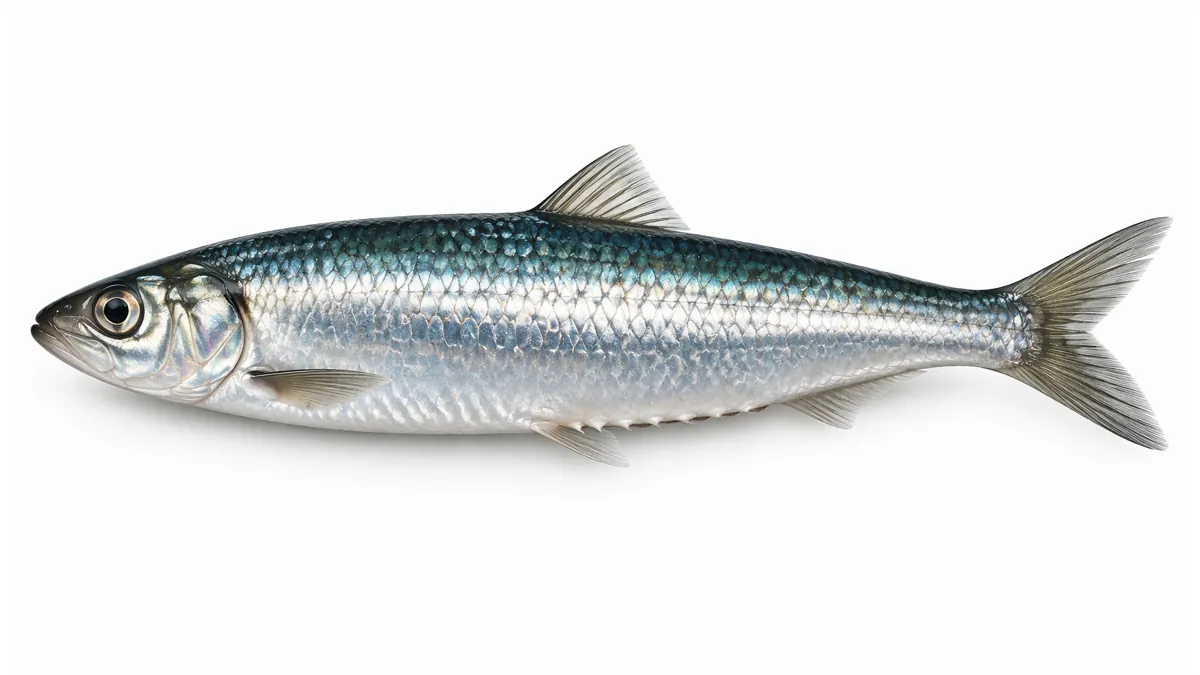
Atlantic herring identification comes down to a handful of clean features: a single short dorsal fin, a forked tail, no conspicuous lateral line, and a belly that feels like a zip fastener.
The body is slender and streamlined, built for swimming in a crowd. The back is blue-green or steel-blue, the flanks are bright silver, and the belly is white. The scales are large, thin, and shed easily; a herring handled roughly will leave a hand full of glitter. The dorsal fin sits near the middle of the back, well forward of the tail, and there is one short anal fin behind the vent. The tail is deeply forked.
Run a finger along the belly and you will feel a row of hard, keeled scales called scutes. That ridge is one of the best field marks for a clupeid and helps separate herring from small mackerel, which have a different body shape and a series of finlets near the tail. Herring have no barbel, no spines, and a mouth that is small and nearly toothless; they feed by filtering plankton through long gill rakers rather than by biting.
Juveniles can be confused with sprat and sardine. Sprat are smaller, with a shorter body and a more rounded belly; sardines have a different gill-cover pattern and a more subtropical range. In northern European waters, the safe rule is that a silver fish the length of a hand, with a single mid-body dorsal fin and a keeled belly, is almost certainly a herring.
Atlantic Herring vs Pacific Herring
Atlantic herring and Pacific herring (Clupea pallasii) are so similar that the Pacific fish was once treated as a subspecies of the Atlantic herring. They are now recognised as two species, and for anglers the separation is mostly about geography.
| Feature | Atlantic herring | Pacific herring |
|---|---|---|
| Range | North Atlantic, both sides | North Pacific, both sides |
| Maximum size | About 45 cm (18 in) | Slightly smaller on average |
| Body | Slender, keeled belly | Similar, often a little deeper |
| Spawning | Spring or autumn, depending on stock | Mostly spring |
| Fisheries | Huge European and Canadian quotas | Big North American and Asian fisheries |
If you catch a herring in Norway, Scotland, or New England, it is an Atlantic herring. If you catch one in Alaska, British Columbia, or Japan, it is a Pacific herring. The finer differences in vertebrae and body depth exist, but they are a job for a laboratory, not a fishing boat.
Is the Atlantic Herring Dangerous?
Atlantic herring are not venomous and have no spines that can hurt a person. The mouth is small, the teeth are tiny, and the fish is built to be eaten. Handling one is about as safe as handling a fish gets.
The genuine hazards around herring fishing are environmental. Herring shoals attract gulls, gannets, seals, and dolphins, and they also attract boats. When a shoal is up, several vessels may converge on the same patch of water, so keep a sharp lookout and give other boats room. In winter, herring fishing often means cold hands, wet decks, and short daylight; cold water is the thing most likely to hurt you.
Herring also spoil fast. The flesh is oily, and a fish left in a warm bucket turns soft within hours. Keep catches cool and clean, and if you plan to use herring as bait, treat the bait with the same care you would give your own dinner.
Where Do Atlantic Herring Live?
Atlantic herring habitat is the open water of the North Atlantic, from the surface down to about 360 m. On the western side, the range runs from Labrador and the Gulf of St. Lawrence down through the Canadian Maritimes and New England. On the eastern side, herring live from Greenland and Iceland through the Barents Sea, Norway, the North Sea, the Irish Sea, and the English Channel. The Baltic holds its own low-salinity form, the strömming, which is smaller and slower-growing.
Herring are pelagic, meaning they live in the water column rather than on the bottom. They gather in shoals that can be kilometres long and dense enough to show on a sonar screen as a solid block. Those shoals move with plankton, light, and temperature. In summer, herring often feed near the surface at night and sink during the day; in winter, they gather in deeper water before moving inshore to spawn.
Where do Atlantic herring live in relation to the coast? It depends on the stock. Some stocks spawn right against rocky shores and sea lochs, while others spawn on offshore banks such as the Dogger Bank in the North Sea. Adults may migrate hundreds of miles between feeding and spawning grounds, and the Norwegian spring-spawning stock is one of the great migrations of the ocean.
Water temperature shapes the map. Herring are a cold-water fish, and the big European stocks sit in water from about 4 to 13°C. Warming water has shifted some stocks north and deepened their summer distribution, which is one reason herring management is watched so closely.
Habits and Diet: What Do Atlantic Herring Eat?
What do Atlantic herring eat? Plankton, mostly. The diet is dominated by copepods, especially the fat-rich Calanus species, along with krill, amphipods, and the larvae of other fish. Herring are filter feeders with long gill rakers, and they strain these small animals from the water as they swim with their mouths open.
That diet explains the shoals. Where plankton concentrates, herring concentrate, and everything that eats herring follows. A feeding shoal is a moving buffet for cod, saithe, mackerel, tuna, seals, dolphins, and seabirds. Anglers who find working birds and breaking fish have usually found herring, or predators driving them up.
Feeding is tied to light. Herring feed most actively at night and in low light, when their plankton prey rises toward the surface. During the day they may hold deeper, out of reach of birds and surface lures. This vertical migration is one of the most reliable patterns in herring fishing: fish the dusk, the dawn, and the dark.
When do Atlantic herring spawn? It depends entirely on the stock group. Norwegian spring-spawning herring spawn from February to April along the Norwegian coast. North Sea autumn-spawning herring spawn from around September to October on shallow banks. Baltic herring spawn in spring and early summer in coastal waters. The eggs are sticky and sink to the bottom, where they attach to gravel, rock, and seaweed; a single female can produce tens of thousands of eggs.
Herring are short-lived compared with cod, but they can still reach 20 years or more. They mature early, spawn in vast numbers, and can rebuild quickly when conditions allow, which is why herring stocks have recovered from collapses that would have finished a slower-growing species.
Size, Records and Regulations
How big do Atlantic herring get? Most adults are 20 to 30 cm and weigh 100 to 400 g. A 35 cm herring is a good one, and the absolute maximum is around 45 cm and about 1 kg (2 lb). The Baltic strömming is usually under 20 cm.
Herring are not a record-oriented sport fish, and there is no meaningful recreational record culture around them. The numbers that matter are commercial: herring is one of the largest fisheries in Europe, and quotas are set every year through ICES advice and negotiations between coastal states. The Norwegian spring-spawning stock, the North Sea stock, and the Baltic stocks are all managed separately.
Recreational rules for herring are light in most of Europe. In many countries there is no minimum size and no closed season for rod-and-line herring, though local bye-laws can restrict gear, access, or sale of catch. Some areas protect spawning shoals, and some harbours ban fishing from the quay. Check with the local authority or harbour office before you fish, especially if you plan to take fish for bait or for the table. Last verified: November 2025.
If you want the official picture, start with ICES for stock status, then check the national agency: the Norwegian Directorate of Fisheries, the UK Marine Management Organisation (MMO) and Marine Scotland, or the relevant EU member state authority. Herring rules are less about size limits than about quotas and closed areas, and those change with the science.
The best bait for atlantic herring is a sabiki rig, a string of tiny flies or hooks fished on light line. A small piece of mackerel or squid on each hook helps, but the lures alone often work when a shoal is thick. Small spoons, metal jigs, and streamer flies also take herring, especially when fish are feeding near the surface at dusk.
How to catch atlantic herring: find the shoal, then keep it simple. Fish from a pier, a harbour wall, or a boat with a light rod, a small reel, and a sabiki or a single small lure. Drop the rig to the depth where fish are showing on the sonar or where birds are working, and jig gently. Herring have soft mouths, so a smooth lift beats a hard strike. At night, a light over the water draws plankton, plankton draws herring, and herring draw everything else.
FAQ
How big do Atlantic herring get? Most are 20–30 cm and 100–400 g. The maximum is about 45 cm and roughly 1 kg (2 lb).
Where do Atlantic herring live? Throughout the North Atlantic, from Labrador and New England to Iceland, Norway, the North Sea, and the Baltic. They are pelagic fish that form huge shoals.
What do Atlantic herring eat? Plankton, mainly copepods and krill, filtered through long gill rakers. They feed most actively at night and in low light.
Atlantic herring vs Pacific herring: how do you tell them apart? Mostly by range: Atlantic herring live in the North Atlantic, Pacific herring in the North Pacific. The two are closely related and very similar in appearance.
When do Atlantic herring spawn? It varies by stock. Norwegian spring-spawning herring spawn February–April; North Sea autumn spawners run September–October; Baltic herring spawn in spring and early summer.
What is the best bait for Atlantic herring? A sabiki rig with tiny flies or hooks, baited with a sliver of mackerel or squid. Small spoons and streamer flies also work.
How do you catch Atlantic herring? Find a shoal, fish light tackle with a sabiki or small lure, and jig gently. Dusk, dawn, and night are the best times.
Related Articles
- Atlantic Cod — the big predator that follows herring shoals.
- European Seabass — an inshore hunter that feeds on small fish.
- Turbot — a flatfish that shares the northern shelf.
- Zander — a freshwater predator with a similar low-light habit.
- All species profiles
Atlantic herring is proof that size is not the same as importance. A hand-length fish feeds the North Atlantic, fills the smoker, and gives light-tackle anglers a busy evening when the shoals move in. Find the birds, find the bait, and the herring will not be far away.
Ready to catch one? Read our step-by-step guide: How to Catch Atlantic Herring.
About the author and how this was tested
About the author
FishermanGuy
Bank, boat and kayak angler · fishing, crabbing and shrimping since 2021
I buy the gear, fish it for a season and write down what failed. No sponsored verdicts, no free-sample flattery. Every rig on this page has landed fish in water I can point at on a map.
How this was tested
- Every rig gets at least six trips on the same water before it is published.
- Gear is bought at retail. Free samples are labelled in the first paragraph.
- Dates show first publication and the last time the page was updated.