Field notes
Turbot: Identification, Habitat & Diet
Turbot: Identification, Habitat & Diet
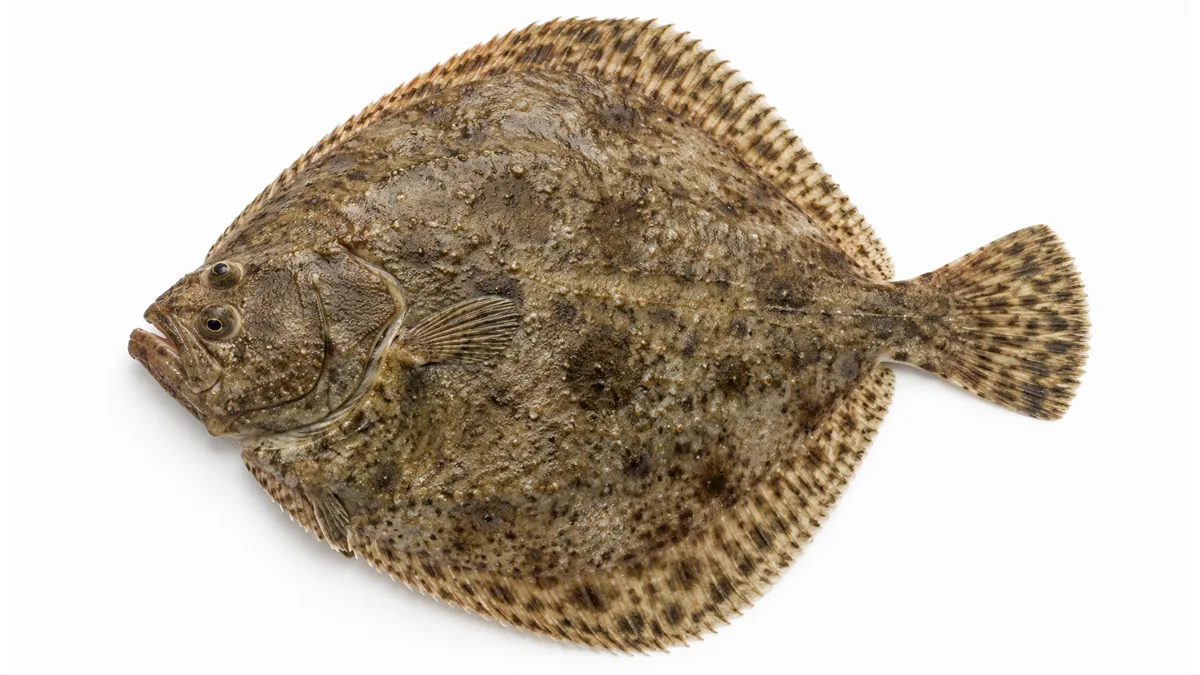
The turbot (Scophthalmus maximus) is the flatfish that chefs argue about and anglers dream about. Round as a dinner plate, studded with bony bumps, and camouflaged like a patch of seabed, it is one of the most valuable fish in European waters. It is also the species behind the Chinese farmed fish sold as duobao, and the fish that taught European farmers how to raise flatfish in tanks. This profile covers turbot identification, habitat, diet, size, records, how it differs from halibut and brill, and how to catch turbot.
Quick ID Card
| Field | Details |
|---|---|
| Scientific name | Scophthalmus maximus (also listed as Psetta maxima) |
| Common names | Turbot, European turbot, duobao (farmed market name) |
| Family | Scophthalmidae (turbots) |
| Typical size | 12–24 inches (30–60 cm); 2–9 lb (1–4 kg) |
| Maximum size | About 40 inches (100 cm) and 25 kg (55 lb) |
| Water type | Salt water, sand and gravel bottoms, estuaries for juveniles |
| Depth range | About 20–100 m, deeper in some areas |
| Active water temperature | Roughly 45–64°F (7–18°C) |
| Difficulty | Moderate; finding them is harder than hooking them |
| Best season | Late spring to autumn on the offshore banks |
How to Identify a Turbot
Turbot identification starts with the eyes. Both eyes sit on the left side of the head, which makes the turbot a left-eyed flatfish. The body is broad and almost circular, with a diamond outline, a narrow tail root, and a small tail fin. The eyed side is mottled in sand, brown, and grey, often with faint darker blotches that match the seabed.
The skin is the second clue. A turbot is not covered in ordinary scales. Instead, the eyed side is studded with small, hard, bony tubercles, like coarse sandpaper or tiny pebbles. Run a hand along the back and you will feel them. The blind side is smooth and pale.
The lateral line curves sharply over the pectoral fin before running to the tail. The dorsal and anal fins form a broad fringe around the body, and the pectoral fin on the eyed side is large and fan-shaped. Small turbot can be confused with brill, so check the skin: brill is smooth, without the tubercles.
A flatfish the size of a plate, with eyes on the left, a round body, and a sandpaper back, is almost certainly a turbot. The combination is hard to mistake once you have felt it.
Turbot vs Halibut (and Brill)
Turbot and halibut are both big, valuable flatfish, and both turn up in the same fishmongers, but they are very different animals.
| Feature | Turbot | Atlantic halibut |
|---|---|---|
| Eye side | Left-eyed | Right-eyed |
| Body shape | Round, diamond, broad | Long, tapered, more like a giant plaice |
| Skin | Bony tubercles on the eyed side | Smooth, small scales |
| Maximum size | About 1 m and 25 kg | Up to 2.5 m and 300 kg or more |
| Typical habitat | Sand and gravel, 20–100 m | Deeper, colder water, often 100–500 m |
| Range | Northeast Atlantic, Mediterranean, Black Sea | North Atlantic, both sides |
The other flatfish that gets mixed up with turbot is brill (Scophthalmus rhombus). Brill has the same left-eyed, round-bodied look, but its skin is smooth, its body is slightly more elongated, and it rarely grows as large. On the market, turbot is the more expensive fish, and the tubercles are the quickest way to check.
For anglers, the practical difference is size and power. A halibut is a much bigger fish with a much bigger fight, and it lives in deeper, colder water. A turbot is a compact, heavy fish that uses its broad body to resist being lifted off the bottom. Both are exceptional catches, but they are not the same target.
Is the Turbot Dangerous?
Turbot are not venomous, and they have no poisonous spines. The bony tubercles look fierce but do not inject anything; they are a texture, not a weapon. The teeth are small and conical, and a turbot is not going to take a finger.
The real hazards are the ones that come with offshore fishing. Turbot are usually caught from boats drifting over banks and reefs, often in a swell, often in cold weather. A rising tide, a wet deck, and a heavy lead swinging on a trace are a more realistic threat than the fish. Wear a life jacket, keep the deck clear, and handle the lead with care when the boat is moving.
Big turbot are strong. A 15-pound fish on light tackle can thump hard enough to bruise a wrist if you grab the trace instead of the fish. Use a net or a wet cloth, support the body, and never lift a heavy flatfish by the head alone. The gill covers are sharp enough to remind you.
Where Do Turbot Live?
Turbot habitat is the sandy and gravelly seabed of the northeast Atlantic, from Iceland and Norway down through the North Sea, the English Channel, and the Atlantic coast of France and Spain, into the Mediterranean and the Black Sea. The Baltic holds a population too, though the low salinity keeps those fish smaller.
They are found from shallow water out to about 100 m, with the biggest fish usually in deeper water and juveniles in the shallows and estuaries. Turbot like open ground: sand, gravel, and mixed bottoms where they can lie flat and ambush passing prey. They are less tied to reefs than cod, but they will use the edge of rough ground where sand meets rock.
Where do turbot live in relation to the tide? They are ambush predators, and they often sit on the down-current side of a bank or a rise, waiting for sandeels and small fish to be swept past. That is why successful turbot fishing is so often about drift lines and tide lanes rather than random spots.
Water temperature matters. Turbot are a cool-water fish, comfortable from about 7 to 18°C, and they move into shallower water in summer and out to deeper water in winter. In the southern North Sea and the Channel, the best fishing is often late spring through autumn, when fish are feeding hard on the banks.
Habits and Diet: What Do Turbot Eat?
What do turbot eat? Fish and crustaceans, taken from the seabed. Sandeels are a staple, along with gobies, small whiting, sprats, and other flatfish. Turbot also eat crabs, shrimp, and squid, and large fish will take a surprisingly big meal for their size.
The hunting method is ambush. A turbot lies flat, half-buried, and waits. When something edible comes close, it lifts and strikes with a sudden, wide mouth. That is why baits fished on the bottom, moving slowly with the tide, work so well: they imitate the sandeels and small fish that drift over the turbot's nose.
Turbot are solitary for much of the year. Smaller fish may gather on good feeding ground, but big fish tend to hold their own patch of seabed. They are not migratory in the way cod or herring are, though they do shift between shallow summer grounds and deeper winter water.
When do turbot spawn? Spawning takes place in late spring and summer, in deeper water, with pelagic eggs and larvae that drift with the current before settling to the bottom. The larvae are symmetrical at first and only later develop the flatfish shape, with one eye migrating around the head. That larval drift is one reason turbot populations are linked to specific currents and nursery areas.
Turbot grow slowly and live for decades. A 10-pound fish is not young, and a 20-pound fish is old. That slow growth is why the species is managed carefully and why big fish are worth releasing.
Size, Records and Regulations
How big do turbot get? Most rod-caught fish are 2 to 9 pounds, with a 15-pound turbot being a serious fish anywhere in Europe. The species can reach about 1 m and 25 kg (55 lb), according to FishBase, but fish of that size are exceptional.
The world record turbot on rod and reel is a fish in the region of 30 pounds (about 14 kg), taken in European waters, far below the 25 kg species maximum. Rod-and-reel records are always smaller than the biggest net-caught or commercial fish, and turbot is no exception.
Regulations vary across Europe. Under EU and UK rules, the minimum conservation reference size for turbot is generally 30 cm (about 12 inches) in the North Sea and many adjacent waters, but Baltic and other areas can differ. ICES assesses North Sea and Skagerrak turbot and sets advice on catches, and recreational rules, bag limits, and closed areas are set by national authorities.
As of 2025, check the current rules before you keep a turbot. In England, the Marine Management Organisation (MMO) and CEFAS publish sizes and closures; Marine Scotland covers Scottish waters; the relevant EU member state authority covers the rest. Turbot is a high-value fish, and illegal keeping is taken seriously. Last verified: November 2025.
The best bait for turbot is a big, fresh, smelly bait fished on the bottom: squid, sandeel, mackerel strip, or a cocktail of all three. A flowing trace with a long hooklength lets the bait move naturally in the tide. On the artificial side, heavy soft plastics and jigs dragged slowly across sand can work, especially when fish are actively feeding on sandeels.
How to catch turbot: drift the banks on a running tide with a bait that moves, keep the lead just heavy enough to hold bottom, and watch the rod tip for the soft, heavy take that is typical of a big flatfish. Give the fish time to turn and swallow the bait before striking. Big turbot often hook themselves against the weight of the lead, so a steady lift, not a hard swing, is usually the right answer.
Shore anglers catch turbot too, mostly at night from beaches and estuaries in the west of Europe. The fish are smaller on average, but a 5-pound turbot from the shore is a fine catch. Use a long rod, a running ledger, and a bait that stays put in the surf.
FAQ
How big do turbot get? Most are 2–9 pounds. A 15-pound fish is a trophy, and the species maximum is about 1 m and 25 kg (55 lb).
What is the world record turbot? The all-tackle rod-and-reel record is a fish of roughly 30 pounds (about 14 kg), caught in European waters.
Where do turbot live? On sand and gravel bottoms of the northeast Atlantic, from Iceland and Norway to the North Sea, Channel, France, Spain, the Mediterranean, and the Black Sea.
What do turbot eat? Sandeels, gobies, small whiting, sprats, crabs, shrimp, and squid. They are ambush predators that lie on the seabed.
Turbot vs halibut: how do you tell them apart? Turbot is left-eyed, round, and covered in bony tubercles; halibut is right-eyed, elongated, smooth, and grows far larger.
When do turbot spawn? In late spring and summer, in deeper water, with pelagic eggs and larvae that drift before settling.
What is the best bait for turbot? Fresh squid, sandeel, and mackerel strip on a flowing trace. Heavy soft plastics dragged on sand also work.
How do you catch turbot? Drift the sandbanks on a running tide with a moving bottom bait, give the fish time to take, and lift steadily rather than striking hard.
Related Articles
- Atlantic Cod — another heavy European bottom fish.
- Atlantic Herring — a forage fish that turbot and their prey depend on.
- European Seabass — an inshore predator of the same coasts.
- Zander — a freshwater ambush predator with a similar low-light approach.
- All species profiles
Turbot is a fish of patience and tide. Find the sandbanks, fish the drift, and use a bait that looks like a sandeel. The take is soft, the fight is heavy, and the reward is one of the best flatfish in Europe, whether it goes back or goes in the pan.
Ready to catch one? Read our step-by-step guide: How to Catch Turbot.
About the author and how this was tested
About the author
FishermanGuy
Bank, boat and kayak angler · fishing, crabbing and shrimping since 2021
I buy the gear, fish it for a season and write down what failed. No sponsored verdicts, no free-sample flattery. Every rig on this page has landed fish in water I can point at on a map.
How this was tested
- Every rig gets at least six trips on the same water before it is published.
- Gear is bought at retail. Free samples are labelled in the first paragraph.
- Dates show first publication and the last time the page was updated.