Field notes
Red King Crab: Identification, Habitat & Diet
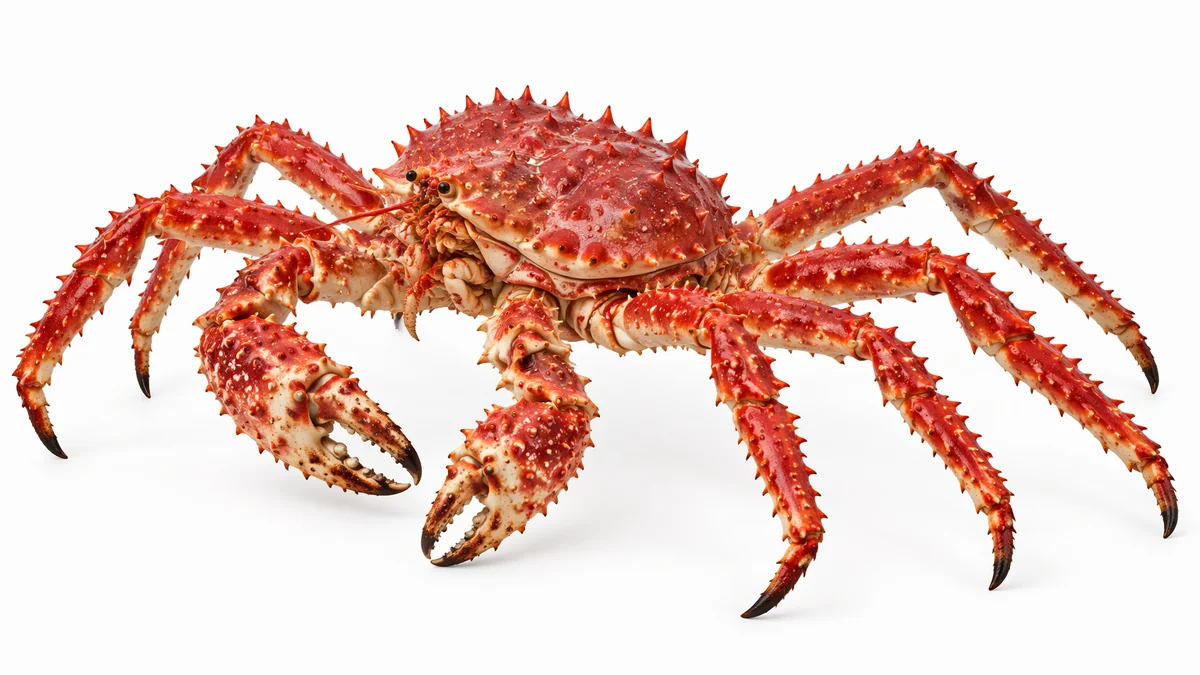
Red King Crab: Identification, Habitat & Diet
The red king crab (Paralithodes camtschaticus) is the celebrity crustacean of the North Pacific — a spiny, deep-red giant with a leg span that can rival a dinner table and a price tag to match. Despite the name, it is not a true crab: king crabs belong to the hermit-crab branch of the decapods, with a reduced, tucked-away abdomen. This profile covers red king crab identification, habitat, diet, size, the Alaska season and size limit, price, and how it differs from snow crab.
Quick ID Card
| Field | Details |
|---|---|
| Scientific name | Paralithodes camtschaticus |
| Common names | Red king crab, Alaskan king crab, Kamchatka crab |
| Family | Lithodidae (king crabs) |
| Typical size | 3–8 kg (7–18 lb); leg span to about 1.5 m (5 ft) |
| Maximum size | Record animals around 12 kg (26 lb) |
| Water type | Cold, deep North Pacific and Barents Sea |
| Depth range | About 30–1,000 ft (10–300 m), deeper in places |
| Active water temperature | Roughly 32–50°F (0–10°C) |
| Difficulty | Commercial pot fishery; recreational access limited |
| Best season | Autumn through winter in Alaska |
How to Identify a Red King Crab
Red king crab identification begins with the armour. The carapace is roughly heart-shaped and covered in short, sharp spines, and the whole animal runs from deep brick-red to orange-red. Big adults have a leg span of several feet, with long, stout walking legs and one pair of heavy claws at the front.
The body plan is the giveaway. A king crab shows three pairs of walking legs and one pair of clawed arms — ten appendages in all, but arranged differently from a true crab, and the abdomen is folded underneath and covered with plates rather than a broad flap. The spinier, longer-legged look separates it at a glance from the rounded, short-legged Dungeness.
Colour alone is not enough, because several king crabs share it. Blue king crab is darker and more chocolate-brown; golden king crab is smaller, with longer, thinner legs and a golden-orange shell. A red king crab's combination of size, deep red colour, short stout legs, and spiny heart-shaped carapace is diagnostic.
Red King Crab vs Snow Crab and Other Relatives
Red king crab vs snow crab is the most common comparison on seafood menus, and the difference is obvious once you see both. A red king crab is far larger, with thick, heavy legs and big claws and a leg span up to 1.5 m. A snow crab (Chionoecetes opilio) is much smaller, with a rounder, flatter carapace, long slender legs, and a smaller body — the legs are the point, which is why snow crab is sold as clusters of thin legs. King crab legs are meaty and chunky; snow crab legs are slim and delicate.
Among king crabs, the blue king crab (Paralithodes platypus) is a close relative from the Bering Sea and is managed separately. The golden king crab (Lithodes aequispinus) is smaller and lives deeper. In the Barents Sea, the introduced red king crab is fished by Norway and Russia and is the same species as the Alaskan crab, just a different population.
Is the Red King Crab Dangerous?
The red king crab has no venom and no poison glands, and the cold-water species is not associated with ciguatera, the warm-water reef-fish toxin. The danger is mechanical and immediate. A large king crab's claws are powerful enough to crush fingers, and its spiny carapace can draw blood. Handle it from behind, gripping the rear of the shell, and keep hands clear of the claws; a heavy glove and a chilled crab make the job safer.
The spines are the second hazard on deck, especially on a moving boat. King crab legs are also armed with rows of sharp spines, so lift and move them with care. On a commercial boat the work itself is among the most dangerous in fishing — heavy pots, icy decks, and brutal weather — which is the real reason the Bering Sea fishery earned its reputation.
For consumers, the safety advice is simple: buy from a reputable source and cook thoroughly. King crab is almost always sold pre-cooked and frozen, and reheating it properly is all that is required.
Where Do Red King Crabs Live?
Where do red king crabs live? Across the cold North Pacific: the Bering Sea, the Gulf of Alaska, the Sea of Okhotsk, and the northern Sea of Japan. They also occur in the Russian Far East and, after a deliberate introduction in the 1960s, in the Barents Sea off Norway and Russia, where they have spread west.
Red king crabs prefer cold, deep water, roughly 30 to 1,000 feet, over mud, sand, and mixed bottom. They migrate with the seasons and with moulting and mating, moving into shallower water in spring and deeper in winter. In Alaska, the great concentrations are in Bristol Bay and around the Aleutian Islands, which is where the commercial fishery is concentrated.
Water temperature is the master variable. The species needs cold water, and its populations rise and fall with shifts in the Bering Sea ecosystem. Warm years and changing ocean conditions have been linked to poor recruitment and to the closures that have hit the fishery hard in recent years, which is why the Alaska season is watched so closely.
Habits and Diet: What Do Red King Crabs Eat?
What do red king crabs eat? A broad, bottom-living diet: sea stars, sea urchins, clams, mussels, barnacles, worms, small fish, and carrion. They are opportunistic predators and scavengers, and they will gather around a food source in numbers. Big crabs crush shells with their claws and pick out the meat.
Red king crabs often form dense aggregations, sometimes piling into "pods" that move across the bottom, especially when young. Adults migrate seasonally, moving inshore to moult and mate and offshore to feed and overwinter. Growth is by moulting, and a crab may take several years and many moults to reach legal size.
Females carry their eggs under the abdomen for roughly a year before the larvae hatch. The larvae drift as plankton for weeks before settling, a life stage that is highly sensitive to temperature and food. That long, fragile early life is the reason king crab stocks can crash quickly and recover slowly, and why managers guard the spawning stock so carefully.
Size, Limits and Regulations
How big do red king crabs get? Adults commonly weigh 3 to 8 kg (7–18 lb), and the leg span of a big male can reach about 1.5 m (5 ft). The largest red king crabs on record are around 12 kg (26 lb). Lifespan is roughly 20 to 30 years.
The red king crab size limit in Alaska is 6.5 inches (165 mm) carapace length, measured on males only. Females are protected and must be released, and the legal catch is male crab above the minimum size. This male-only, minimum-size system is the same principle used for Dungeness, scaled up to a much bigger and slower-growing animal.
The red king crab season in Alaska is set by the Alaska Department of Fish and Game (ADF&G). The Bristol Bay red king crab fishery traditionally opens around October 15 and runs through the winter, but the stock has been through severe closures: the fishery was shut in 2021 and 2022 after a collapse in mature male abundance, and it reopened in 2023 under a much-reduced quota. As of 2025, the season and quota are announced year by year and can be closed again if the stock does not improve. Check ADF&G's current announcement before planning anything.
The commercial fishery is managed under an individual fishing quota (IFQ) system with pot limits, and most red king crab reaches the market through that route. Recreational harvest exists in some Alaska areas but is tightly restricted by gear, bag, and area rules and requires a licence. In the Barents Sea, Norway and Russia manage the introduced stock jointly, and Norway sets its own recreational and commercial rules.
As of 2025, verify all rules with ADF&G for Alaska and with the Norwegian Directorate of Fisheries for the Barents Sea. Seasons, quotas, size limits, and gear rules change yearly. Last verified: November 2025.
How to catch red king crab: in practice, this is a commercial pot fishery. Specialised king crab pots are set on the bottom and baited with fish such as herring or cod, then hauled after a soak. Recreational anglers rarely target red king crab because the stocks are managed for commercial harvest and access is limited; where it is allowed, a licence, pot limits, and strict size and sex rules apply.
On the red king crab price: it is one of the most expensive crabs in the world. Legs and clusters commonly sell for tens of dollars per pound, and prices move with quota, season, and the cost of the fishery. Smaller quotas in recent years have kept prices high. Expect premium pricing for premium size.
FAQ
How big do red king crabs get? Adults are usually 3–8 kg (7–18 lb) with a leg span up to 1.5 m. Record animals reach about 12 kg (26 lb).
What is the red king crab size limit? 6.5 inches (165 mm) carapace length in Alaska, males only. Females must be released.
When is the red king crab season in Alaska? Traditionally from about October 15 in Bristol Bay, but the fishery has been closed and reopened with reduced quotas in recent years. Check ADF&G's current announcement.
Where do red king crabs live? The Bering Sea, Gulf of Alaska, Sea of Okhotsk, and northern Sea of Japan, plus the introduced Barents Sea population. They prefer cold water 30–1,000 feet deep.
Red king crab vs snow crab: what is the difference? Red king crab is much larger, with thick, meaty legs and big claws and a leg span to 1.5 m. Snow crab is smaller, with a rounder body and long, slender legs sold as clusters.
What do red king crabs eat? Sea stars, sea urchins, clams, mussels, worms, small fish, and carrion. They are predators and scavengers.
How do you catch red king crab? Mostly with commercial pots on the bottom. Recreational access is limited, and where allowed requires a licence and strict size, sex, and gear rules.
Why is red king crab so expensive? It is large, slow-growing, and tightly quota-managed, and recent stock closures cut supply. Legs and clusters command premium prices per pound.
Related Articles
- Snow Crab — the smaller, long-legged cold-water crab it is often compared with.
- Dungeness Crab — a Pacific coast crab with a similar male-only, minimum-size system.
- Brown Crab — Europe's heavyweight edible crab.
- Atlantic Cod — a Bering and North Atlantic neighbour in the cold-water fishery.
- Whiting — a cold-water fish from the same northern seas.
- All species profiles
The red king crab is a cold-water giant with a fragile future: magnificent to look at, superb to eat, and expensive for good reason. Learn the spiny heart-shaped shell and the deep-red colour, respect the 6.5-inch male-only rule, and follow the ADF&G season announcements, which can change the whole fishery overnight. Treated as the slow-growing, long-lived animal it is, the king crab remains the crown jewel of the northern seas.
Ready to catch one? Read our step-by-step guide: How to Catch Red King Crab.
About the author and how this was tested
About the author
FishermanGuy
Bank, boat and kayak angler · fishing, crabbing and shrimping since 2021
I buy the gear, fish it for a season and write down what failed. No sponsored verdicts, no free-sample flattery. Every rig on this page has landed fish in water I can point at on a map.
How this was tested
- Every rig gets at least six trips on the same water before it is published.
- Gear is bought at retail. Free samples are labelled in the first paragraph.
- Dates show first publication and the last time the page was updated.