Field notes
Whiting: Identification, Habitat & Diet
Whiting: Identification, Habitat & Diet
The whiting (Merlangius merlangus) is one of the most abundant fish in the seas around Britain and northern Europe, and one of the easiest to catch. A slim, silver, cod-shaped fish with three dorsal fins and no chin barbel, it comes aboard charter boats in numbers, fills the fishmonger's slab, and ends up in some of the fish and chips eaten across the continent. Plenty of anglers dismiss the whiting as a nuisance, but it is a willing, sporting fish and a fine eating fish in its own right. This profile covers whiting identification, habitat, what whiting eat, how big they get, how they differ from cod, and how to catch them.
Quick ID Card
| Field | Details |
|---|---|
| Scientific name | Merlangius merlangus |
| Common names | Whiting, merling, silver whiting |
| Family | Gadidae (cods and haddocks) |
| Typical size | 10–14 in (25–36 cm); 6 oz–1 lb (170–450 g) |
| Trophy size | 18 in (45 cm) and 2 lb (0.9 kg) plus |
| Water type | Sea; open coast, sandbanks, reefs, wrecks, estuaries |
| Depth range | About 10–100 m, occasionally deeper |
| Active water temperature | Roughly 43–61°F (6–16°C) |
| Best season | Autumn and winter; young fish inshore in summer |
| Difficulty | Easy; abundant and willing |
How to Identify a Whiting
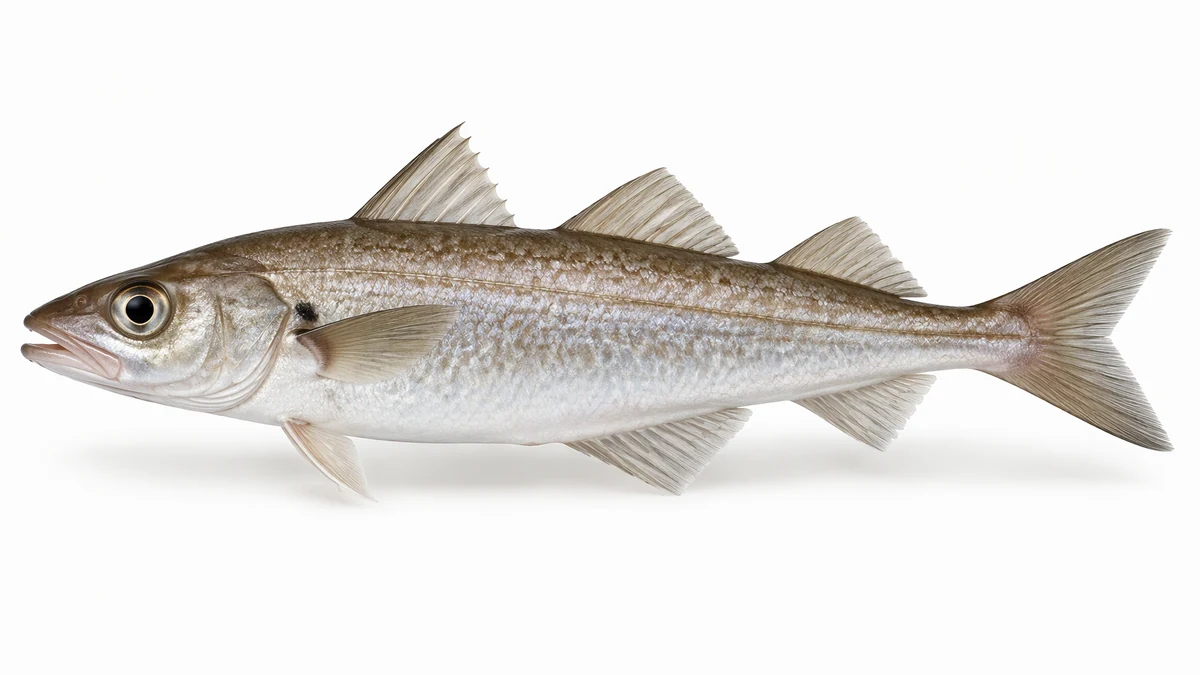
Whiting identification is mostly about the head and the fins. The fish is slender and elegant next to a cod, with a pointed snout and a small mouth. The back is pale brownish-grey to sandy, the flanks are silvery-white, and the belly is white. A faint lateral line curves gently along the flank.
The fins are the cod family's signature. A whiting has three separate dorsal fins along the back and two anal fins underneath, all soft-rayed. The tail is only slightly forked or almost square. Look for a small dark spot at the base of the pectoral fin, a useful mark that helps separate whiting from its cousins.
The single most useful test is the chin. A whiting has no barbel under the lower jaw. A cod has a distinct barbel, a haddock has a small one, but a whiting has none. Combined with the slim silver body, the pointed snout, and the dark spot at the pectoral base, the missing barbel makes whiting one of the easier sea fish to identify.
Whiting vs Cod
Whiting and cod (Gadus morhua) share the three dorsal fins and two anal fins of the cod family, so beginners often confuse them. The differences are reliable once you know them.
| Feature | Whiting | Cod |
|---|---|---|
| Chin barbel | None | Prominent barbel |
| Body shape | Slim, silver, pointed snout | Heavy, deep-bodied, blunt snout |
| Pectoral base | Small dark spot | No dark spot |
| Lateral line | Pale, gently curved | Pale, distinct curve over the pectoral |
| Typical size | 25–36 cm, under 1 lb | Much larger, commonly 2–10 kg |
| Colour | Silvery, pale brown back | Olive to brown, mottled |
The barbel is the fastest test. If there is a whisker under the chin, it is a cod or a haddock, not a whiting. Haddock also has a small barbel and a dark blotch behind the pectoral fin, sometimes called a "thumbprint", and a black lateral line, which a whiting lacks. Pollack and coalfish are other cod-family fish that turn up on the same grounds, but both are bulkier and darker than the slim, silver whiting.
Is Whiting Dangerous?
Whiting are not venomous and have no sting. The hazards are the ordinary ones of handling a lively sea fish.
The gill covers are thin and sharp, and a whiting flapping on deck can rake a finger. The small teeth are not dangerous but can nip. Hold the fish across the back, behind the head, or use a damp cloth, and unhook with forceps or a disgorger. Whiting are slimy, so a firm, dry grip on the body is safer than grabbing the line.
The bigger risks come from the setting, not the fish. Boat fishing means moving decks, wet surfaces, and heavy leads swinging on the swell, so keep your footing and watch the rod tip when a neighbour winds up. On piers and beaches, watch for waves and slippery weed. Whiting are also delicate and die quickly out of water, so if you are not keeping fish, unhook them fast and return them promptly.
Where Do Whiting Live?
Whiting habitat is cool coastal sea water over sand, gravel, and mud. The species is widespread in the north-east Atlantic, from Iceland and Norway south to Portugal, and it is common throughout the North Sea, the English Channel, the Irish Sea, and the western Baltic. It is one of the most numerous commercial fish in these waters.
Where do whiting live in the water column? Mostly near the seabed, but they rise well off the bottom to feed, especially at night and around baitfish shoals. Adults favour depths from about 10 to 100 m, over open ground such as sandbanks and mixed seabeds, and around reefs and wrecks. Young whiting are found much closer to shore, in shallow water and estuaries, often in large shoals.
Season matters. In many areas, big whiting move into shallower coastal water in autumn and winter and are caught in numbers from boats and piers. Through summer, the largest fish often sit in deeper water, while small "pin whiting" swarm the inshore marks. Cold water suits them; whiting are most active in the cooler months and are a staple of winter boat fishing.
Habits and Diet: What Do Whiting Eat?
What do whiting eat? Whiting are active predators of small prey. Their diet is dominated by small fish such as sprat, sandeel, young herring, and Norway pout, along with shrimp, amphipods, small crabs, worms, and squid. They feed throughout the water column, hunting shoals of baitfish as well as grubbing near the bottom, which is why they take both baited hooks and lures.
Whiting are social fish that gather in shoals, especially when young. Those shoals can be enormous, and where one whiting is caught there are usually many more, which makes them a reliable catch on busy charter trips. They are fast, greedy feeders, and they are not shy of a bait, which is part of why they are so easy to catch.
When do whiting spawn? Spawning takes place mainly in late winter and spring, roughly February to June depending on the region, often in deeper water. The eggs are pelagic, drifting in the plankton, and the larvae settle into coastal nursery areas as they grow. Whiting are relatively short-lived and fast-growing compared with cod, which is one reason their stocks can recover more quickly from heavy fishing pressure.
Size, Records and Regulations
How big do whiting get? Most whiting caught by anglers run 25 to 36 cm and 170 to 450 g. A 40 cm fish is a good one, and anything over 45 cm or 2 lb (0.9 kg) is a fine specimen. The species can reach around 70 cm and a few kilograms in exceptional cases, though such fish are rare.
The world record whiting is modest by cod standards. Rod-caught records sit in the low 2 kg range (roughly 4–5 lb), and the largest fish are usually taken from deep water or northern grounds. Exact record weights vary by national list, so check the current record rather than relying on memory.
Regulations are set through the EU and UK systems and vary by sea area. Minimum conservation reference sizes apply to whiting, and the limit is typically around 27 cm in the North Sea, but it differs between regions, so check the rule for the water you fish. The International Council for the Exploration of the Sea (ICES) assesses whiting stocks and advises on catch levels, and in the UK the Marine Management Organisation and CEFAS, together with the devolved fisheries bodies, set and monitor the rules. Charter boats often impose their own bag limits or release practices on top of the legal minimum.
As of 2025, recreational and commercial rules for whiting are subject to change as stocks are reassessed. Check the current size limits and any bag limits for your area before you keep fish. Last verified: November 2025.
How to Catch Whiting
The best bait for whiting is a strip of squid, a lugworm, a ragworm, a strip of mackerel, or a whole sandeel. Whiting are greedy and not fussy, and a cocktail bait on a small hook picks up fish quickly. From a boat, a paternoster or flowing-trace rig with a size 1 to 2/0 hook and a light lead is the standard approach, and feathers or lures worked near the bottom also take plenty of fish.
How to catch whiting: find the shoals and keep the bait in the strike zone. From a charter boat, drop to the seabed and lift the bait a turn or two off the bottom, then wait for the tap. Whiting bites are often quick, so be ready to strike. On a productive mark, expect a fish on nearly every drop, which makes whiting an ideal species for beginners and for filling the cooler.
From the shore, whiting are caught from piers, breakwaters, and beaches after dark in autumn and winter, often on small baits fished close in. A light rod, a simple running ledger, and a strip of squid will find them. Handle fish quickly, return undersized or unwanted fish carefully, and keep only what you will eat. Whiting are a superb eating fish, with soft white flesh that suits frying, grilling, and, of course, fish and chips.
FAQ
How big do whiting get? Most are 25–36 cm and under about 1 lb (450 g). A 45 cm or 2 lb fish is a specimen, and the largest reach around 70 cm.
What is the world record whiting? Rod-caught records sit in the low 2 kg range, roughly 4–5 lb. Check your national list for the exact figure.
Where do whiting live? In cool coastal water of the north-east Atlantic, North Sea, English Channel, and Irish Sea, over sand, gravel, and mud from about 10 to 100 m, with young fish inshore.
What do whiting eat? Small fish such as sprat, sandeel, and young herring, plus shrimp, small crabs, worms, and squid.
Whiting vs cod: how do you tell them apart? A whiting has no chin barbel, a slim silver body, a pointed snout, and a dark spot at the pectoral base. A cod has a barbel and a heavier, mottled body.
When do whiting spawn? Mainly late winter and spring, roughly February to June, often in deeper water, with pelagic eggs.
What is the best bait for whiting? Squid strips, lugworm, ragworm, mackerel strip, or sandeel on a small hook.
How do you catch whiting? Drop a baited paternoster to the seabed from a boat, lift it just off the bottom, and strike the quick bites. From shore, fish piers and beaches after dark.
Related Articles
- Plaice — another North Sea favourite, a flatfish that shares the same sandy grounds.
- All species profiles
The whiting is the dependable fish of northern European waters: silver, slim, and almost always willing. Learn the missing barbel and the three dorsal fins, drop a squid bait to the sand, and you will have fish on the deck all winter.
Ready to catch one? Read our step-by-step guide: How to Catch Whiting.
About the author and how this was tested
About the author
FishermanGuy
Bank, boat and kayak angler · fishing, crabbing and shrimping since 2021
I buy the gear, fish it for a season and write down what failed. No sponsored verdicts, no free-sample flattery. Every rig on this page has landed fish in water I can point at on a map.
How this was tested
- Every rig gets at least six trips on the same water before it is published.
- Gear is bought at retail. Free samples are labelled in the first paragraph.
- Dates show first publication and the last time the page was updated.