Field notes
Plaice: Identification, Habitat & Diet
Plaice: Identification, Habitat & Diet
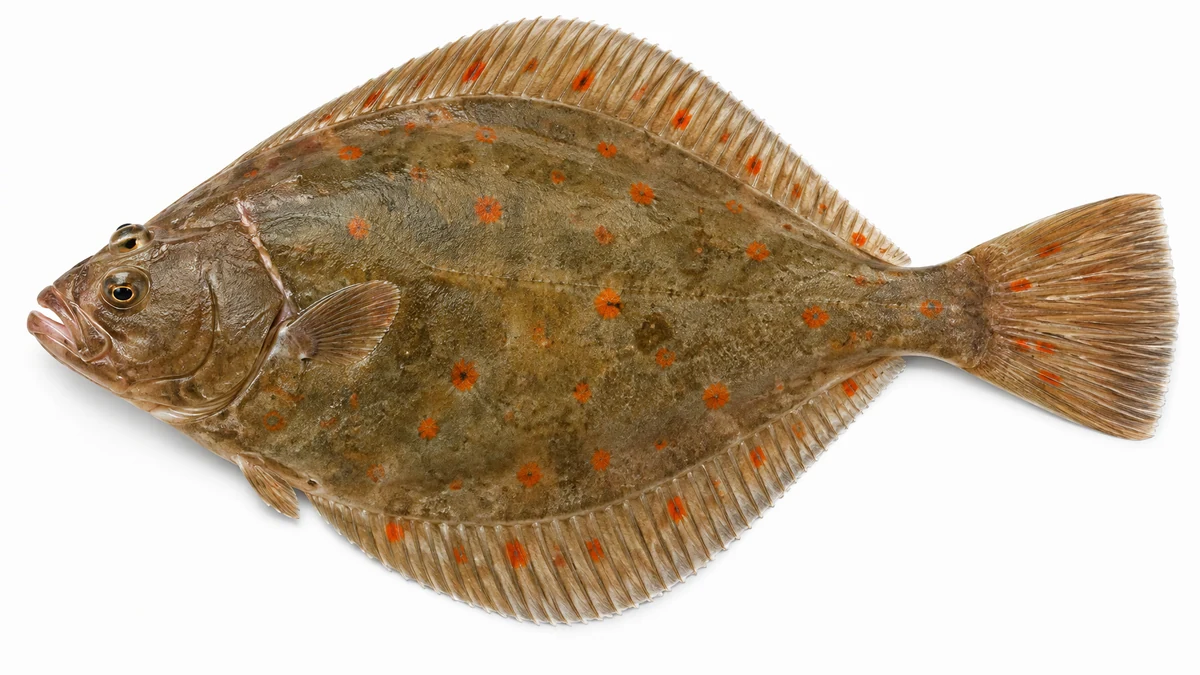
The plaice (Pleuronectes platessa) is the flatfish most British and northern European anglers picture first: a broad, oval fish lying on the seabed with both eyes on one side, its back scattered with bright orange spots. It is one of the best-eating fish in European waters, a staple of the fishmonger's slab, and a favourite target from beaches, piers, and charter boats. This profile covers plaice identification, habitat, what plaice eat, how big they get, how they differ from flounder, and how to catch them.
Quick ID Card
| Field | Details |
|---|---|
| Scientific name | Pleuronectes platessa |
| Common names | Plaice, European plaice |
| Family | Pleuronectidae (righteye flounders) |
| Typical size | 10–18 in (25–45 cm); 1–3 lb (0.5–1.5 kg) |
| Trophy size | 22 in (55 cm) and 4 lb (1.8 kg) plus |
| Water type | Sea; sandy and mixed seabeds, estuaries to open coast |
| Depth range | Shallow water to about 100 m, deeper offshore in winter |
| Active water temperature | Roughly 41–59°F (5–15°C) |
| Best season | Late winter to spring, and autumn |
| Difficulty | Moderate; find the right ground and bait |
How to Identify a Plaice
Plaice identification rests on three things: the eyes, the spots, and the skin. Like all righteye flounders, a plaice carries both eyes on the right side of its head and lies on the seabed with its blind left side down. The eyed side is olive-brown to greenish-grey, and it is covered in bright orange to red spots. Those spots are the field mark most people remember, and they are usually easy to see on a freshly caught fish.
The body is a broad oval, almost diamond-shaped, with a small mouth and a slightly protruding lower jaw. The skin is smooth and slippery, without visible scales, which is a key difference from a flounder. The lateral line runs nearly straight along the flank with only a gentle curve above the pectoral fin, and behind the upper eye there is a row of four to seven bony lumps or tubercles along the head ridge. Those bony knobs are a genuine plaice feature, though they are easier to feel than to see.
When a flatfish settles on the seabed, it can change the shade of its upper surface to match the ground, so a plaice on sand looks paler than one on gravel or mud. The orange spots, however, stay.
Plaice vs Flounder
Plaice and flounder are the two flatfish that confuse anglers most, and the difference matters because the rules and the table quality differ too. Both are right-eyed flatfish that lie on the seabed, but they are easy to tell apart if you look at the skin and the spots.
| Feature | Plaice | Flounder |
|---|---|---|
| Upper skin | Smooth, slime-covered | Rough, with small scales and tubercles |
| Orange spots | Usually present, bright | Absent or very faint |
| Colour | Olive-brown with orange spots | Dull brown to grey, sometimes mottled |
| Bony ridge behind eyes | A row of knobs behind the upper eye | Few or none |
| Lateral line | Nearly straight, gentle curve | Sharply curved above the pectoral |
| Salinity | More marine | Tolerates low salinity, common in estuaries |
The smooth-skin test is the quickest. Run a finger along the back: a plaice feels smooth and soapy, a flounder feels rough like sandpaper. Then look for the orange spots. A smooth flatfish with orange spots is a plaice; a rough fish without them is a flounder. Plaice are also generally more marine, while flounder push far up estuaries into brackish and even fresh water.
Dab are another small flatfish that turn up on the same grounds. They have rough skin, a sharply curved lateral line, and no orange spots, and they rarely grow large. If it is small, rough, and spotless, it is a dab.
Is Plaice Dangerous?
Plaice are not venomous and have no sting. They are among the gentler fish you will handle, but a few points are worth knowing.
The gill covers are thin and can be sharp, and a flatfish flapping on deck can catch a finger. The bony tubercles behind the head are hard and can jab. Hold the fish flat with a hand across the back, or grip the body firmly with a damp cloth, and keep fingers away from the gill slits. Flatfish also carry a lot of slime, which makes them slippery; a wet cloth or a towel helps.
On the shore, the risks are the setting rather than the fish. Beaches and rocks are slippery, tides move fast, and a rising sea can cut off a mark. On boats, watch the swinging lead and the moving deck. Plaice are hardy compared with some fish, but they still deserve quick, careful handling; unhook them over a wet surface and return unwanted fish promptly.
Where Do Plaice Live?
Plaice habitat is sandy and mixed seabed in cool coastal water. The species is widespread in the north-east Atlantic, from Iceland and Norway south to Portugal, and it is common throughout the North Sea, the English Channel, the Irish Sea, and the western Baltic. It is one of the most important commercial flatfish in these waters.
Where do plaice live in the sea? Adults favour sandy and gravelly ground from the shallows out to about 100 m, and they often gather on sandbanks and in areas rich in shellfish and worms. In winter, big plaice move offshore into deeper water to spawn. In spring and summer, they spread back into shallower water, and young plaice settle in very shallow sandy nurseries, including surf beaches and estuaries, where they grow before moving out.
Plaice are famous for their migrations. Tagging studies have shown that some fish travel long distances between feeding and spawning grounds, and adults can return to the same areas year after year. For anglers, the practical point is seasonal: plaice show up on the beaches and shallow banks in spring and autumn, and the biggest fish are often caught in late winter and early spring as they gather before spawning.
Habits and Diet: What Do Plaice Eat?
What do plaice eat? Plaice are bottom-feeders that prey on the animals living in and on the seabed. Their diet is dominated by bivalves such as cockles and mussels, polychaete worms including ragworm and lugworm, and small crustaceans such as shrimp and amphipods. Larger plaice also take small fish. Young plaice eat mainly small crustaceans and worms.
Plaice feed by day and night, grubbing through the sediment and picking prey from the surface of the sand. Their small mouth is built for nibbling shellfish and worms rather than chasing fish, which is why shellfish and worm baits work so well. They are ambush-avoiders as much as predators: lying flat and camouflaged is their defence, and their spotted back breaks up their outline on the seabed.
When do plaice spawn? Spawning happens in winter and early spring, roughly January to April, in deeper water offshore. Females release large numbers of pelagic eggs, and the larvae drift with the currents before settling into shallow sandy nurseries. As the young grow, they undergo the remarkable flatfish transformation: one eye migrates around the head so that both eyes end up on the right side, and the fish settles onto the seabed for life.
Size, Records and Regulations
How big do plaice get? Most plaice caught by anglers run 25 to 45 cm and 0.5 to 1.5 kg. A 50 cm fish is a good one, and anything over 55 cm or 4 lb (1.8 kg) is a fine specimen. Big females can reach around 60 to 70 cm and 3 kg or more, though such fish are uncommon.
The world record plaice sits in the low-to-mid 4 kg range, roughly 9 to 10 lb, and record fish come from the richer northern and offshore grounds. National records differ, so check the current figure for your country rather than trusting a single number.
Regulations are set through the EU and UK systems and vary by sea area. Minimum conservation reference sizes apply to plaice, typically around 27 cm in the North Sea, but the limit differs between regions and can change with stock assessments, so check the rule for the water you fish. The International Council for the Exploration of the Sea (ICES) assesses plaice stocks and advises on catches, and in the UK the Marine Management Organisation, CEFAS, and the devolved fisheries bodies set and enforce the rules. Charter skippers and beach angling clubs often add their own size limits or release practices.
As of 2025, plaice rules and stock advice are reviewed regularly, so confirm the current size and bag limits before you keep fish. Last verified: November 2025.
How to Catch Plaice
The best bait for plaice is fresh worm and shellfish. Ragworm, lugworm, peeler crab, mussel, and squid strips all work, and a cocktail of worm and shellfish is a classic. Plaice have small mouths, so use a small hook and a bait that sits neatly on it rather than a huge lump.
From a boat, fish a running ledger or a paternoster rig over sandbanks and mixed ground, and keep the bait on or just above the seabed. From the shore, cast onto sandy beaches and into the gullies between banks, and let the bait roll with the tide. Plaice often feed best when the sea is stirred up by a bit of weather, and night tides can be productive.
How to catch plaice: find the right ground, use fresh bait, and fish it slow along the bottom. Plaice bites can be gentle, so watch the rod tip and strike when the line draws away steadily. On a good bank, a moving tide and a ragworm bait will find fish. Handle each plaice carefully and measure it against the local limit; undersized fish go straight back. Kept fish should be dispatched quickly and cooled, because plaice is one of the finest flatfish on the table, with firm white flesh that holds together in the pan.
FAQ
How big do plaice get? Most are 25–45 cm and 0.5–1.5 kg. A 55 cm or 4 lb fish is a specimen, and big females can reach 60–70 cm and 3 kg or more.
What is the world record plaice? Records sit in the low-to-mid 4 kg range, roughly 9–10 lb. Check your national record for the exact figure.
Where do plaice live? In cool coastal water of the north-east Atlantic and North Sea, over sand and mixed ground from the shallows to about 100 m, moving offshore to spawn in winter.
What do plaice eat? Bivalves, worms, small crustaceans, and small fish, taken from the seabed.
Plaice vs flounder: how do you tell them apart? A plaice has smooth skin and bright orange spots; a flounder has rough skin and no spots. Plaice are also more marine.
When do plaice spawn? In winter and early spring, roughly January to April, in deeper offshore water.
What is the best bait for plaice? Ragworm, lugworm, peeler crab, mussel, and squid, fished on a small hook near the seabed.
How do you catch plaice? Fish sandy and mixed ground from a boat or beach with fresh worm or shellfish bait, keep it on the bottom, and strike the steady bites.
Related Articles
- Whiting — a slim, silver cod-family fish that shares the same sandy North Sea grounds.
- All species profiles
The plaice is the flatfish that rewards local knowledge: the right bank, the right tide, and a fresh worm bait. Learn the smooth skin and the orange spots, fish the sand in spring and autumn, and you will take one of the best-eating fish in European waters.
Ready to catch one? Read our step-by-step guide: How to Catch Plaice.
About the author and how this was tested
About the author
FishermanGuy
Bank, boat and kayak angler · fishing, crabbing and shrimping since 2021
I buy the gear, fish it for a season and write down what failed. No sponsored verdicts, no free-sample flattery. Every rig on this page has landed fish in water I can point at on a map.
How this was tested
- Every rig gets at least six trips on the same water before it is published.
- Gear is bought at retail. Free samples are labelled in the first paragraph.
- Dates show first publication and the last time the page was updated.