Field notes
Mackerel: Identification, Habitat & Diet
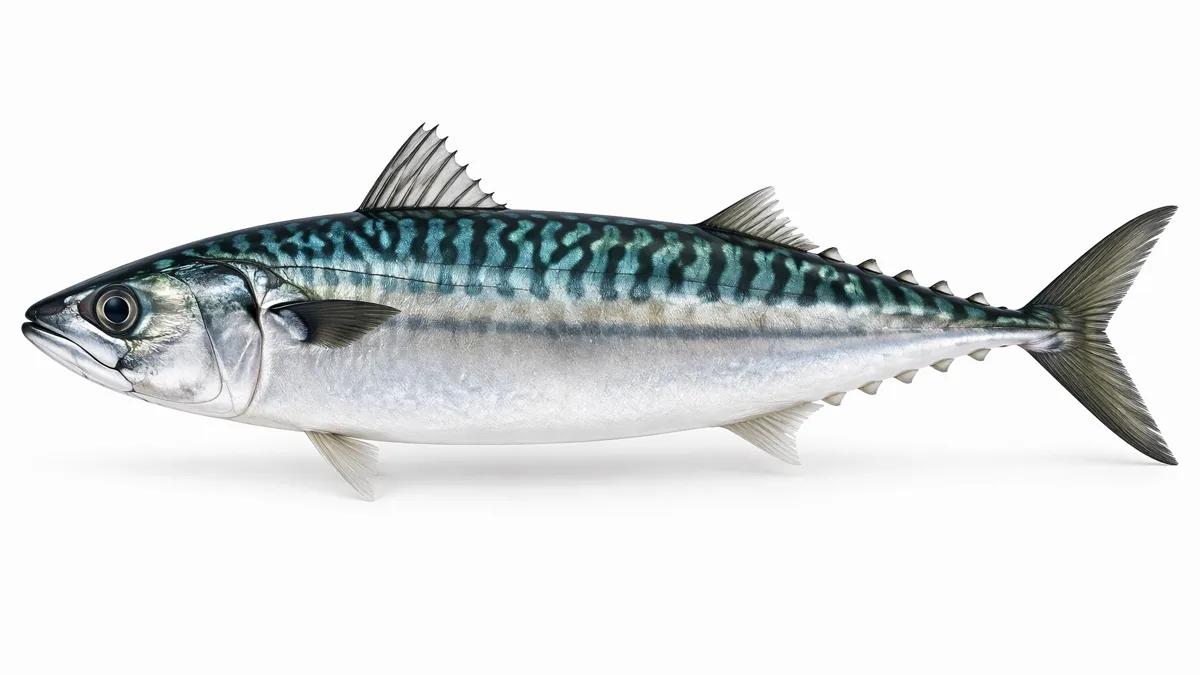
Mackerel: Identification, Habitat & Diet
The mackerel is the fish that turns a quiet harbour wall into a feeding frenzy. When a school pushes bait against the surface, birds dive, water boils, and every rod within sight bends at once. This profile deals with the Atlantic mackerel (Scomber scombrus), the species most European and North American anglers mean when they say mackerel. It is a fast, streamlined, cold-water hunter with a beautiful barred back and a well-earned reputation as one of the best-eating fish in the sea. Here is how to recognise a mackerel, where it lives, what it eats, how big it grows, how it differs from its relatives, and how to catch one.
Quick ID Card
| Field | Details |
|---|---|
| Scientific name | Scomber scombrus |
| Common names | Atlantic mackerel, mackerel, joey (small fish), tinker (medium fish) |
| Family | Scombridae (tunas, mackerels and bonitos) |
| Typical size | 10–14 inches (25–35 cm); 9–18 oz (250–500 g) |
| Maximum size | About 24 inches (60 cm) and roughly 7.5 lb (3.4 kg) |
| Water type | Cold to temperate salt water, open sea and inshore |
| Depth range | Surface to about 300 m, mostly 50–200 m |
| Active water temperature | Roughly 46–59°F (8–15°C), with seasonal shifts |
| Difficulty | Easy to catch when a school is present; frantic, fast action |
| Best season | Late spring to early autumn in the northeast Atlantic |
How to Identify a Mackerel
Mackerel identification comes down to three features: a metallic blue-green back crossed by dark wavy bars, a bright silver belly with no spots, and a row of small finlets between the dorsal and tail.
The body is a perfect torpedo, built for speed. The head is pointed, the eye is large, and the mouth is wide enough to take small fish whole. The back carries 20 to 30 irregular dark bars that look like tiger stripes or worm tracks. Below the lateral line the flank turns to mirror silver, sometimes with a faint yellowish or pinkish sheen. There are no spots anywhere on the fish, and that detail alone rules out several lookalikes.
Count the fins. There are two dorsal fins. The first is short and spiny, with roughly 9 to 13 spines; the second is soft and sits far back. Behind the second dorsal and the anal fin you will find five small, separate finlets on each edge. The tail is deeply forked, and the base of the tail carries two small keels on each side. The scales are tiny and smooth, and the fish feels slick rather than rough.
One internal feature matters for identification and for behaviour: the Atlantic mackerel has no swim bladder. It cannot hover in neutral water, so it swims almost constantly. Some closely related species, including the chub mackerel, do have a swim bladder, which is one of the cleanest ways to tell them apart when you have the fish in hand.
Mackerel vs Spanish Mackerel (and Chub Mackerel)
Anglers confuse three fish under the name "mackerel", and the differences are worth knowing before you decide what is on the line.
The Atlantic mackerel is the small, barred, cold-water fish described above. The Spanish mackerel (Scomberomorus maculatus) is a different animal entirely: it belongs to another genus, grows much larger, and is decorated with golden-yellow spots instead of wavy bars. A good Spanish mackerel is a serious fish; a good Atlantic mackerel is a plate-sized one.
| Feature | Atlantic mackerel | Spanish mackerel |
|---|---|---|
| Back pattern | Dark wavy bars | Golden-yellow spots |
| Typical size | 10–14 inches | 20–30 inches and far heavier |
| Body | Compact torpedo | Longer, more streamlined |
| Range | Cold North Atlantic | Warmer western Atlantic |
| Fight | Fast, frantic, light tackle | Long runs, much more power |
The chub mackerel (Scomber colias) is the closer lookalike. It shares the barred back, but its wavy markings often continue onto the belly, its eye is smaller, and it has a swim bladder. Chub mackerel also tend to be a little deeper in the body. In European waters the two overlap, so check the belly pattern and the eye before you call it.
Is Mackerel Dangerous to Handle?
Mackerel are not venomous, and their teeth are small. The real danger is on the plate, not on the hook.
Mackerel are "scombroid" fish, a group with very high levels of histidine in the dark muscle. Once the fish dies and warms up, bacteria convert that histidine into histamine, and histamine is not destroyed by cooking. Eating a mackerel that has been left warm can cause scombroid poisoning: flushing, headache, a racing heart, stomach cramps, and a rash that can look like an allergic reaction. It is not an allergy, and it is entirely preventable.
The rule is simple. Bleed and chill mackerel immediately, keep them on ice, and cook or freeze them the same day. A mackerel that has been properly iced tastes sweet and clean; one that has sat in a warm bucket smells sharp and should be discarded, not cooked. This is one fish where a cool box is not optional.
Handling hazards are minor. The gill covers are thin and sharp, and a big mackerel thrashing on a boat deck can rake a hand. Wet your hands, support the body, and use a cloth if the fish is lively. The small teeth can draw blood but do no lasting damage.
Where Do Mackerel Live?
Mackerel habitat is the open water of the cold and temperate North Atlantic. On the eastern side, the range runs from Iceland and Norway down through the North Sea, the English Channel, the Celtic Sea, and the Bay of Biscay, with populations in the western Baltic, the Mediterranean, and the Black Sea. On the western side, Atlantic mackerel live from the Gulf of St Lawrence and Newfoundland down to North Carolina.
They are pelagic fish, at home in the water column rather than on the bottom. Most fishing happens between the surface and about 50 m, but mackerel can go far deeper, and in winter they retreat to 100–200 m to conserve energy in colder, more stable water. Because they have no swim bladder, they cannot rest on the bottom and simply wait; they keep moving, which is why a school can appear and vanish in minutes.
Where do mackerel live in relation to the shore? In spring and summer, they push inshore to feed and spawn, and that is when shore anglers and small boats get their chance. Marks with tide, structure, and baitfish hold fish: headlands, reef edges, harbour mouths, and the meeting line where two currents collide. In autumn they move offshore and south, and the inshore fishing fades.
Habits and Diet: What Do Mackerel Eat?
What do mackerel eat? Plankton first, then anything small and shiny. The diet is built on copepods, krill, amphipods, mysids, and decapod larvae, topped up with small fish such as herring, sprat, sandeel, and the young of their own kind. Mackerel also take squid, fish eggs, and small worms. They are opportunists with a fast metabolism, and they feed hardest before spawning and again in autumn, when they need to lay down fat.
Mackerel are schooling fish, and the schools are usually sorted by size. Small fish form tight, nervous balls; bigger fish form looser, faster groups. Schools often mix with other pelagic fish, and they respond to temperature, tide, and light. Dawn and dusk are prime, and an overcast day usually beats bright sun.
Mackerel are strong swimmers and vertical movers. They rise toward the surface at night and sink during the day, following plankton as it migrates. That daily rhythm is one reason the fishing can switch on and off within an hour. When mackerel are high, a lure retrieved just under the surface gets hit; when they are deep, you need weight or a sinking lure to reach them.
When do mackerel spawn? In the northeast Atlantic, spawning runs from about May to July, peaking in late May and June. In the northwest Atlantic, it is a little earlier, mostly May and June. A female releases her eggs in batches over several weeks, and a large fish can produce hundreds of thousands to more than a million eggs in a season. The eggs float, and the larvae drift with the current. Mackerel mature at around two to three years old and roughly 30 cm, which is why the species can recover faster than a slow-growing cod.
Size, Records and Regulations
How big do mackerel get? A typical adult is 10 to 14 inches and under a pound. A 1.5-pound mackerel is a big one for most anglers, and a 2-pound fish is a trophy on light tackle. The species maximum is around 24 inches and 7.5 lb, according to FishBase, but fish near that size are exceptional.
The world record mackerel on rod and reel is a surprisingly modest fish. The IGFA all-tackle record sits at roughly 3 kg (about 6 to 7 lb), which is close to the top of the species range. Mackerel are not a record-hunting fish; they are a volume fish, and the pleasure is in the speed of the action rather than the size of a single specimen.
Regulations vary by country and by stock. In EU and UK Atlantic waters, the minimum size for mackerel is commonly 20 cm (about 8 inches), and there are quotas, bag limits, and closed areas in some fisheries. Recreational rules differ between England, Scotland, Wales, Ireland, and Norway, and they change with stock advice. As of 2025, check the current rules for your area before you fill a bucket; the relevant authorities are the national fisheries departments and, in the EU, the member state administration. Last verified: November 2025.
The best bait for mackerel is a strip of mackerel, fished on a feather rig or a small hook. Mackerel are cannibals, and a sliver of silver belly is as good as anything you can buy. On the artificial side, small metal spoons, chrome wedges, sabiki feathers, and tiny jigs all work. A silver spoon retrieved fast is the classic, and a sinking lure helps when the fish are deep.
How to catch mackerel: find the school, then keep the lure moving. Watch for diving birds, surface disturbance, and the dark patch of a shoal under the water. Drift or anchor uptide of a mark and cast across the current, letting the lure swing and flutter. Retrieve fast, because a mackerel is built to chase. When the school is thick, a rig with several feathers will take fish two or three at a time. Handle each fish quickly, chill it at once, and release what you will not eat.
FAQ
How big do mackerel get? Most adults are 10–14 inches and under a pound. Fish over 1.5 pounds are big, and the species maximum is about 24 inches and 7.5 lb.
What is the world record mackerel? The IGFA all-tackle record is a fish of roughly 3 kg (about 6–7 lb), close to the top of the natural size range.
Where do mackerel live? In the cold and temperate North Atlantic, from Iceland and Norway to Spain on the east, and from the Gulf of St Lawrence to North Carolina on the west, plus the Mediterranean and Black Sea.
What do mackerel eat? Plankton such as krill and copepods, plus small fish, squid, and fish eggs. They feed hardest before spawning and in autumn.
Atlantic mackerel vs Spanish mackerel: what is the difference? Atlantic mackerel are small, barred, and cold-water; Spanish mackerel are larger, spotted with gold, and warmer-water fish of a different genus.
When do mackerel spawn? Mostly May to July in the northeast Atlantic, and May to June in the northwest. Eggs are pelagic and drift with the current.
What is the best bait for mackerel? A strip of mackerel belly on a feather rig, or a small silver spoon retrieved fast. Live or fresh small fish also work.
How do you catch mackerel? Find the school using birds and surface activity, cast across the tide, and retrieve fast. Chill every fish immediately.
Related Articles
- Smelt — another small, silver, schooling fish that shares the same cold coasts.
- Coral Trout — a warm-water reef predator with a very different hunting style.
- Murray Cod — a freshwater giant for anglers who also fish inland.
- All species profiles
Mackerel is a fish of speed and abundance. Learn the barred back and the five finlets, watch the birds, and keep a cool box ready. Catch them fast, chill them faster, and the mackerel rewards you with one of the finest meals the North Atlantic has to offer.
Ready to catch one? Read our step-by-step guide: How to Catch Mackerel.
About the author and how this was tested
About the author
FishermanGuy
Bank, boat and kayak angler · fishing, crabbing and shrimping since 2021
I buy the gear, fish it for a season and write down what failed. No sponsored verdicts, no free-sample flattery. Every rig on this page has landed fish in water I can point at on a map.
How this was tested
- Every rig gets at least six trips on the same water before it is published.
- Gear is bought at retail. Free samples are labelled in the first paragraph.
- Dates show first publication and the last time the page was updated.