Field notes
Smelt: Identification, Habitat & Diet
Smelt: Identification, Habitat & Diet
The smelt is a small fish with a large reputation. Fresh from cold water, a European smelt (Osmerus eperlanus) gives off a clean scent of cucumber, which is why it is called the cucumber fish in parts of Europe and why the Chinese name translates the same way. It is slender, silver, and barely longer than a finger, yet it supports commercial fisheries, feeds bigger predators, and turns up fried by the plateful in spring. This profile covers smelt identification, habitat, diet, size, spawning, how it differs from anchovy, and how to catch and cook one.
A note on names before we start: "smelt" is used for several species. In Europe the default is the European smelt, Osmerus eperlanus. In North America it usually means the rainbow smelt, Osmerus mordax, a close relative. Both are osmerids, both are small, silver, and schooling, and both are eaten whole. This article focuses on the European fish, with notes where the two differ.
Quick ID Card
| Field | Details |
|---|---|
| Scientific name | Osmerus eperlanus |
| Common names | European smelt, sparling, cucumber fish |
| Family | Osmeridae (smelts) |
| Typical size | 4–8 inches (10–20 cm) |
| Maximum size | About 12 inches (30 cm) |
| Water type | Cold coastal water, estuaries and rivers; some landlocked lakes |
| Depth range | Surface to about 20 m in coastal water |
| Active water temperature | Roughly 41–59°F (5–15°C) |
| Difficulty | Easy to catch in numbers; not a rod-and-reel trophy |
| Best season | Late winter to spring, when fish run upstream |
How to Identify a Smelt
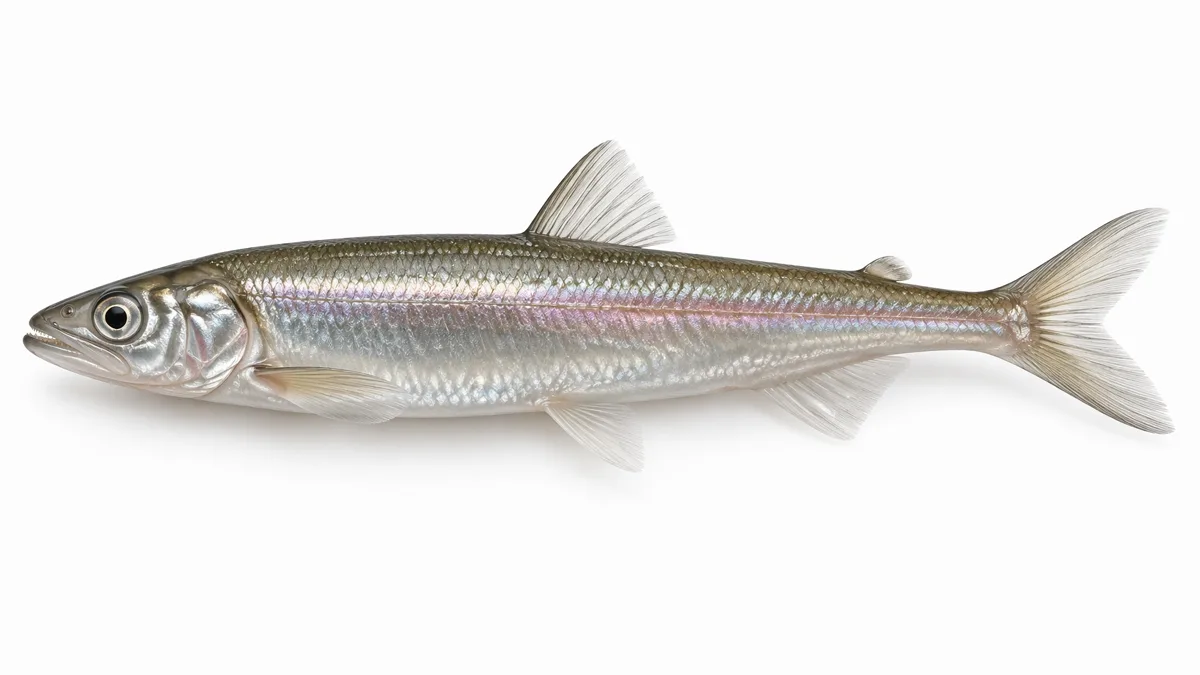
Smelt identification is mostly about size, shine, and smell. A fresh European smelt is small, slim, and almost translucent, with a pale silvery flank that carries a faint pink or lilac iridescence. The back is darker, often olive or pale brown. The fish looks delicate, but the mouth tells a different story.
The mouth is large for such a small fish, and the jaws and tongue carry prominent teeth. The eye is relatively big. There is a single soft dorsal fin roughly midway along the back, an anal fin further back, and a small adipose fin on the upper edge near the tail, a giveaway shared with salmon and trout. The tail is forked. The lateral line is short and does not run the full length of the body.
The nose is the clincher. A truly fresh smelt smells of cucumber, a clean green scent that fades quickly after death. That smell, combined with the slender silver body and the small adipose fin, is enough to separate a smelt from most small coastal fish. If the fish is dull, soft, and smells of nothing but fish, it is not fresh, and it will not taste like much.
Smelt vs Anchovy (and Other Small Silver Fish)
Smelt vs anchovy is a common confusion in fishmongers and on bait tables, because both are small, silver, and sold in bulk.
| Feature | Smelt | Anchovy |
|---|---|---|
| Adipose fin | Present | Absent |
| Mouth | Large, toothed, ends before the eye | Huge, extends behind the eye |
| Snout | Normal | Projects forward |
| Flank stripe | None; faint iridescence | Bright silver stripe |
| Smell when fresh | Cucumber | Mild, fishy |
| Dorsal fin | Mid-back | Far back, above the anal fin |
The anchovy's mouth is the easiest check. An anchovy looks like it is built entirely around a gaping jaw, and the snout sticks out beyond the lower jaw. A smelt has a big mouth too, but it is a normal fish mouth with visible teeth, not a trap.
Two other fish cause trouble. The capelin (Mallotus villosus) is another osmerid, marine and cold-water, with much smaller teeth and a different body shape. The rainbow smelt of North America is so similar to the European smelt that most anglers treat them the same; the main differences are range and the fact that rainbow smelt often have landlocked populations in lakes. If you are in Europe and catch a small silver fish with an adipose fin and a cucumber smell, it is almost certainly the European smelt.
Is Smelt Dangerous?
Smelt are not venomous, and their teeth are too small to do real damage. The risks are culinary and environmental rather than physical.
The first is freshness. Smelt spoil quickly, and a smelt that has been dead too long loses the cucumber smell and gains a soft, mushy texture. Eat them the day you catch them, or freeze them promptly. The second is the general risk that comes with eating small freshwater or estuarine fish raw: freshwater fish can carry parasites, so smelt should be cooked, and any fish eaten raw should come from a trusted, properly frozen source.
The third is the water itself. Smelt are caught at night, in estuaries, on slippery banks, often in cold weather and rising tides. A headtorch, a companion, and a life jacket near deep water matter more than any fish. Dip-netting from a wet rock at 2 a.m. is exactly the kind of situation where people fall in.
Where Do Smelt Live?
Smelt habitat is cold, clean coastal water and the rivers that feed it. The European smelt lives along the coasts of the northeast Atlantic, from Iceland and Norway down through the North Sea, the British Isles, the Channel, and the Atlantic coast of France. It is common in the Baltic Sea and in many of its estuaries, and there are landlocked populations in lakes across northern Europe.
The species is anadromous, which means it lives in salt water or estuaries as an adult and runs up rivers to spawn. Some populations are resident in fresh water and never see the sea. In spring, smelt gather at the mouths of rivers and wait for the right tide, then push upstream in shoals, often at night. That run is the basis of the traditional smelt fishery, and it is why the fish appears in markets for a few weeks each year.
Where do smelt live in summer? After spawning, adults drop back downstream to estuaries and coastal water, where they feed and recover. Young smelt use the lower reaches of rivers and shallow coastal zones as nursery areas. Water temperature and water quality matter: smelt are sensitive to pollution, barriers, and low oxygen, and many river populations have declined where rivers have been straightened, dammed, or polluted.
Habits and Diet: What Do Smelt Eat?
What do smelt eat? Mostly small crustaceans, and plenty of them. Mysids, copepods, amphipods, and other planktonic animals form the bulk of the diet, along with worms and insect larvae in estuarine water. Larger smelt also take small fish and fish larvae. They are mid-water feeders that hunt in shoals, and they are themselves a key link in the food chain between plankton and predators such as cod, salmon, trout, and seabirds.
Smelt are schooling fish, and the schools can be dense. They orient to light, which is why night fishing with a lamp works, and why smelt gather around harbour lights and pier lamps. They are also sensitive to tide: the upstream spawning run often happens on a rising tide after dark, when the fish feel safe.
When do smelt spawn? In Europe, the run usually begins in late winter and continues through spring, roughly February to May depending on latitude and water temperature. Fish move upstream, often into shallow riffles, and lay adhesive eggs that stick to gravel, stones, and submerged plants. Many smelt die after their first spawning, a life-history strategy that puts a lot of energy into one big reproductive event. Landlocked populations may spawn in lake margins or in the lower reaches of inflowing streams.
Smelt are short-lived. Most fish are only a few years old, and the whole population turns over quickly. That makes them responsive to good conditions but also vulnerable to a bad year, a blocked river, or a pulse of pollution.
Size, Records and Regulations
How big do smelt get? Most European smelt are 10 to 20 cm long, and a 25 cm fish is a big one. The maximum is around 30 cm, but fish that size are unusual. Smelt are not weighed and recorded like game fish; there is no meaningful rod-and-reel world record, and the species is judged by the plate and the bucket rather than the scales.
Regulations are local and matter. In parts of Europe, smelt are protected or subject to closed seasons, especially in rivers where populations are fragile. In the Baltic and some estuaries, smelt support commercial and recreational fisheries with their own rules on gear, season, and size. In the UK, smelt are a species of conservation concern in some rivers, and local bylaws can restrict netting. As of 2025, check with the relevant national or regional fisheries authority before you fish, and never net a river that is closed. Last verified: November 2025.
The best bait for smelt is tiny. A small hook baited with a sliver of worm, a bit of fish, or a single maggot will catch them; so will a sabiki rig with tiny flies or luminous beads. In Europe, many smelt are taken with dip nets or cast nets during the spawning run rather than on rod and line. In North America, ice fishing with tiny jigs and spikes is the classic method for rainbow smelt.
How to catch smelt: find the run, fish at night, and use light. A lamp over the water draws plankton and smelt, and a small baited hook or a tiny jig fished below the light will do the rest. Keep the rig light, strike quickly, and handle the fish gently because they are delicate. If you are netting, work from a safe, stable spot and respect local rules.
Fried smelt is the classic way to eat them. Clean the fish, leave the head on or off as you prefer, roll them in seasoned flour or batter, and fry hot and fast until crisp. The bones are small and soften in the heat, so the whole fish can be eaten. Tempura, pickling, and grilling also work. The cucumber scent is faint by the time they hit the pan, but the sweet, delicate flesh is the reason the run is worth waiting for.
FAQ
How big do smelt get? Most are 10–20 cm, and a 25 cm fish is large. The maximum is about 30 cm.
Smelt vs anchovy: how do you tell them apart? Smelt have an adipose fin and a mouth that ends before the eye; anchovies have no adipose fin, a mouth that extends behind the eye, and a bright silver stripe.
Where do smelt live? Along cold northeast Atlantic coasts and estuaries, from Iceland and Norway to France, plus the Baltic and landlocked lakes. They run up rivers to spawn.
What do smelt eat? Small crustaceans such as mysids and copepods, plus worms, insect larvae, and small fish.
When do smelt spawn? Mostly late winter to spring, February to May, on upstream runs that often happen at night on a rising tide.
What is the best bait for smelt? A tiny hook with worm, fish, or maggot, or a small sabiki rig. In Europe, dip nets are traditional during the run.
How do you catch smelt? Fish at night under a lamp, with light tackle and tiny baits. Find the spawning run and respect local netting rules.
How should you cook smelt? Fried whole in seasoned flour or batter is classic; the small bones soften, so the fish can be eaten head to tail. Tempura and pickling also work.
Related Articles
- Mackerel — a fast pelagic school fish that shares the same cold coasts.
- Taimen — a cold-water predator from the rivers where small fish like smelt matter.
- Murray Cod — a freshwater giant with a very different approach to feeding.
- All species profiles
Smelt are small, silver, and easy to overlook, but they carry a whole food web on their backs. Learn the cucumber smell, the adipose fin, and the spring run, and you will understand why generations of coastal families waited for the smelt to arrive. Catch a few, cook them crisp, and the smelt earns its place at the table.
Ready to catch one? Read our step-by-step guide: How to Catch Smelt.
About the author and how this was tested
About the author
FishermanGuy
Bank, boat and kayak angler · fishing, crabbing and shrimping since 2021
I buy the gear, fish it for a season and write down what failed. No sponsored verdicts, no free-sample flattery. Every rig on this page has landed fish in water I can point at on a map.
How this was tested
- Every rig gets at least six trips on the same water before it is published.
- Gear is bought at retail. Free samples are labelled in the first paragraph.
- Dates show first publication and the last time the page was updated.