Field notes
Murray Cod: Identification, Habitat & Diet
Murray Cod: Identification, Habitat & Diet
The Murray cod is Australia's largest freshwater fish and one of the great freshwater sportfish of the world. It is not a true cod at all, despite the name. It is a temperate perch of the family Percichthyidae, a green-and-gold ambush predator that lives among sunken timber in the slow rivers of the Murray-Darling Basin. A big Murray cod is thick, wary, and brutally strong, and it has a habit of diving straight back into the snag it came from. This profile covers Murray cod identification, habitat, diet, size, records, how it differs from trout cod, and how to catch one legally and responsibly.
Quick ID Card
| Field | Details |
|---|---|
| Scientific name | Maccullochella peelii |
| Common names | Murray cod, cod, greenfish, Goodoo |
| Family | Percichthyidae (temperate perches) |
| Typical size | 20–40 inches (50–100 cm); 5–40 lb (2–18 kg) |
| Maximum size | Historic record about 6 ft (1.8 m) and 113 kg (250 lb); modern fish over 1 m are exceptional |
| Water type | Warm, slow fresh water; lowland rivers, pools and reservoirs |
| Depth range | Surface to the bottom of deep pools, often 2–8 m |
| Active water temperature | Roughly 59–79°F (15–26°C) |
| Difficulty | Hard; powerful, structure-oriented, and highly regulated |
| Best season | Warmer months, especially spring and summer, subject to closed seasons |
How to Identify a Murray Cod
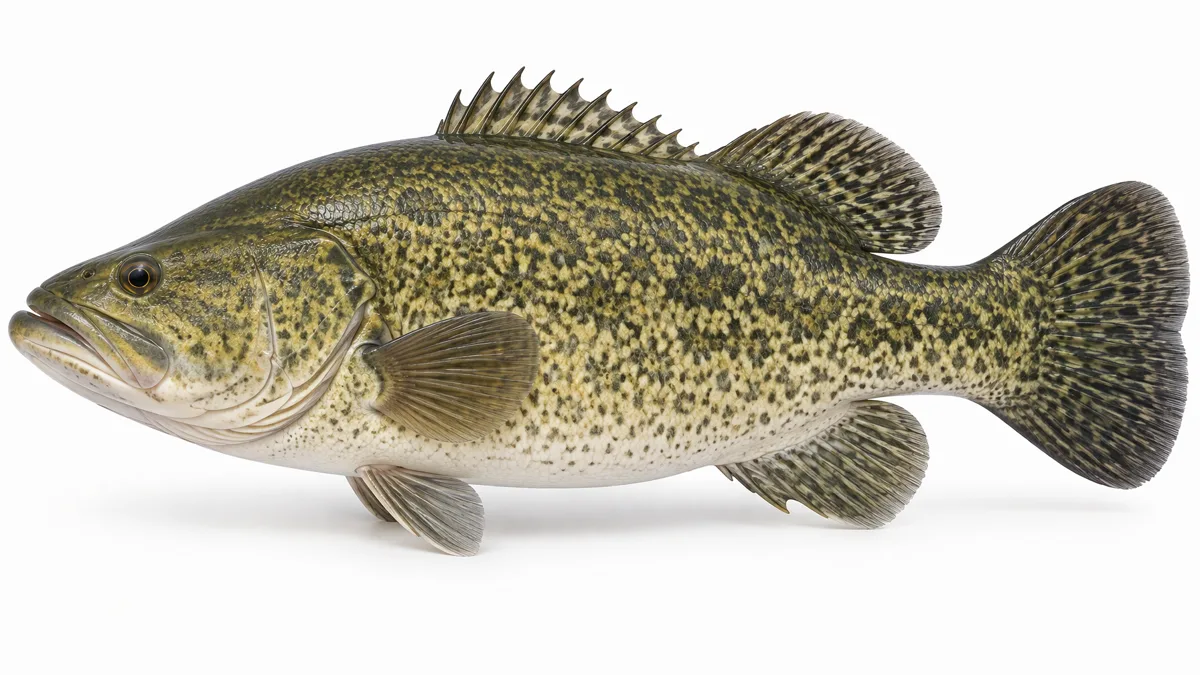
Murray cod identification is built around the head, the pattern, and the fins. The fish has a broad, rounded head and a very large mouth that reaches back past the eye. The lower jaw is heavy. The body is thick and slightly humped behind the head, tapering to a broad tail. The first dorsal fin is spiny and rounded, the second is soft, and the tail fin is rounded rather than forked.
Colour is variable and beautiful. The back and flanks are olive-green to golden-green, sometimes almost yellow, and the body is covered in a marbled or mottled pattern of darker green and black blotches. The belly is pale. The pattern can look like camouflage or like a piece of old timber, which is exactly the point: a Murray cod in a snag is very hard to see.
The mouth is the quickest check against other native fish. A Murray cod's mouth is huge, and the head profile is rounded or slightly convex above the eye. A trout cod, by contrast, has a concave forehead and a more pointed snout. If you catch a cod-like fish and are not sure which species it is, treat it as protected and release it immediately.
Murray Cod vs Trout Cod
Murray cod and trout cod are close relatives in the same genus, and they are easy to confuse, which matters because trout cod are endangered and fully protected.
| Feature | Murray cod | Trout cod |
|---|---|---|
| Head profile | Rounded or convex above the eye | Concave forehead, more pointed snout |
| Maximum size | About 1.8 m and 113 kg historically | Much smaller, rarely over 60 cm |
| Pattern | Marbled green and gold | Mottled with a spotted or banded look |
| Status | Protected and managed | Endangered and protected |
| Range | Murray-Darling Basin | A few remnant reaches, mostly the Murray and Murrumbidgee |
The other relatives are the eastern freshwater cod of the Clarence River and the Mary River cod, both of which are also protected and have restricted ranges. The practical rule for anglers in the basin is simple: if the fish has a concave forehead and a pointed snout, it is not a Murray cod, and it must go back at once. Learn the head shape before you fish, not after you have a fish on the bank.
Is the Murray Cod Dangerous?
Murray cod are not venomous, but they are strong, heavy, and armed with sharp gill covers and spiny dorsal fins. A big cod thrashing in a boat can do real damage to a hand, a shin, or a rod.
Handle them with care. Support the body horizontally, never lift a big fish by the jaw or the gill cover, and use a wet cloth or a large landing net. The spines on the dorsal fin and the sharp edges of the gill plates are the main hazards. A fish that has been hooked in a snag is also likely to be exhausted, so keep it in the water while you unhook it and give it time to recover.
The environment is the bigger risk. Murray cod fishing happens at night, in rivers with strong current, snags, and steep banks. Falling in among submerged timber is far more dangerous than any fish. Wear a life jacket on the water, carry a light, and never wade a flooded river. Snags that hold cod also hold branches that can pin a person.
Where Do Murray Cod Live?
Murray cod habitat is the slow, warm, turbid water of the Murray-Darling Basin, the vast river system that drains much of inland southeastern Australia. The species lives in the Murray, Darling, Murrumbidgee, Lachlan, Macquarie, Gwydir, Namoi, and other connected rivers, and in lakes and reservoirs within the basin.
Within a river, Murray cod are creatures of cover. They hold around large woody debris, known locally as snags, and in deep pools, undercut banks, rock ledges, and the tail-outs below weirs. Big fish are territorial and may occupy the same snag or pool for years. They are also found in clear, rocky upland reaches, but the classic cod water is a slow, green, timber-lined lowland river.
Water temperature and flow drive the fish. Murray cod are most active between about 15 and 26°C, and they become sluggish in winter. They move more in spring and summer, especially when a rise in water level or a flood triggers spawning behaviour. Dams, weirs, and flow regulation have changed the basin enormously, and the species depends on environmental flows, snag habitat, and good water quality.
Habits and Diet: What Do Murray Cod Eat?
What do Murray cod eat? Almost anything that fits in that huge mouth. The core diet is freshwater crayfish, especially yabbies, along with shrimp, fish, frogs, and aquatic insects. Big cod also take turtles, water rats, ducks, and snakes. They are opportunistic ambush predators, and a large fish will sit in a snag and wait for something edible to pass.
The hunting style is classic structure fishing. A Murray cod holds tight to cover, often with just its head showing, and strikes with a sudden, powerful suction. That is why lures and baits fished close to snags work: the fish is not cruising the open river, it is waiting in the timber. At night, big cod sometimes move into shallower water and take surface lures, which is one of the most exciting ways to catch them.
When do Murray cod spawn? Spawning happens in spring and early summer, roughly October to December, when water temperatures rise above about 16 to 20°C and flows increase. Adults move upstream, and the female lays adhesive eggs on hard surfaces such as logs, rocks, or the nest site. The male guards the eggs. Murray cod mature slowly, often at four to six years old, and they can live for decades, with fish aged over 40 years recorded. That slow life history is why the species is so vulnerable to overfishing and habitat loss.
Size, Records and Regulations
How big do Murray cod get? Most anglers catch fish between 50 and 80 cm, and a 90 cm cod is a good fish anywhere. A fish over a metre is a trophy, and a 1.2 m cod is exceptional. The historic record is a fish of about 1.8 m and 113 kg, taken in the 19th century, but fish anywhere near that size have not been seen for generations.
The world record Murray cod on rod and reel is a fish of roughly 1 m and 30 kg or more in modern times, far below the old 113 kg specimen. The species is not really a record-chasing fish; it is a fish of the snag, the night, and the long battle.
Regulations are strict and vary by state, so they matter more than the fishing itself. In New South Wales and Victoria, the minimum size is commonly 55 cm with a bag limit of two fish and a possession limit, plus a closed season from around September to November to protect spawning. Queensland sets a larger minimum size and its own closed season. Barbless hooks, circle hooks, and catch-and-release are encouraged or required in many waters, and some areas are closed entirely. As of 2025, check the current rules for the state and river you plan to fish before you leave; the relevant authorities are the state fisheries departments and the Murray-Darling Basin Authority. Last verified: November 2025.
The best bait for Murray cod is a big, fresh bait fished close to a snag. Whole fish, fish fillets, yabbies, and large shrimp all work, and a dead bait left to sit in a deep pool is a classic approach. On the artificial side, large deep-diving minnows, big soft plastics, spinnerbaits, chatterbaits, and surface lures all take fish. Murray cod are not shy about size: a 20 cm lure is a sensible choice for a metre-long fish.
How to catch Murray cod: fish the snags, fish slowly, and fish at night. Cast close to timber, let the lure or bait settle, and work it with patience. A big cod usually takes on the drop or as the lure deflects off structure, and the strike is a heavy, solid weight rather than a tap. Use heavy braid, a strong leader, and a rod with the backbone to turn a fish away from a snag. When you hook a good fish, apply pressure early and keep its head up. Land it quickly, keep it wet, measure it, and release it if the rules require it. A Murray cod is a long-lived, slow-growing fish, and the future of the fishery depends on anglers letting the big ones go.
FAQ
How big do Murray cod get? Most caught fish are 50–80 cm. A fish over 1 m is a trophy, and the historic record is about 1.8 m and 113 kg, though fish that size no longer exist.
What is the world record Murray cod? The old record is about 1.8 m and 113 kg from the 19th century. Modern rod-and-reel records are fish of roughly 1 m and 30 kg or more.
Where do Murray cod live? In the slow rivers, pools, and reservoirs of the Murray-Darling Basin in southeastern Australia, mostly around snags and deep cover.
What do Murray cod eat? Yabbies, shrimp, fish, frogs, and aquatic insects, plus turtles, water rats, ducks, and snakes for big fish.
Murray cod vs trout cod: how do you tell them apart? Murray cod have a rounded head and grow much larger; trout cod have a concave forehead, a pointed snout, and are smaller, endangered, and protected.
When do Murray cod spawn? In spring and early summer, roughly October to December, when water warms and flows rise. The male guards the eggs.
What is the best bait for Murray cod? A whole fish or fish fillet fished close to a snag, or a yabby. Large deep-diving lures and surface lures also work.
How do you catch Murray cod? Fish snags and deep pools slowly, often at night, with heavy tackle. Apply pressure early to keep the fish out of cover, and release big fish.
Related Articles
- Taimen — another giant freshwater ambush predator with a cult following.
- Coral Trout — a reef predator that shares the sit-and-strike hunting style.
- Mackerel — a saltwater school fish for anglers who fish both fresh and salt.
- All species profiles
The Murray cod is a fish of timber, patience, and power. Learn the rounded head, fish the snags at night, and respect the closed seasons. Catch one, release it well, and you have met the fish that defines freshwater fishing in Australia.
Ready to catch one? Read our step-by-step guide: How to Catch Murray Cod.
About the author and how this was tested
About the author
FishermanGuy
Bank, boat and kayak angler · fishing, crabbing and shrimping since 2021
I buy the gear, fish it for a season and write down what failed. No sponsored verdicts, no free-sample flattery. Every rig on this page has landed fish in water I can point at on a map.
How this was tested
- Every rig gets at least six trips on the same water before it is published.
- Gear is bought at retail. Free samples are labelled in the first paragraph.
- Dates show first publication and the last time the page was updated.