Field notes
Giant Tiger Prawn: Identification, Habitat & Diet
Giant Tiger Prawn: Identification, Habitat & Diet
The giant tiger prawn (Penaeus monodon) is the largest penaeid prawn in the Indo-Pacific and one of the most striking. Bold dark bands cross a grey-brown body, the rostrum is long and serrated, and the antennae trail back like whips. Also sold as the black tiger prawn, it is a commercial trawling target, a major aquaculture species, and a prized catch for anyone working an estuary with a cast net. This giant tiger prawn guide covers identification, habitat, diet, size, farming, spawning, and how to catch giant tiger prawns legally.
Quick ID Card
| Field | Details |
|---|---|
| Scientific name | Penaeus monodon |
| Common names | Giant tiger prawn, black tiger prawn, grass prawn, jumbo tiger prawn |
| Family | Penaeidae (penaeid prawns) |
| Typical size | 20–30 cm (8–12 in) total length; 150–300 g |
| Maximum size | About 33–35 cm (13–14 in) and 300–500 g; females grow largest |
| Water type | Tropical marine and estuarine, Indo-West Pacific |
| Depth range | Juveniles in shallow estuaries; adults mostly 10–50 m |
| Active water temperature | Roughly 25–32°C (77–90°F) |
| Difficulty | Commercial trawl; recreational cast net or dip net |
| Best season | Warm months; closures vary by fishery and state |
How to Identify a Giant Tiger Prawn
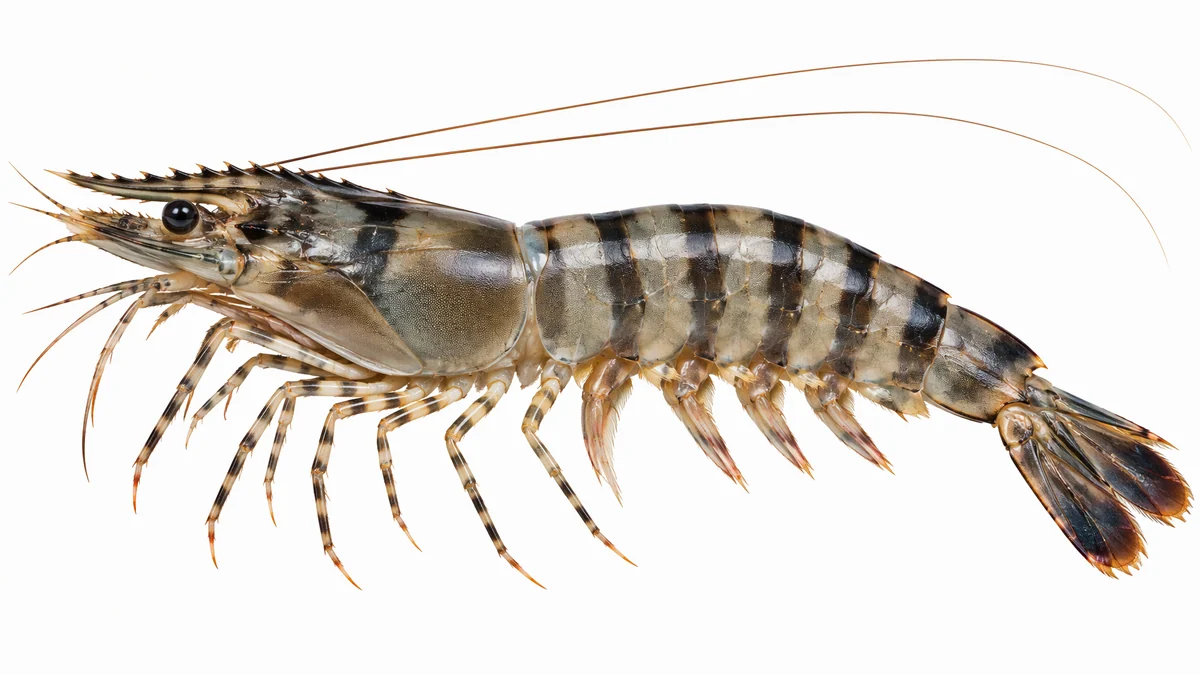
Giant tiger prawn identification starts with the bands. The carapace and abdomen carry roughly eight to ten dark transverse bars over a background that ranges from pale grey through greenish-brown to almost black. Those bars are the "tiger" stripes, and they are far bolder than the faint mottling on most other prawns.
Look next at the head. The rostrum is long, armed with teeth along its upper edge, and angled slightly upward. Two very long antennae, often reddish, sweep back past the body. The walking legs are banded in yellow and dark brown, and the tail fan usually shows red or blue-black edging. The overall build is heavy for a prawn; a big female looks more like a small lobster than a shrimp.
Sexing is straightforward once the animal is in hand. Females grow larger and carry a shield-shaped plate, the thelycum, between the last pair of walking legs. Males have a pair of clasping structures, the petasma, in the same area and are usually slimmer. Juveniles in estuaries are paler and more translucent, and their bands are weaker, which is one reason they are easy to overlook.
Giant Tiger Prawn vs Whiteleg Shrimp and Other Prawns
The comparison that matters most in shops and on farms is giant tiger prawn vs whiteleg shrimp. The whiteleg (Litopenaeus vannamei) is native to the eastern Pacific, has a pale grey-white body with no bold bands, and is generally smaller. It now dominates global shrimp farming because it breeds readily in captivity and tolerates high pond densities. The giant tiger prawn is larger, banded, and native to the Indo-Pacific; it commands a premium in many Asian markets for its size and firm texture.
Against other prawns, the tiger is hard to mistake. Banana prawns are cream to yellow-green and much smaller, and they lack the heavy banding. King prawns carry a different colour pattern and no tiger bars. The freshwater prawn (Macrobrachium rosenbergii) is sometimes confused by name alone, but it has long claws, lives in fresh water, and belongs to a different family. If the animal has bands, a serrated rostrum, and a marine or estuarine address, it is almost certainly a tiger.
Is the Giant Tiger Prawn Dangerous?
A giant tiger prawn is not venomous, but it is not harmless either. The serrated rostrum and the sharp antennal spines can puncture a hand, and a live prawn flicks its tail fan with surprising force. Commercial crews wear gloves for a reason. Handle prawns by the body, keep the head pointed away from your palm, and expect the spines to find a gap in bare skin.
The bigger concern is food safety. Prawns spoil quickly and can carry Vibrio bacteria, which multiply in warm conditions. Keep them on ice, cook them thoroughly until the flesh is opaque and pearly, and avoid cross-contaminating cooked and raw batches. People with shellfish allergies should treat prawns, like all crustaceans, as a serious risk rather than a mild one.
There is also an ecological angle. Wild prawn trawling historically caught large amounts of bycatch, including turtles and juvenile fish. Australian trawlers now use turtle excluder devices and bycatch reduction devices, and closures protect spawning stock. Buying certified product and respecting closed areas is part of responsible prawn fishing.
Where Do Giant Tiger Prawns Live?
Where do giant tiger prawns live? Across the tropical Indo-West Pacific: the east coast of Africa and the Red Sea, through Pakistan, India, Sri Lanka, and Southeast Asia, to Indonesia, the Philippines, Taiwan, southern Japan, and northern Australia. The species has also been introduced to parts of the Atlantic and the Mediterranean through farming and shipping, though its native range is Indo-Pacific.
Giant tiger prawn habitat shifts with age. Adults live offshore over muddy and sandy seabeds, mostly in about 10 to 50 metres, where they burrow by day and emerge at night. Juveniles need estuaries. Postlarvae drift into mangrove creeks and tidal rivers, grow through the brackish zone, and move offshore as subadults. That dependence on estuaries is why mangrove clearing and coastal development hit the species hard.
Temperature drives the pattern. The prawn is most active in water of roughly 25 to 32°C. In the southern part of its range, catches fall away in winter, and in the tropics the warm season brings the strongest spawning and recruitment.
Habits and Diet: What Do Giant Tiger Prawns Eat?
What do giant tiger prawns eat? They are omnivorous scavengers with a strong carnivorous streak. The diet includes polychaete worms, small crustaceans, bivalves, insect larvae, fish flesh, detritus, and algae. They hunt by smell and touch at night, using the antennae and chemosensory hairs on the legs to locate food, then tearing it apart with small mouthparts.
In ponds, the same opportunism makes them difficult to feed cheaply. They take formulated pellets but also graze on natural pond organisms, and when density is high and food is short they cannibalise weaker prawns, especially fresh moults. That is one reason commercial densities are managed carefully and why whiteleg, which tolerates crowding better, has overtaken tiger prawn in much of the industry.
Growth happens by moulting. A prawn sheds its shell repeatedly, expanding before the new cuticle hardens, and is soft and vulnerable for a short window after each moult. Giant tiger prawns are fast-growing but short-lived, with a lifespan of only about two to three years. Most growth occurs in the first year, and few survive to spawn more than once or twice.
Size, Limits and Regulations
How big do giant tiger prawns get? Females reach about 33 to 35 cm in total length and 300 to 500 g, while males stay smaller. That makes the species one of the biggest penaeid prawns, and it is why "jumbo tiger" is a common market label. Lifespan is roughly two to three years, and growth is quick enough that a single warm season can produce a marketable prawn.
When do giant tiger prawns spawn? Mature females spawn offshore in the open sea, usually at night, releasing hundreds of thousands of eggs that hatch into drifting larvae. The larvae pass through several stages before postlarvae enter estuaries. Spawning peaks in the warm months, and the exact timing varies with latitude; in northern Australia, fishery closures and effort limits are timed to protect spawning and recruitment.
Giant tiger prawn farming is a major industry in Southeast Asia, India, Bangladesh, Vietnam, and China, and it is also attempted in parts of Latin America. Farms rely on wild or hatchery postlarvae, and disease outbreaks, mangrove conversion, and water quality are persistent issues. Certification schemes such as ASC and BAP are used to audit environmental and social performance; they are not a guarantee, but they give buyers a starting point.
For wild capture, Australia's Northern Prawn Fishery is a limited-entry trawl fishery managed by the Australian Fisheries Management Authority (AFMA), with seasonal closures and bycatch devices. Recreational fishers in Queensland, the Northern Territory, and Western Australia generally take prawns with cast nets or dip nets under gear rules, and recreational trawling is not permitted. Some states set net specifications and closed areas rather than a minimum size for prawns.
As of 2025, rules differ by jurisdiction and change often. Check the current regulations with AFMA, the Queensland Department of Agriculture and Fisheries, NT Fisheries, or the WA Department of Primary Industries and Regional Development before you fish. In Asia, national and provincial fisheries agencies set licences, closed seasons, and gear limits. Last verified: November 2025.
How to catch giant tiger prawns: in estuaries, work a falling tide at night with a cast net or dip net and a headlamp, targeting the edges of mangrove creeks and mud banks. Commercially, the species is taken by otter trawl on soft ground. Handle the catch quickly, ice it at once, and release undersized or egg-bearing prawns where local rules require it.
FAQ
How big do giant tiger prawns get? Females reach about 33–35 cm and 300–500 g; males are smaller. Most market prawns are 20–30 cm.
Giant tiger prawn vs whiteleg shrimp: which is bigger? The giant tiger prawn is larger and heavier, with bold dark bands. Whiteleg shrimp are paler, smaller, and now dominate global farming.
Where do giant tiger prawns live? The tropical Indo-West Pacific, from East Africa to northern Australia and Japan. Adults live offshore over mud and sand; juveniles use estuaries and mangroves.
What do giant tiger prawns eat? Worms, small crustaceans, bivalves, insect larvae, detritus, algae, and fish flesh. They scavenge and hunt at night, and cannibalise in crowded ponds.
When do giant tiger prawns spawn? Offshore, mainly in the warm months, with peaks that vary by region. Larvae drift into estuaries as postlarvae.
How do you catch giant tiger prawns? Commercially by trawl; recreationally with a cast net or dip net in estuaries at night. Check state net rules and closures first.
Are giant tiger prawns dangerous? Not venomous, but the rostrum and antennal spines can puncture skin, and raw prawns carry spoilage and Vibrio risks. Handle with gloves and cook thoroughly.
Is giant tiger prawn farming sustainable? It can be, but outcomes depend on mangrove protection, disease control, and certification. Look for ASC or BAP labels and avoid product from cleared mangroves.
Related Articles
- Mud Crab — the mangrove-dwelling crab that shares these estuaries.
- Ornate Rock Lobster — another large Indo-Pacific crustacean with high market value.
- Nile Perch — a giant freshwater predator from another continent.
- Arapaima — the air-breathing giant of the Amazon.
- All species profiles
The giant tiger prawn is the benchmark large prawn of the Indo-Pacific: banded, heavy-bodied, and built for muddy coastal ground. Learn the bars, the serrated rostrum, and the estuarine life cycle, and you can read both the animal and its habitat. Fish within the net and closure rules, buy certified farmed product where you can, and this giant tiger prawn will keep earning its place on the plate and in the trap.
Ready to catch one? Read our step-by-step guide: How to Catch Giant Tiger Prawn.
About the author and how this was tested
About the author
FishermanGuy
Bank, boat and kayak angler · fishing, crabbing and shrimping since 2021
I buy the gear, fish it for a season and write down what failed. No sponsored verdicts, no free-sample flattery. Every rig on this page has landed fish in water I can point at on a map.
How this was tested
- Every rig gets at least six trips on the same water before it is published.
- Gear is bought at retail. Free samples are labelled in the first paragraph.
- Dates show first publication and the last time the page was updated.