Field notes
Mud Crab: Identification, Habitat & Diet
Mud Crab: Identification, Habitat & Diet
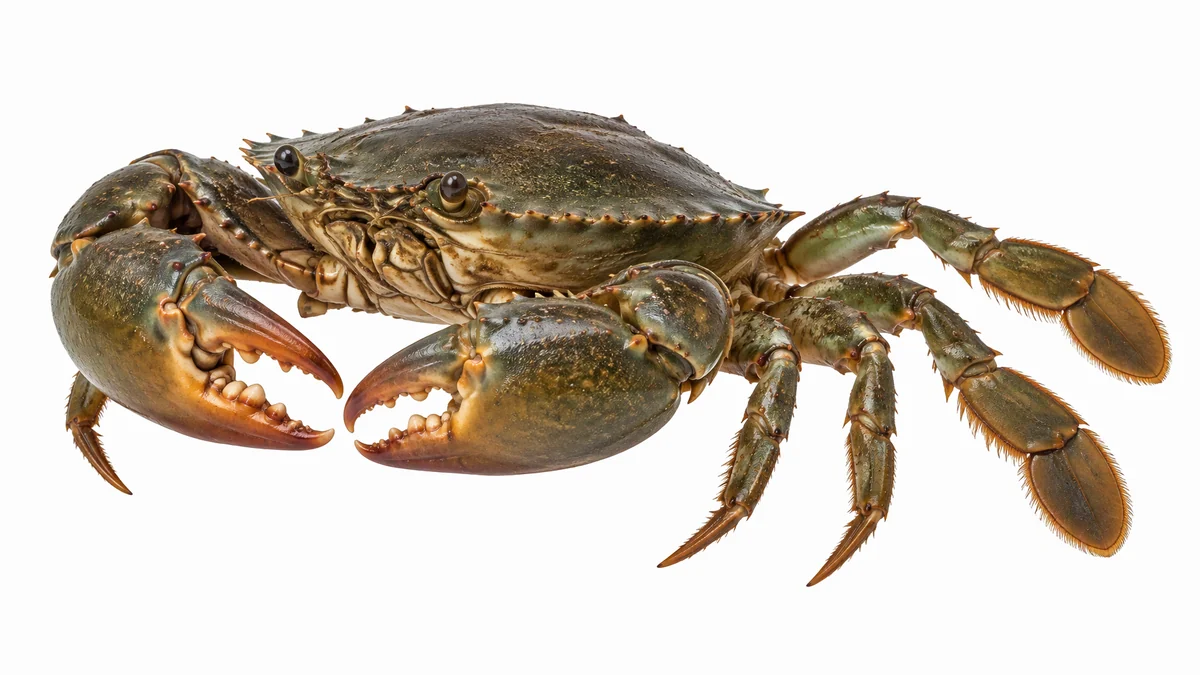
The mud crab (Scylla serrata) is the heavy, bad-tempered king of the mangrove flat. Broad-shelled, olive to almost black, with claws that can crush a cockle and an attitude to match, it is one of the most valuable crabs in the Indo-Pacific and the centrepiece of chilli crab and black pepper crab. This mud crab profile covers identification, habitat, diet, size, the Australian size and female rules, how it differs from the blue crab, how to catch mud crab, and how to cook it.
Quick ID Card
| Field | Details |
|---|---|
| Scientific name | Scylla serrata (similar S. paramamosain, S. olivacea) |
| Common names | Mud crab, mangrove crab, black crab, green crab, alimango, kepiting |
| Family | Portunidae (swimming crabs) |
| Typical size | 10–20 cm (4–8 in) carapace width; 0.5–2 kg |
| Maximum size | To about 25–28 cm and 2.5–3 kg for big males |
| Water type | Estuarine and coastal marine, tropical and subtropical |
| Depth range | Intertidal mudflats and mangrove creeks to a few metres |
| Active water temperature | Roughly 20–32°C (68–90°F) |
| Difficulty | Pot, scoop net, or hand; strong and aggressive |
| Best season | Warm months; peak catches vary by state and latitude |
How to Identify a Mud Crab
Mud crab identification begins with the shell. The carapace is broad, thick, and smoothly oval, with a row of sharp teeth along each side and a surface that looks polished rather than spiny. Colour runs from olive-green and brown to dark grey or almost black, often with a paler underside and muddy staining. The animal looks built for pushing through mud, because it is.
The claws are large, smooth, and dark-tipped, and both are heavy, though one is usually bigger. The last pair of legs ends in flattened paddles, the trademark of the swimming crab family. The eyes sit on short stalks and are set wide apart. Males have a narrow, pointed abdominal flap; mature females have a broad, rounded one, which is important because several states protect females outright.
Several Scylla species look alike, and the genus has been split and renamed more than once. Scylla serrata is the largest and most widespread in Australia. Scylla paramamosain is the main farmed species in China, and Scylla olivacea is smaller and often more orange. Where ranges overlap, the safest identification is the local fisheries guide rather than colour alone, and the rules for females apply across the genus.
Mud Crab vs Blue Crab and Other Relatives
Mud crab vs blue crab is the comparison most coastal anglers need. The blue crab (Callinectes sapidus) is an Atlantic species with blue-tinted legs, a olive-green shell, and long lateral spines that extend well beyond the body. Mud crabs have no long lateral spines, a heavier rounder shell, and a much darker, mud-coloured look. Blue crabs are faster and more open-water; mud crabs are slower, stronger, and tied to mangroves and burrows.
In Australia, the closer confusion is with the blue swimmer crab (Portunus armatus). It is smaller, blue-green, and has long spines and a much lighter build. It is a fine eating crab, but it is not a mud crab, and the size and female rules differ. The other Scylla species are the real lookalikes; if you are unsure, measure the carapace and check the local species guide before you keep a crab.
Is the Mud Crab Dangerous?
The mud crab is not venomous, but it is one of the most dangerous crabs to handle casually. The claws are strong enough to break a shell and draw blood, and a big male can take a finger if you give it the chance. The usual grip is from behind, holding the rear of the carapace with the claws facing away from your body. A thick glove helps; a chilled crab is slower and safer.
Hand-fishing in burrows adds risk. Mud and mangrove roots hide sharp shells, barnacles, and broken glass, and a crab that feels cornered will defend itself. Work with a partner, wear enclosed footwear, and never put a bare hand into a burrow you cannot see into. Scoop nets and pots are safer than bare hands.
Food safety matters too. Mud crabs live in estuarine mud and can carry Vibrio bacteria, so keep them cool and cook them thoroughly. The hepatopancreas, often called the mustard, is eaten in many cuisines, but it should come from a fresh, well-cooked crab. People with shellfish allergies should avoid crabs entirely.
Where Do Mud Crabs Live?
Where do mud crabs live? Across the tropical and subtropical Indo-West Pacific, from South Africa and East Africa through India and Southeast Asia to southern Japan, the Philippines, Indonesia, Papua New Guinea, and Australia. In Australia they are fished in the Northern Territory, Queensland, and northern Western Australia, with smaller populations in northern New South Wales.
Mud crab habitat is the estuary: mangrove creeks, tidal mudflats, saltmarsh edges, and the mouths of coastal rivers. They dig burrows in soft mud, often among mangrove roots, and tolerate a wide range of salinity. That tolerance lets them push well upstream into brackish water, and it is why they are so closely tied to mangrove health. Clear the mangroves and the crab population follows.
Adults are mostly intertidal to shallow subtidal. They can survive long periods out of water, which is why live mud crabs can be transported and sold in markets far from the coast. Females move offshore to spawn, releasing larvae into coastal waters; the larvae drift and later settle back into estuaries as small crabs.
Habits and Diet: What Do Mud Crabs Eat?
What do mud crabs eat? They are opportunistic predators and scavengers. The diet includes bivalves, gastropods, small crabs, shrimp, fish, worms, and carrion. The heavy claws are built for crushing shells, and a mud crab will work methodically through a bed of cockles or oysters. They are also cannibalistic, particularly in crowded pots and ponds.
Mud crabs are largely nocturnal. They leave their burrows at night to hunt on the falling tide, then retreat before daylight. During the day they sit in burrows or under mangrove roots, often with only the eyes and antennae showing. That habit makes them vulnerable to pots and to patient sight-fishing on dark nights with a light.
Growth is by moulting. A crab that has just shed its shell is soft and vulnerable, and it must hide until the new shell hardens. Mating usually follows a female's moult, and the female carries the fertilised eggs under her abdomen, producing the "berry" or sponge that is protected in every Australian state. Mud crabs are relatively short-lived for their size, with a lifespan of roughly three to five years.
Size, Limits and Regulations
How big do mud crabs get? A legal adult is commonly 10 to 20 cm across the carapace and 0.5 to 2 kg. Big males can reach about 25 to 28 cm and 2.5 to 3 kg, and a crab of that size is a serious animal. Lifespan is about three to five years, so growth to legal size is reasonably quick by crab standards, but fishing pressure on big males is still heavy.
The mud crab size limit depends on where you are. In Queensland, the minimum is about 150 mm carapace width, female mud crabs are protected and must be returned, and there is a possession limit. In the Northern Territory, the minimum is about 130 mm, the bag limit is small, and egg-bearing females must be released. In Western Australia, the minimum is around 150 mm, with a bag limit and protection for egg-bearing females. Rules are reviewed, so treat these as a guide, not a licence.
The female rules are the heart of the management. Protecting females, especially berried ones, preserves the spawning stock, and Queensland's outright ban on taking females is one of the strictest arrangements in the country. Recreational crabbers also need to check whether a permit or licence applies, and pot design rules, escape gaps, and closed areas can all affect where and how you fish. Traditional and cultural fishing rights are recognised separately.
As of 2025, confirm the current rules with the Queensland Department of Agriculture and Fisheries, NT Fisheries, or the WA Department of Primary Industries and Regional Development before you set a pot. Outside Australia, Indonesia, the Philippines, Vietnam, and India each manage mud crab fisheries under national or provincial licences, and mangrove protection laws apply. Last verified: November 2025.
How to catch mud crab: set a baited pot or trap in a mangrove creek or on a mudflat, using fish frames or a whole fish as bait, and soak it over a tide. Scoop nets and hand capture work on dark, low tides, and some fishers use a baited hook or "crab hook" at a burrow mouth. Measure every crab across the carapace, return females where required, and release undersized crabs immediately.
FAQ
How big do mud crabs get? Common legal crabs are 10–20 cm across the carapace and 0.5–2 kg. Big males reach about 25–28 cm and up to 3 kg.
What is the mud crab size limit? About 150 mm carapace width in Queensland and Western Australia, and about 130 mm in the Northern Territory. Check current state rules.
Can you keep female mud crabs? In Queensland, no — females are protected. In the Northern Territory and Western Australia, egg-bearing females must be returned.
Mud crab vs blue crab: what is the difference? Mud crabs are heavier, darker, and have no long lateral spines. Blue crabs are lighter, blue-tinged, and have long spines.
Where do mud crabs live? Mangrove creeks, estuaries, and tidal mudflats across the Indo-West Pacific, including northern and eastern Australia.
What do mud crabs eat? Bivalves, snails, small crabs, shrimp, fish, worms, and carrion. They crush shells with their heavy claws.
When do mud crabs spawn? Females move offshore to release larvae, mainly in the warmer months. Berried females are protected.
How do you cook mud crab? Clean the crab, then steam or boil for roughly 12–15 minutes per kg until the shell turns orange-red. Chilli crab and black pepper crab are classic mud crab recipe dishes; cook thoroughly and eat the mustard only from a fresh crab.
Related Articles
- Giant Tiger Prawn — the large prawn that shares these mangrove estuaries.
- Ornate Rock Lobster — a high-value crustacean from the same tropical coastline.
- Nile Perch — a freshwater giant with a very different set of rules.
- Arapaima — an air-breathing Amazon giant with strict protection.
- All species profiles
The mud crab is the mangrove's heavy-weight: a broad dark shell, crushing claws, and a life tied to tides, burrows, and estuary health. Learn the paddle legs and the carapace teeth, measure every crab, respect the female rules that vary from state to state, and cook it properly. Handled within those limits, the mud crab remains one of the great eating crabs of the Indo-Pacific and a fine reason to fish the falling tide.
Ready to catch one? Read our step-by-step guide: How to Catch Mud Crab.
About the author and how this was tested
About the author
FishermanGuy
Bank, boat and kayak angler · fishing, crabbing and shrimping since 2021
I buy the gear, fish it for a season and write down what failed. No sponsored verdicts, no free-sample flattery. Every rig on this page has landed fish in water I can point at on a map.
How this was tested
- Every rig gets at least six trips on the same water before it is published.
- Gear is bought at retail. Free samples are labelled in the first paragraph.
- Dates show first publication and the last time the page was updated.