Field notes
Arapaima: Identification, Habitat & Diet
Arapaima: Identification, Habitat & Diet
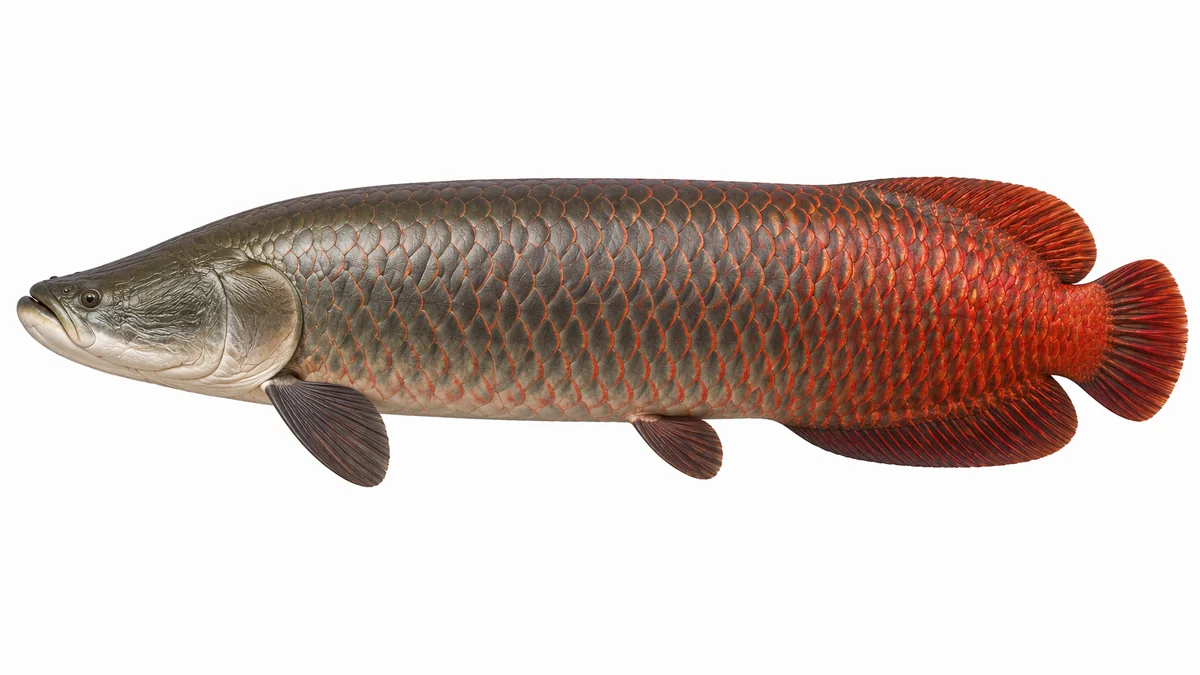
The arapaima (Arapaima gigas) is one of the largest freshwater fish on Earth and one of the strangest. It breathes air, wears armour-like scales, grows past two metres, and turns from olive-grey to red-orange towards the tail. It is also heavily protected across much of its Amazon range, so the fishing story is as much about rules and conservation as it is about tackle. This arapaima profile covers identification, habitat, diet, size, records, Brazil and CITES protection, and the limited fishing that is still allowed.
Quick ID Card
| Field | Details |
|---|---|
| Scientific name | Arapaima gigas |
| Common names | Arapaima, pirarucu (Brazil), paiche (Peru), giant arapaima |
| Family | Osteoglossidae (bony-tongued fishes) |
| Typical size | 1.5–2.5 m (5–8 ft); 50–150 kg |
| Maximum size | Reported to 3–4 m and over 200 kg |
| Water type | Warm, slow, often low-oxygen fresh water |
| Depth range | Surface to a few metres; surfaces to breathe |
| Active water temperature | Roughly 24–30°C (75–86°F) |
| Difficulty | Very hard; protected in most of its range |
| Best season | Flood season for feeding; fishing is tightly regulated |
How to Identify an Arapaima
Arapaima identification is hard to get wrong once you have seen one. The body is long, thick, and almost cylindrical, tapering to a short tail. The head is relatively small and blunt, with a short, upturned mouth and a tiny eye set high. The scales are enormous, thick, and outlined in red, giving the fish the look of something assembled from armour plates.
Colour is the giveaway. The front half is dark olive to grey-green, and the rear half, along with the tail and the edges of the fins, turns vivid red-orange. The dorsal and anal fins sit far back near the tail, and the tail fin is rounded rather than deeply forked. Big fish often show scars and rubbed patches from spawning and from pushing through flooded forest.
The behaviour is diagnostic too. Arapaima must surface to breathe, and they do it with a characteristic roll and a loud gulp, roughly every five to fifteen minutes. On a quiet Amazon lake, those rolls are often the first sign that fish are present. The combination of a huge cylindrical body, red rear, and regular surface gulps is unique.
Arapaima vs Pirarucu and Other Relatives
Arapaima vs pirarucu is a question with a simple answer: they are the same fish. Pirarucu is the Brazilian Portuguese name, and paiche is the Spanish name used in Peru. The scientific name is Arapaima gigas. Local names vary across the Amazon, but the animal is the same.
The closest visual relatives are the arowanas, which belong to the same order of bony-tongued fishes. Asian arowanas are much smaller, have barbels on the chin, and carry a different scale pattern. Arapaima have no chin barbels, a blunter head, a much thicker body, and a red rear that arowanas do not match. The other Arapaima species are difficult to separate in the field, and some populations once lumped under A. gigas are now recognised as distinct; for anglers, the practical identification is the giant size, the armour scales, and the air-breathing habit.
Is the Arapaima Dangerous?
The arapaima is not venomous, but it is a very large, very strong animal. A two-metre fish can knock a person down in a boat, break a rod, or drive a hook into a hand. The scales are thick enough to deflect a careless gaff, and the fish's thrashing is dangerous in a small boat or on a narrow bank.
Handle arapaima with respect and with the right equipment. Support the body horizontally, keep the fish in the water as much as possible, and never lift a big one by the jaw or the gill cover. Because the fish breathes air, a released arapaima must be held upright and allowed to recover before it swims away; a exhausted fish that cannot surface will drown.
The bigger danger is legal. In Brazil and much of the Amazon, arapaima are protected, and taking one outside a licensed community quota can be a serious offence. The conservation status is not a technicality: illegal fishing has collapsed populations in many rivers, and the rules exist because the species is slow to recover. Check the law before you wet a line, not after.
Where Do Arapaima Live?
Where do arapaima live? In the Amazon basin and connected waters of South America, mainly Brazil, Peru, and Guyana, with populations in neighbouring countries. They are found in the main river, in oxbow lakes, in slow tributaries, and in flooded forests and swamps during the wet season.
Arapaima habitat is warm, slow-moving, and often low in oxygen. That is exactly why the air-breathing adaptation matters. In stagnant lakes and flooded forest, the fish can gulp atmospheric air while other species struggle. They prefer quiet backwaters with plenty of cover and prey, and they move into the flooded forest as water levels rise, then retreat to lakes and channels as the water falls.
The species has been introduced outside its native range, including to parts of Asia, where it is farmed and stocked in private lakes. Those introduced populations are not wild Amazon fish, and the rules that apply to them are local, not Brazilian. A fish caught in a Thai stocked lake is a different proposition from a fish in a protected Amazon reserve.
Habits and Diet: What Do Arapaima Eat?
What do arapaima eat? They are large predators. The diet includes fish, but also birds, small mammals, reptiles, and invertebrates that fall or venture into the water. The upturned mouth is built for grabbing prey at the surface, and the fish will take floating animals as well as fish in the water column. Juveniles eat more insects and small fish before switching to larger prey.
The air-breathing habit shapes everything. Arapaima surface every few minutes, which makes them vulnerable to harpoons and nets but also means they cannot be treated like a normal fish after capture. They are most active in warm water and often feed in the early morning and late afternoon, though the surface rolls continue through the day.
Spawning is tied to the flood cycle. Arapaima build nests in shallow water or flooded vegetation, and the male guards the young after they hatch. Parental care is unusually strong for a fish of this size, and the male may stay with the brood for weeks. That behaviour makes breeding fish easy to target, which is one reason protection during the spawning season matters. Arapaima are long-lived, with a lifespan of twenty years or more.
Size, Limits and Regulations
How big do arapaima get? Fish of 3 to 4 m and more than 200 kg have been reported, and a large adult is commonly 1.5 to 2.5 m and 50 to 150 kg. The world record arapaima is usually quoted in the region of 340 lb (about 154 kg) on IGFA all-tackle gear, though much larger fish have been claimed and not verified. Treat record claims with caution, and check the current IGFA list.
Protection is the central fact of arapaima fishing. In Brazil, the species is protected, commercial fishing is banned, and harvest is restricted to licensed community management in specific reserves. The Mamirauá Sustainable Development Reserve is the best-known example, where communities count fish, work to a quota, and may take only large adults above a minimum size of roughly 1.5 m. Outside those arrangements, taking an arapaima is illegal.
Internationally, Arapaima gigas was listed on CITES Appendix II in 2019, which means trade in the species is regulated and must be accompanied by permits. The listing reflects concern about overharvesting and the importance of legal, traceable supply chains. It does not make wild fish a free resource, and it does not override national bans.
Catch-and-release sport fishing for arapaima is mainly associated with Guyana and Peru, where licensed operators run fly and lure trips in rivers and reserves. In Thailand and parts of Asia, arapaima are stocked in private lakes and caught on a catch-and-release basis. Brazil's rules are stricter, and recreational take is not generally permitted. As of 2025, confirm the current position with IBAMA in Brazil, the relevant national authority in Peru or Guyana, and the operator you plan to fish with. Last verified: November 2025.
Best bait for arapaima is a large surface lure, a big swimbait, or a fly fished near the surface, plus live or dead fish bait where local rules allow it. The strike is explosive and the fight is heavy and dogged. Use a strong rod, PE 6 to 10 braid, and a heavy leader; the fish's scales and power demand tackle that can take punishment. When do arapaima spawn? In the flood season, in shallow vegetated water, with the male guarding the brood. How to catch arapaima legally: book a licensed operator in a jurisdiction where catch-and-release is allowed, fish barbless where required, keep the fish in the water, and release it upright.
FAQ
How big do arapaima get? Common large adults are 1.5–2.5 m and 50–150 kg. Reports of 3–4 m and over 200 kg exist, though verified fish are smaller.
What is the world record arapaima? Usually quoted around 340 lb (about 154 kg) on IGFA all-tackle gear. Larger claims exist but are hard to verify; check the IGFA list.
Where do arapaima live? The Amazon basin of Brazil, Peru, and Guyana, in slow rivers, oxbow lakes, and flooded forest. They are also stocked in parts of Asia.
Arapaima vs pirarucu: are they different fish? No. Pirarucu is the Brazilian name and paiche the Peruvian name for Arapaima gigas.
What do arapaima eat? Fish, birds, small mammals, reptiles, and invertebrates. They grab prey at the surface and also hunt in the water column.
When do arapaima spawn? In the flood season, in shallow water and flooded vegetation. The male guards the young.
Can you fish for arapaima in Brazil? Generally no. Brazil protects the species, bans commercial fishing, and allows only licensed community harvest in specific reserves. Sport catch-and-release is mainly in Guyana and Peru.
What is the best bait for arapaima? Large surface lures, big swimbaits, and flies fished near the surface, plus fish bait where legal. Heavy tackle is essential.
Related Articles
- Nile Perch — another giant freshwater predator with a complicated conservation story.
- Giant Tiger Prawn — a high-value species from the same tropical belt.
- Mud Crab — an estuarine crustacean with its own female-protection rules.
- Ornate Rock Lobster — a premium reef catch managed by quota and size limits.
- All species profiles
The arapaima is a fish that seems designed to test anglers and governments at the same time: enormous, air-breathing, armoured, and slow to recover from overfishing. Learn the red rear, the armour scales, and the surface roll, and you can recognise one anywhere in the Amazon. Then learn the rules. In Brazil it is protected, CITES regulates trade, and community quotas are the exception rather than the norm; catch-and-release sport fishing belongs mainly to Guyana, Peru, and stocked lakes elsewhere. Fished legally and released carefully, the arapaima remains the greatest freshwater prize in South America.
Ready to catch one? Read our step-by-step guide: How to Catch Arapaima.
About the author and how this was tested
About the author
FishermanGuy
Bank, boat and kayak angler · fishing, crabbing and shrimping since 2021
I buy the gear, fish it for a season and write down what failed. No sponsored verdicts, no free-sample flattery. Every rig on this page has landed fish in water I can point at on a map.
How this was tested
- Every rig gets at least six trips on the same water before it is published.
- Gear is bought at retail. Free samples are labelled in the first paragraph.
- Dates show first publication and the last time the page was updated.