Field notes
Tigerfish: Identification, Habitat & Diet
Tigerfish: Identification, Habitat & Diet
The tigerfish is the fish that made the Zambezi famous. It is a silver, hard-muscled characin with a mouth full of interlocking canines, a taste for fast water, and a habit of throwing a lure back at the boat with a violent head shake. Anglers travel from Europe, South Africa and the United States to fish for it, and most of them lose a lure or two before they land anything. This profile covers tigerfish identification, habitat, diet, size, the question of tigerfish vs piranha, and how to catch one on bait and lures.
The species most anglers mean is Hydrocynus vittatus, the African tigerfish or striped tigerfish. It is not a piranha, although the two are often confused. It is a pursuit predator of open water, built for speed rather than ambush, and it lives in some of the wildest rivers left on the planet.
Quick ID Card
| Field | Details |
|---|---|
| Scientific name | Hydrocynus vittatus |
| Common names | Tigerfish, African tigerfish, striped tigerfish, Zambezi tigerfish |
| Family | Alestidae (African tetras) |
| Order | Characiformes |
| Typical size | 40–75 cm (16–30 in); 2–8 kg (4–18 lb) |
| Maximum size | About 90 cm–1 m for H. vittatus; the Congo's goliath tigerfish (H. goliath) reaches about 1.5 m and 50 kg |
| Water type | Warm, well-oxygenated rivers, lakes and reservoirs |
| Active water temperature | Roughly 22–30°C (72–86°F) |
| Difficulty | Hard; fast, acrobatic and sharp-toothed |
| Best season | Late dry season into the first rains, when water clears and fish concentrate |
How to Identify a Tigerfish
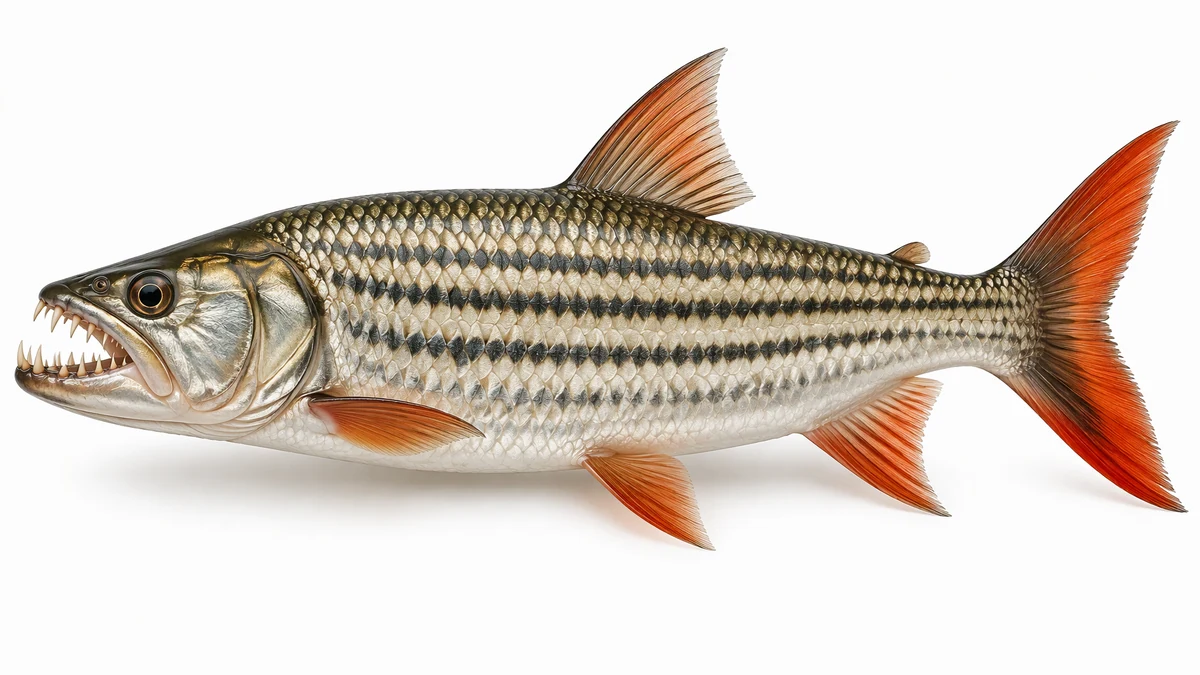
Tigerfish identification starts with the body and the mouth. The body is long, streamlined and strongly silver, with a series of dark horizontal stripes running from the gill cover to the tail. The stripes are more obvious in young fish and in clear water, and they fade on some big adults. The tail is deeply forked and usually tinged with orange or red, and the other fins often carry the same warm colour. The head is pointed, the eye is large, and the mouth is big enough to take a baitfish a third of the fish's own length.
Then there are the teeth. A tigerfish has a single outer row of about 32 large, conical teeth, with smaller teeth behind them, and the upper and lower sets interlock when the mouth closes. They are not serrated like a piranha's; they are spikes, designed to grab and hold a slippery fish. On a fresh specimen, they are visible even with the mouth shut.
The overall impression is of a scaled torpedo with a bad attitude. A tigerfish has none of the deep, round body of a piranha, and none of the mottled camouflage of a bass. If the fish is silver, striped, long, and showing a mouth full of pins, it is a tigerfish.
Tigerfish vs Piranha and Other Lookalikes
Tigerfish vs piranha is the comparison everyone asks about. Both are characiforms, and both have serious teeth, but they are different fish with different jobs. Tigerfish belong to the African tetra family, Alestidae, and hunt in open water. Piranhas belong to the Serrasalmidae, are native to South America, and have deep, laterally compressed bodies with a red or orange belly in the red-bellied species. A piranha's teeth are triangular and fit together like shears. A tigerfish's teeth are conical and interlock like a cage.
Within the tigerfish genus there are several species. The goliath tigerfish, Hydrocynus goliath, is the giant of the Congo and Lake Tanganyika, with a heavier head and a maximum around 1.5 m and 50 kg. The elongate tigerfish, H. forskahlii, is a smaller, more slender fish of West and Central Africa. H. vittatus is the widespread, striped species that most safari anglers target in the Zambezi and Okavango systems, and the one described in this profile.
The name "tigerfish" is also used for unrelated aquarium fish, including some South American and Asian species. In a fishing context, and on this site, it means the African characin.
Is the Tigerfish Dangerous?
Tigerfish are not venomous, and they do not hunt people. There is no reliable record of a tigerfish killing a swimmer, and tales of them attacking canoes and cattle belong more to bar-room storytelling than to field biology. That said, a hooked tigerfish is a genuine hazard.
The teeth are the reason. A 5 kg fish can remove a finger, and it can cut through 20–30 lb nylon as if it were cotton. Experienced anglers use a wire trace of 30–40 lb, sometimes heavier, and they never put a hand near the mouth. Unhook the fish with long-nosed pliers or a jaw spreader, keep the head pointed away from your body, and hold the fish behind the gill cover with a wet cloth if you must lift it. A fish that is thrashing in a boat with treble hooks attached is the real danger, not the fish in the water.
The environment adds its own risks. Zambezi and Congo tributaries carry hippos, crocodiles, fast water and remote country. Fish with a guide, wear a life jacket, and treat the river with more respect than you treat the fish.
Where Do Tigerfish Live?
Tigerfish habitat is warm, oxygen-rich flowing water. Hydrocynus vittatus is widespread across central and southern Africa, with strong populations in the Zambezi, Okavango, Limpopo, Rufiji and Congo systems, and in large reservoirs such as Lake Kariba and Cahora Bassa. The goliath tigerfish is more restricted, with its stronghold in the Congo basin and Lake Tanganyika.
Within a river, tigerfish prefer the places where current does something interesting. They hold around rapids, riffles, eddies, sandbanks, confluence seams, and the mouths of channels, where baitfish are pushed together and disoriented. Big fish also patrol deep pools below rapids and the edges of drop-offs in lakes. They are not structure-huggers like bass or Murray cod; they are open-water hunters that use current and light to trap prey.
Juveniles live in quieter water, often among marginal vegetation and flooded grass, before moving out into the main flow. Water temperature matters: the fish are most active between about 22 and 30°C, and they become harder to find in cold, dirty water. In the Zambezi, the best fishing typically comes in the late dry season, when the water clears and the fish concentrate in the remaining channels, and again when the first rains stir the system.
Habits and Diet: What Do Tigerfish Eat?
What do tigerfish eat? Mostly other fish. The diet is dominated by small schooling species such as sardines, butterfish, cichlids and juvenile tigerfish, along with insects, shrimp and whatever else is available. Tigerfish are pursuit predators: they accelerate, grab, and then turn away with the prey held crosswise in those interlocking teeth. They often hunt in loose packs, driving baitfish to the surface, and when a shoal is cornered the water can erupt with fish jumping in every direction.
That surface activity is one of the reasons tigerfish are such a popular sportfish. A feeding frenzy is visible from a distance, and a well-placed spoon or swimbait cast into the edge of it usually gets attention. The strikes are violent, and the fight is fast, with repeated jumps and head shakes.
Tigerfish also have a stranger trick. In 2014, researchers in Botswana documented H. vittatus leaping from the water to catch barn swallows in flight, which was the first published evidence of a freshwater fish taking birds on the wing. It is a reminder that this is an opportunistic predator with an athletic range that most fish cannot match.
When do tigerfish spawn? Spawning is tied to the rains. In southern Africa, it generally happens between about December and March, when rivers rise and flood onto marginal plains. Adults move upstream or into newly flooded habitat, and the females release large numbers of eggs into the water column. There is no parental care. The young fish use the flooded grass as nursery cover, and they grow quickly in the warm, food-rich water. Tigerfish mature in roughly two to four years, and they can live for a decade or more.
Size, Records and Regulations
How big do tigerfish get? Most H. vittatus caught by anglers are between 40 and 75 cm and weigh 2 to 8 kg. A fish over 90 cm is a good one anywhere, and a fish near a metre is exceptional. The all-tackle world record recognized by the International Game Fish Association is a fish of roughly 31 lb (14 kg); check the IGFA's current listing, because record status changes. The goliath tigerfish is in a different class, with verified fish around 1.5 m and 50 kg.
The best bait for tigerfish is a live baitfish of 10–15 cm, hooked through the back or lips and fished on a strong wire trace. Dead bait works, but it does not trigger the same response. On the artificial side, metal spoons, large swimbaits, flukes and topwater plugs all catch fish, especially when retrieved fast. The classic tigerfish strike comes on the drop or on a sudden change of speed, so keep the lure moving and be ready to strike hard.
How to catch tigerfish: find current, find bait, and fish the seam. Cast upstream and retrieve with the current, or cast across an eddy and let the lure swing. Use a rod with enough backbone to turn a jumping fish, a reel with a smooth drag, and 30–50 lb braid. Set the drag a little lighter than you would for a similar-sized bass, because the first run is explosive. Keep the rod tip low during jumps to reduce the chance of throwing the hook, and never grab the leader with a bare hand.
Regulations vary by country and by water, and they change. In the Zambezi and Okavango regions, catch-and-release is encouraged and often required for trophy fish, and some operators and reserves operate strict single-hook or barbless rules. National agencies such as the Zambian Department of Fisheries, the Zimbabwe Parks and Wildlife Management Authority, the Namibia Ministry of Environment, Forestry and Tourism, and South Africa's Department of Forestry, Fisheries and the Environment set the rules in their waters. As of 2025, check the current licence, bag limit and closed-season requirements before you travel. Last verified: November 2025.
FAQ
How big do tigerfish get? Most are 40–75 cm and 2–8 kg. A fish over 90 cm is exceptional. The goliath tigerfish, a different species, reaches about 1.5 m and 50 kg.
What is the world record tigerfish? The IGFA all-tackle record for Hydrocynus vittatus is roughly 31 lb (14 kg). Check the IGFA listing for the current record and line-class details.
Where do tigerfish live? In warm, flowing water across central and southern Africa, including the Zambezi, Okavango, Limpopo, Rufiji and Congo systems, plus large reservoirs such as Kariba and Cahora Bassa.
What do tigerfish eat? Mostly small fish, along with insects, shrimp and whatever else they can catch. They hunt in open water and sometimes leap from the surface to take birds.
Tigerfish vs piranha: what is the difference? Tigerfish are African, long-bodied, open-water hunters with conical interlocking teeth. Piranhas are South American, deep-bodied, often red-bellied, and have triangular shearing teeth.
When do tigerfish spawn? With the rains, roughly December to March in southern Africa, when rivers rise and flood onto marginal plains. There is no parental care.
What is the best bait for tigerfish? A live baitfish on a wire trace. Spoons, swimbaits, flukes and topwater plugs also work well when retrieved fast around current.
How do you catch tigerfish? Fish current seams and eddies with a wire trace, cast upstream or across the flow, retrieve fast, and keep the rod tip low during jumps.
Related Articles
- Piranha — the other famous toothy characin, and a very different fish.
- Nile Perch — another African giant and a top predator of the same waters.
- Taimen — a huge, hard-fighting freshwater predator for anglers who like wild rivers.
- All species profiles
The tigerfish is not the monster of legend, but it is one of the hardest freshwater fish in the world to land on light tackle. Learn the stripes, the teeth and the current seams, use a wire trace, and give the fish a clean release. Catch one in the Zambezi and you will understand why anglers keep going back.
Ready to catch one? Read our step-by-step guide: How to Catch Tigerfish.
About the author and how this was tested
About the author
FishermanGuy
Bank, boat and kayak angler · fishing, crabbing and shrimping since 2021
I buy the gear, fish it for a season and write down what failed. No sponsored verdicts, no free-sample flattery. Every rig on this page has landed fish in water I can point at on a map.
How this was tested
- Every rig gets at least six trips on the same water before it is published.
- Gear is bought at retail. Free samples are labelled in the first paragraph.
- Dates show first publication and the last time the page was updated.