Field notes
Piranha: Identification, Habitat & Diet
Piranha: Identification, Habitat & Diet
The piranha has a reputation that is mostly fiction and a bite that is mostly fact. The red-bellied piranha, Pygocentrus nattereri, is a small, deep-bodied fish of the Amazon and Orinoco basins, and it is nowhere near the unstoppable pack killer of old movies. It is, however, a genuine predator with triangular teeth, a powerful jaw, and a strong response to blood and vibration in the water. This profile covers piranha identification, habitat, diet, the real story behind piranha attacks, how it differs from a pacu, and how to catch one.
Piranhas are also a fine sportfish. They hit hard, fight above their weight, and are abundant in many South American rivers, which makes them a favorite target for visiting anglers and a standard part of a Pantanal fishing trip.
Quick ID Card
| Field | Details |
|---|---|
| Scientific name | Pygocentrus nattereri |
| Common names | Red-bellied piranha, red piranha, red-bellied piranha |
| Family | Serrasalmidae (piranhas and pacus) |
| Order | Characiformes |
| Typical size | 15–25 cm (6–10 in); 0.5–1.5 kg (1–3 lb) |
| Maximum size | About 30–35 cm (12–14 in); fish over 3 kg are exceptional |
| Water type | Warm lowland rivers, flooded forests, lakes and backwaters |
| Active water temperature | Roughly 23–28°C (73–82°F) |
| Difficulty | Moderate; easy to catch, demanding to unhook safely |
| Best season | Dry season, when fish concentrate in shrinking water bodies |
How to Identify a Piranha
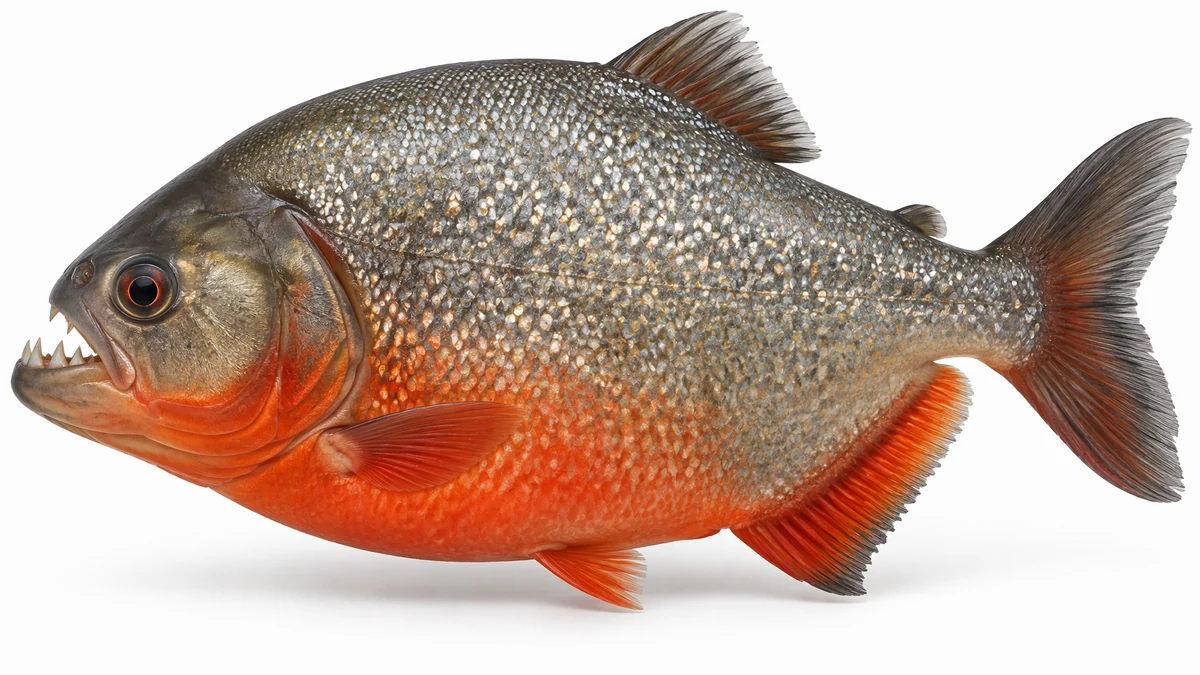
Piranha identification is straightforward once you know what to look at. The red-bellied piranha has a deep, laterally compressed body, a blunt head, and a heavy lower jaw that juts past the upper jaw. The back and upper flanks are silver-grey, often speckled with dark spots, and the belly, chest, and anal fin are red to orange. The colour is strongest in healthy adults and weaker in stressed or young fish.
The teeth are the clincher. A piranha has a single row of sharp, triangular teeth in each jaw, and the upper and lower rows meet like a set of shears. The teeth are visible when the mouth is open, and the whole jaw assembly is built for slicing rather than gripping. If you catch a deep-bodied silver fish with a red belly and a mouth full of triangles, you have a piranha.
Juveniles can be trickier. They are more silvery, less red, and often have dark vertical bars or spots that break up the body outline. They also school tightly in marginal cover, which is exactly where young fish should be.
Piranha vs Pacu and Other Lookalikes
Piranha vs pacu is the most important identification question in South America, because pacus are closely related, grow much larger, and are usually harmless. Both have deep bodies and both belong to the Serrasalmidae. The difference is in the teeth and the face. A piranha has pointed, triangular teeth and a protruding lower jaw. A pacu has flat, square, human-like teeth and a more rounded snout, and it feeds largely on fruit, seeds, and plant material.
Pacus also grow much bigger. The tambaqui (Colossoma macropomum) and other pacus can reach 30 kg or more, while a big red-bellied piranha is a 2–3 kg fish. Colour helps: pacus are usually darker, without the bright red belly of P. nattereri, though some pacus have red on the belly as juveniles.
There are other piranhas, too. The black piranha (Serrasalmus rhombeus) is a larger, solitary, darker fish with a more pointed head and a reputation as the most aggressive species. The San Francisco piranha (Pygocentrus piraya) is a big, blunt-headed relative from the São Francisco basin. All of them have the same basic triangular-tooth design, and all deserve careful handling.
Are Piranha Dangerous?
Are piranha dangerous? Yes, but not in the way the films suggest. A piranha can take a chunk out of a hand, and a shoal in feeding mode can strip a fish carcass quickly. What piranhas do not do is coordinate a planned attack on a healthy adult human in open water. The real incidents are mostly bites to hands and feet, and they happen in specific conditions: shallow water, low water levels, warm temperatures, people washing or cleaning fish, and fish concentrated in pools with little food.
Fatal attacks are extremely rare. When they happen, they usually involve small children, incapacitated adults, or people who fall into water where fish are already feeding. The pattern is opportunistic, not cinematic. The dry season is the riskiest time, because water levels fall, fish crowd together, and food is scarce.
The bite itself is impressive for the fish's size. A 2012 study in Scientific Reports found that some piranhas, including the black piranha, can bite with a force of roughly 30 times their own body weight, one of the strongest bites relative to mass of any bony fish. The jaw muscles are huge, the teeth are self-sharpening, and the lower jaw works like a lever.
For anglers, the danger is practical. A hooked piranha is a small, furious fish with a mouth full of blades, and it will bite anything within reach. Use long-nosed pliers or a hook-out, keep your fingers away from the mouth, and never hold a piranha by the jaw. A wire trace is essential, because a piranha will cut through mono and braid. The fish is not venomous, and it is good to eat, but it demands more respect than its size suggests.
Where Do Piranha Live?
Piranha habitat is warm, slow-moving lowland water. The red-bellied piranha is native to the Amazon basin, the Orinoco basin, the Essequibo, and parts of the Paraná-Paraguay system, with populations across Brazil, Peru, Colombia, Venezuela, Bolivia, Ecuador, and the Guianas. It has also been introduced in some other tropical waters, usually through the aquarium trade.
Within a river system, piranhas use flooded forests, oxbow lakes, backwaters, slow channels, and the edges of main rivers. They tolerate low-oxygen water and a range of water chemistry, and they are often most abundant in quiet, vegetated habitats rather than fast current. During the wet season they spread into the flooded forest to feed and spawn; during the dry season they retreat to lakes, pools, and the deeper parts of channels.
Water temperature is a useful guide. Piranhas are most active between about 23 and 28°C, and they become sluggish in cooler water. They are also sensitive to disturbance, and a shoal that is feeding can go quiet quickly if a boat motor or a shadow passes overhead.
Habits and Diet: What Do Piranha Eat?
What do piranha eat? The answer is broader than most people expect. Red-bellied piranhas are omnivores. They eat fish, insects, crustaceans, worms, snails, and carrion, and they also take fins from larger fish, fruit, and seeds when those are available. The classic image of a pack bringing down a large animal is rare; a more typical meal is a smaller fish, an insect that fell into the water, or a dead fish on the bottom.
Piranhas are schooling fish, and shoals of 20 to 100 fish are common. The school is a defense against predators as much as a hunting strategy. When a shoal feeds, the fish make a low grunting or croaking sound, and the water can boil briefly as they tear at a carcass. But they also spend long periods doing very little, holding in cover or drifting in slow water.
When do piranha spawn? Spawning is tied to the rainy season, when warm water and flooded habitat become available. The fish build nests in vegetation or on the bottom, and the male guards the eggs and the young. A female can lay thousands of eggs, and the young grow quickly in the food-rich floodplain. Piranhas mature at around one year old and can live for a decade or more in the wild.
The seasonal cycle explains the reputation. In the dry season, fish are packed into small pools, food is limited, and any blood or struggle in the water sets off a feeding response. That is when bites happen. In the wet season, the same fish are spread across a flooded forest with plenty to eat, and they are much less of a problem.
Size, Records and Regulations
How big do piranha get? Most red-bellied piranhas caught by anglers are 15–25 cm and weigh under 1.5 kg. A 30 cm fish is a good one, and anything over 3 kg is exceptional. The IGFA all-tackle record for the red-bellied piranha is under 4 kg; check the IGFA's current listing for the exact mark. The black piranha grows larger and is the species most likely to be called a "giant piranha."
The best bait for piranha is a piece of fresh fish, a prawn, or a chunk of meat fished on a wire trace and a strong hook. Piranhas are not fussy, and a bait that bleeds a little works better than a clean one. Small spoons, spinners, and soft plastics also catch fish, especially when retrieved quickly through a school. The strike is usually a sharp tug followed by a frantic fight, and the fish often bites through the line if the trace is too light.
How to catch piranha: fish slow water near cover, use a wire trace of 20–30 lb, and keep the bait small enough for a 20 cm fish to take. Cast near submerged vegetation, flooded timber, or the edge of a channel, and let the bait sit for a minute before moving it. When a fish takes, strike firmly and keep the line tight. Land the fish with a net or a firm grip behind the head, and use pliers to remove the hook.
Regulations vary widely across South America, and the details matter. In Brazil, piranha fishing is generally allowed with a state or federal fishing licence, and many sport-fishing lodges in the Pantanal operate catch-and-release policies for piranha and other species. Piranhas are not protected in the way the arapaima is: arapaima fishing is tightly controlled, with strict size limits and closed areas in many states, while piranha is a common food fish and a standard sport target. Even so, local rules on bag limits, gear, and closed seasons apply, and they change. As of 2025, check with IBAMA, the relevant state environmental agency, or your lodge before you fish. Last verified: November 2025.
FAQ
How big do piranha get? Most red-bellied piranhas are 15–25 cm and under 1.5 kg. A 30 cm fish is large, and fish over 3 kg are rare. The black piranha grows bigger.
Are piranha dangerous? They can give serious bites, especially in shallow water during the dry season, but coordinated attacks on healthy adults are rare. Fatal attacks are extremely rare.
What do piranha eat? Fish, insects, crustaceans, worms, carrion, fins, fruit, and seeds. They are omnivores, not obligate blood feeders.
Where do piranha live? In warm lowland rivers, flooded forests, lakes, and backwaters of the Amazon, Orinoco, Essequibo, and Paraná-Paraguay basins in South America.
Piranha vs pacu: how do you tell them apart? Piranhas have triangular, pointed teeth and a protruding lower jaw. Pacus have flat, square teeth, a rounder snout, and grow much larger.
When do piranha spawn? In the rainy season, when warm water floods the forest. The male guards the nest and the young.
What is the best bait for piranha? Fresh fish, prawn, or meat on a wire trace. Small spoons and spinners also work when fished fast.
How do you catch piranha? Fish slow water near cover with a wire trace and a small bait, strike firmly, and unhook with pliers. Keep fingers away from the mouth.
Related Articles
- Tigerfish — Africa's toothy characin, often compared with the piranha.
- Arapaima — the giant of the same Amazon waters, and a very different fishing proposition.
- All species profiles
The piranha is a small fish with a large legend. Treat it as a sharp-toothed omnivore rather than a movie monster, fish it with a wire trace, and handle it with pliers. In the right water, on the right day, it is one of the most entertaining light-tackle fish in South America.
Ready to catch one? Read our step-by-step guide: How to Catch Piranha.
About the author and how this was tested
About the author
FishermanGuy
Bank, boat and kayak angler · fishing, crabbing and shrimping since 2021
I buy the gear, fish it for a season and write down what failed. No sponsored verdicts, no free-sample flattery. Every rig on this page has landed fish in water I can point at on a map.
How this was tested
- Every rig gets at least six trips on the same water before it is published.
- Gear is bought at retail. Free samples are labelled in the first paragraph.
- Dates show first publication and the last time the page was updated.