Field notes
Ornate Rock Lobster: Identification, Habitat & Diet
Ornate Rock Lobster: Identification, Habitat & Diet
The ornate rock lobster (Panulirus ornatus) is the showpiece of the tropical spiny lobsters: a big, spiny, intricately patterned animal with long antennae, no claws, and a tail built for swimming backwards into a crevice. It supports one of Australia's most valuable tropical fisheries, migrates in vast lines across Torres Strait, and commands premium prices live in Asia. This ornate rock lobster profile covers identification, habitat, diet, size, the Australian rules, how it differs from the western rock lobster, and how to catch one.
Quick ID Card
| Field | Details |
|---|---|
| Scientific name | Panulirus ornatus |
| Common names | Ornate rock lobster, ornate spiny lobster, tropical rock lobster, painted lobster |
| Family | Palinuridae (spiny lobsters) |
| Typical size | 30–45 cm (12–18 in) total length; 1–3 kg |
| Maximum size | About 50–60 cm and 4–5 kg |
| Water type | Tropical marine, coral and rock reefs |
| Depth range | Roughly 1–50 m |
| Active water temperature | Roughly 22–30°C (72–86°F) |
| Difficulty | Pot or hand capture; spiny and strong |
| Best season | Warm months; Torres Strait season is managed separately |
How to Identify an Ornate Rock Lobster
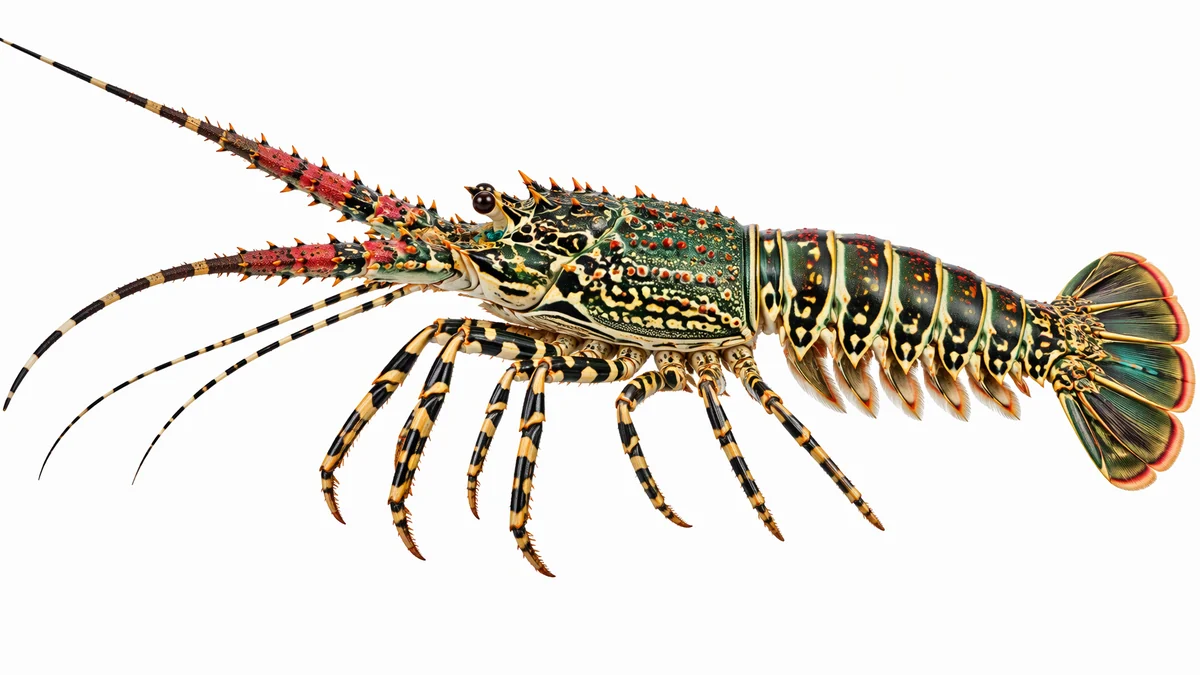
Ornate rock lobster identification is mostly about pattern. The carapace is covered in spines and painted with an intricate mosaic of green, cream, black, and red, and the abdomen carries bold bands and spots that look almost tropical-fish bright. No other Australian spiny lobster is this heavily ornamented, which is where the name comes from.
The head carries two huge spiny antennae, longer than the body, plus smaller antennules. There are no large claws; spiny lobsters do not have them. The legs are banded, the tail fan is broad and powerful, and the eyes sit on stalks. A big ornate can look almost armour-plated, and the spines point in every direction.
Sexing is possible but not always obvious. Females have a wider abdomen and, when breeding, carry a mass of orange eggs under the tail. Males tend to be larger and heavier in the head and tail. Juveniles are more secretive and often settle in shallow reef crevices before moving deeper.
Ornate Rock Lobster vs Western Rock Lobster and Other Relatives
The comparison that comes up most often is ornate rock lobster vs western rock lobster. The western rock lobster (Panulirus cygnus) is the temperate species of Western Australia, smaller, reddish, and the backbone of a long-established licensed fishery. The ornate is tropical, larger, far more colourful, and fished mainly in Queensland and Torres Strait. Their ranges barely overlap, and the rules are completely separate.
Within the tropics, the ornate can be confused with other Panulirus species such as the painted and scalloped spiny lobsters, which are smaller and less boldly marked. The Chinese or Japanese spiny lobsters have different patterns and ranges. The reliable checks are the ornate mosaic on the carapace, the very long spiny antennae, and the absence of any large claw. If it has big claws, it is not a spiny lobster at all.
Is the Ornate Rock Lobster Dangerous?
The ornate rock lobster is not venomous, but it is well armed. The carapace is covered in sharp spines, and the antennae carry rows of teeth that can rake a hand. A lobster thrashing in a boat can drive a spine into a finger or a shin, and the wounds are prone to infection because they are deep and dirty.
Handle them from the carapace, behind the antennae, with the tail pointing away from your body. Gloves help, and so does chilling the animal before you measure it. Do not grab a lobster by the antennae or the tail fan; both give it leverage to jerk free and cut you.
Food safety is the other issue. Lobsters spoil quickly, and raw or undercooked meat can carry Vibrio and other bacteria. Keep the catch cold, cook it thoroughly, and do not eat lobster that has died before cooking. Shellfish allergies apply to crustaceans, so treat lobster as a serious allergen.
Where Do Ornate Rock Lobsters Live?
Where do ornate rock lobsters live? Across the tropical Indo-West Pacific, from the Red Sea and East Africa through India and Southeast Asia to southern Japan, the Philippines, Indonesia, Papua New Guinea, the Solomon Islands, Fiji, and northern Australia. In Australia the main grounds are the Great Barrier Reef and Torres Strait, with smaller numbers along the tropical north and west.
Ornate rock lobster habitat is coral reef and rocky reef, roughly one to fifty metres deep. They shelter in caves, ledges, and crevices by day, often in groups, and come out at night to feed. The best habitat has plenty of holes, strong current, and a mix of coral, rock, and rubble. Unlike the mud crab, the ornate is a reef animal and does not tolerate muddy estuaries.
The species is famous for a mass migration. Mature ornate lobsters move from the Torres Strait and the northern Great Barrier Reef towards spawning grounds in the Gulf of Papua, travelling in long queues across the seabed. That migration is one reason the fishery is managed across national borders and why the Torres Strait Protected Zone has special rules.
Habits and Diet: What Do Ornate Rock Lobsters Eat?
What do ornate rock lobsters eat? They are nocturnal predators and scavengers. The diet includes molluscs such as snails and small clams, crustaceans, sea urchins, worms, and carrion. Without crushing claws, they use the legs and mouthparts to hold and tear food, and they will readily take dead fish or other bait.
By day they retreat into crevices, often with the antennae projecting and the tail tucked in. Spiny lobsters do not dig burrows like mud crabs; they rely on reef structure for shelter. That makes them vulnerable to habitat damage and easy to target with pots placed near known holes.
Reproduction is tied to the offshore migration. Females carry fertilised eggs under the tail, and the larvae, called phyllosoma, drift in the plankton for months before settling as small lobsters. That long larval life connects populations across huge distances and makes local management dependent on what happens elsewhere. Ornate rock lobsters are long-lived, with a lifespan of roughly ten to fifteen years.
Size, Limits and Regulations
How big do ornate rock lobsters get? Large adults reach about 50 to 60 cm in total length and 4 to 5 kg, though most legal fish are smaller. A typical adult is 30 to 45 cm and one to three kilograms. Lifespan is about ten to fifteen years, so they grow slowly and cannot replace heavy fishing pressure quickly.
In Queensland, tropical rock lobsters including the ornate are managed with a minimum carapace length of roughly 115 mm, a small bag limit, and protection for egg-bearing females. Soft-shelled lobsters and lobsters with eggs must be returned, and taking only the tail is not allowed. In the Torres Strait Protected Zone, traditional inhabitants have separate fishing rights, and the commercial fishery is managed by the Australian Fisheries Management Authority (AFMA) with a total allowable catch and seasonal rules.
Western Australia manages its own western rock lobster fishery under a completely different regime, with a higher-profile licensed recreational sector and a minimum size around 76 mm carapace length for that species. Do not carry western rock lobster rules into Queensland waters; the species, the measurements, and the seasons differ.
As of 2025, check the current rules with the Queensland Department of Agriculture and Fisheries, AFMA for Torres Strait, and the WA Department of Primary Industries and Regional Development if you are fishing the west. Rules on gear, possession, and egg-bearing females are enforced, and the ornate fishery is valuable enough that compliance matters. Last verified: November 2025.
How to catch ornate rock lobster: commercial fishers use baited pots and, in some sectors, hand collection by divers. Recreational fishers mostly take them by hand while diving or snorkelling on reef, and some use pots where permitted. Work at night when the lobsters are active, check the carapace length, return egg-bearing females, and never take a lobster that is soft-shelled or undersized.
FAQ
How big do ornate rock lobsters get? Up to about 50–60 cm and 4–5 kg, though most adults are 30–45 cm and 1–3 kg.
Ornate rock lobster vs western rock lobster: what is the difference? The ornate is tropical, larger, and brightly patterned, fished in Queensland and Torres Strait. The western is temperate, smaller, and fished in Western Australia under separate rules.
Where do ornate rock lobsters live? Coral and rocky reefs of the tropical Indo-Pacific, from East Africa to northern Australia and Fiji, in about 1–50 m.
What do ornate rock lobsters eat? Snails, small clams, crustaceans, sea urchins, worms, and carrion. They feed at night and shelter in reef crevices by day.
When do ornate rock lobsters spawn? Females carry eggs under the tail and release larvae offshore. The Torres Strait population migrates to spawning grounds in the Gulf of Papua.
How do you catch ornate rock lobster? Commercially with baited pots or by hand; recreationally by hand while diving, where permitted. Check size, gear, and female rules first.
What is the ornate rock lobster price? It is a premium live-export product, especially to China, and wholesale prices are high and volatile. Expect to pay well above western rock lobster at retail.
Are ornate rock lobsters dangerous? Not venomous, but the spines and antennae can cause deep, infection-prone wounds. Handle from the carapace with gloves.
Related Articles
- Mud Crab — a clawed crustacean from the same tropical coast.
- Giant Tiger Prawn — another high-value Indo-Pacific crustacean.
- Nile Perch — a giant freshwater predator with a different set of rules.
- Arapaima — an Amazon giant that is protected rather than targeted.
- All species profiles
The ornate rock lobster is the most colourful and one of the largest spiny lobsters in the Indo-Pacific, and its value reflects that. Learn the mosaic carapace, the long spiny antennae, and the absence of claws, and you can tell it from every other lobster on the reef. Respect the carapace-length rule, the female protection, and the Torres Strait arrangements, and this ornate rock lobster will remain a sustainable premium catch rather than a story about what used to be there.
Ready to catch one? Read our step-by-step guide: How to Catch Ornate Rock Lobster.
About the author and how this was tested
About the author
FishermanGuy
Bank, boat and kayak angler · fishing, crabbing and shrimping since 2021
I buy the gear, fish it for a season and write down what failed. No sponsored verdicts, no free-sample flattery. Every rig on this page has landed fish in water I can point at on a map.
How this was tested
- Every rig gets at least six trips on the same water before it is published.
- Gear is bought at retail. Free samples are labelled in the first paragraph.
- Dates show first publication and the last time the page was updated.