Field notes
How to Catch Ornate Rock Lobster: Pots & Reef Tactics
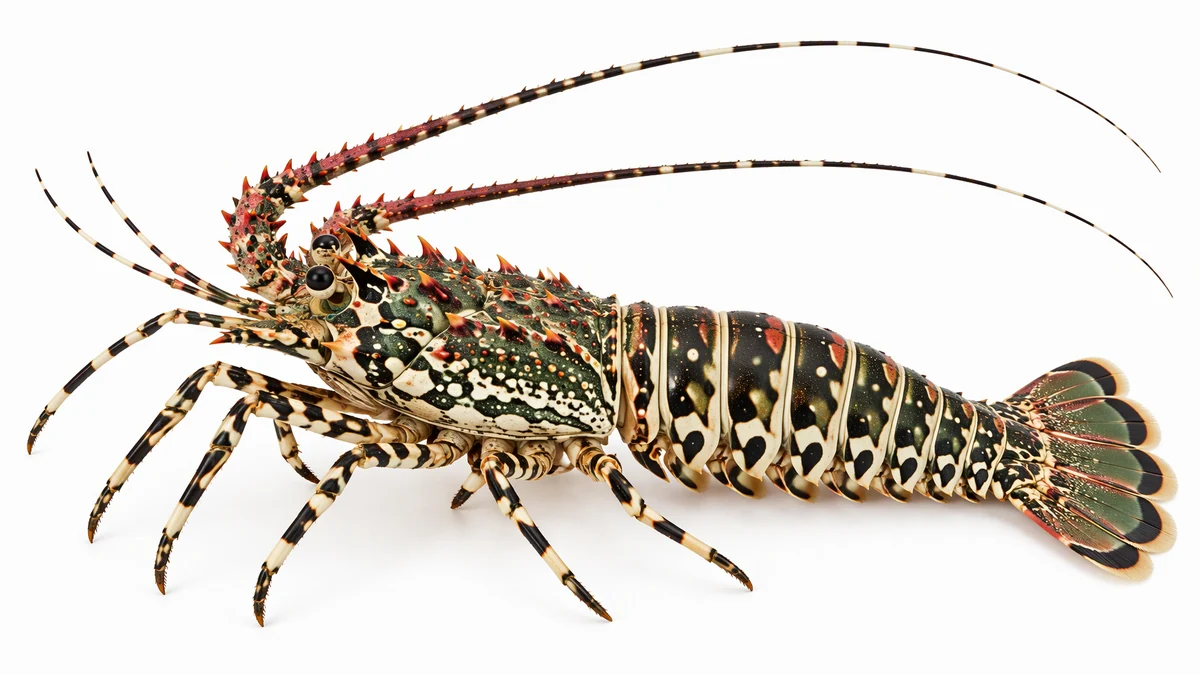
How to Catch Ornate Rock Lobster
The ornate rock lobster is the showpiece of the tropical spiny lobsters: big, spiny, intricately patterned, and worth a premium at the market. It has no claws, so it cannot pinch you, but it is armoured in every other way and lives in reef caves that reward a careful approach. Learning how to catch ornate rock lobster means working nights on the reef, either with a baited pot where permitted or by hand on a dive, and knowing the carapace-length rule before you touch one. Read the full Ornate Rock Lobster species profile for identification and biology; this guide covers the catching.
Best Time to Catch Ornate Rock Lobster
The best time to catch ornate rock lobster is the warm season, at night, when the lobsters leave their caves to feed. They are most active in water of roughly 22 to 30°C, so the tropical summer is the natural window across northern Australia and the rest of its range.
Night is non-negotiable for most methods. By day the lobster sits deep in a cave or under a ledge, often in groups, with its antennae out and its tail tucked. After dark it comes out to hunt, and that is when a pot fishes and a diver can find one in the open. Dawn and the first hours of darkness are the best edges of the night.
Tide and moon shape the detail. A running tide carries scent to pots and stirs the reef life the lobster feeds on. Dark nights suit hand capture, because a lobster is less shy and your torch does more work. Bright moonlit nights are slower on the shallow reef but can still fish in deeper water.
The Torres Strait population adds a calendar of its own. Mature lobsters migrate from Torres Strait and the northern Great Barrier Reef toward spawning grounds in the Gulf of Papua, travelling in long queues across the seabed. The commercial fishery is managed around that cycle, and the Torres Strait Protected Zone has special rules. For a recreational fisher, the practical advice is simple: check the current season and closures with the state or Commonwealth agency, because they are timed to the migration and the spawn.
Best Gear for Ornate Rock Lobster
Ornate rock lobster gear is pot gear or dive gear, depending on what your state allows.
| Gear | What it does |
|---|---|
| Rock lobster pot | A baited trap set on reef where pots are permitted |
| Pot rope and float | Marks the pot and lets you haul it from the surface |
| Dive mask, fins and snorkel | For hand capture on shallow reef |
| Dive torch | Lights caves, ledges and lobsters at night |
| Gloves | The spines and antennae rake bare hands |
| Catch bag | Holds the catch securely while you keep working |
| Measuring gauge | Checks carapace length against the 115 mm rule |
| Boat with sounder | Finds reef structure and gets you home safely |
Pot rules differ by jurisdiction and by zone, so confirm what is legal before you buy. In Queensland, tropical rock lobsters are managed with a minimum carapace length of roughly 115 mm, a small bag limit, and protection for egg-bearing females; soft-shelled lobsters must be returned, and taking only the tail is not allowed. Some recreational fishers use pots where permitted, but hand capture while diving or snorkelling is the more common route.
For hand capture, the gear list is short but the technique matters. A good torch, a sturdy catch bag and a gauge on a lanyard are the essentials. A tickle stick or similar probe can help ease a lobster out of a cave, but check whether your state allows it; some restrict what you can use.
Best Bait for Ornate Rock Lobster
The best bait for ornate rock lobster is oily fish, and the stronger the smell the better. Fish heads, mackerel, tuna heads, squid and fish frames all work. Spiny lobsters are nocturnal scavengers, and a pot full of oily fish draws them from a surprising distance in clear tropical water.
Whole fish heads are the potter's standard because they are tough and leak scent for hours. Tuna or mackerel heads are excellent. Squid is tougher still and suits an overnight soak. Tie the bait into the pot so lobsters have to work at it rather than drag it out.
Because spiny lobsters have no crushing claws, they cannot break into a hard bait. They use their legs and mouthparts to hold and tear, so a soft, fleshy bait is easier for them to feed on than a hard-shelled one. That is also why a bait that is firmly secured still works: the lobster can pick at it for hours without freeing it.
For hand capture there is no bait. You are hunting, not attracting. The bait side of this fishery is entirely about pots.
Ornate Rock Lobster Rigs
An ornate rock lobster rig is a pot setup or a dive setup. These three cover the fishery.
The pot rig. A legal rock lobster pot on a length of rope with a float, baited with fish heads and set on reef structure in roughly 5 to 30 metres. Set it so it sits flat, mark it clearly, and soak it overnight. This is the low-effort method and the one that works while you sleep.
The dive rig. Mask, fins, torch, gloves, catch bag and gauge on a lanyard. Work the reef at night, shine the torch into caves and under ledges, and take legal lobsters by hand. This is the active method and the one that produces the biggest lobsters, because you can see and measure before you commit.
The shallow snorkel rig. On a shallow reef flat, a snorkel, mask and torch are enough. Work the ledges on a rising tide, when lobsters move shallower to feed, and check every cave carefully before you reach in. It is the most accessible version of the dive rig and a good way to learn the reef.
Whichever rig you use, the carapace-length gauge is not optional. A lobster that looks big in the torchlight is often short, and the measurement is taken on the carapace, not the tail.
How to Catch Ornate Rock Lobster, Step by Step
- Check the rules for your zone. Size, bag limit, pot rules, female protection and Torres Strait arrangements all apply.
- Find reef structure. Caves, ledges and crevices in 1 to 50 metres hold lobsters. Use a sounder or local knowledge.
- Work at night. Set pots in the evening and haul at dawn, or dive after dark when the lobsters are out.
- Bait pots with oily fish. Fish heads, mackerel or tuna heads, tied in, and set the pot flat on the reef.
- Approach quietly on a dive. Shine the torch into the cave, spot the lobster, and ease it out rather than grabbing blindly.
- Handle from the carapace. Grip behind the antennae with the tail pointing away, and wear gloves.
- Measure carapace length. 115 mm in Queensland. Return shorts, soft-shells and egg-bearing females immediately.
- Keep the catch cool and legal. No tailing, no undersized lobsters, and a cool box for the trip home.
Where to Catch Ornate Rock Lobster
Ornate rock lobster live across the tropical Indo-West Pacific, from the Red Sea and East Africa through India and Southeast Asia to southern Japan, the Philippines, Indonesia, Papua New Guinea, the Solomon Islands, Fiji and northern Australia. In Australia the main grounds are the Great Barrier Reef and Torres Strait, with smaller numbers along the tropical north and west.
The habitat is coral reef and rocky reef, roughly 1 to 50 metres deep. They shelter in caves, ledges and crevices by day, often in groups, and come out at night to feed. The best ground has plenty of holes, strong current and a mix of coral, rock and rubble. Unlike the mud crab, the ornate is a reef animal and does not tolerate muddy estuaries.
For a recreational fisher, the targets are the reef edges, ledges and bommies where caves are abundant. Shallow reef flats fish on a rising tide at night; deeper reef edges fish on a running tide. Local knowledge of which caves hold lobsters is worth more than any piece of gear, and a few exploratory dives will teach you more than a chart.
Ornate Rock Lobster Regulations and Safety
Ornate rock lobster rules are set by state and Commonwealth agencies and are strictly enforced. As of 2025, Queensland manages tropical rock lobsters including the ornate with a minimum carapace length of roughly 115 mm, a small bag limit, and protection for egg-bearing females. Soft-shelled lobsters and lobsters with eggs must be returned, and taking only the tail is not allowed.
In the Torres Strait Protected Zone, traditional inhabitants have separate fishing rights, and the commercial fishery is managed by the Australian Fisheries Management Authority with a total allowable catch and seasonal rules. Western Australia manages its own western rock lobster fishery under a completely different regime, with a minimum size around 76 mm carapace length for that species and its own seasons. Do not carry western rock lobster rules into Queensland waters; the species, the measurements and the seasons differ.
Check the current rules with the Queensland Department of Agriculture and Fisheries, AFMA for Torres Strait, and the WA Department of Primary Industries and Regional Development if you are fishing the west. Rules on gear, possession and egg-bearing females are enforced, and the fishery is valuable enough that compliance matters.
On safety, the ornate rock lobster is not venomous, but it is well armed. The carapace is covered in sharp spines, and the antennae carry rows of teeth that can rake a hand. A lobster thrashing in a boat can drive a spine into a finger or a shin, and the wounds are prone to infection because they are deep and dirty. Handle from the carapace, behind the antennae, with the tail pointing away. Gloves help, and so does chilling the animal before you measure it. Never grab a lobster by the antennae or the tail fan.
Diving adds its own risks: currents, boat traffic, and the simple fact that a night dive on a reef is not a place to be careless. Dive with a buddy, use a surface marker where boats are moving, and know the tide. Keep lobsters cold and cook them thoroughly, because raw or undercooked meat can carry Vibrio and other bacteria.
Common Mistakes and Ornate Rock Lobster Fishing Tips
- Measuring the tail. The limit is carapace length. Measure the carapace, not the tail or the total length.
- Keeping egg-bearing females. Protected, and the future of the fishery. Check under the tail and put them back.
- Taking soft-shells. A lobster that has just moulted is watery and vulnerable. Return it.
- Grabbing the antennae. They rake, and the lobster uses them for leverage. Grip the carapace.
- Diving without a gauge. A lobster that looks legal in a torch beam often is not. Carry a gauge.
- Setting pots in the wrong zone. Pot rules and closures vary. Check before you set.
- Ignoring the Torres Strait rules. The Protected Zone is managed separately. Do not assume Queensland rules apply.
- Letting the catch warm up. Lobsters spoil quickly. Ice them from the moment they are aboard.
FAQ
What is the best time to catch ornate rock lobster? Warm months, at night, in water around 22 to 30°C. Lobsters leave their caves after dark, so evening pots and night dives fish best.
What bait for ornate rock lobster works best? Oily fish: fish heads, mackerel, tuna heads and squid, tied into the pot. Spiny lobsters scavenge at night and follow strong scent.
What are the best ornate rock lobster fishing techniques? A baited pot soaked overnight where permitted, or hand capture while diving or snorkelling on reef at night, measuring every lobster before you keep it.
How big must an ornate rock lobster be? About 115 mm carapace length in Queensland. Western Australia's western rock lobster has a different minimum, around 76 mm carapace length.
Where can you catch ornate rock lobster in Australia? On the Great Barrier Reef, in Torres Strait and along the tropical north and west, on coral and rocky reef in about 1 to 50 metres. Torres Strait has separate rules.
How big do ornate rock lobsters get? Up to about 50 to 60 cm and 4 to 5 kg, though most adults are 30 to 45 cm and 1 to 3 kg.
Related Articles
- How to Catch Mud Crab — a clawed crustacean from the same tropical coast.
- Mud Crab — the species profile behind that fishery.
- How to Catch Giant Tiger Prawn — another high-value Indo-Pacific crustacean.
- How to Catch Snow Crab — a cold-water trap fishery at the opposite end of the map.
- How to Catch Mantis Shrimp — another armed crustacean that punishes careless handling.
Learning how to catch ornate rock lobster is about night diving, reef knowledge and the carapace gauge. Work the caves after dark, bait a pot with oily fish where pots are legal, measure every lobster at 115 mm, and return the egg-bearing females. Do that within the state and Torres Strait rules, and this ornate rock lobster stays a premium catch rather than a story about what used to be there.
About the author and how this was tested
About the author
FishermanGuy
Bank, boat and kayak angler · fishing, crabbing and shrimping since 2021
I buy the gear, fish it for a season and write down what failed. No sponsored verdicts, no free-sample flattery. Every rig on this page has landed fish in water I can point at on a map.
How this was tested
- Every rig gets at least six trips on the same water before it is published.
- Gear is bought at retail. Free samples are labelled in the first paragraph.
- Dates show first publication and the last time the page was updated.