Field notes
Red Snapper: Identification, Habitat & Diet
Red Snapper: Identification, Habitat & Diet
The red snapper (Lutjanus campechanus) is the signature reef fish of the Gulf of Mexico and the US South Atlantic. A brick-red body, a steeply sloped forehead, and a big red eye make it one of the easiest offshore fish to recognise and one of the hardest to manage — a slow-growing, long-lived species whose popularity as table fare has shaped some of the most complicated fishing rules in America. This profile covers red snapper identification, habitat, diet, size, the world record, spawning, and how to catch one within the current regulations.
Quick ID Card
| Field | Details |
|---|---|
| Scientific name | Lutjanus campechanus |
| Common names | Red snapper, northern red snapper, American red snapper |
| Family | Lutjanidae (snappers) |
| Typical size | 2–15 lb (1–7 kg); 16–28 inches |
| Maximum size | To roughly 40 inches and 50 lb (23 kg) |
| Water type | Offshore salt water over reef and structure |
| Depth range | About 30–600 ft (10–180 m), occasionally deeper |
| Active water temperature | Roughly 60–82°F (16–28°C) |
| Difficulty | Moderate; strong fish, strict rules |
| Best season | Late spring through autumn in the Gulf |
How to Identify a Red Snapper
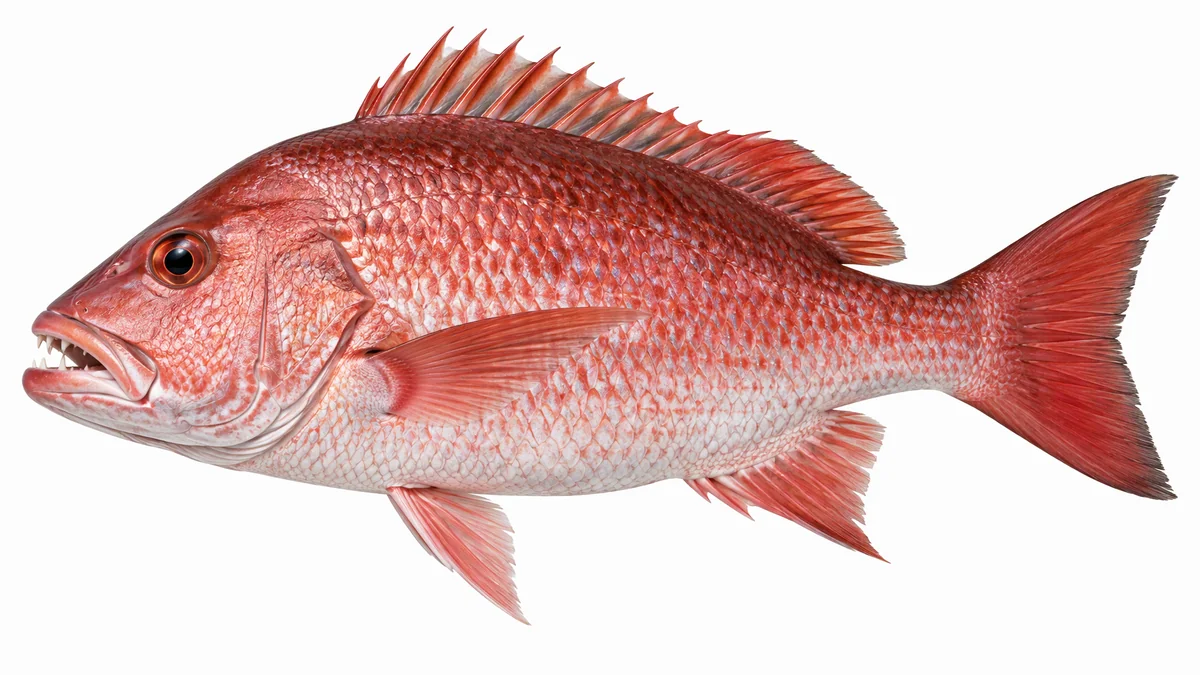
Red snapper identification starts with the head. The dorsal profile rises steeply from the snout to the top of the head, giving the fish a forehead that looks almost humped in big adults. The eye is large and red, matching a body that runs from brick-red on the back to pinkish-red and white on the belly. The skin is smooth-scaled and uniform — no stripes, no bars, no bright spots on adults.
The fins are the second clue. The dorsal fin is long and spiny, with ten spines followed by soft rays. The anal fin is the giveaway: in adults it is pointed and triangular, not rounded. The pectoral fins are long and reach back toward the eye when folded forward. The mouth is large, with a pair of prominent canine teeth in the front of each jaw, which is why red snapper cut line and fingers with equal ease.
Juveniles are lighter and can carry a faint dark spot on the upper flank, but the spot fades as the fish grows. A true red snapper has no yellow body lines and no black blotch below the soft dorsal fin, two marks that belong to other snappers.
Red Snapper vs Lookalikes
Several snappers share the red colour, and a few other species are sold under the same name at market. Getting the identification right matters both on the water and at the fish counter.
Vermilion snapper (Rhomboplites aurorubens), also called the beeliner, is smaller and slimmer, with a much larger eye, a more pointed head, and a rounded anal fin. It rarely grows past 2–3 pounds.
Lane snapper (Lutjanus synagris) wears thin yellow lines along its sides and a dark spot below the soft dorsal fin. It stays small, mostly under 3 pounds.
Mangrove and grey snapper are more grey-silver, with a different head profile and a darker, less red body.
At the market, "red snapper" has a long history of mislabelling around the world, with tilapia, rockfish, and other species sold under the name. A whole Gulf red snapper has the sloped head, the red eye, and the pointed anal fin. Fillets are harder; buy from a source you trust and ask where the fish was landed.
Is the Red Snapper Dangerous?
The red snapper is not venomous and has no poison glands, but it is not a harmless fish to handle. The dorsal and anal spines are sharp, the gill covers are edged with hard plates, and the canine teeth can open a finger. Hold the fish with a wet towel or a lip grip, support the body horizontally, and keep fingers clear of the gills.
The bigger risk is on the plate. Red snapper is a reef predator in subtropical water, which puts it in the ciguatera zone. Ciguatera is a food-borne illness caused by toxins that build up in large reef fish, and it is not removed by cooking or freezing. The risk varies by location and by the size of the fish, so follow local advisories and avoid the largest specimens from known hotspots.
For released fish, barotrauma is the hidden danger. A red snapper pulled from 100-plus feet arrives with an inflated swim bladder, bulging eyes, and a stomach pushed out of its mouth. Returning it quickly with a venting tool or, better, a descending device gives it a real chance to survive. Federal rules in the Gulf and South Atlantic increasingly expect descending devices to be on board.
Where Do Red Snapper Live?
Where do red snapper live? Across the Gulf of Mexico and the US South Atlantic, from the Campeche Bank off Mexico around to Florida, Georgia, and the Carolinas. The species is structure-oriented and largely sedentary. Adults hold on natural limestone reefs, ledges, and hard bottom, and they readily colonise artificial structure such as wrecks, rubble piles, and oil and gas platforms — the vertical "rigs" of the central Gulf are classic red snapper habitat.
Depth depends on the region and the season. In the Gulf, fish are common from about 60 to 300 feet, with larger fish often deeper; deep-droppers find them past 400 feet. In the South Atlantic, the productive range runs from roughly 60 to 250 feet over live bottom. Red snapper show strong site fidelity, which is why a good reef can produce fish year after year and why local depletion is slow to heal.
Water temperature shapes the pattern. The fish are most active in the 60s and 70s Fahrenheit and move shallower in spring and deeper in the heat of summer and the cold of winter. Juveniles settle on sandy and shell bottom before moving to reef, and they use shallower nearshore structure as nursery habitat.
Habits and Diet: What Do Red Snapper Eat?
What do red snapper eat? An opportunistic mix of fish and crustaceans: menhaden, croakers, pinfish, sardines, small mackerel, squid, shrimp, and crabs. Big adults lean heavily on fish, while smaller fish take more shrimp and other invertebrates. They feed around structure, picking prey off the bottom and snatching baitfish that drift over the reef.
Red snapper are ambush hunters with a strong territorial streak. They hold near ledges and potholes, rise to intercept wounded bait, and often follow a hooked fish up the water column hoping for an easy meal. That habit is why a slow, natural presentation near structure out-fishes a fast retrieve, and why a second bait dropped behind a hooked fish frequently gets eaten.
When do red snapper spawn? Spawning runs through the warm months, roughly April to September, with a Gulf peak in early to midsummer. Females are batch spawners, releasing eggs repeatedly over the season, and large old females produce far more eggs than young ones. That biology is central to management: protecting big females protects the spawning stock. Red snapper are long-lived — fish of 50 years or more have been aged — and they mature slowly, which makes them vulnerable to overfishing.
Size, Records and Regulations
How big do red snapper get? Most keepers run 2 to 15 pounds, and a 20-pound fish is a good one. The species can reach about 40 inches and roughly 50 pounds. The IGFA all-tackle world record sits near 50 pounds (about 23 kg), and because record lists are updated, confirm the current entry with IGFA before quoting it. State and release records can be larger.
The world record red snapper is a reminder of how old and how big these fish can grow. A 40-pound snapper may be decades old, and the species' slow growth is exactly why the rules are tight.
Regulations are the hardest part of red snapper fishing and the most important to get right. In federal waters of the Gulf of Mexico, the recreational minimum size is 16 inches total length, and the bag limit is two fish per person per day. The red snapper season in the Gulf of Mexico has been extremely short in recent years — measured in days rather than months — with most angler access delivered through state seasons run under exempted fishing permits. The South Atlantic has its own, separately managed season and bag rules. Commercial fishing is managed under an individual transferable quota system.
As of 2025, these numbers change from year to year and differ between federal and state waters. Check the current rules with NOAA Fisheries, the Gulf of Mexico Fishery Management Council, the South Atlantic Fishery Management Council, and your state agency (Texas Parks and Wildlife, Louisiana Department of Wildlife and Fisheries, Florida Fish and Wildlife Conservation Commission, and so on) before you keep a fish. In the Gulf you also generally need a state saltwater licence, and many states require reef-fish permits and reporting. Many areas require a descending device and non-stainless circle hooks. Last verified: November 2025.
The best bait for red snapper is fresh cut fish and whole baitfish: menhaden, Spanish sardine, cigar minnow, and squid, fished on a knocker rig or a fish-finder rig with a circle hook. Live pinfish and live cigar minnows are deadly on big fish. On the artificial side, bucktail jigs, soft plastics on heavy jig heads, and slow-pitch jigs all take snapper around structure.
How to catch red snapper: find hard bottom and structure, anchor or drift so your baits sit near the reef, and fish a natural presentation on the bottom. Use enough weight to hold bottom but let the bait move. When a fish is hooked, expect a hard initial run for the rocks — apply pressure early to turn its head. Handle released fish quickly, use a descending device for deep-caught fish, and follow the season and bag rules exactly.
FAQ
How big do red snapper get? Most are 2–15 pounds. The species can reach about 40 inches and roughly 50 pounds, and the IGFA all-tackle record is near 50 pounds.
What is the world record red snapper? Around 50 pounds (about 23 kg) on the IGFA all-tackle list. Confirm the current entry, since records are updated.
Where do red snapper live? Across the Gulf of Mexico and the US South Atlantic, on reefs, ledges, wrecks, and oil platforms, mostly in 30–600 feet of water.
What do red snapper eat? Fish, squid, shrimp, and crabs. Big adults focus on baitfish; smaller fish take more invertebrates.
When do red snapper spawn? Through the warm months, roughly April to September, with a Gulf peak in early to midsummer. Females spawn in batches.
What is the red snapper size and bag limit? In federal Gulf waters the minimum is 16 inches total length and the bag is two fish per person per day, as of 2025. Seasons are short — check current federal and state rules.
What is the best bait for red snapper? Fresh cut menhaden, sardine, cigar minnow, and squid on a circle hook, or live pinfish. Jigs work around structure too.
How do you catch red snapper? Fish structure with a natural bottom presentation, apply pressure early to keep fish off the rocks, and use a descending device on releases.
Related Articles
- Coral Trout — a reef-dwelling grouper relative with a similar ambush habit.
- Cobia — another structure-loving Gulf predator.
- Mahi-Mahi — the offshore pelagic you meet on the way out to the reef.
- Atlantic Cod — a cold-water bottom fish with its own strict management story.
- Dungeness Crab — a West Coast crustacean with a size-limit system worth comparing.
- All species profiles
The red snapper is a fish of ledges, rigs, and warm Gulf water, and one of the best-eating fish in the sea. Learn the sloped head, the red eye, and the pointed anal fin; respect the 16-inch rule, the two-fish bag, and the short seasons; and release deep-caught fish with a descending device. Managed well and fished within the rules, this slow-growing reef fish will keep producing for generations.
Ready to catch one? Read our step-by-step guide: How to Catch Red Snapper.
About the author and how this was tested
About the author
FishermanGuy
Bank, boat and kayak angler · fishing, crabbing and shrimping since 2021
I buy the gear, fish it for a season and write down what failed. No sponsored verdicts, no free-sample flattery. Every rig on this page has landed fish in water I can point at on a map.
How this was tested
- Every rig gets at least six trips on the same water before it is published.
- Gear is bought at retail. Free samples are labelled in the first paragraph.
- Dates show first publication and the last time the page was updated.