Field notes
Blue Crab: Identification, Habitat & Diet
Blue Crab: Identification, Habitat & Diet
The blue crab (Callinectes sapidus) is the crab most East Coast anglers picture when someone says "crabbing." It's a swimming crab that turns up from Nova Scotia all the way to Argentina, but nowhere in bigger numbers than the Chesapeake Bay. For a beginner, the blue crab is about as friendly a target as shellfish gets: a chicken-neck hand line runs around $20, and you don't need a boat. What you do need is a working feel for its seasons, its molting cycle, and a rulebook that changes from one state to the next.
Blue Crab Quick Facts
| Field | Details |
|---|---|
| Scientific name | Callinectes sapidus |
| Common names | Blue crab, blue claw; males are "Jimmies," mature females "sooks," freshly molted crabs "soft-shell crabs," egg-bearing females "sponge crabs" |
| Typical size | Adults 5–7 in across the shell, up to 9 in |
| Water | Estuaries, bays, nearshore coast; intertidal down to about 120 ft |
| Difficulty | Beginner-friendly (hand line with a chicken neck, about $20 to start) |
| Best season | Spring through fall in most states, peaking in summer (June–August) |
Blue Crab Identification
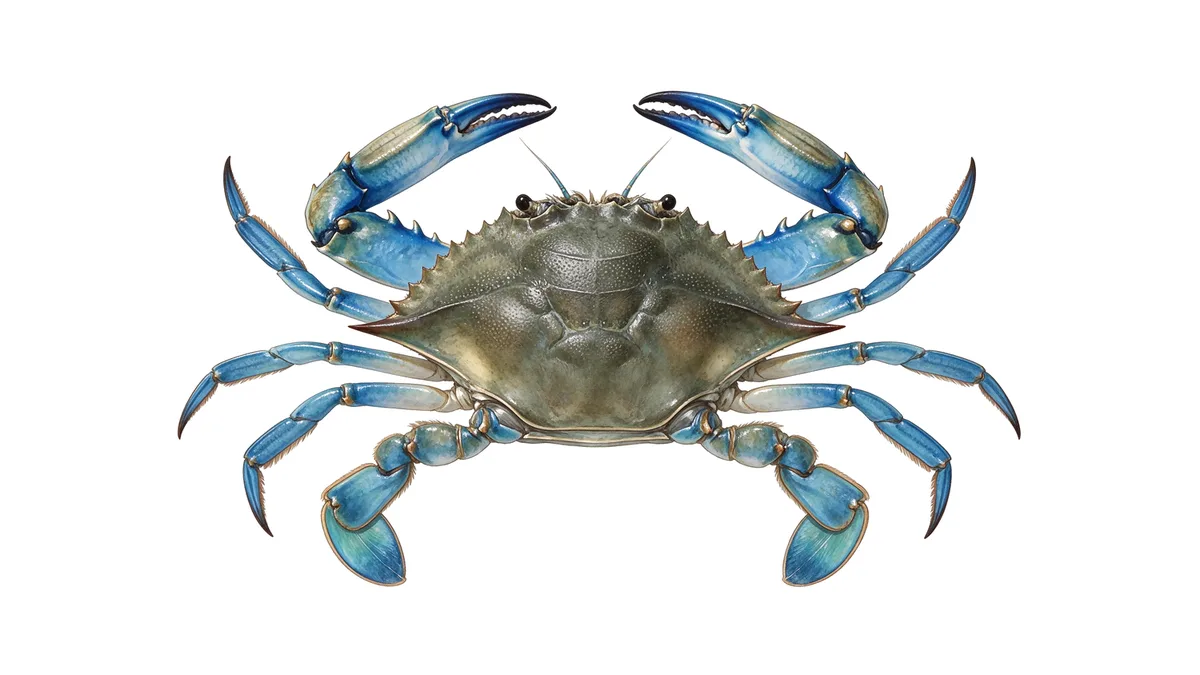
Blue crab identification starts with the legs. This is a member of the swimming crab family Portunidae, and the giveaway is the last pair of legs, flattened into paddle shapes. Those paddles let it shoot sideways and even backward in a hurry. The shell, or carapace, runs olive to blue-green with lighter mottling, which is exactly why the name is a little misleading: the "blue" really comes from the claws. A male's claws are bright blue, while a female's claw tips carry a reddish-orange tint. Male or female, every crab has white claw tips.
Flip one over and sexing gets easy. The apron — that folded flap on the belly — tells the whole story. A male's apron is a narrow T shape, the outline people compare to the Washington Monument. A mature female's apron is broad and rounded, like the Capitol dome. An immature female lands in between, with a triangular apron.
There's one more form worth knowing: the soft-shell crab. Right after a blue crab molts and before the new shell hardens, the whole animal is edible, shell and all. That narrow window is why soft-shells fetch a premium price.
Similar Species
No single look-alike is commonly mistaken for the blue crab. The thing worth remembering is the family it belongs to: Portunidae, the swimming crabs. If the last pair of legs is flat and paddle-shaped, you're holding a swimming crab, which rules out most of the other crabs you'll meet on the coast.
Is the Blue Crab Dangerous?
There's no venom or poison to worry about. The real hazard is mechanical: those claws are strong, and they will pinch. Handling comes down to one rule. Never reach for a blue crab from the front, because the claws can strike forward and to the side. Grip it from behind instead, pinching the two rear swimming legs together. If one does latch on, put it back in the water — a blue crab will open its claw to escape and let go quickly.
Blue Crab Habitat
Blue crab habitat is brackish water, mostly. These crabs live in estuaries, bays, and nearshore coastal water, anywhere from the intertidal zone down to roughly 120 feet deep. They favor shallow grass beds — eelgrass and widgeon grass — along with mud and sand bottoms, and they tolerate everything from nearly fresh water to full-strength saltwater.
The range is wide. Blue crabs run the Atlantic from Nova Scotia down to Argentina, but the mid-Atlantic is where they pile up. If there's a single name tied to this fishery, it's the Chesapeake Bay blue crab — the Maryland and Virginia bay outproduces any other body of water on Earth. Behind it sit North Carolina, the second-biggest producer, and Louisiana, which claims the title of Gulf of Mexico blue crab capital. South Carolina, Delaware, New Jersey, and Florida round out the list, and every one of them has a recreational crabbing scene.
Life history drives the big moves. Females migrate toward the mouth of the bay and offshore to spawn, while males stay upriver in lower-salinity water. In winter, once shallow water drops below about 50°F, adults pull out of the creeks and marshes and bury into deeper, warmer water to wait it out — though the timing shifts with latitude, so check your state's seasonal reports before planning a trip around it.
Blue Crab Behavior
The blue crab runs on a seasonal clock. In spring (April and May) the crabs dig out of their winter mud and move shallow, and the first peelers and hard crabs show up. Summer (June through August) is the peak — heavy feeding and constant molting. Fall (September through November) is about fattening up, while the females head toward the bay mouth to spawn. Winter (December through March) is the slow season: crabs are buried, mostly inactive, and most states close crabbing or watch it slow to a crawl.
Within a day, dawn and dusk are the prime feeding windows, and a rising tide ramps activity up — many crabbers swear by the two hours before high tide. The moon matters too. New and full moons drive the month's strongest currents, and a lot of crabbers build their trips around the two or three days on either side of them. Quarter moons bring weak tides and, usually, slow pots.
Water temperature is the on-off switch. Around 50°F is the line where shallow-water crabbing either wakes up or shuts down. In the 50s the crabs are sluggish; by the 60s and 70s, feeding, growth, and molting all kick into gear. Treat those numbers as a guide rather than gospel, because local conditions bend them.
What Do Blue Crabs Eat?
Blue crabs are not picky. They eat clams, mussels, and small fish, and they'll grab anything else they can catch — plus they scavenge whatever's around. That opportunistic appetite is a big reason a chicken neck on a string works so well. A blue crab lives roughly three years.
When Do Blue Crabs Molt?
Molting is the centerpiece of blue crab biology, and crabbers read it through the "peeler" — a crab that's about to shed. The tell is a line on the swimming legs. A white line means a molt in roughly 7 to 10 days; a pink line, 2 to 5 days; a red line, 1 to 2 days; and a dark red "rank" crab may shed within hours. That's why shedding tanks get checked around the clock.
There's a hard stop, though. A mature female molts for the last time and never sheds again, while juveniles molt every few days and then every 3 to 7 weeks as they approach legal size. The soft-shell season follows the same calendar: in the Chesapeake and the mid-Atlantic, the first big peeler runs often land on the May full or new moon, peaking in May and June, while Gulf crabs molt from roughly April through October and slow as the water cools. Timing shifts year to year, so check local reports instead of betting on a date.
Blue Crab Size and Regulations
Adult blue crabs usually measure 5 to 7 inches across the shell, and the record animals top 9 inches and a pound. Commercial keepers generally start at 5 to 5.5 inches. For everyone else, the common minimum sits around 5 inches, but states set their own lines between roughly 4.5 and 5.5 inches, and egg-bearing females — "sponge crabs" — must go back everywhere. Most states also require a recreational crabbing or saltwater license.
Regulations vary by state, always check your local rules. They also shift year to year, so treat the specifics below as a snapshot to confirm before you fish, not a standing reference.
- Maryland: recreational crabbers may keep male hard crabs only. The minimum is 5 inches point-to-point before July 14, then 5¼ inches from July 15 through December 15. Female hard crabs and female peelers are off the table. Shore fishing with no pots (or two pots) caps out at 2 dozen male hard crabs; a licensed crabber may take 1 bushel, or 6 dozen when not using a bushel basket. The Chesapeake Bay and its tidal rivers run April 1 through December 15.
- Virginia: 1 bushel of hard crabs plus 2 dozen peelers per person per day, with a boat total of 1 bushel (roughly 40 lb). Males and immature females need to be 5 inches; mature females carry no size limit. Pots close December 1 through March 16, trotlines run April 15 through October 15, and hand lines, dip nets, and cast nets stay legal year-round in tidal water.
- Louisiana: no recreational minimum size, 12 dozen per person per day, and sponge females are protected. The season is open all year.
- Texas: no bag or possession limit and a 5-inch minimum. Up to 5% of a day's catch may be undersized for bait, kept in a separate container. There's no closed season, but crab traps must come out of coastal waters for 10 straight days starting the third Friday in February (February 20 through March 1 in 2026), and you'll need the saltwater endorsement on your license.
One more reminder that these numbers move: Maryland rolls out new recreational boat limits on July 1, 2026, running through June 2027. Before any trip, check your state's marine agency for the current regs.
Frequently Asked Questions
How big do blue crabs get?
Most adults run 5 to 7 inches across the shell. The biggest on record stretch past 9 inches and a pound, and commercial keepers usually start around 5 to 5.5 inches.
How to catch blue crabs?
The chicken-neck hand line is the classic beginner rig — tie on a chicken neck, drop it, and pull up slow when you feel weight. It runs around $20 to get started, and most states will still want you to carry a recreational crabbing license.
Where do blue crabs live?
In brackish estuaries and bays, mostly — shallow grass beds, mud, and sand from the intertidal zone down to about 120 feet. They range from Nova Scotia to Argentina, with the Chesapeake Bay as the global hotspot.
When is blue crab season in the Chesapeake Bay?
Late May through October is the sweet spot, when the water is warm enough for steady feeding and molting and the crabs have reached legal size. April and November still produce, but the bite slows, and the size line tightens in mid-July.
What is the blue crab size limit?
Around 5 inches in most places, with states setting lines from about 4.5 to 5.5 inches. Sponge crabs must be released everywhere. Check your state before you keep anything.
Do I need a license to catch blue crabs?
In most states, yes — a recreational crabbing or saltwater/shellfish license. Trotlines and multiple pots often need extra permits on top of that.
Why can't I keep female blue crabs in Maryland?
It protects the spawn. Females carry the eggs and rebuild the population, so Maryland's recreational rules allow only male hard crabs, plus soft crabs. Virginia takes a different path and lets anglers keep mature females with no size limit.
Full moon or new moon — which is better for crabbing?
Both. Each brings the month's strongest tides, and that moving water concentrates feeding crabs. Plenty of crabbers plan around the two to three days on either side; quarter moons tend to be weak and slow.
Related Articles
- [Placeholder] How to Rig a Chicken-Neck Hand Line for Blue Crabs
- [Placeholder] Blue Crab Season by State: A Month-by-Month Breakdown
- [Placeholder] Soft-Shell Crabs: Timing the Molt for the Market
Ready to catch one? Read our step-by-step guide: How to Catch Blue Crab.
About the author and how this was tested
About the author
FishermanGuy
Bank, boat and kayak angler · fishing, crabbing and shrimping since 2021
I buy the gear, fish it for a season and write down what failed. No sponsored verdicts, no free-sample flattery. Every rig on this page has landed fish in water I can point at on a map.
How this was tested
- Every rig gets at least six trips on the same water before it is published.
- Gear is bought at retail. Free samples are labelled in the first paragraph.
- Dates show first publication and the last time the page was updated.