Field notes
Smallmouth Bass: Identification, Habitat & Diet
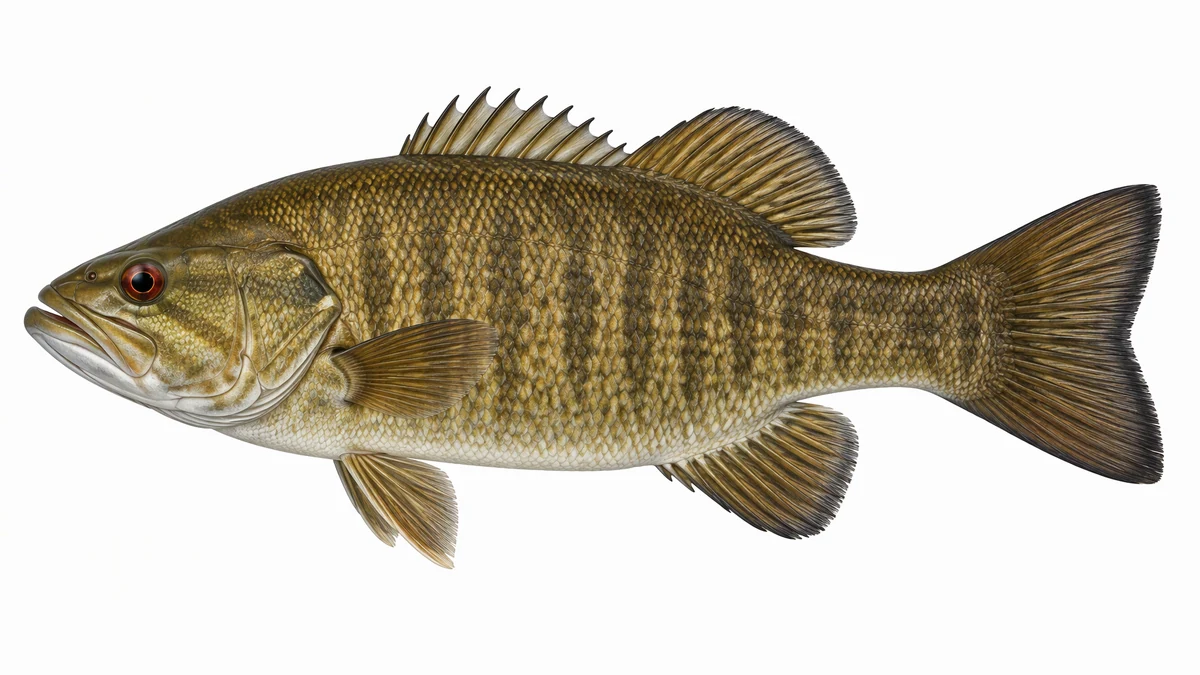
Smallmouth Bass: Identification, Habitat & Diet
The smallmouth bass is a bronze, hard-fighting freshwater fish that anglers link to clear water, rocky shorelines, and cold northern rivers. It belongs to the sunfish family, Centrarchidae, and shares the genus Micropterus with the largemouth and spotted bass. Compared with its relatives, the smallmouth prefers cooler, cleaner water and stronger current. That preference shapes where it lives, what it eats, and how you catch it. This profile covers smallmouth bass identification, habitat, diet, size, spawning, regulations, and the tactics that work through the season.
Quick ID Card
| Field | Details |
|---|---|
| Scientific name | Micropterus dolomieu |
| Common names | Smallmouth bass, bronzeback, brown bass, smallie |
| Family | Centrarchidae (sunfishes) |
| Typical size | 12–16 inches (30–41 cm), 1–3 lb |
| Trophy size | 20+ inches, 5+ lb |
| Water type | Clear, cool lakes, reservoirs, and rocky streams |
| Active water temperature | 59–81°F (15–27°C) |
| Difficulty | Moderate; light tackle and finesse presentations |
| Best season | Late spring and fall; dawn and dusk in summer |
How to Identify a Smallmouth Bass
Start with the mouth. On a smallmouth, the upper jaw ends level with the rear edge of the eye or slightly short of it. On a largemouth, the jaw extends well past the eye. That single feature settles most identification questions, even on a small fish held in wet hands.
The body is lean and torpedo-shaped, less deep through the belly than a largemouth of the same length. Coloration runs from olive-green to bronze and yellow-brown, and fish from dark, tannic water can look almost chocolate. Faint dark vertical bars usually mark the sides, though they fade in bright light and on pale fish. The eye is often red or amber.
Look at the fins as well. The dorsal fin is broadly joined, with a shallow notch between the spiny front section and the softer rear section. The largemouth's dorsal fin is nearly separated into two fins, with a deep dip between them. Smallmouth fins often carry dark edges, especially on the soft dorsal, tail, and anal fin. The scales are small, and the overall impression is of a compact, muscular fish built for current.
Juveniles are trickier. Young smallmouth show a tri-color pattern: dark back, a distinct lateral band, and a pale belly. They also have a tricolor tail base in some populations. If the jaw ends at the eye and the fish came from a rocky stream, smallmouth is the safe call.
Smallmouth Bass vs Largemouth Bass
The two bass are relatives, share much of the same range, and end up in the same photos, so confusion is common. The table below covers the differences that matter in the field.
| Feature | Smallmouth bass | Largemouth bass |
|---|---|---|
| Jaw | Ends at or before the rear edge of the eye | Extends past the rear edge of the eye |
| Color | Bronze, olive, brown | Green with a broad dark lateral band |
| Vertical bars | Faint, usually present | Absent; heavy dark blotches instead |
| Dorsal fin | Broadly joined, shallow notch | Nearly separate, deep notch |
| Preferred water | Clear, cool, rocky, with current | Warmer, weedier, slower water |
| Fight | Jumps, runs, and uses current | Bullying runs and head shakes |
Smallmouth also differ in attitude. They are more migratory on rivers, moving between pools and riffles with the seasons, and they tolerate cold water that sends largemouth looking for warm backwaters. A bronze fish with a small mouth from a gravel riffle is a smallmouth. A green fish with a jaw past the eye from a weed bed is a largemouth.
The spotted bass is the third lookalike. It has a jaw that stops at the eye like a smallmouth, but its lower side carries rows of small dark spots and the dorsal fin base is marked with black spots. Spotted bass usually come from warmer southern rivers and reservoirs. Range and spotting separate them from smallmouth in most cases.
Is the Smallmouth Bass Dangerous?
No. The smallmouth is not venomous, and it has no teeth capable of harming a person beyond a scrape. It does have sharp spines in the dorsal, anal, and pelvic fins, plus a hard, serrated edge on the gill cover. A thrashing fish can drive a spine into a hand, and the result is a painful puncture rather than a serious injury.
Handle smallmouth with a wet hand or a rubber-mesh net. Support the belly if you lift the fish horizontally, or grip the lower jaw vertically and keep the body straight. Do not bend the jaw sideways, and do not let the fish drop onto rocks. A dropped bass loses scales and mucus, which leaves it open to infection.
Range and Habitat
The smallmouth bass is native to the Ohio River basin, the Great Lakes system, and the upper Mississippi River drainage. Its original range ran from southern Ontario and Quebec through the northeastern and north-central United States. Stocking has since spread it across the continent and into Europe, Asia, and Africa, where it is both a sport fish and, in some places, an invasive species.
Within that range, smallmouth bass habitat comes down to three things: cool water, clean substrate, and structure. Lakes and reservoirs hold fish around rocky points, boulder-strewn flats, bluff walls, and deep drop-offs. Rivers hold them in riffles, pool tails, eddies behind boulders, and current seams along bridge pilings. Gravel and cobble bottom is a strong sign, because it supports the crayfish and insect life the fish depend on.
Water temperature matters. Smallmouth stay active from roughly 59°F to 81°F (15–27°C). They feed best in the middle of that band and become sluggish at the upper end. In summer, they often drop to deeper, cooler water or find current that carries oxygen. In winter, they group in deep pools and move little.
Smallmouth are less tolerant of silt and pollution than largemouth. Heavy erosion, farm runoff, and warming water tend to hurt smallmouth populations first. That is one reason good smallmouth fisheries are often associated with forested watersheds and clean, gravel-bottom rivers.
Behavior and Diet
Crayfish form the core of the adult diet. Smallmouth also eat minnows, shiners, sculpins, darters, leeches, and aquatic insects, and they will take frogs and small snakes when the chance appears. The mix shifts with season and size. Juvenile fish eat more insects; big adults focus on crayfish and fish.
Feeding peaks at dawn and dusk, and in clear water the fish often feed after dark. During the day, they hold near cover and wait for food to drift or swim past. A smallmouth does not need heavy cover the way a largemouth does. A single boulder, a ledge, a log, or a seam between fast and slow water is enough.
Current is the fish's advantage. Smallmouth use their streamlined shape to hold in moving water while expending little energy, then dart out to take prey swept past. That is why river smallmouth often sit behind obstructions, facing upstream, and why lake fish orient to wind-driven current on points and causeways.
Spawning begins when water reaches about 60–70°F (16–21°C), usually from late April through June depending on latitude. Males fan shallow nests in gravel, often 1–4 feet deep, and guard the eggs and fry. Females may visit several nests. The bedding period is short, and fishing pressure on visible beds can pull guarding males off nests. Quick release and limited harvest protect the year class.
Size, Records and Regulations
Most adult smallmouth bass run 12–16 inches and 1–3 pounds. A 20-inch fish is a serious catch in most waters, and anything over 5 pounds is a trophy in the North. Growth is slow compared with largemouth, especially in cold, short growing seasons, so a 5-pound northern smallmouth can be a decade old or more.
The all-tackle world record is 11 pounds 15 ounces (5.4 kg), caught in 1955 at Dale Hollow Lake, Tennessee. The fish has stood for nearly seventy years, which says something about how rarely smallmouth reach double digits. Southern reservoirs with long growing seasons and abundant forage produce the biggest fish.
State records range from the mid-single digits in cold northern states to double digits in the South. Most waters are open year-round, but some rivers restrict harvest in spring; check the rules for the water you fish.
Regulations vary by state and by water. Common tools include a minimum length of 12–14 inches, daily bag limits of five or six fish, and special rules on famous rivers and reservoirs, including catch-and-release or slot limits. Some states protect bedding fish in spring; others allow harvest year-round under general panfish or game fish rules. A fishing license is required, and some waters add a trout or special permit stamp.
Do not rely on a blog for the rule that applies to your river. Check the current regulation booklet or website for the state fish and wildlife agency that manages the water. Dale Hollow, for example, is covered by the Tennessee Wildlife Resources Agency (TWRA) and the Kentucky Department of Fish and Wildlife Resources; other waters have their own agencies. Last verified: November 2025.
FAQ
How big do smallmouth bass get? Most adults reach 12–16 inches and 1–3 pounds. An exceptional fish passes 20 inches and 6 pounds, and the world record sits at 11 pounds 15 ounces. Northern fish grow slowly and rarely reach trophy size, while southern reservoirs produce the largest specimens.
What is the world record smallmouth bass? An 11-pound 15-ounce fish taken from Dale Hollow Lake, Tennessee, in 1955. It remains the heaviest smallmouth recorded on conventional tackle.
What do smallmouth bass eat? Crayfish are the main food, followed by minnows, shiners, sculpins, leeches, and aquatic insects. Big fish lean heavily on crayfish and fish; small fish eat more insects.
Where do smallmouth bass live? They live in clear, cool lakes, reservoirs, and rocky rivers across North America, from the Great Lakes and St. Lawrence system through the Mississippi drainage and into stocked waters nationwide. They favor gravel and boulder bottom, current, and clean water.
How do you tell a smallmouth from a largemouth? Check the jaw. A smallmouth's upper jaw ends at or before the rear of the eye; a largemouth's passes it. Color helps too: bronze versus green, faint bars versus a broad dark band.
When do smallmouth bass spawn? From late April through June, when water warms to about 60–70°F (16–21°C). Males build and guard nests in shallow gravel.
What is the best bait for smallmouth bass? Tube jigs, Ned rigs, drop-shot plastics, crayfish imitations, small crankbaits, and topwater poppers all work. Live crayfish and minnows are effective where legal. In current, a tube or grub bounced along the bottom is hard to beat.
When is the best time to catch smallmouth bass? Late spring and fall, when fish feed heavily in shallow water. In summer, fish dawn, dusk, and night, or target deeper structure and current. Winter fishing is slow but possible in deep pools.
The smallmouth bass remains a fish of clean water, hard bottom, and moving current. Protect those places, handle the fish with care, and the bronze fight will be there for the next cast and the next generation.
Related Articles
- Spotted Bass — the other bronze-toned Micropterus, with spots instead of bars.
- Yellow Perch — a cool-water schooling fish that shares northern lakes and rivers.
- Pumpkinseed — a colorful sunfish often caught in the same clear-water habitats.
- All bass and panfish profiles
Ready to catch one? Read our step-by-step guide: How to Catch Smallmouth Bass.
About the author and how this was tested
About the author
FishermanGuy
Bank, boat and kayak angler · fishing, crabbing and shrimping since 2021
I buy the gear, fish it for a season and write down what failed. No sponsored verdicts, no free-sample flattery. Every rig on this page has landed fish in water I can point at on a map.
How this was tested
- Every rig gets at least six trips on the same water before it is published.
- Gear is bought at retail. Free samples are labelled in the first paragraph.
- Dates show first publication and the last time the page was updated.